Macy’s Department Store – Herald Square // 1902

Thanksgiving in the days of Covid-19 will be different in more ways than one. A notable loss will be the absence of the annual Macy’s Thanksgiving Day Parade in New York, which has been a national pastime broadcast on televisions for millions of Americans every year. The six-mile route through the city, giant balloons and all, would end at Macy’s Herald Square, the flagship store of the department store chain. The building (one of the largest stores in the world) was completed in 1902 and its 2.5 million square feet of space, occupy an entire city block. The building was designed by Interestingly, in 1900, a small five-story building on the corner of 35th and Seventh was purchased by Robert H. Smith in 1900 for $375,000 ($11.5 million today). The idea had been to obstruct Macy’s from becoming the largest store in the world. It is largely supposed that Smith, was acting on behalf of Siegel-Cooper, which had built what they thought was the world’s largest store nearby in 1896. Macy’s ignored the tactic and built around the building, which now carries Macy’s “shopping bag” sign by lease arrangement! Oh, and Macy’s even hired the same architect for their department store that Siegel-Cooper used for their building, Theodore de Lemos, adding insult to injury. A great example of a spite building!

1908 image of Macy’s Herald Square courtesy of LOC.

Flatiron Building // 1902

The 22-story Flatiron Building in New York is easily one of the most recognizable and iconic buildings in the world. Built in 1902, the building replaced a collection of smaller commercial buildings on one of the most visible lots in this section of the city, thanks to the convergence of 5th Avenue and Broadway at Madison Square Park. The lot was developed by Harry S. Black, President of the Fuller Company, a general contracting company whose specialty was the construction of skyscrapers for their own offices. The company hired Chicago architect Daniel Burnham, who was known throughout the world for his skyscraper designs. Upon completion after just 9 months of construction, the building was called the “Fuller Building”, which was quickly overtaken by the public who named the building the “Flatiron” thanks to its footprint resembling an old flat iron. The building was recently vacant and has been undergoing a complete update inside with sprinkler systems, new floorplans and HVAC.

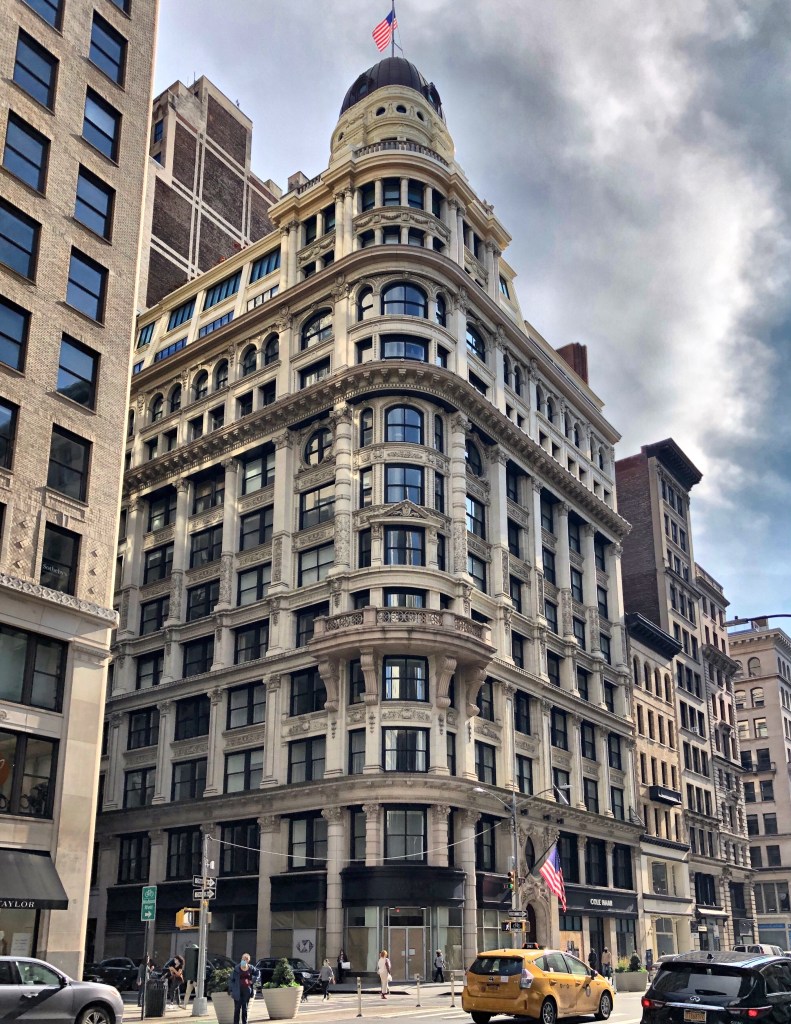
141-147 5th Avenue // 1896 & 1900

This stunning Beaux-Arts store and loft structure, is located on a
prominent corner site at 5th Ave and 21st Street in Manhattan. The structure is faced in limestone and terra cotta and was constructed in two phases. The original three southern bays (on the right side of the image) on 5th Avenue were designed by prominent architect Robert Maynicke for real estate developer Henry Corn. In 1899, two years after its completion, architect Henry Edwards Ficken designed an addition to the north wrapping around and running along 21st Street. The addition continued the richly embellished facade and supplemented it with a twelve-story, curved corner bay which is crowned by a dome. The building appears to have been constructed without a major tenant, and many companies utilized the iconic space including: the Merchant Bank of New York, Park & Tilford’s, a fancy grocer, and lace companies. In the mid 20th century the building suffered from deferred maintenance until 2005 when the building was restored and converted to 38 apartments (including one utilizing the dome)!