Narragansett Engine Company No. 3 // 1846

The Narragansett Engine Company No. 3 Station is an absolutely charming two-story building tucked away on Baker Street in Warren, Rhode Island, and is one of the oldest extant historic fire stations in New England. Built in 1846, the building features a flushboard-façade, pedimented-gable end oriented to the street, paneled double-leaf engine doors, and a rundbogenstil Palladianesque window centered on the second story. The small fire station was built to house, “Little Button”, a fire engine manufactured in Waterford, New York. This building served as a fire station well into the 20th century, and was restored decades ago by local preservationists. The building is open by appointment and houses the Warren Fire Department Museum.

William Winslow House // 1850

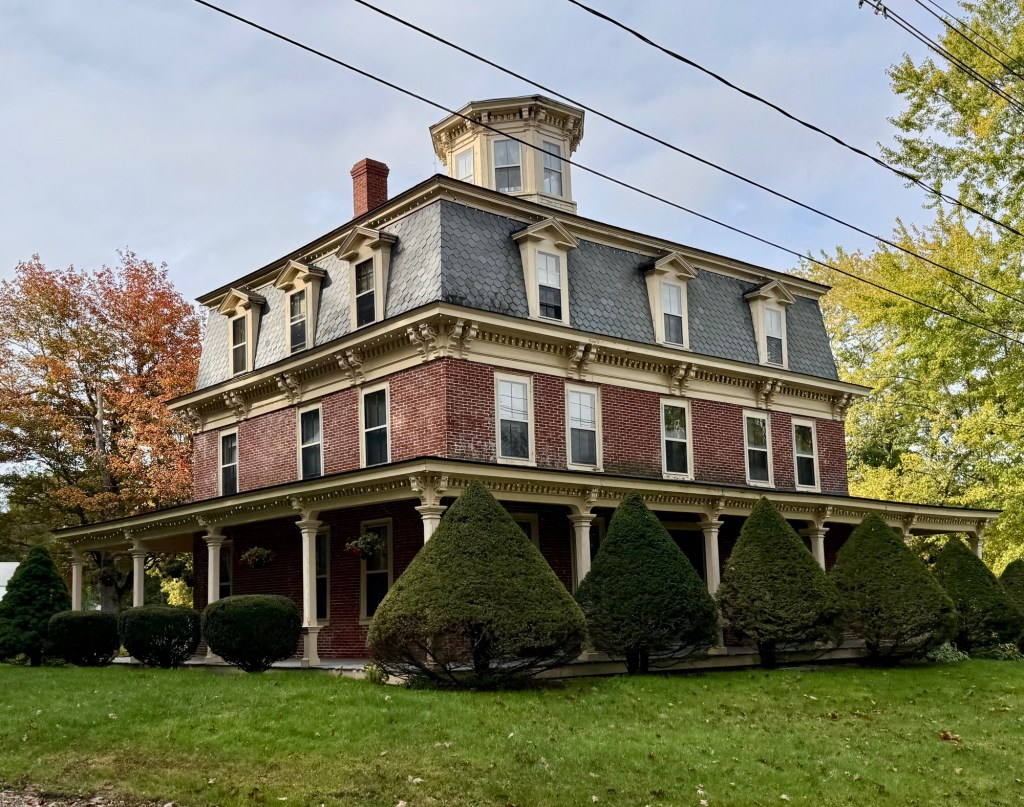
The Smith-Winslow House on Warren’s Main Street is a striking two-story Italianate house with cubical massing with smooth stucco walls and bold detailing. The residence was constructed in around 1850
and was owned by Captain William Winslow captain of the schooner ‘‘Metamora’’, a trading vessel, and proprietor of Warwick’s Rocky Point, a shore resort and amusement park just across Narragansett Bay. The Winslow House was designed by Rhode Island architect, Russell Warren, who showcased his architectural prowess through the roof cupola, overhanging eaves, window hoods, and the unique Egyptian columns at the entry. Today, the residence operates as the Women’s Resource Center, a non-profit founded in 1977 to provide comprehensive domestic violence intervention and services that educate, advocate, and shelter any individual in need of assistance in the region.

Lyric Theater // 1914

The most whimsical and unique building in Warren, Rhode Island, is this architectural landmark, the former Lyric Theater on Miller Street. Built in 1914, the building historically had a large projecting marquee, and today retains the large blind arch with applied ornament in the form of Ionic pilasters, panels, frets, and swags to decorate the facade. The Lyric remained active as a motion-picture theatre until 1967 and was converted to retail use in the 1980s, becoming an antique store in 1992.

John R. Hoar House // 1841

The J. R. Hoar House on Washington Street in Warren, Rhode Island, is one of the best examples of a 1-1/2-story Greek Revival cottage in the town. The house has a full Doric portico in front, an arched second-story bedroom window in the pediment and pedimented lintels over the windows. Built in the 1841 for John Rodgers Hoar, the house has been lovingly preserved and restored by later owners.

Hall’s Block // 1883

This diminutive commercial building on Water Street in Warren, Rhode Island stands out as one of the state’s best examples of a historic Victorian-era wooden commercial building, and its preservation is notable. The late-Italianate style wooden block dates to 1883, and exhibits its original wooden storefronts, second floor round arched windows with stained glass, and ornate detailing including the brackets, parapet and period-appropriate paint colors which allow those details to pop. The shop was owned in its early days by the John C. Hall, a carpenter who built the house next door. The building was used as an antique shop on the ground floor with a studio for author and illustrator, David Macaulay on the second floor. These types of smaller-scale commercial spaces are some last remaining (relatively) affordable spaces for small businesses to operate, and they add so much intrigue to the streetscape, especially compared to suburban cookie-cutter banks and stores.

Hoar-Hall House // c.1770

This stately two-story, five-bay Colonial house at 172 Water Street in Warren, Rhode Island, is significant as a well-preserved Georgian style residence that has connections to a prominent local family. It is unclear who originally owned the residence, but by the mid-19th century, the property was owned by John C. Hoar, a blockmaker for the maritime trade. Passed through members of the Hoar family into the mid-19″ century, owned by John Champlain Hall (1818-1912), the son of John C. Hoar, who actually changed his last name from Hoar to Hall in 1867, but it is unclear why. John C. Hall worked as a carpenter and builder in town, building homes and commercial buildings for area residents, including his own shop nearby.

Burr-Eddy-Peck House // c.1786

This Federal style residence on Main Street in Warren, Rhode Island, features one of the town’s most spectacular entries, likely dates to the 1780s and exhibits later alterations. The house was originally owned by Rufus and Anna Burr, and was possibly built following their marriage in 1786. The late 18th century front entrance is one of Warren’s most elaborate examples with fluted Ionic pilasters supporting embellished frieze blocks, above which the pediment rests and contains a elli[tical fanlight transom. In the 19th century, the property was owned by James Maxwell Eddy (1811-1901), who, after the Civil War, elongated the southernmost bay on the facade, adding a bay window on the side which ties into the roofline with a half-hipped connector. In the 20th century, this was the home of illustrator Henry Jarvis Peck 1880-1967, whose work was re gularly published in Colliers, Harper’s Weekly, Ladies Home Journal, and other prominent magazines. The shingle siding was likely added in the first half of the 20th century.

Warren Manufacturing Company Mill // 1896

No single company had a greater impact on the town of Warren in the 19″ century than the Warren Manufacturing Company. The company built, expanded and rebuilt major mill buildings, established new streets in town, and provided mill housing for its workers, both native-born residents and immigrants who enlivened the community building new churches and housing. The company was founded in 1847, as whaling and shipping declined in Warren prior to the Civil War. Wealthy manufacturers and investors with ties to the South turned to textile manufacturing. The newly established company built three mills in the 19th century, all of which burned to the ground in a massive fire in 1895. A year later, in 1896, The Warren Manufacturing Company rebuilt this brick mill which features a handsome Romanesque tower with open belfry and brick corbelling, with a repeated pattern of pier-spandrel-and-arch construction running down the elongated facade. After the company closed, the building was occupied by the American Tourister Company, a luggage manufacturer. In 2015, the building was awarded federal and state preservation grants, and restored and adaptively reused as apartments, today known as Tourister Mill.

Dow-Starr House // c.1850

A big departure from the less ornate, yet classically proportioned Georgian and Federal style homes in Warren, Rhode Island, this Gothic Revival beauty on the town’s Main Street stands out for its detail and materiality. Built as a quintessential Gothic “cottage,” the facade of the Dow-Starr House in Warren has also been graced by a three-sectioned Gothic Revival porch as illustrated in Alexander Jackson Downing’s plan books from the 1840s. As completed, this house followed almost exactly Andrew Jackson Downing’s Design II as illustrated in Cottage Residences 1842 ; it differed only in its use of speckled fieldstone over coursed ashlar. The house was later acquired by and used as a convent for the St. Jean Baptiste Church in Warren, who also built a school building behind. The house has seen some alterations, but remains an important architectural landmark of the town.

Wheaton-Capper House and Store // c.1760

Built before the Revolutionary War, this charming building on Water Street in Warren, Rhode Island, dates to around 1760 and was The house was occupied by D. B. Wheaton as a residence and later by James Capper (1819-1891), an Irish immigrant who settled in Warren. James’ wife Ann, worked as a dressmaker and the couple sold goods out of the storefront in their residence. The retail storefront helps to tell the evolution of Water Street from a more industrial and residential street to a commercial corridor, similar to Main Street. The Wheaton-Capper House and Store legacy lives on with the building still occupied by a local business and residence.