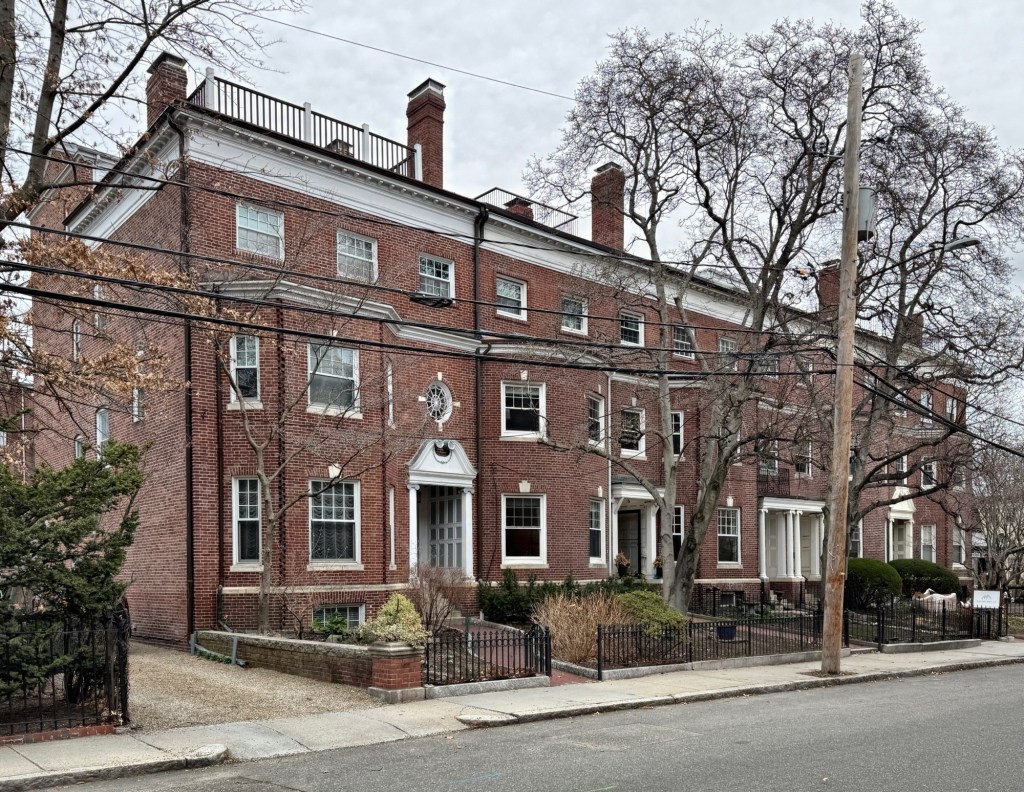
Merrill Rowhouses // c.1896

Around the turn of the 20th century, much of Brookline, Massachusetts, saw rapid development and suburbanization as the area streetcars and subway made Boston better-connected to adjacent communities. Developers eyed un- and under-developed lots near major corridors and stations to develop denser housing at varied success. In the Longwood neighborhood, Luther Merrill owned property along Beacon Street and in the more established wealthy neighborhood, where he sought to build. Taking cues from the surrounding context and precedence for rowhouse development, Merrill hired the local architectural firm of Ball and Dabney to furnish plans for a five-unit row. The firm designed the four-story building in the Colonial Revival style with its upper floor set back off the facade to give it the appearance of a three-story structure, to better fit with the surrounding character. The five privately owned rowhouses feature rounded bays and recessed paneled entrances, some surmounted by large swans neck pediments.

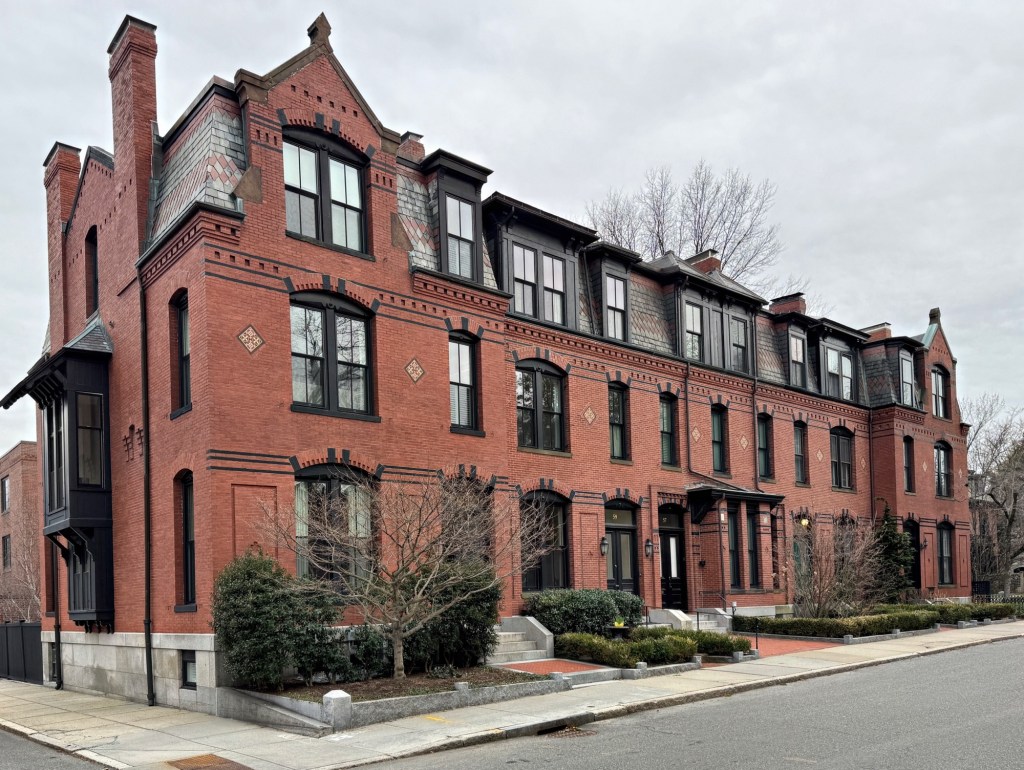
Amos Lawrence Rowhouses // c.1877

53-61 Monmouth Street

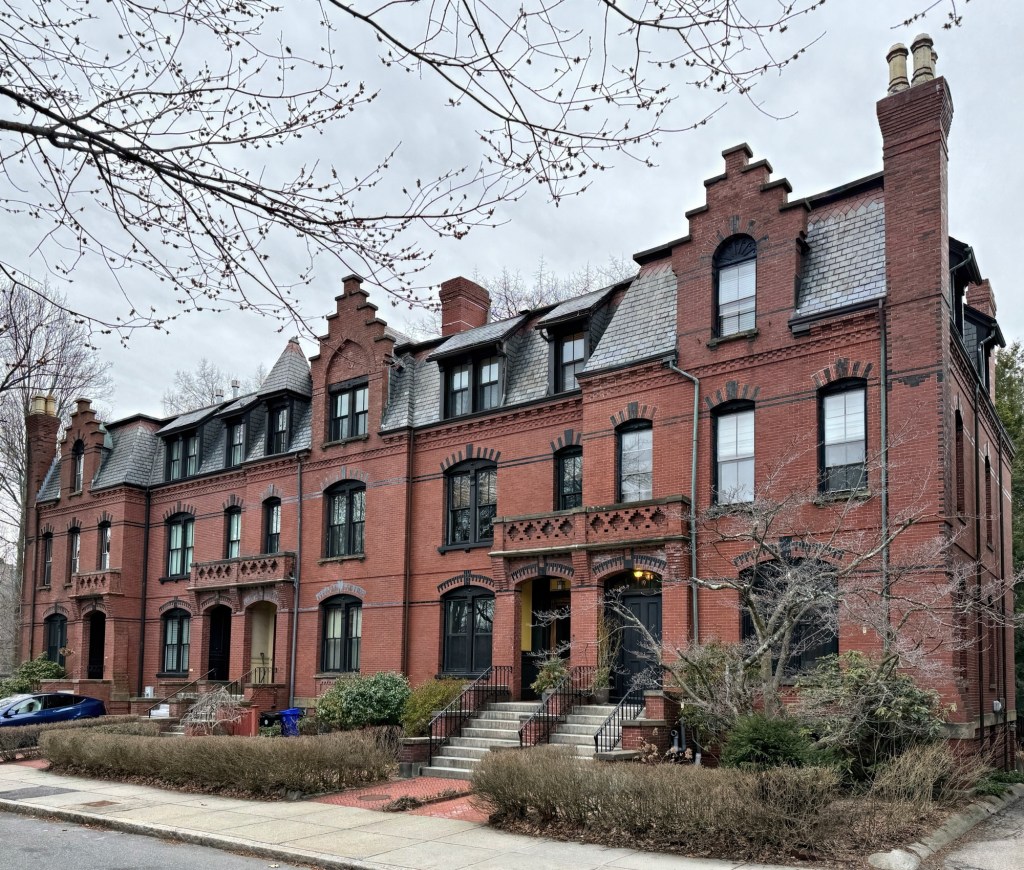
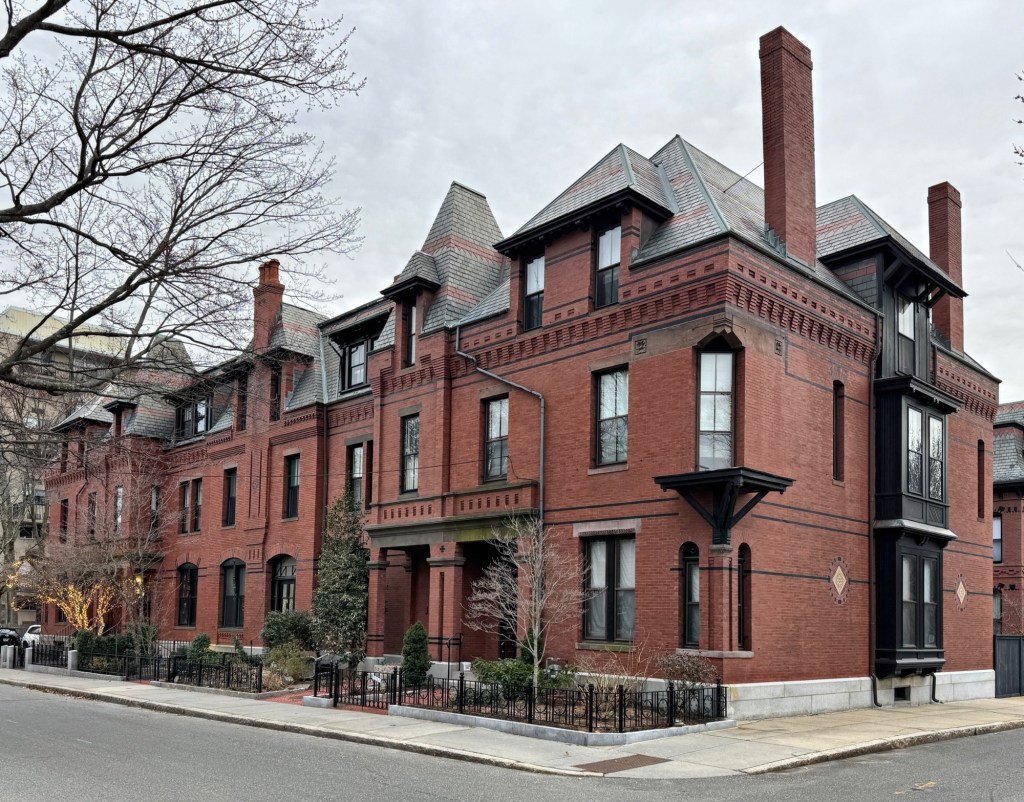
Amos A. Lawrence (1814-1886), a wealthy Boston merchant, owned land holdings in the present-day Longwood neighborhood of Brookline, just over the Muddy River from Boston, and developed the area into a wealthy and high-quality suburb. Lots were laid and Lawrence hired civil engineer, Ernest Bowditch, to plat for multiple sets of distinctive rowhouses surrounding a small green mall, which was later named Monmouth Court. Once the property was laid out, Amos Lawrence hired the Boston architects, J. Pickering Putnam and George T. Tilden, to design rowhouses for rental income. George Tilden was previously employed at the firm of Ware & Van Brunt, a firm that mastered and popularized the panel brick style in the Boston area in the 1870s and 1880s, and he clearly built upon this expertise for the rows for Amos Lawrence in Brookline. All four rows of houses are distinctive, yet compliment eachother stylistically with projecting bays. intricate brickwork, complex rooflines with dormers, and applied ornament. These two rows on the western side of Monmouth Court at 53-61 Monmouth Street and 19-27 Monmouth Court, were also likely the work of Putnam and Tilden, who practiced jointly for a couple years but published their work separately. Stylistically, the two Monmouth Street rows appear to be of the same architect, George Tilden with identical tilework and elements, and the two Monmouth Court rows as the work of Putnam with polychromatic segmental arches over the windows.

19-27 Monmouth Court

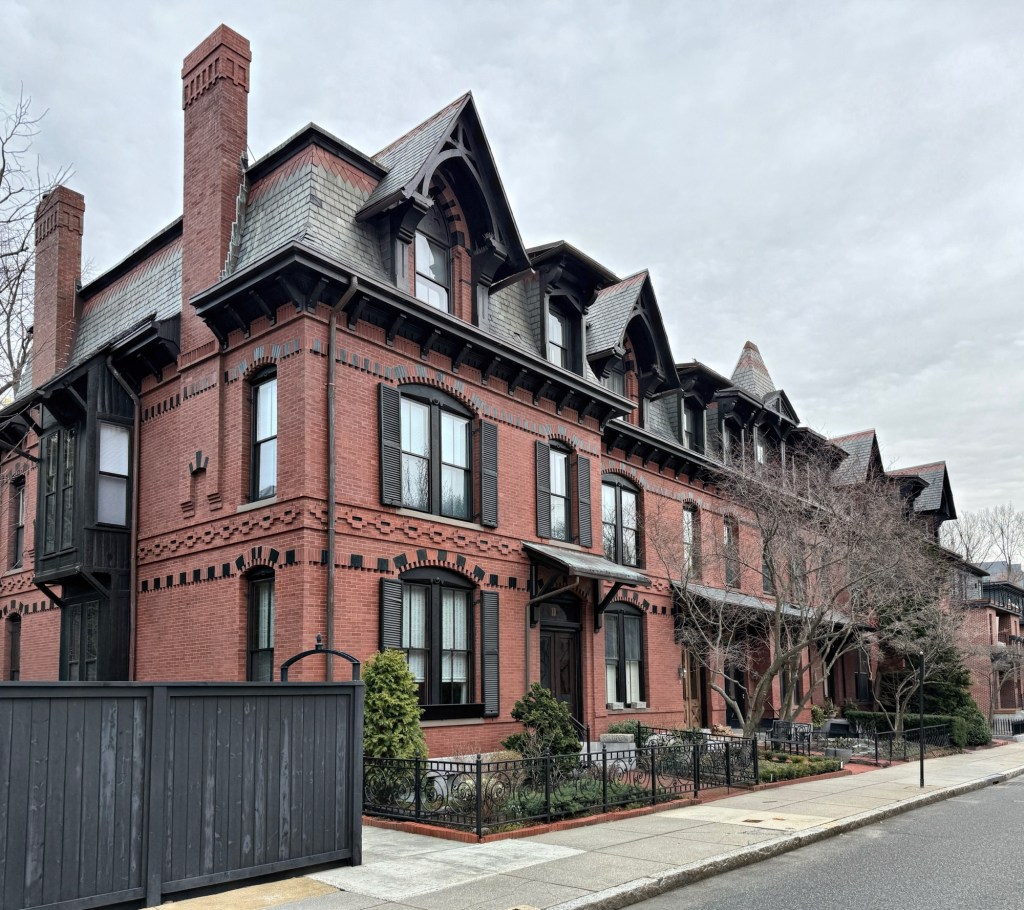
Amos Lawrence Rowhouses // 1876

Amos A. Lawrence (1814-1886), a wealthy Boston merchant, owned land holdings in the present-day Longwood neighborhood of Brookline, just over the Muddy River from Boston, and developed the area into a wealthy and high-quality suburb. Lots were laid and Lawrence hired civil engineer, Ernest Bowditch, to plat for multiple sets of distinctive rowhouses surrounding a small green mall, which was later named Monmouth Court. Once the property was laid out, Amos Lawrence hired the Boston architects, J. Pickering Putnam and George T. Tilden, to design rowhouses for rental income. George Tilden was previously employed at the firm of Ware & Van Brunt, a firm that mastered and popularized the panel brick style in the Boston area in the 1870s and 1880s, and he clearly built upon this expertise for the rows for Amos Lawrence in Brookline. All four rows of houses are distinctive, yet compliment each other stylistically with projecting bays. intricate brickwork, complex rooflines with dormers, and applied ornament. This row at 10-18 Monmouth Court was from the designs of partner, J. Pickering Putnam and was highlighted in an architectural publication soon after completion. The row exhibits a slate mansard roof disrupted by dormers with trusses, lancet arch and trefoil motifs, polychromatic brick and pent roof entrances all stepping out to the private courtyard.

Amos Lawrence Rowhouses // 1876

Amos A. Lawrence (1814-1886), a wealthy Boston merchant, owned land holdings in the present-day Longwood neighborhood of Brookline, just over the Muddy River from Boston, and developed the area into a wealthy and high-quality suburb. Lots were laid and Lawrence hired civil engineer, Ernest Bowditch, to plat for multiple sets of distinctive rowhouses surrounding a small green mall, which was later named Monmouth Court. Once the property was laid out, Amos Lawrence hired the Boston architects, J. Pickering Putnam and George T. Tilden, to design rowhouses for rental income. George Tilden was previously employed at the firm of Ware & Van Brunt, a firm that mastered and popularized the panel brick style in the Boston area in the 1870s and 1880s, and he clearly built upon this expertise for the rows for Amos Lawrence in Brookline. All four rows of houses are distinctive, yet compliment eachother stylistically with projecting bays. intricate brickwork, complex rooflines with dormers, and applied ornament. This row at 69-77 Monmouth Street exhibits inlaid tile medallions and small balconets on the chamfered corners that are missing their railings.

Wooster Square Brownstone Row // 1871

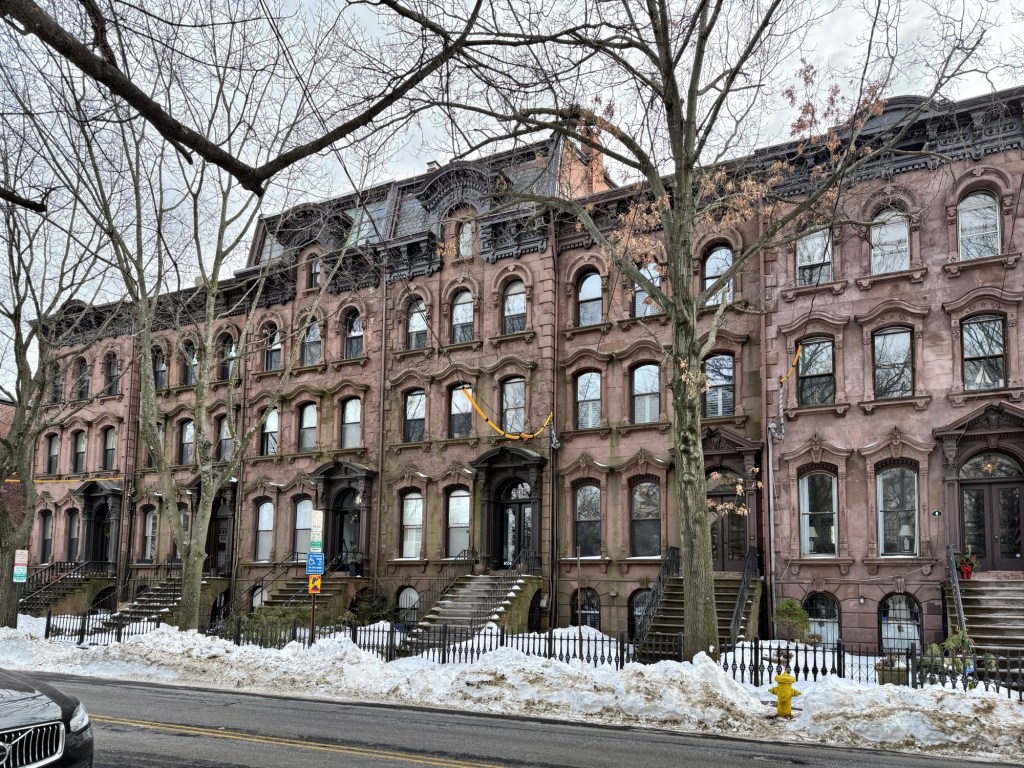
This extraordinary row of brownstone homes is located on Chapel Street in New Haven, Connecticut, and overlooks Wooster Square as its southern anchor. Built in 1871, the symmetrical row of six rowhouses are clad with brownstone facades which read more like Brooklyn townhouses than what is typical in New Haven, which is why these are so special. The row was designed by New Haven architect, David R. Brown, who got his start as an apprentice under Henry Austin, and became a prolific local designer. The row was likely constructed by one owner on speculation and subsequently sold to individual owners, who have maintained the structure over 150 years since. The Brownstone Row is Italianate/Second Empire in style with window surrounds, bracketed cornice and cupolas on the flanking homes with the center two residences capped by mansard roofs.

Olive Street Rowhouses // c.1865

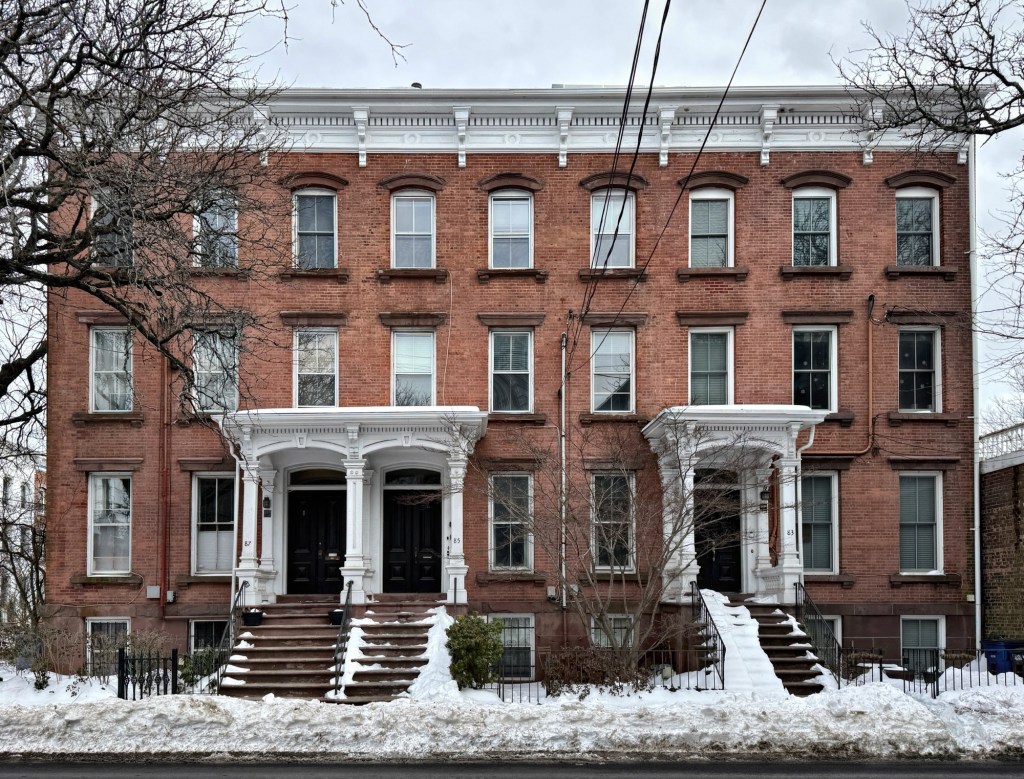
The Wooster Square area of New Haven, Connecticut, is comprised of a lovely collection of houses and institutional buildings from the 1830s through the late 19th century, showing the ever-changing taste of architectural styles from Greek Revival to Italianate to Second Empire and Queen Anne. These rowhouses on Olive Street serve as bookends to long rows of houses on Court Street, a narrow, one-way street radiating from Wooster Square. The buildings were developed by the Home Insurance Company, a fire insurance firm and developer that helped fuel the development of residential New Haven in the 1860s by investing in real estate, primarily with fireproof masonry buildings. These Italianate style rowhouses were built in the 1860s after the Civil War and were sold on speculation to middle-class families. All buildings retain the original bracketed cornices, brownstone sills, lintels, and basement facing, and projecting porticos at the entries.

Samuel and Emily Eliot Rowhouses // 1871

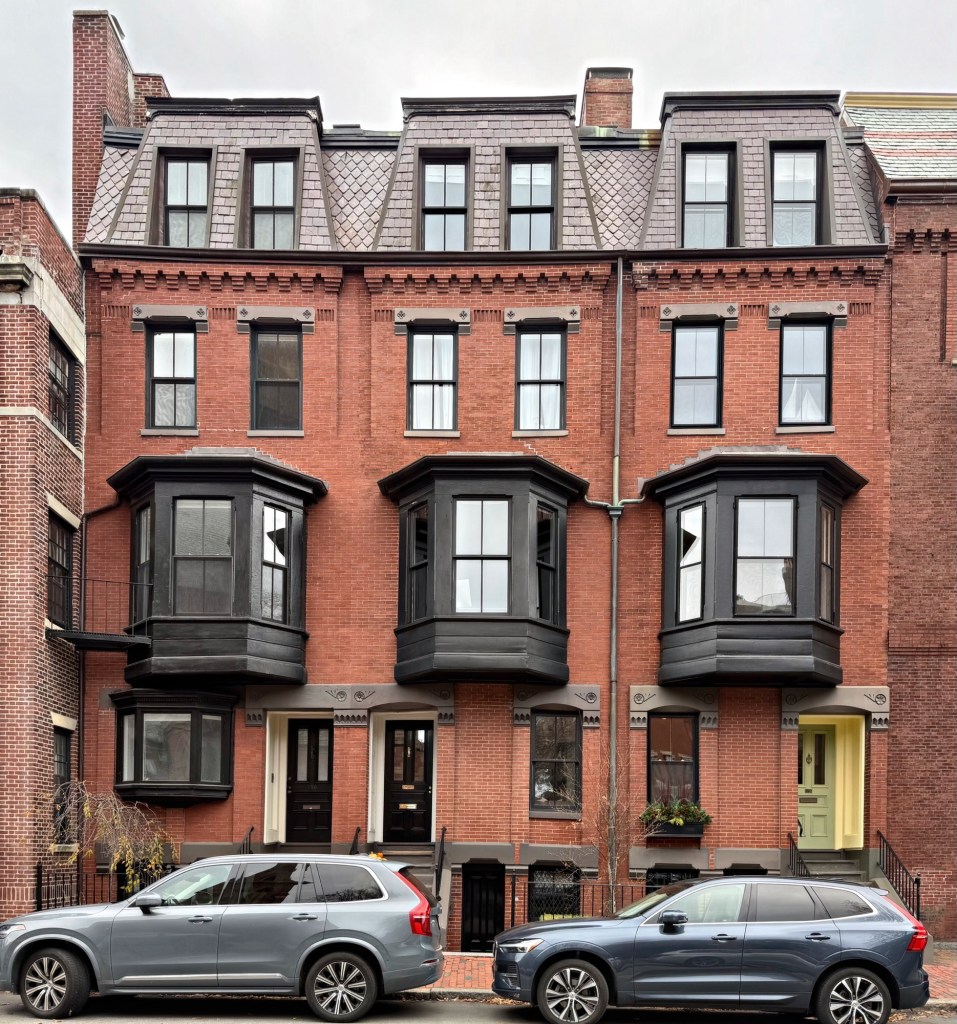
These three identical three-story houses at 156, 158 & 160 Mt. Vernon Street in Beacon Hill Flat were built in 1871 as income producing properties for Samuel and Emily Otis Eliot who lived next door on the corner of Brimmer Street. The architect is not evident from my research, but they were likely designed by Abel C. Martin, who furnished speculative housing for the Eliot’s elsewhere in the neighborhood. All three residences feature brick facades with off-center recessed entries on raised stoops. The use of brownstone lintels and sills, decorative brick cornice, and second-story hexagonal oriel windows add intrigue to the design, along with the slate mansard roofs. The three houses were sold or rented and all were owned by various families, but notable owners of the central house include the architect George Russell Shaw (1848-1937) of the firm Shaw and Hunnewell through the early 1900s. Later in the 20th century, the house was owned by Kevin White (1929-2012), who served as the mayor of Boston for four terms from 1968 to 1984.
All three residences are well-preserved and look much as they did when constructed over 150 years ago.

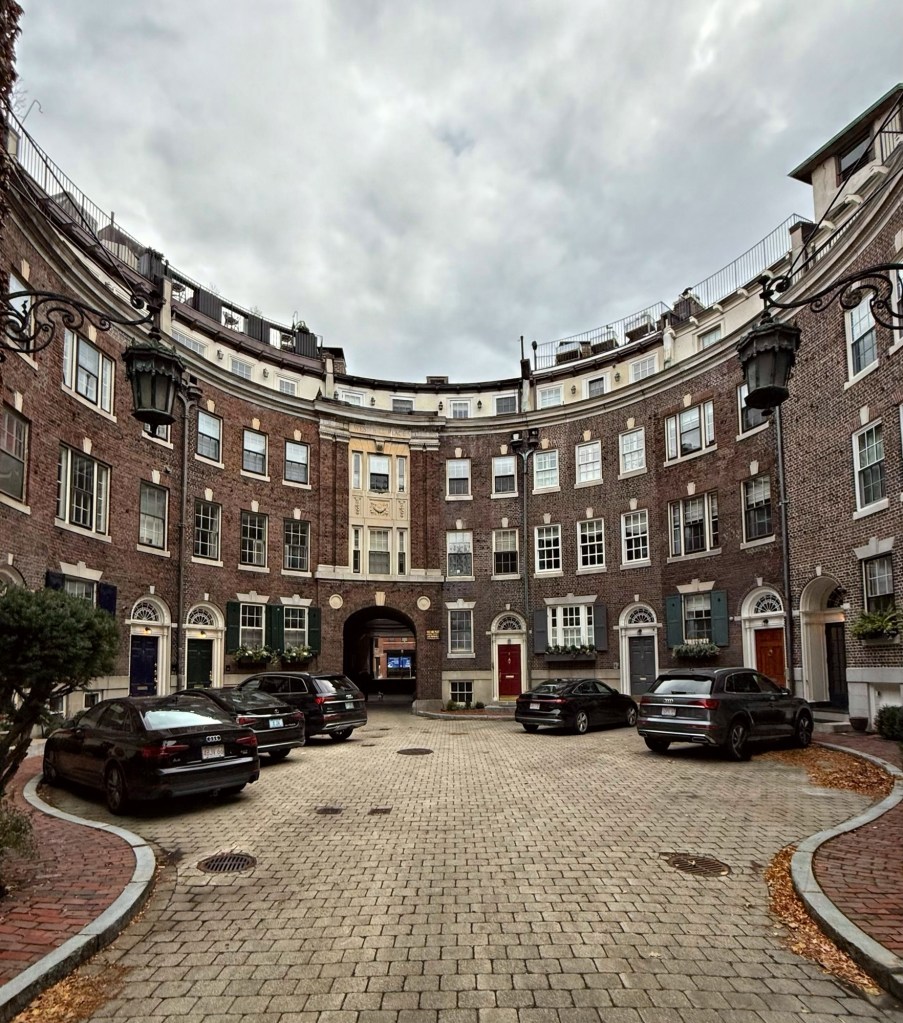
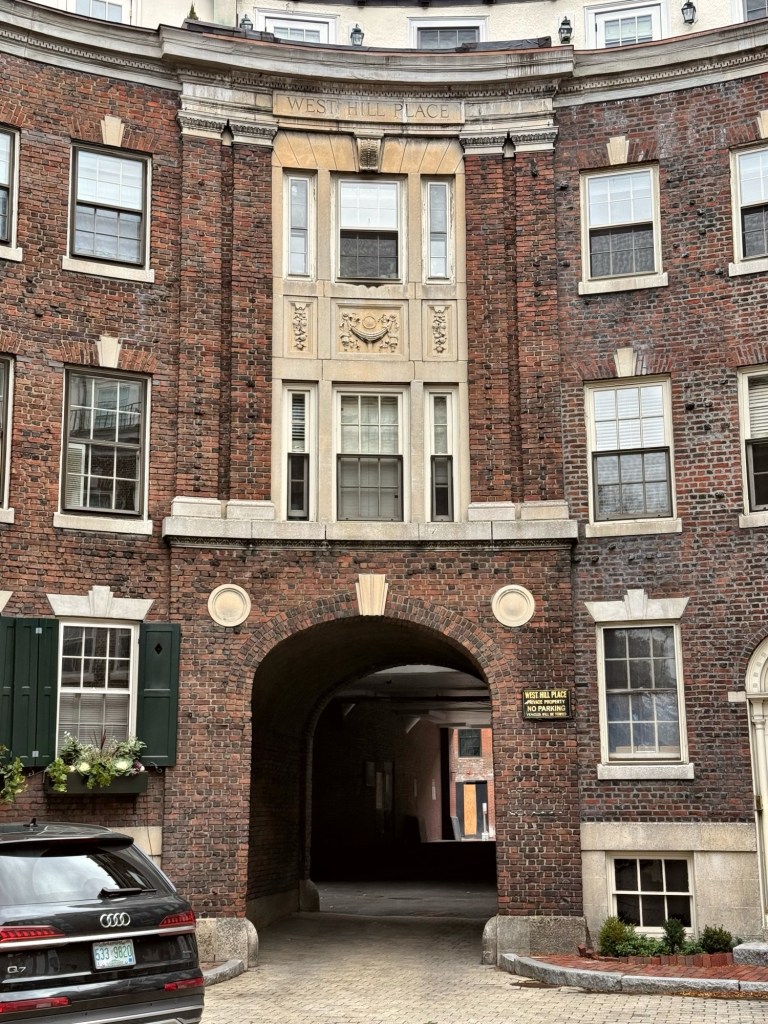
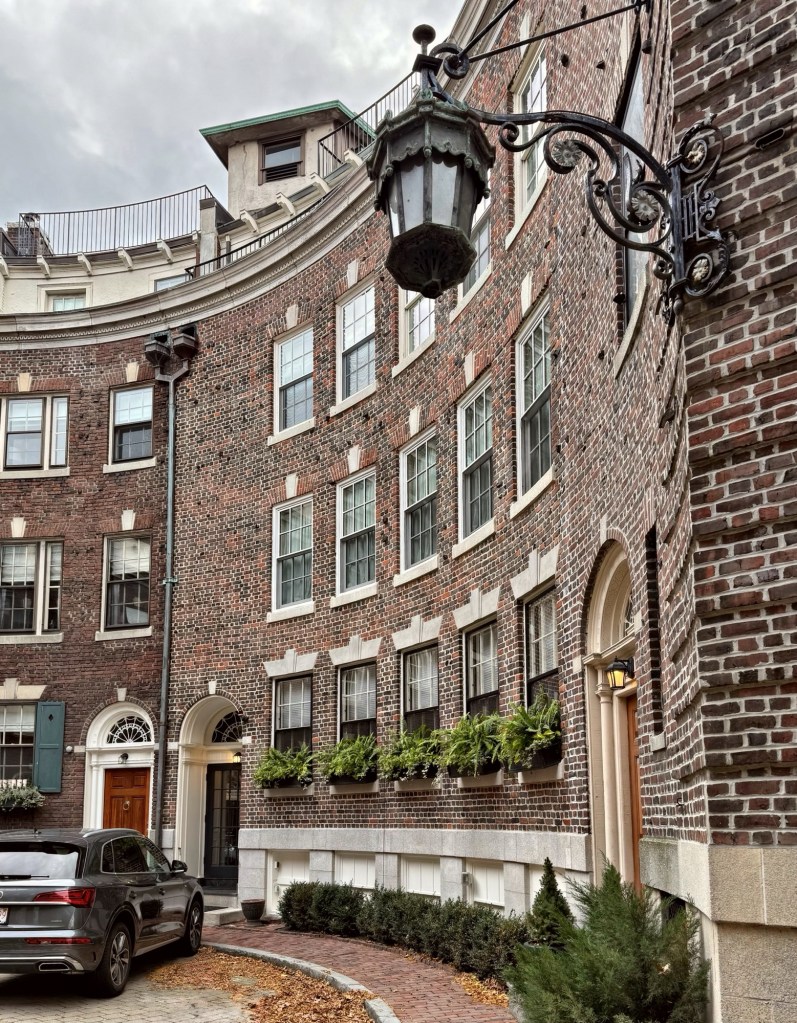
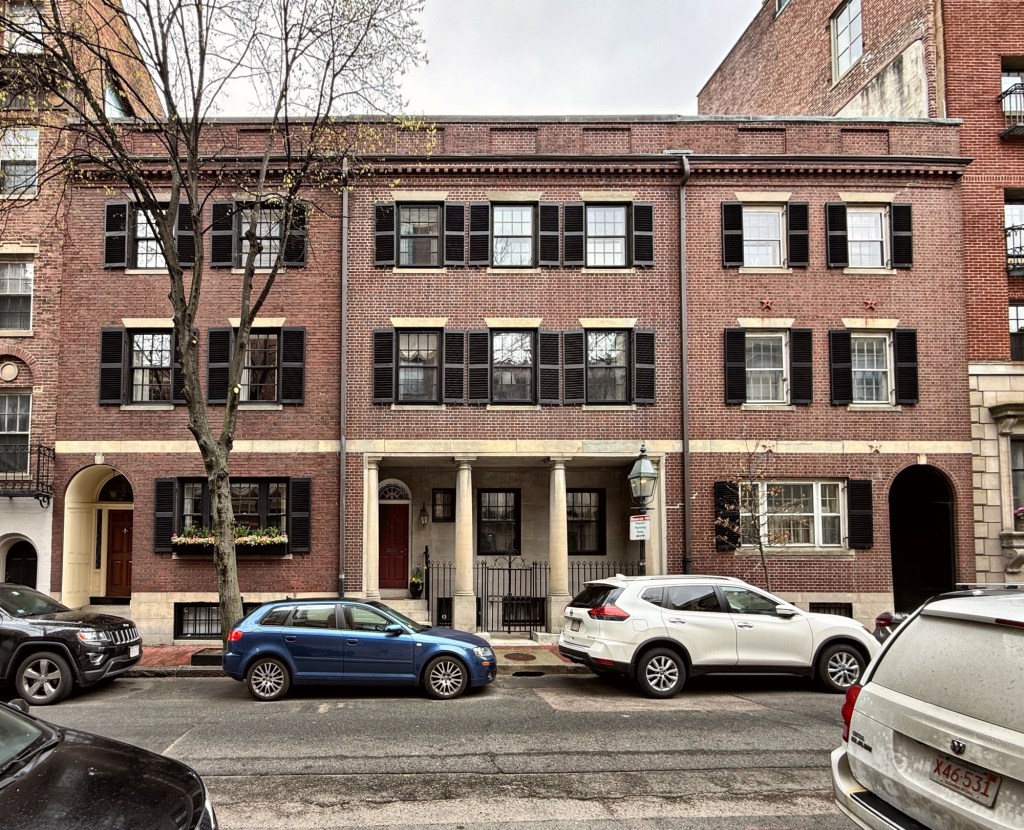
West Hill Place // 1916

West Hill Place is a small development in Beacon Hill that feels like it was transported to Boston from London! The group of 14 four-story brick townhouses that comprise West Hill Place were built on the site of a gas holder in 1916. The Georgian Revival style development was designed by the firm of Coolidge and Carlson, who aligned six of the townhomes to face west on the Charles River Embankment and arranged the remaining eight residences around a circular court. The development was inspired by Charles River Square, located to its south and built six years prior. The driveway extends off what is today Storrow Drive, with a second exit set within an arched passageway that connects through the Charles Street garage, which was built later. The dark brick with cast stone trim works elegantly with the curving facades facing the courtyard, many of which are adorned with arched doorways and the original iron lanterns. The development has been harmed by the creation of Storrow Drive in the 1950s, but it remains one of the most unique and picturesque enclaves in New England. 

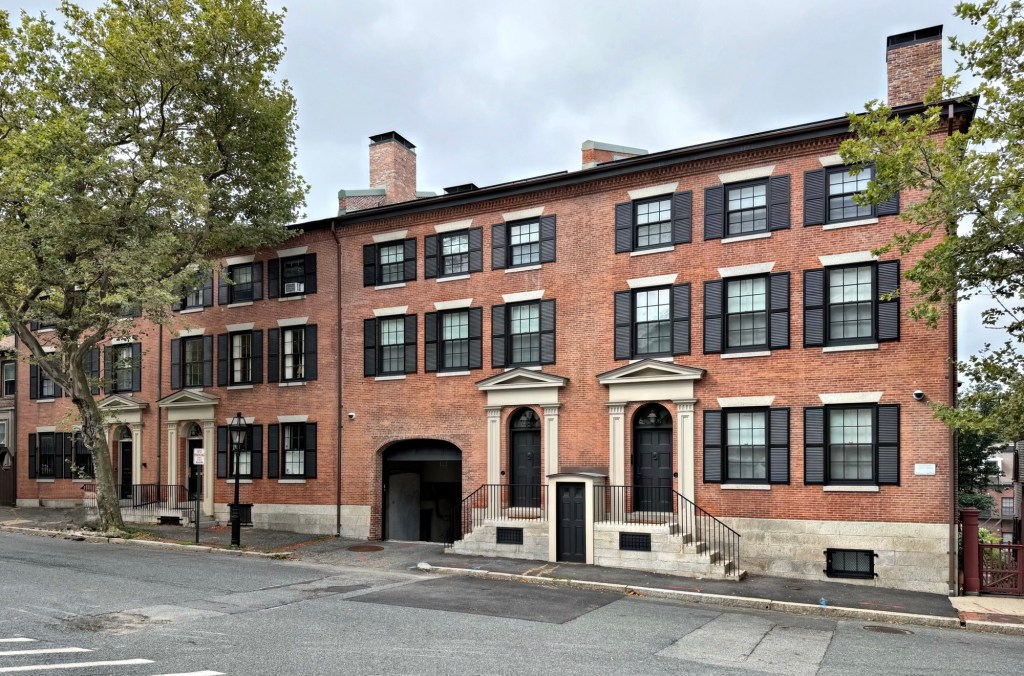
Ives Rowhouses // 1814

The Ives Rowhouses stand at 270-276 Benefit Street in Providence and are an important and intact example of a Federal period row from the early 19th century. These four, three-story brick rowhouses were built between 1814-19 as investment property for Thomas Poynton Ives, a successful local merchant and partner in the firm of Brown & Ives, who lived nearby on Power Street. Each of the houses has a three-bay facade with pedimented fanlight doorways. The one residence was significantly altered in 1948 by the massive archway for vehicular access at the rear. The houses stand out in Providence, as fairly uncommon rowhouses, which never took off quite like they did in Boston and other New England cities. The row is today neighbors with the National Historic Landmark Hopkins House.

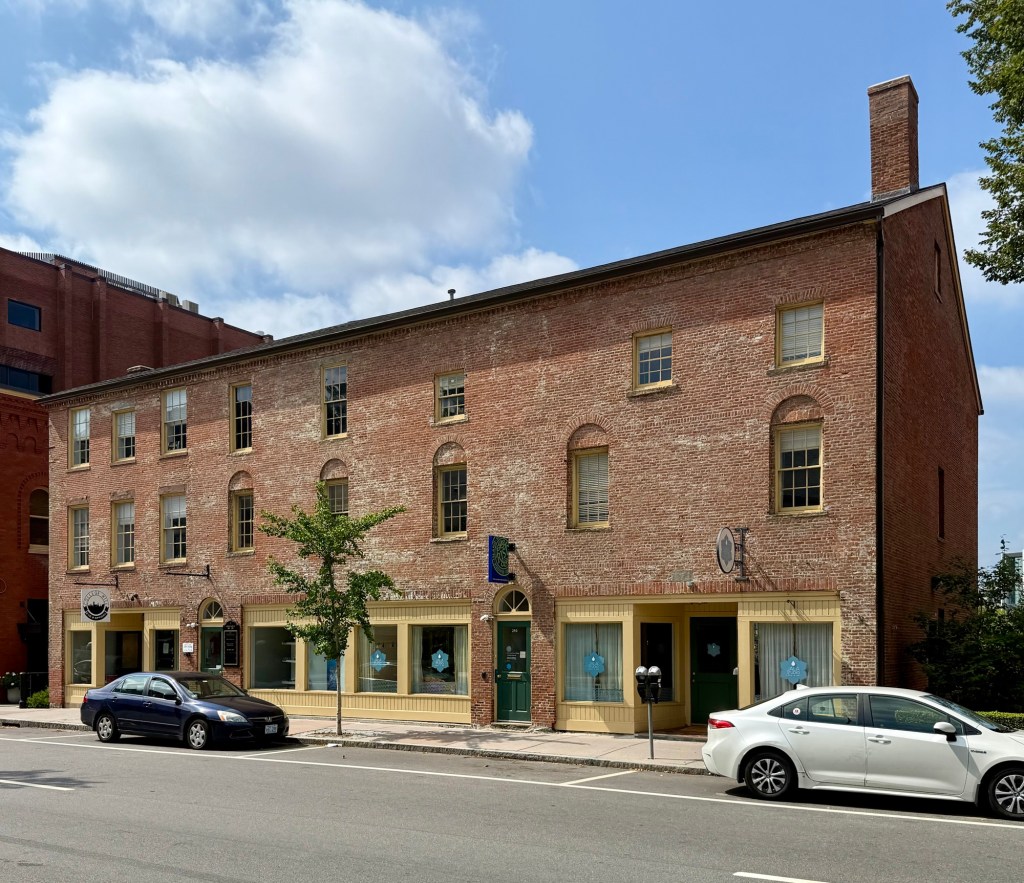
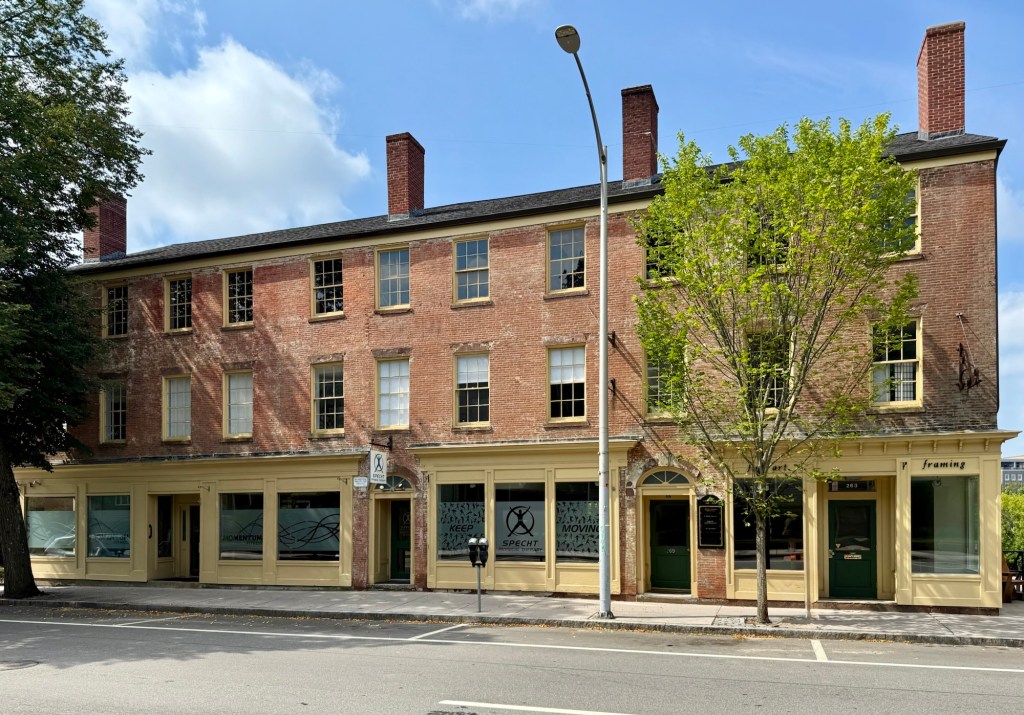
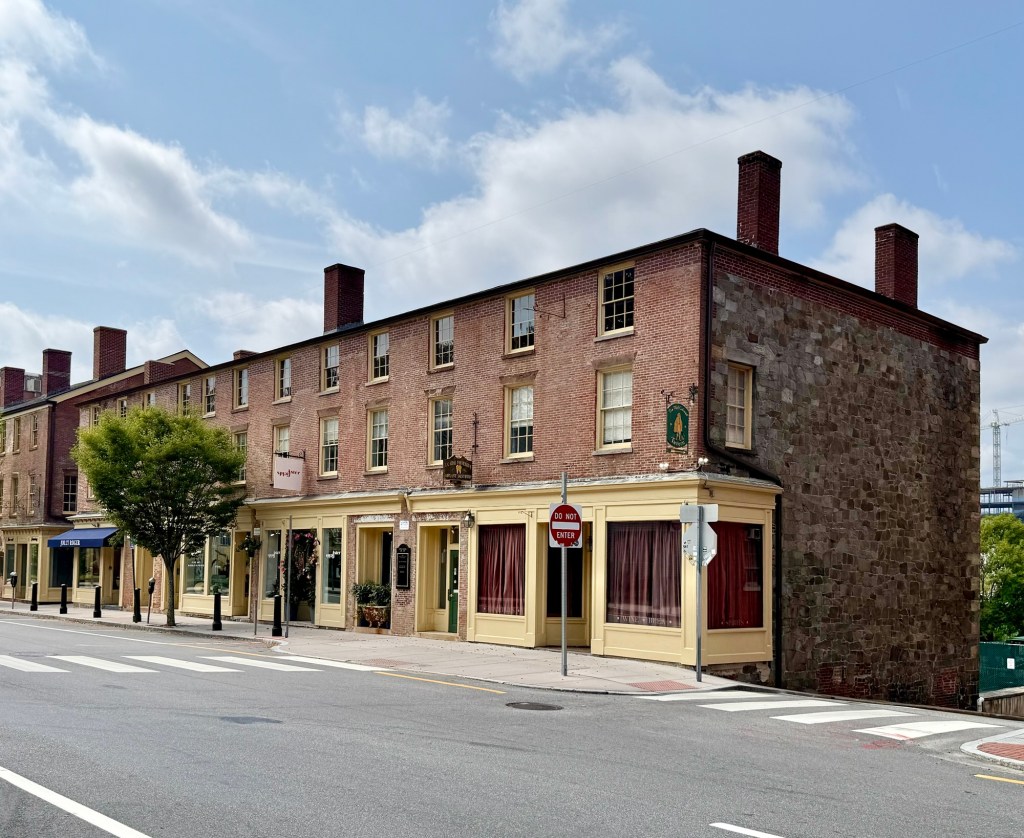
Eddy Block // 1812

The last of the three similar brick rowhouse blocks on South Main Street in Providence’s East Side is the most altered, but maintains much of its architectural integrity and street-presence. Like the Comstock and Clark-Nightingale blocks further up South Main Street, the Eddy Block was built in 1812, at the beginning of the 19th century for a wealthy merchant, Moses Eddy (1766-1823), who owned and operated packet ships that transported mail and other goods between Providence and New York. The building is one of the oldest rowhouses in Providence, and its three-bays contain an interesting mix of alterations and original details that were changed or preserved over-time. Like the other two rows nearby, the Eddy Block was gutted, and rehabilitated in the 1970s as part of the Urban Renewal plan for Providence’s East Side.