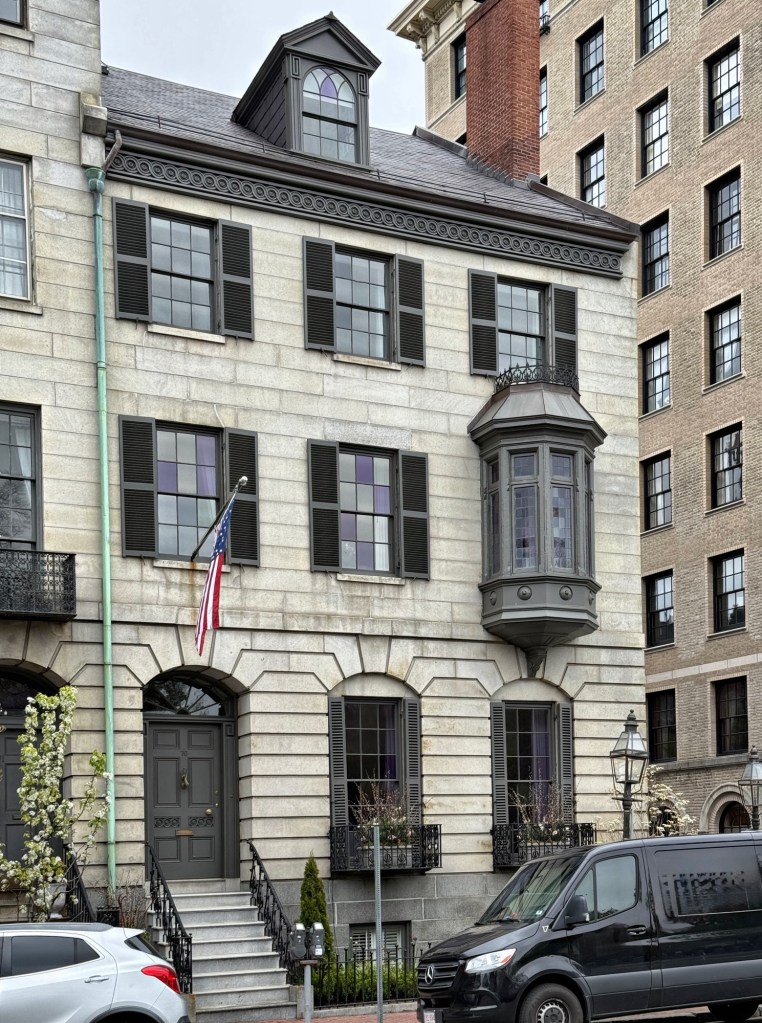
Greenough-Dwight House // 1829

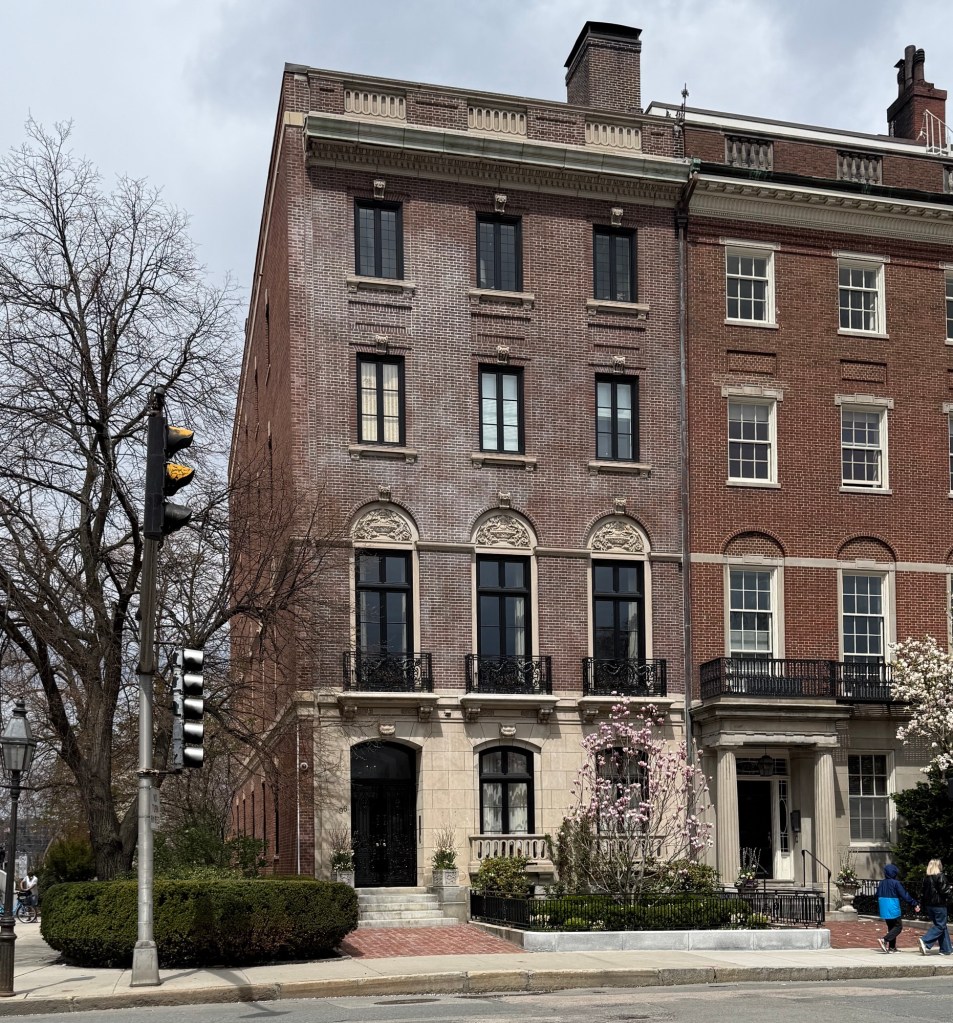
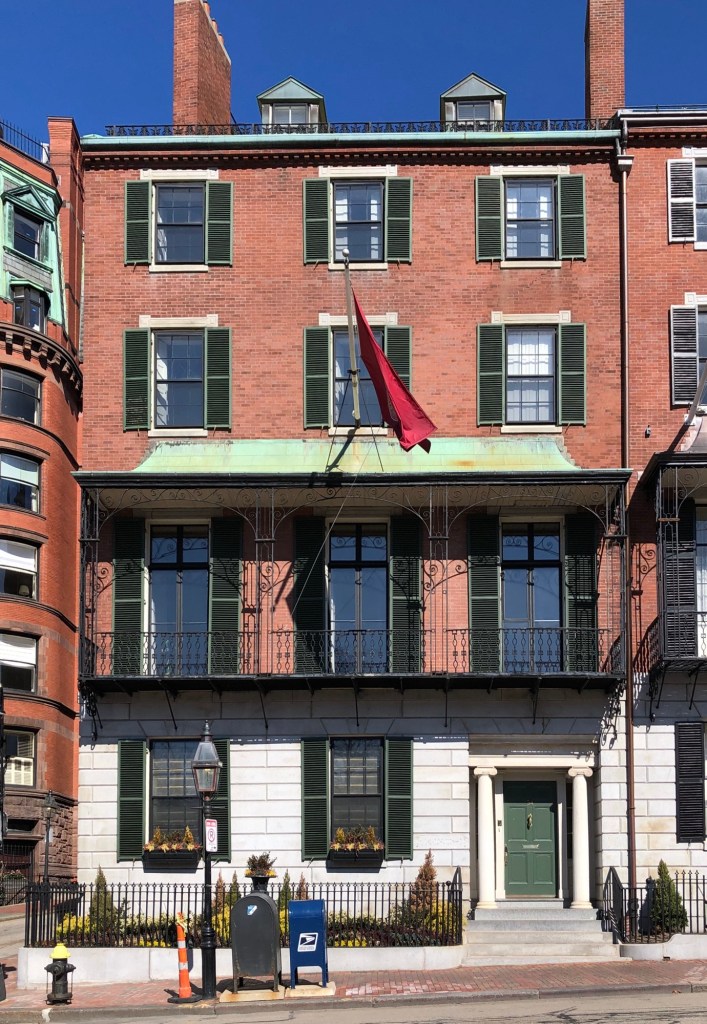
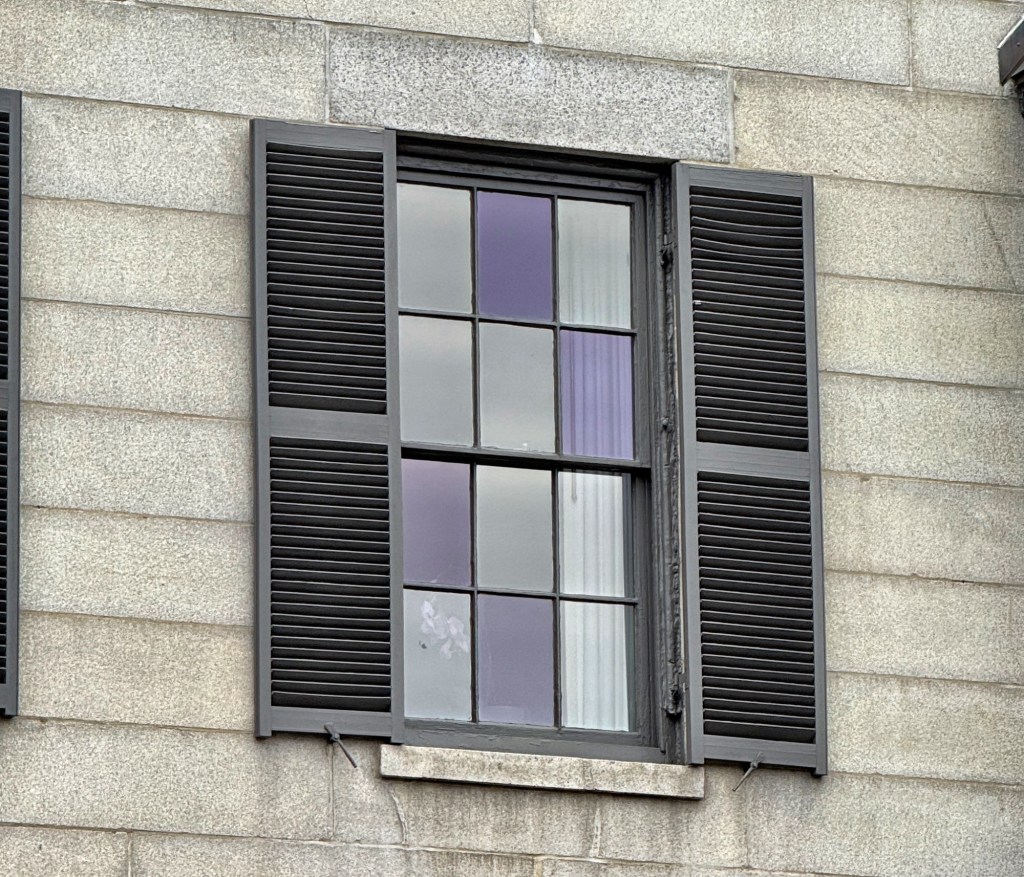
One of six attached houses townhouses between 70-75 Beacon Street, this stately granite-faced residence was built concurrently with its neighbors in 1828 on speculation for the Mount Vernon Proprietors, a group of wealthy Boston businessmen who helped develop Beacon Hill into the posh, architecturally significant neighborhood it is today. The Mount Vernon Proprietors knew how important Beacon Street was as the entry into the neighborhood, and thus, hired Boston’s premier architectAsher Benjamin, to design the row. When completed, all of the houses were identical, but throughout the 19th and 20th centuries, they all deviated from the original design, some gaining additional floors, others adding bay windows, but all together form a cohesive and architecturally significant span of houses. Completed in 1829, the corner dwelling is known as the Greenough-Dwight House and it retains its original three-story rusticated granite façade with segmental arch openings. The major change to the exterior of the Greenough-Dwight House is the addition of the ornate wood oriel window with iron cresting in 1874, the oriel and facade feature the iconic purple windows, which became a status symbol in the 20th century. The story goes, that between 1818 and 1824, an English company sent shipments of glass that contained too much manganese oxide into Boston Harbor. After being exposed to sunlight for an extended period of time, the manganese oxide in the glass began to turn purple creating the colored panes we love today. Over time, many panes broke or were replaced, creating the checkerboard appearance on so many windows, but many owners in the 20th century had imitation purple glass installed as a marker of wealth and prestige, like in this house and bay, which were built after the period that the glass was brought over from England. My favorite in the row, the Greenough-Dwight House shines with its granite facade and brick end wall, with panes reflecting the sun off her violet glass windowpanes. 
Burnham Townhouse – Engineer’s Clubhouse // 1911

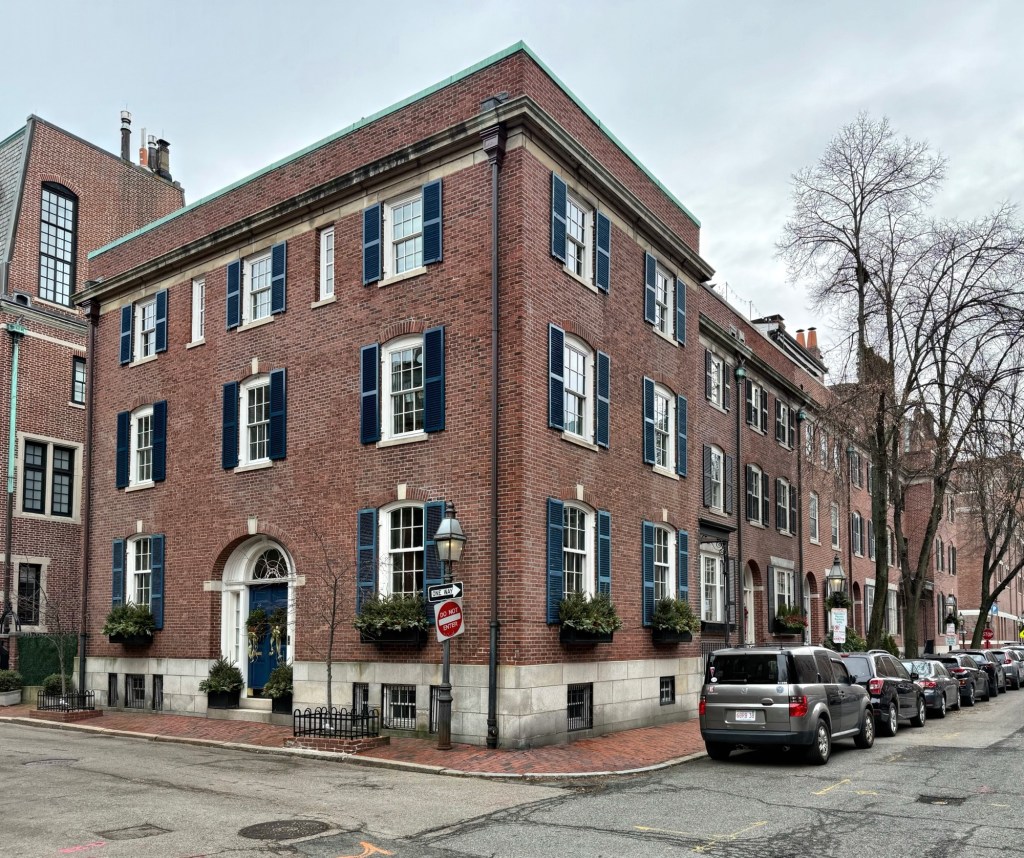
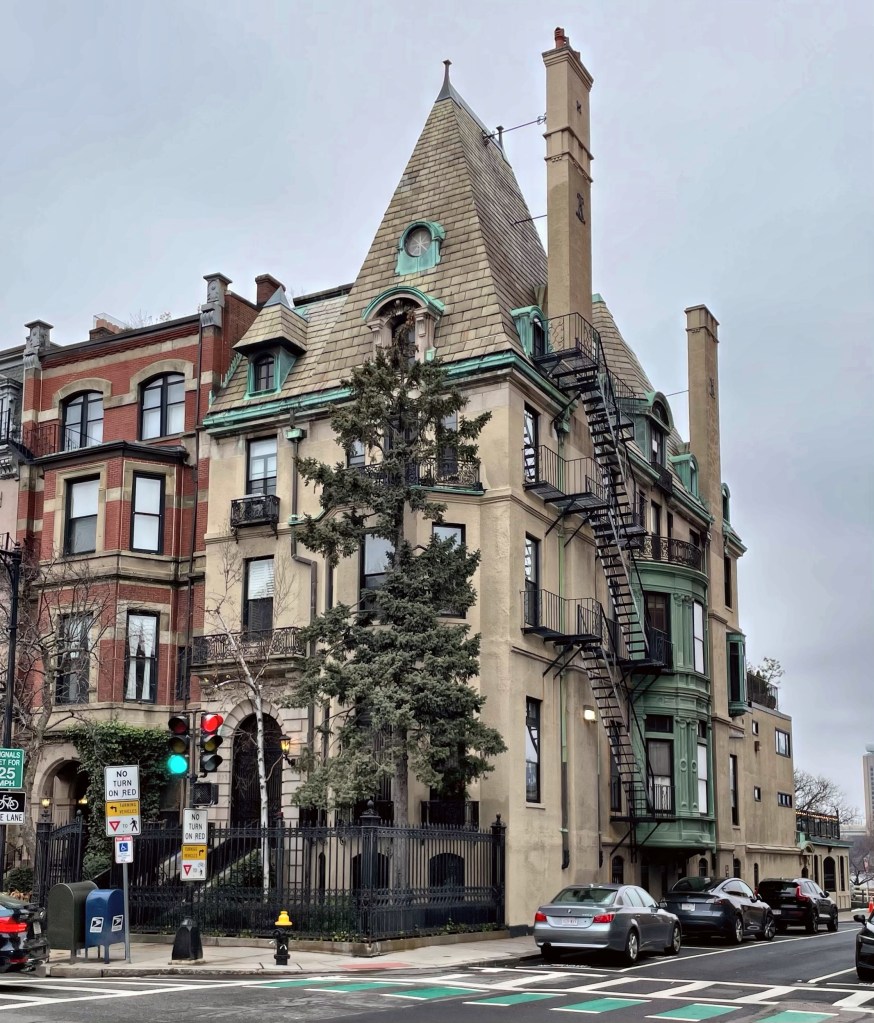
Located at the boundary of the Beacon Hill and Back Bay neighborhoods, this prominent townhouse on a corner lot at Beacon Street and Mugar Way was built in 1911, replacing an 1840s townhouse of the same form. The Colonial Revival style townhouse was built for Henry D. and Johanna H. Burnham from plans by the architectural firm of Wheelwright, Haven & Hoyt. Henry Burnham was the son of cotton broker, John Appleton Burnham and was in the real estate business. Henry and Johanna lived at 96 Beacon Street through at least 1938. The house was bought by the Engineer’s Club, a social and professional organization, in 1947. In the 1950s, the formerly mid-block townhouse suddenly became a corner lot with the construction of Storrow Drive, its off ramp as Mugar Way, and the addition of the Fielder Footbridge connecting Beacon Hill to the Esplanade. The Engineer’s Club took over renovations at the interior, which were done to adapt the former single-family residence for clubhouse functions, including a large banquet hall. In the 1960s, the property was acquired by Emerson College and used it as a college center and cafeteria until the early 2000s when it was converted into condominiums by Grassi Design Group, adding new openings to the formerly solid brick side wall.

Brimmer Street Terrace // 1912

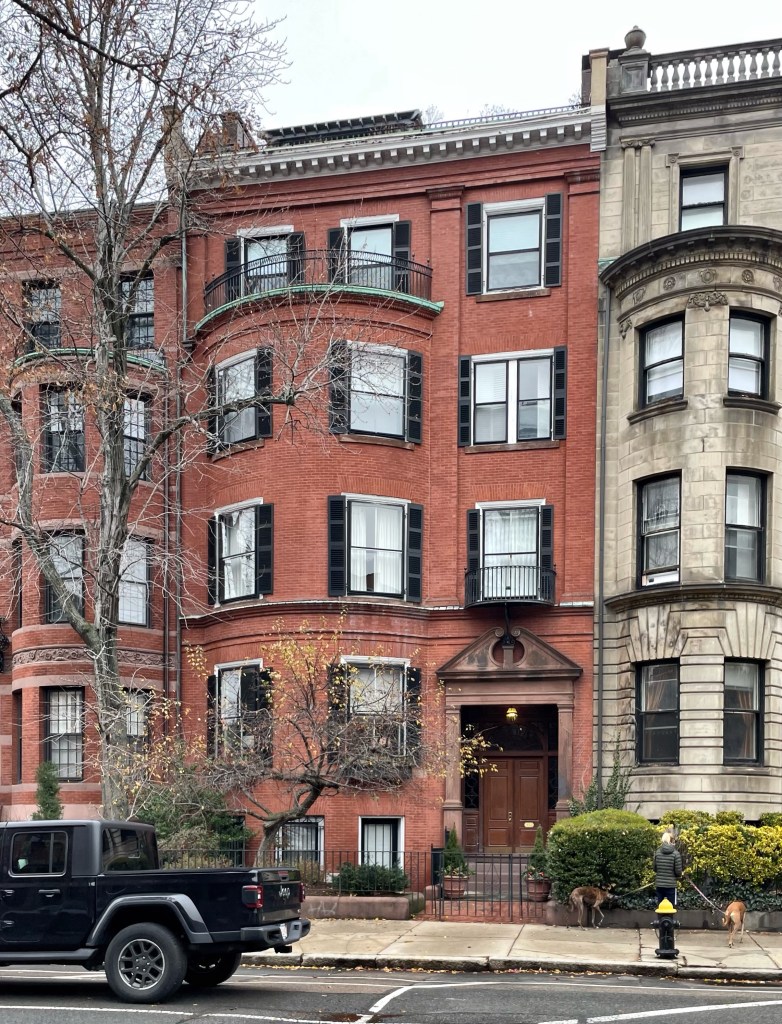
An interesting ensemble of seven rowhouses running along Brimmer Street in Beacon Hill, the Brimmer Street Terrace development showcases the rebirth the “Flat” of Beacon Hill encountered in the early 20th century from livery stables and carpentry shops to high-end housing and artist’s studios. Built on the site of a large livery stable, Brimmer Street Terrace was developed in 1912 by Gerald G. E. Street and William C. Codman, developers who sought to enhance this section of Beacon Hill and protect it from unsympathetic development, and hired architect Richard Arnold Fisher to design the houses. The rowhouses were originally rented to upper-class families but later were sold off as individual properties. Colonial Revival in style, the row is built of the iconic Boston red brick, Federal Revival style fanlight transoms over the entrances, include shutters, and all sit atop a stone basement. The row is anchored on each end by residences facing north and south with large symmetrical facades with the five more narrow rowhouses connecting them along Brimmer Street. 

Olive Street Rowhouses // c.1865

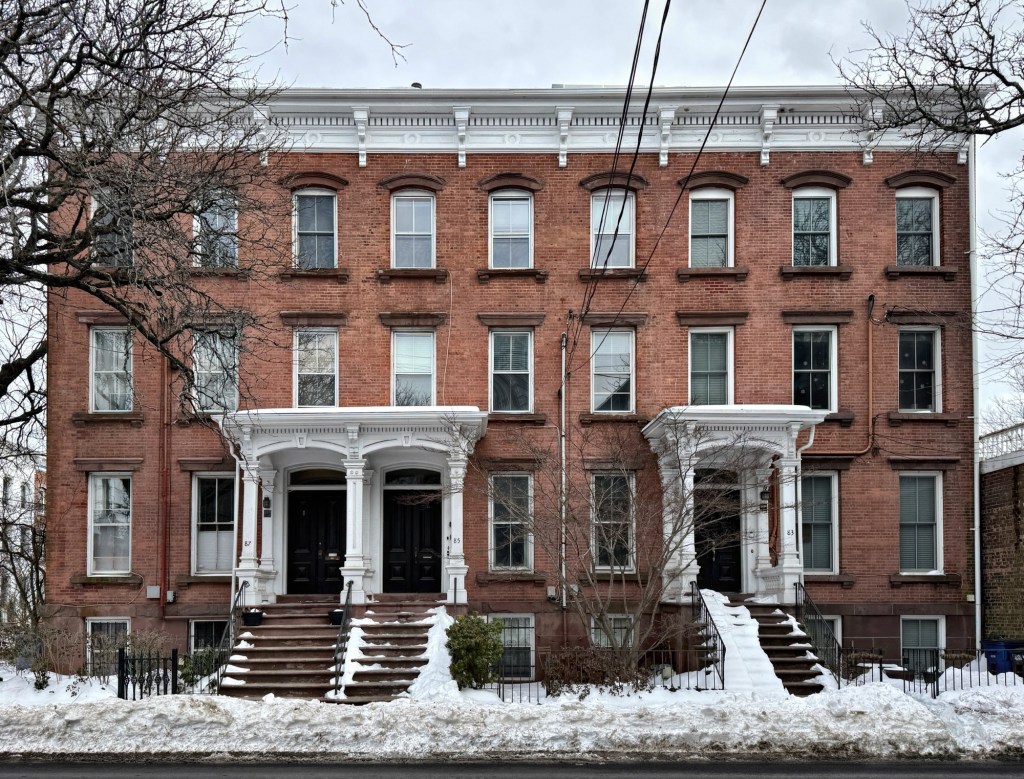
The Wooster Square area of New Haven, Connecticut, is comprised of a lovely collection of houses and institutional buildings from the 1830s through the late 19th century, showing the ever-changing taste of architectural styles from Greek Revival to Italianate to Second Empire and Queen Anne. These rowhouses on Olive Street serve as bookends to long rows of houses on Court Street, a narrow, one-way street radiating from Wooster Square. The buildings were developed by the Home Insurance Company, a fire insurance firm and developer that helped fuel the development of residential New Haven in the 1860s by investing in real estate, primarily with fireproof masonry buildings. These Italianate style rowhouses were built in the 1860s after the Civil War and were sold on speculation to middle-class families. All buildings retain the original bracketed cornices, brownstone sills, lintels, and basement facing, and projecting porticos at the entries.

Faulkner-Hayden House // 1881

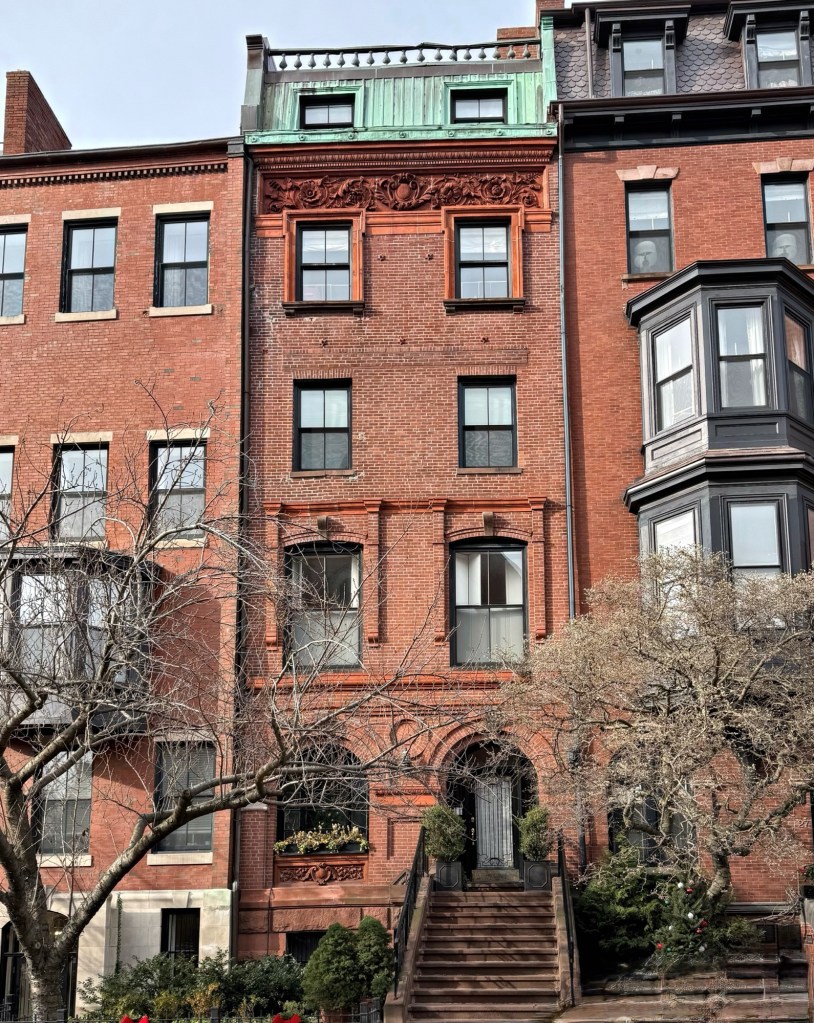
This unique house at 29 Brimmer Street in Boston’s Beacon Hill, was completed in 1881 is architecturally distinctive compared to the early 19th century homes that the neighborhood is known for. The five-story residence has a raised entrance up a flight of steps set within an arched opening. To the side, an arched window frames the facade and has an ornate terracotta panel as a base. More terracotta ornament can be found at the second floor and under the cornice as a thick band frieze with a copper-clad mansard roof above. The single-family residence was built in 1881 for Charles Faulkner (1811-1885), a commission merchant, for his daughter, Ann Ruth Faulkner the year of her marriage to Charles Rowley Hayden. Mr. Hayden was a musician and vocalist. For the new wedding gift, Faulkner hired the esteemed architectural firm of Bradlee & Winslow prepare the designs. The former Faulkner-Hayden House today contains five condominiums.


Baker-Byrd House // 1888

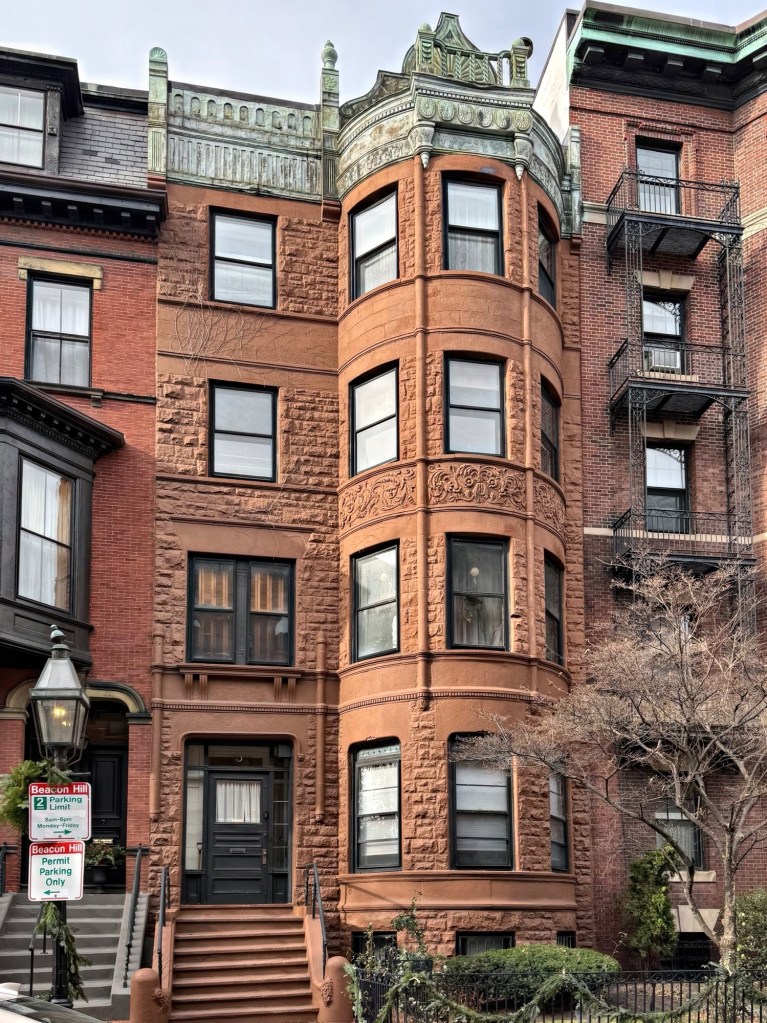
Located on Brimmer Street in Beacon Hill, this handsome residence is constructed of rough-faced brownstone laid in a random ashlar pattern and is among the most unique in a neighborhood known for brick townhouses. Decorative treatment includes a stone band that is carved with foliate and faces, colonettes that rise along the facade at the bay, and an ornate molded copper entablature and parapet at the roof. The residence dates to 1888 and was built for Seth R. Baker, a Boston real estate developer at the end of the 19th century. It can be inferred that the building was designed by architect, Ernest N. Boyden, as Baker hired Boyden as architect for a half-dozen other apartment buildings between 1888-1890. Antoino Xavier, a Portuguese-born mason is listed as the builder. In the 1910s, the property was purchased by Marie Ames Byrd, wife of polar explorer Richard A. Byrd, who lived a few houses away at 9 Brimmer Street. She rented the four apartments to boarders through the 1930s.


Eliot C. Clarke Townhouse // 1884

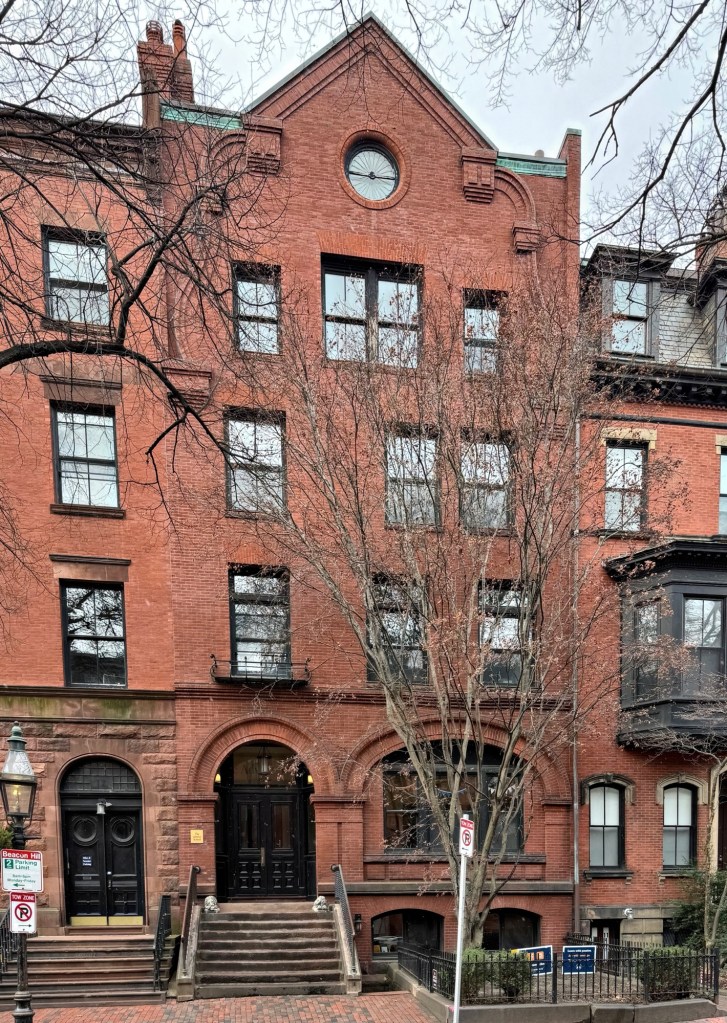
One of the many great townhouses on Brimmer Street in Boston’s Beacon Hill neighborhood is this residence designed as a unique interpretation of Queen Anne and Romanesque Revival styles. Original owner, Eliot Channing Clarke (1845-1921), an MIT-educated civil engineer. His uncle, Thomas Curtis Clarke, was a noted civil engineer, a member of the firm of Clarke, Reeves & Co., Bridge Builders in Pennsylvania, and served later as President of the American Society of Civil Engineers. When Thomas Clarke’s firm was designing and building a new bridge over the Mississippi River in Quincy, Illinois, he had his nephew lead in the design. In 1876, Eliot was appointed engineer in charge of a survey for a main drainage system for Boston. The project was adopted and construction began a year later, taking years to complete. In 1885, Clarke published the work that he oversaw, modernizing a rapidly growing Boston water and plumbing system. He became one of the leading sanitary engineers of the United States. In 1884, Clarke hired architect, S. Edwin Tobey, who designed this townhouse with a unique gable containing a ocular window and panel brick parapet as an interpretation of a Flemish gable. A traditional arched entry in brick is a nod to the Romanesque Revival style, which surged in popularity in Boston following the completion of H. H. Richardson’s Trinity Church. In 1969, the Clarke house’s interior was connected with its neighbor as the Advent School, a private K-6 school associated with the Church of the Advent across the street.

Charles and Elizabeth Ware Mansion // 1870

Located at the corner of Brimmer and Mount Vernon streets in Beacon Hill, this stately mansion showcases the various architectural styles and methods utilized by architects in the waning decades Victorian-era Boston. Set atop a brownstone base, the floors above are in the “Panel Brick” style, which utilizes brick masonry in a variety of decorative patterns of slight projecting or receding panels. The style was popularized by the Boston architectural firm of Ware & Van Brunt, as noted by architectural historian, Bainbridge Bunting. As expected, this house (and the attached townhouse next door) was designed by William Robert Ware for his uncle, Dr. Charles Eliot Ware (1814-1887) and his wife, Elizabeth Cabot Lee Ware. Dr. Ware was a physician at Massachusetts General Hospital and secretary of the Massachusetts Medical Society. After the death of Dr. Ware and Elizabeth, the property was inherited by their daughter, Mary L. Ware (1858-1937), a naturalist and botanist who was the principal sponsor of the Harvard Museum of Natural History‘s famous Glass Flowers. After the death of Mary, the property sold out of the family to Robert Wales Emmons III, a financier from a yachting family. The mansion remains in a great state of preservation, and is among the great Victorian-era residences in Beacon Hill.

Perkins House – Diocesan House // 1832

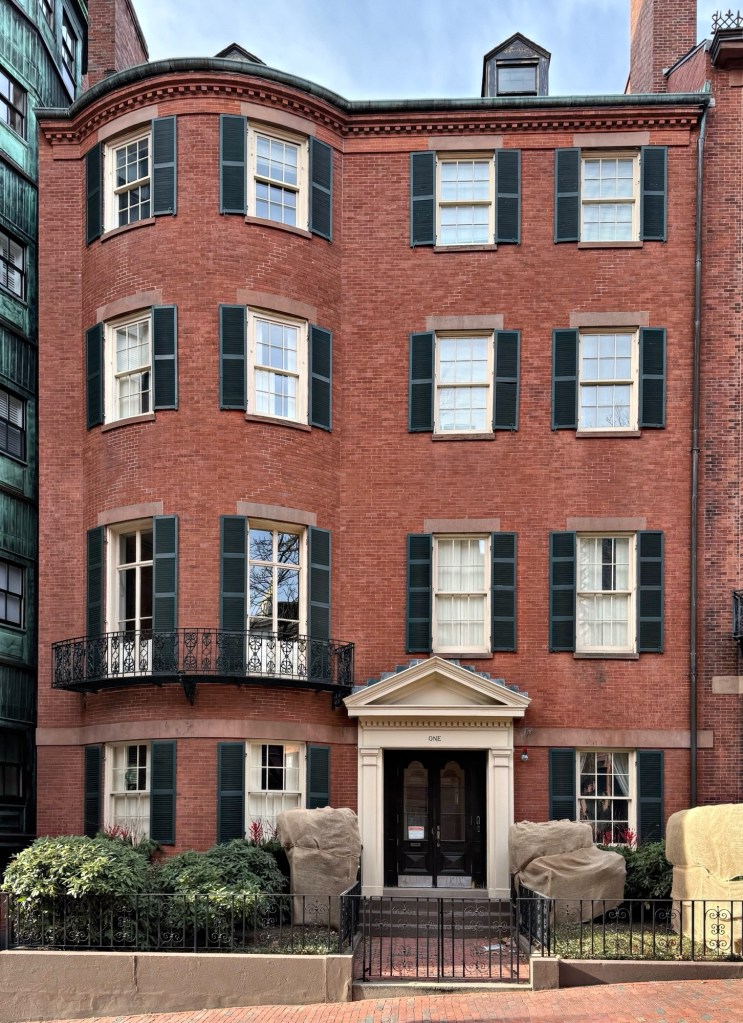
Constructed of red brick and trimmed with brownstone, the beautiful townhouse at 1 Joy Street, is one of a few properties in Boston’s Beacon Hill neighborhood to have a front yard. Built in 1832, the four-story residence has its primary facade characterized by a flat entrance with a rounded bay extending upwards to the roof. Designed by architect, Cornelius Coolidge, who designed many other homes in this section of Beacon Hill, the completed house was purchased by Thomas Handasyd Perkins, Jr. (1796-1850), the eldest son of the enormously wealthy and influential Thomas Handasyd Perkins, Sr., who is considered by many to have been the most successful merchant prince of Boston’s Federal period. In 1892, the Episcopal Association purchased 1 Joy Street for use as headquarters of the diocese, and it became known as the Diocesan House. Today, the building is divided up into condominium units, providing residences just steps from the Boston Common.

Unitarian Universalist Association Headquarters // 1926

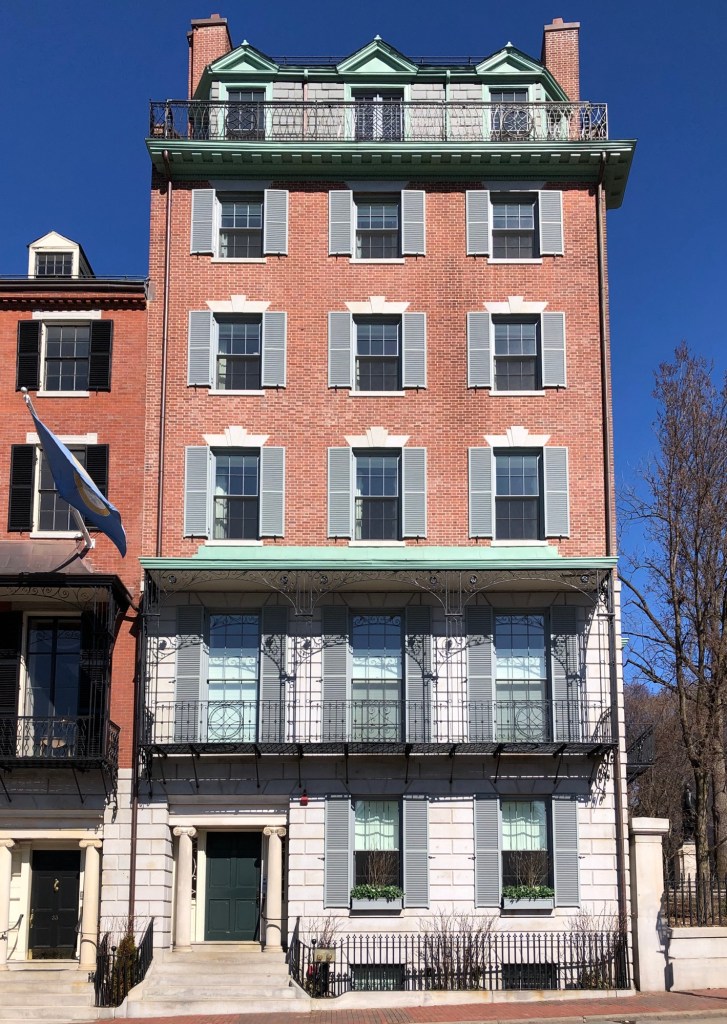
The American Unitarian Association (AUA) opened its first headquarters in Boston in 1865, forty years after the organization was founded. Since its founding in 1825, the AUA occupied several locations but eventually took residence in a Richardsonian Romanesque style building constructed in 1886 at the corner of Beacon and Bowdoin streets. The handsome structure, designed by Robert Swain Peabody of the firm, Peabody and Stearns, served as the headquarters for the association until it was demolished in the 1920s for the expansion of the Hotel Bellevue. In 1926, the AUA purchased an 1840s townhouse and demolished it, replacing the former residence with their new building to serve as a church headquarters office building. The American Unitarian Association hired the Boston architectural firm of Putnam and Cox to design their building, which employed architectural similarities to the adjacent 1820s townhouses designed by Cornelius Coolidge. The six-story building is constructed of red brick with a two-story granite base with piano nobile with a balcony, all under a mansard roof with dormers. The American Unitarian Association sold their Beacon Street building and relocated to a new headquarters on Farnsworth Street in the Seaport/Fort Point area of Boston in 2014. The 1926 building was converted to high-end luxury condominiums.