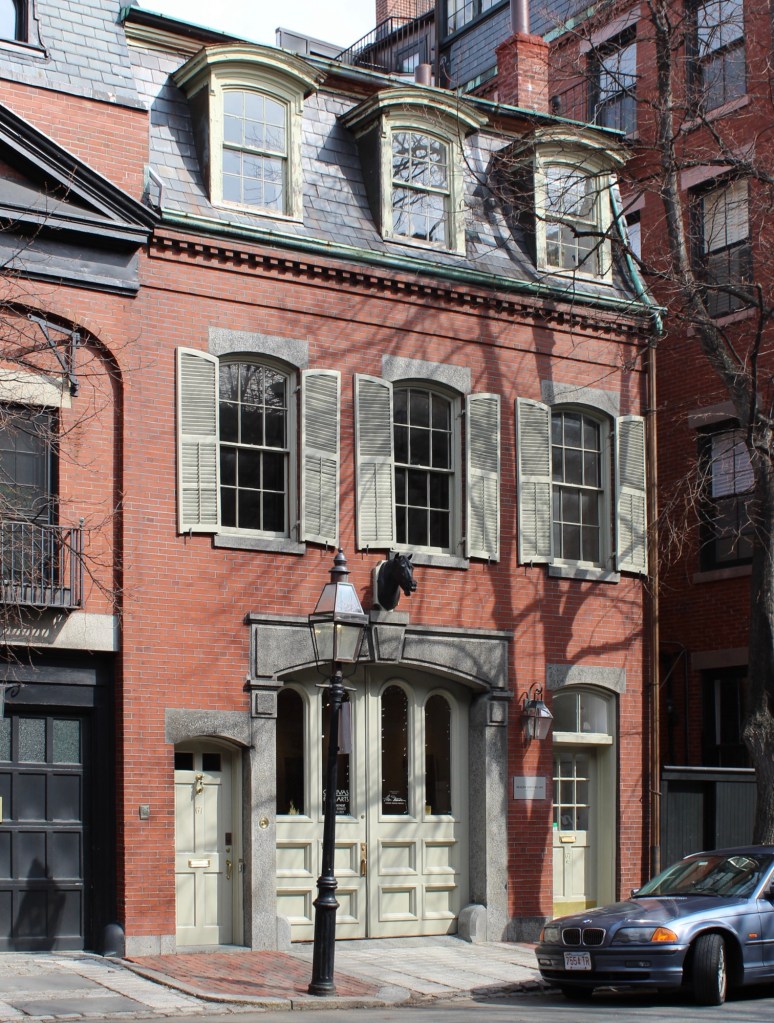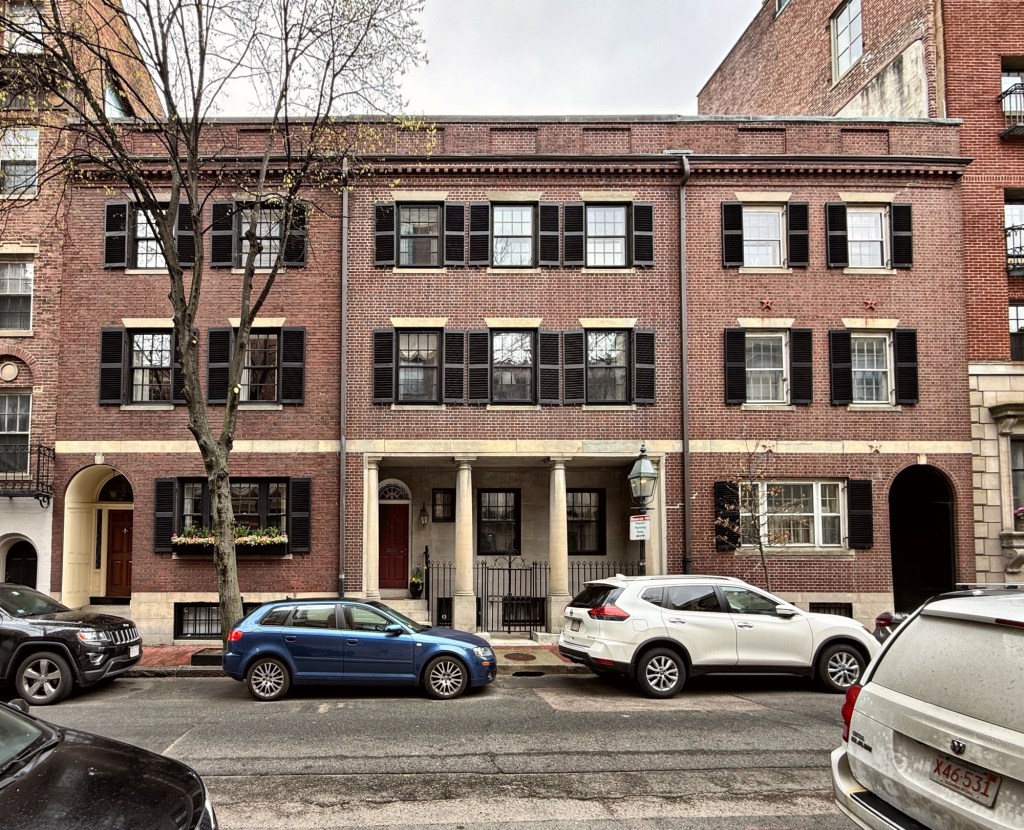
Similar to the Brimmer Street Terrace development nearby, this set of three rowhouses on Chestnut Street on the Flat of Beacon Hill, is an excellently designed development of residences as a collection rather than individually designed townhomes. The Chestnut Street Rowhouses replaced a stable formerly on the site, and were designed by the architectural firm of Richardson, Barott & Richardson, made up of Philip Richardson, Chauncey Edgar Barott, and Frederic Leopold William Richardson. Philip and Frederic Richardson were sons of architect Henry Hobson Richardson, but they did not reach the same level of notoriety as their late father, and charted their own course. The rowhouses read as a single composition with a unique center section flanked by two matching wings. The center house has a three bay front façade with the first-story clad in limestone which is all recessed and supported by Doric columns.
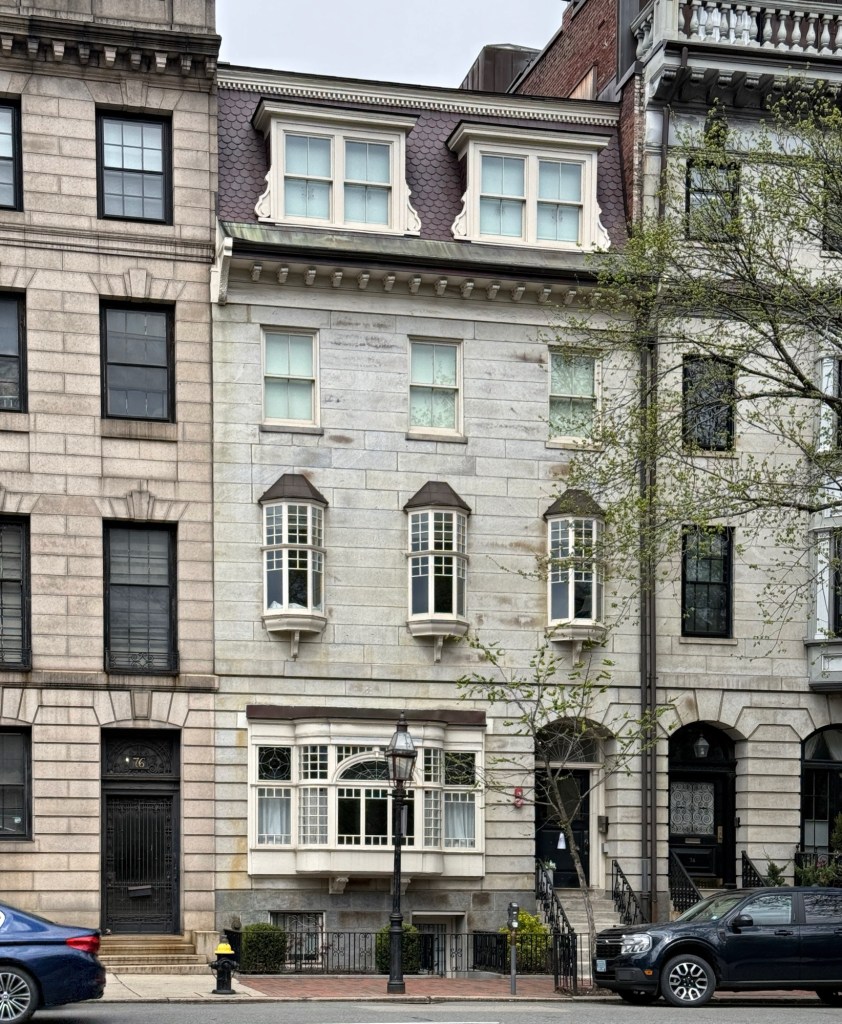
One of six attached houses townhouses between 70-75 Beacon Street, this stately granite-faced residence was built concurrently with its neighbors in 1828 on speculation for the Mount Vernon Proprietors, a group of wealthy Boston businessmen who helped develop Beacon Hill into the posh, architecturally significant neighborhood it is today. The Mount Vernon Proprietors knew how important Beacon Street was as the entry into the neighborhood, and thus, hired Boston’s premier architect, Asher Benjamin, to design the row. When completed, all of the houses were identical, but throughout the 19th and 20th centuries, they all deviated from the original design, some gaining additional floors, others adding bay windows, but all together form a cohesive and architecturally significant span of houses. Completed in 1829, the residence at 75 Beacon Street is known as the Mason-Fitz House and was originally owned by Jonathan Mason (1756-1831), a U.S. Congressman and U.S. Senator, and later inherited by his son, William Powell Mason (1791-1867), who engaged in real estate. It was likely William Mason who added the mansard roof in the late 1850s or 1860s, but the main unique detailing of the residence occurred in 1889 when newlyweds, Henrietta G. and Walter Scott Fitz hired the popular architectural firm of Little & Browneto reconfigure the front of the house in the Colonial Revival style. Little & Browne added the rather fanciful, oriel windows on the facade, which include the three, small hipped-roof oriels on the second story and larger projecting oriel on the first floor with fanlight and leaded glass. Cambridge architect, Edward T. P. Graham later purchased the residence and petitioned to convert the single-family house into eight apartments, but was denied, later converting the residence into four units. Today, the Mason-Fitz House is broken up into two larger condominium units.
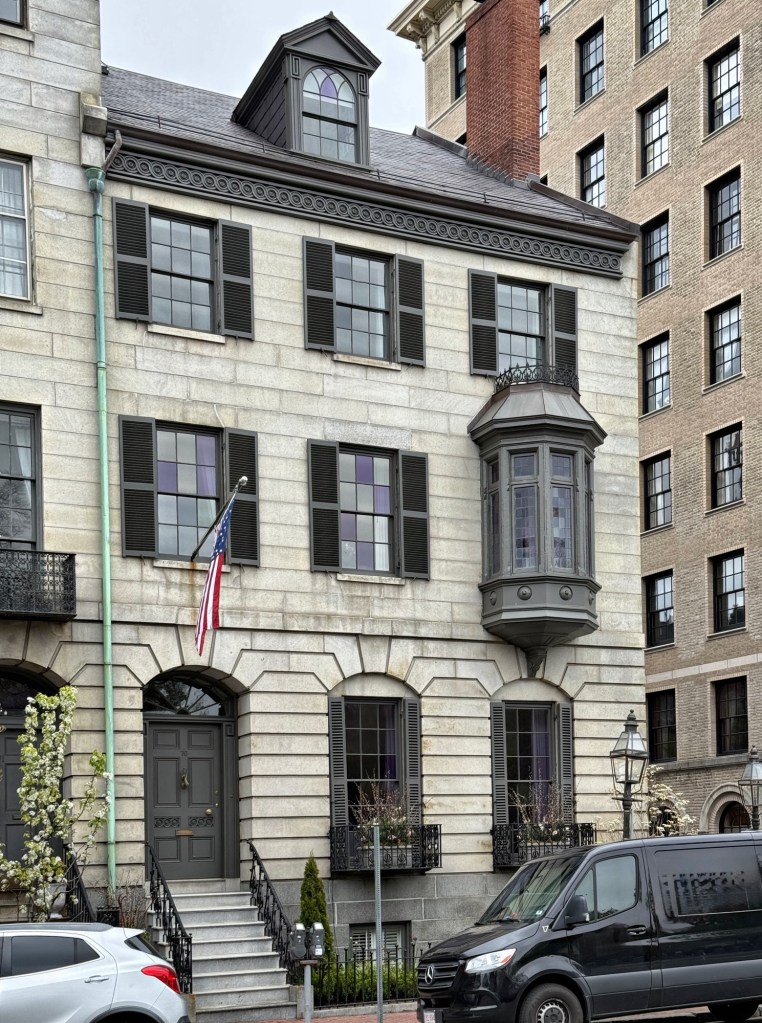
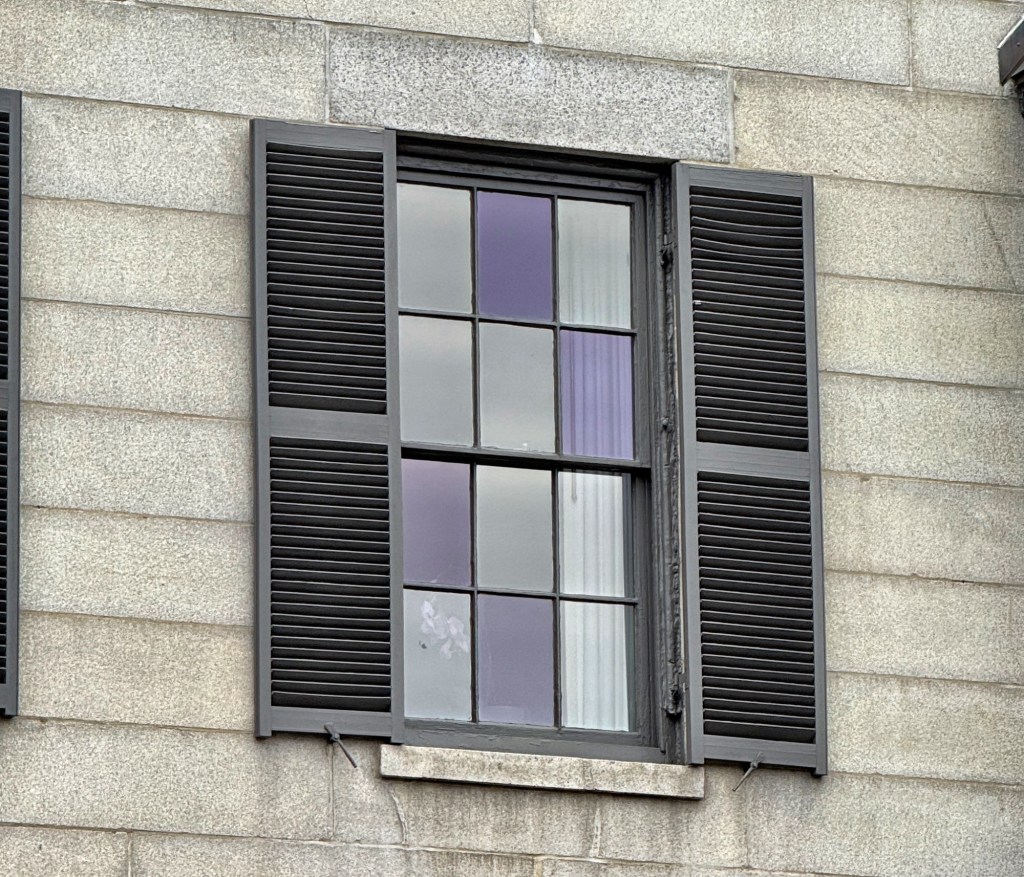
One of six attached houses townhouses between 70-75 Beacon Street, this stately granite-faced residence was built concurrently with its neighbors in 1828 on speculation for the Mount Vernon Proprietors, a group of wealthy Boston businessmen who helped develop Beacon Hill into the posh, architecturally significant neighborhood it is today. The Mount Vernon Proprietors knew how important Beacon Street was as the entry into the neighborhood, and thus, hired Boston’s premier architect, Asher Benjamin, to design the row. When completed, all of the houses were identical, but throughout the 19th and 20th centuries, they all deviated from the original design, some gaining additional floors, others adding bay windows, but all together form a cohesive and architecturally significant span of houses. Completed in 1829, the corner dwelling is known as the Greenough-Dwight House and it retains its original three-story rusticated granite façade with segmental arch openings. The major change to the exterior of the Greenough-Dwight House is the addition of the ornate wood oriel window with iron cresting in 1874, the oriel and facade feature the iconic purple windows, which became a status symbol in the 20th century. The story goes, that between 1818 and 1824, an English company sent shipments of glass that contained too much manganese oxide into Boston Harbor. After being exposed to sunlight for an extended period of time, the manganese oxide in the glass began to turn purple creating the colored panes we love today. Over time, many panes broke or were replaced, creating the checkerboard appearance on so many windows, but many owners in the 20th century had imitation purple glass installed as a marker of wealth and prestige, like in this house and bay, which were built after the period that the glass was brought over from England. My favorite in the row, the Greenough-Dwight House shines with its granite facade and brick end wall, with panes reflecting the sun off her violet glass windowpanes.
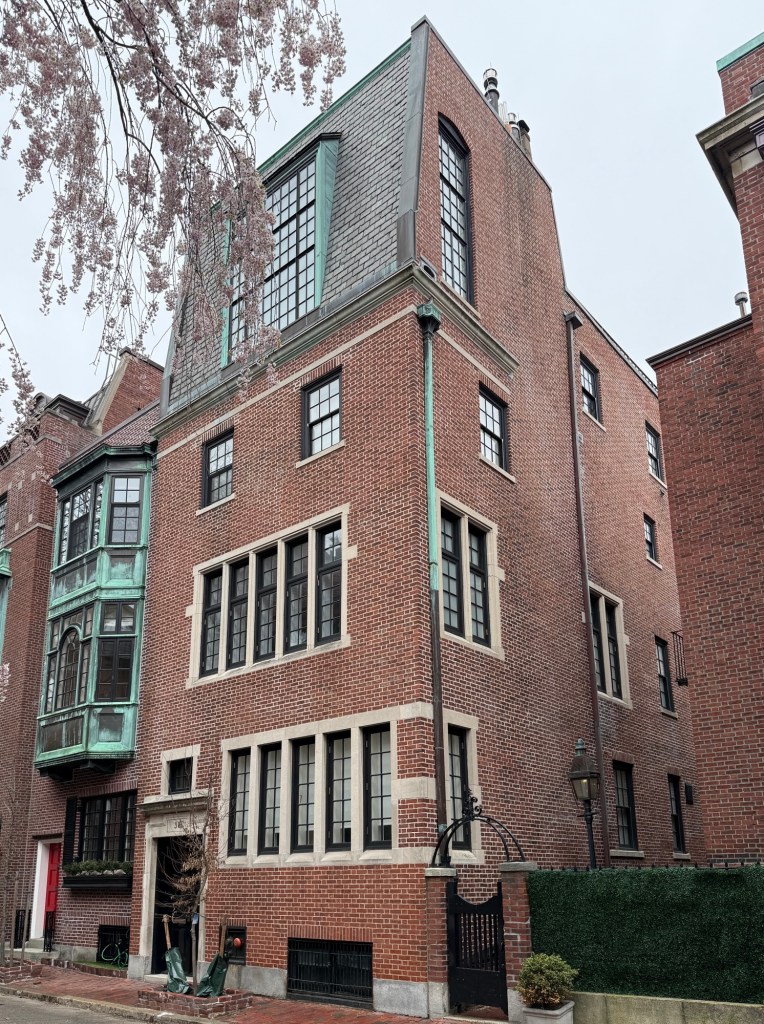
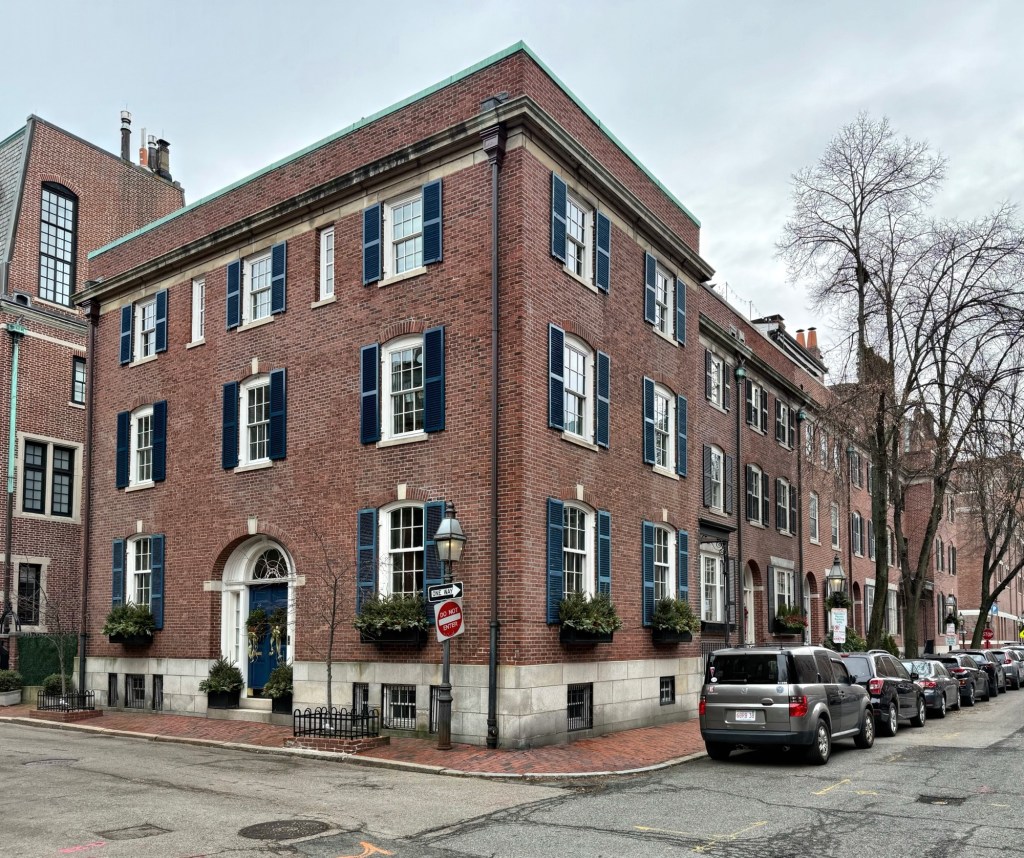
An interesting ensemble of seven rowhouses running along Brimmer Street in Beacon Hill, the Brimmer Street Terrace development showcases the rebirth the “Flat” of Beacon Hill encountered in the early 20th century from livery stables and carpentry shops to high-end housing and artist’s studios. Built on the site of a large livery stable, Brimmer Street Terrace was developed in 1912 by Gerald G. E. Street and William C. Codman, developers who sought to enhance this section of Beacon Hill and protect it from unsympathetic development, and hired architect Richard Arnold Fisher to design the houses. The rowhouses were originally rented to upper-class families but later were sold off as individual properties. Colonial Revival in style, the row is built of the iconic Boston red brick, Federal Revival style fanlight transoms over the entrances, include shutters, and all sit atop a stone basement. The row is anchored on each end by residences facing north and south with large symmetrical facades with the five more narrow rowhouses connecting them along Brimmer Street.
These two near-identical townhouses at 1 & 2 Otis Place in Beacon Hill are significant architecturally and as they are bounded by four streets. The unique lots were created when Otis Place was laid out on made land in 1869 and were built the following year as an identical pair sharing a party wall and with their front facades facing south on Otis Place. The two residences were designed by the firm of Ware and Van Brunt, who blendedSecond Empire and Victorian Gothic styles with gothic arched windows, bracketed cornices, slate mansard roof, and later Colonial Revival porticos added in 1916 by architect, Frank A. Bourne. No. 1 Otis Place (right side with the oriel bay window) was first owned by Henry G. Pickering, a dealer in engines and machinery at the height of New England’s industrial revolution. No. 2 Otis Place (left with later fanlight entry), was originally owned by Robert E. Apthorp, an attorney and realtor, who decades earlier, was an active member of the Boston Vigilance Committee, the group established to harbor and assist fugitives from slavery after the passage of the Fugitive Slave Act in September 1850.
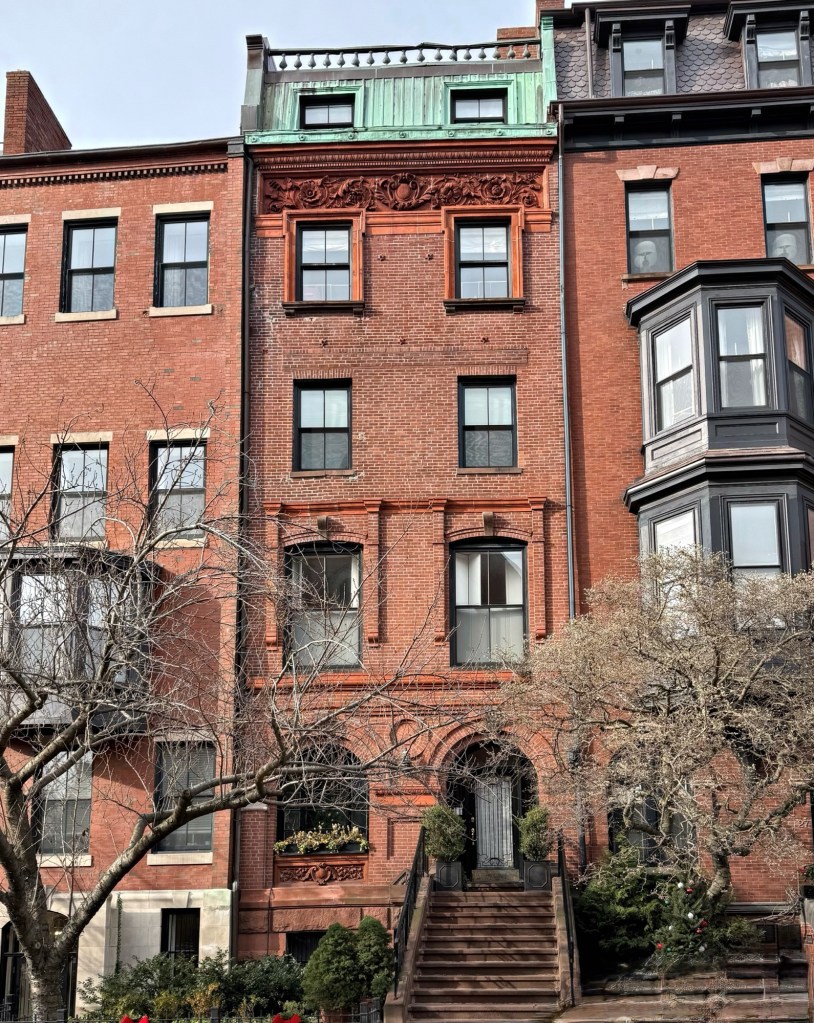
This unique house at 29 Brimmer Street in Boston’s Beacon Hill, was completed in 1881 is architecturally distinctive compared to the early 19th century homes that the neighborhood is known for. The five-story residence has a raised entrance up a flight of steps set within an arched opening. To the side, an arched window frames the facade and has an ornate terracotta panel as a base. More terracotta ornament can be found at the second floor and under the cornice as a thick band frieze with a copper-clad mansard roof above. The single-family residence was built in 1881 for Charles Faulkner (1811-1885), a commission merchant, for his daughter, Ann Ruth Faulkner the year of her marriage to Charles Rowley Hayden. Mr. Hayden was a musician and vocalist. For the new wedding gift, Faulkner hired the esteemed architectural firm of Bradlee & Winslow prepare the designs. The former Faulkner-Hayden House today contains five condominiums.
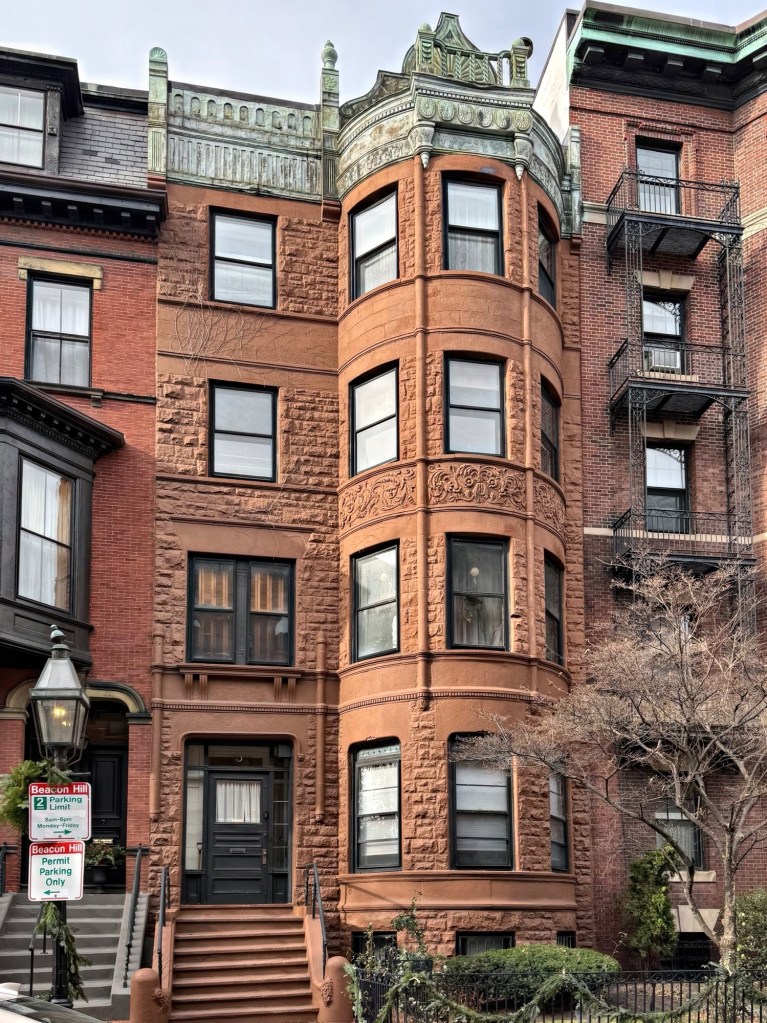
Located on Brimmer Street in Beacon Hill, this handsome residence is constructed of rough-faced brownstone laid in a random ashlar pattern and is among the most unique in a neighborhood known for brick townhouses. Decorative treatment includes a stone band that is carved with foliate and faces, colonettes that rise along the facade at the bay, and an ornate molded copper entablature and parapet at the roof. The residence dates to 1888 and was built for Seth R. Baker, a Boston real estate developer at the end of the 19th century. It can be inferred that the building was designed by architect, Ernest N. Boyden, as Baker hired Boyden as architect for a half-dozen other apartment buildings between 1888-1890. Antoino Xavier, a Portuguese-born mason is listed as the builder. In the 1910s, the property was purchased by Marie Ames Byrd, wife of polar explorer Richard A. Byrd, who lived a few houses away at 9 Brimmer Street. She rented the four apartments to boarders through the 1930s.
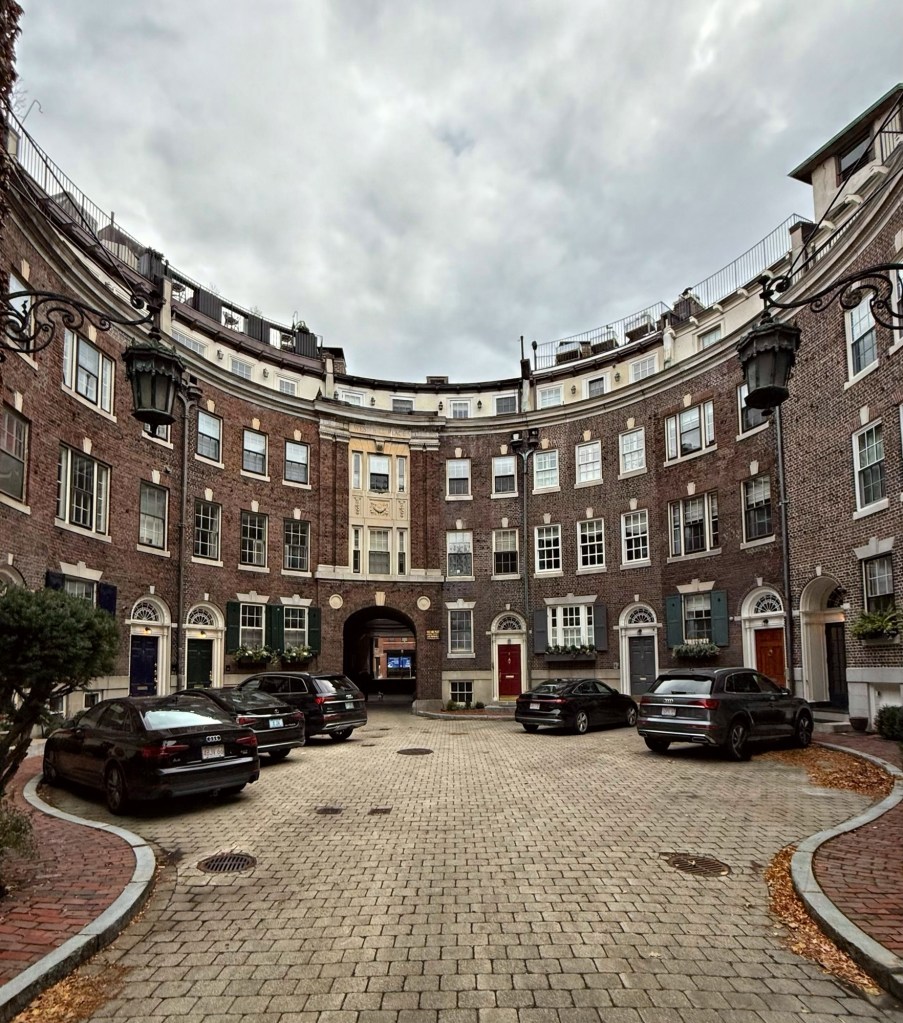
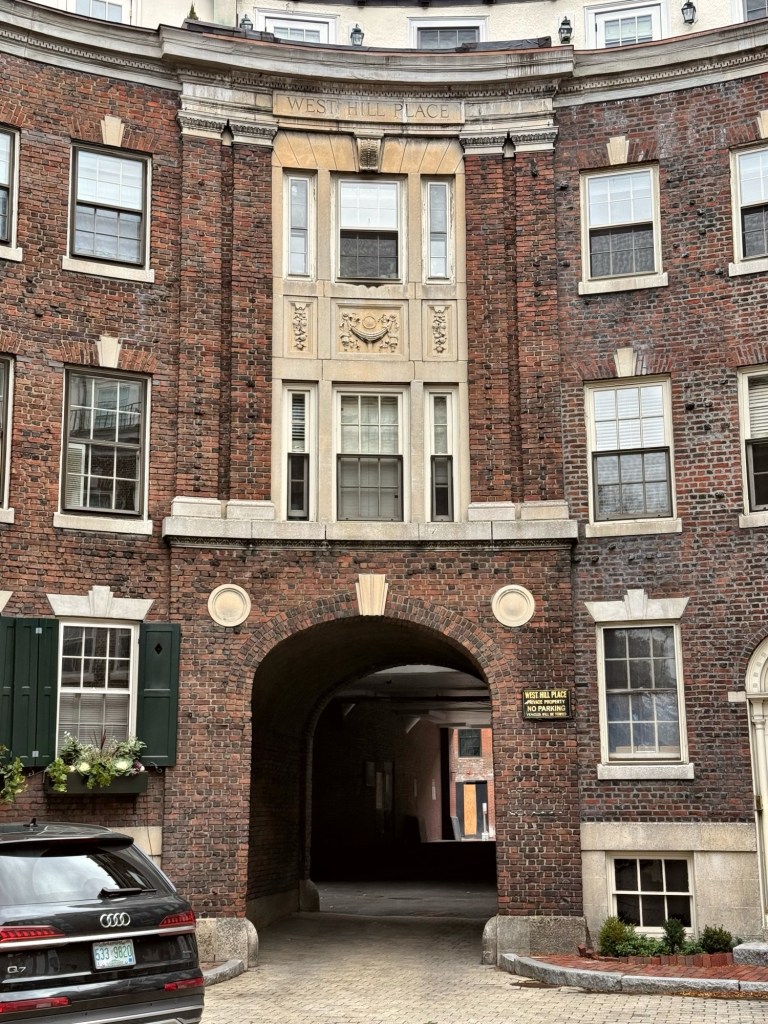
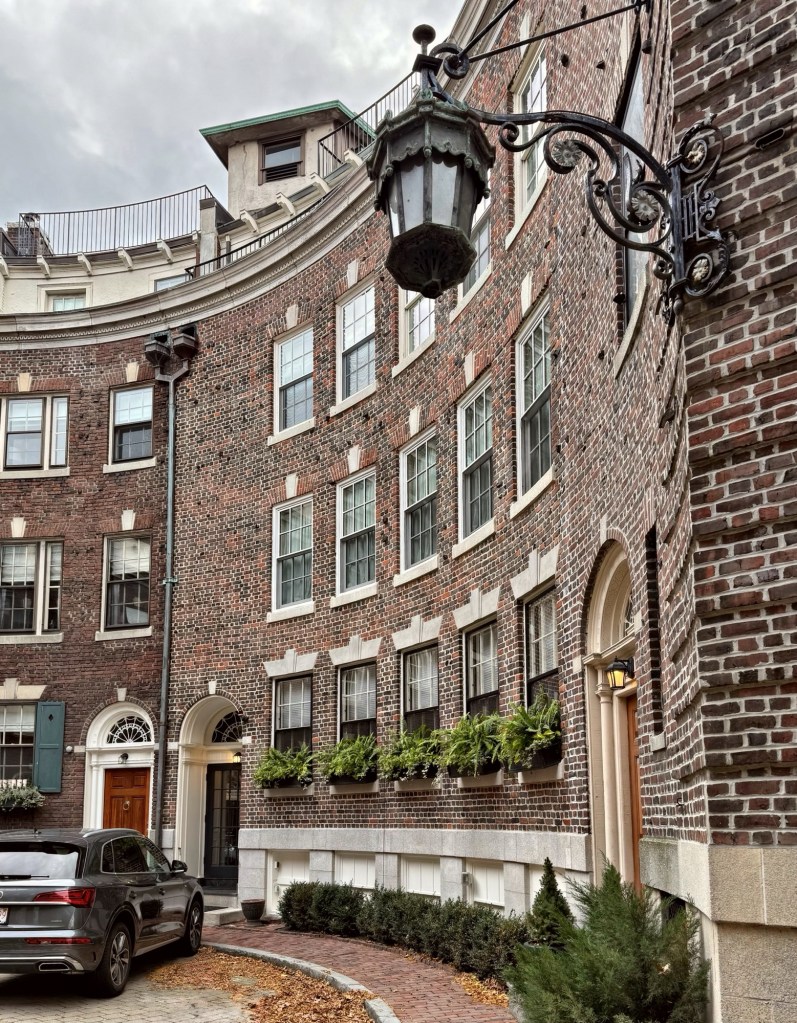
West Hill Place is a small development in Beacon Hill that feels like it was transported to Boston from London! The group of 14 four-story brick townhouses that comprise West Hill Place were built on the site of a gas holder in 1916. The Georgian Revival style development was designed by the firm of Coolidge and Carlson, who aligned six of the townhomes to face west on the Charles River Embankment and arranged the remaining eight residences around a circular court. The development was inspired by Charles River Square, located to its south and built six years prior. The driveway extends off what is today Storrow Drive, with a second exit set within an arched passageway that connects through the Charles Street garage, which was built later. The dark brick with cast stone trim works elegantly with the curving facades facing the courtyard, many of which are adorned with arched doorways and the original iron lanterns. The development has been harmed by the creation of Storrow Drive in the 1950s, but it remains one of the most unique and picturesque enclaves in New England.
Charles River Square, a delightful development of red brick and cast-stone Colonial Revival townhomes in the Beacon Hill Flat, was developed in 1910 from plans by Boston architect, Frank A. Bourne. The development consists of a total of 21 residences, 19 of which front on the courtyard that is known as Charles River Square. The development is accessed off Charles River Road (which was made a busy thoroughfare in the 1950s and renamed Storrow Drive) and through a Palladianesque passageway off Revere Street. Along with its neighbor to the north, West Hill Place (1916), another group of attached townhouses organized around a courtyard built years later, its layout is a departure from the previous approach to urban planning, resembling the atmosphere of an old London street or mews. Charles River Square remains one of the most desirable developments in the exclusive Beacon Hill neighborhood.
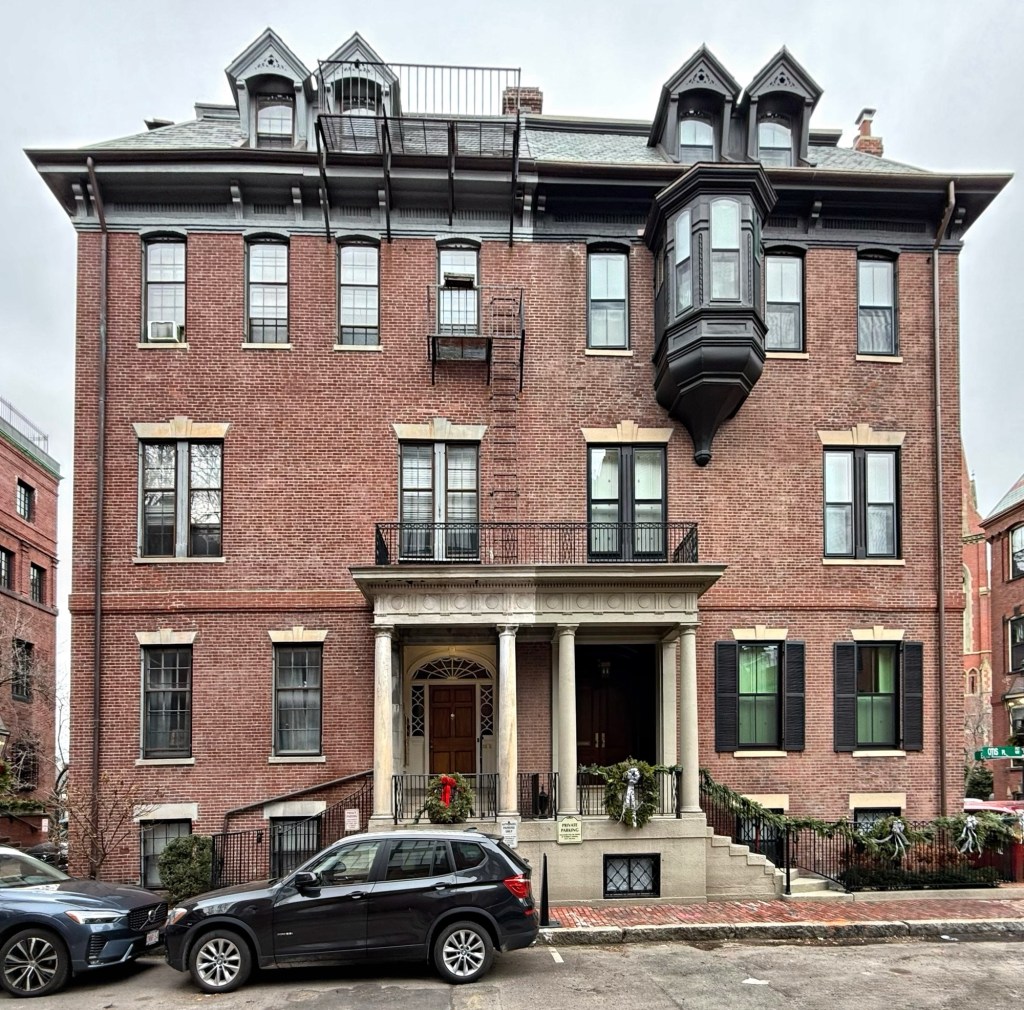
Located at the corner of Brimmer and Mount Vernon streets in Beacon Hill, this stately mansion showcases the various architectural styles and methods utilized by architects in the waning decades Victorian-era Boston. Set atop a brownstone base, the floors above are in the “Panel Brick” style, which utilizes brick masonry in a variety of decorative patterns of slight projecting or receding panels. The style was popularized by the Boston architectural firm of Ware & Van Brunt, as noted by architectural historian, Bainbridge Bunting. As expected, this house (and the attached townhouse next door) was designed by William Robert Ware for his uncle, Dr. Charles Eliot Ware (1814-1887) and his wife, Elizabeth Cabot Lee Ware. Dr. Ware was a physician at Massachusetts General Hospital and secretary of the Massachusetts Medical Society. After the death of Dr. Ware and Elizabeth, the property was inherited by their daughter, Mary L. Ware (1858-1937), a naturalist and botanist who was the principal sponsor of the Harvard Museum of Natural History‘s famous Glass Flowers. After the death of Mary, the property sold out of the family to Robert Wales Emmons III, a financier from a yachting family. The mansion remains in a great state of preservation, and is among the great Victorian-era residences in Beacon Hill.