Bayard Thayer House – Hampshire House // 1911

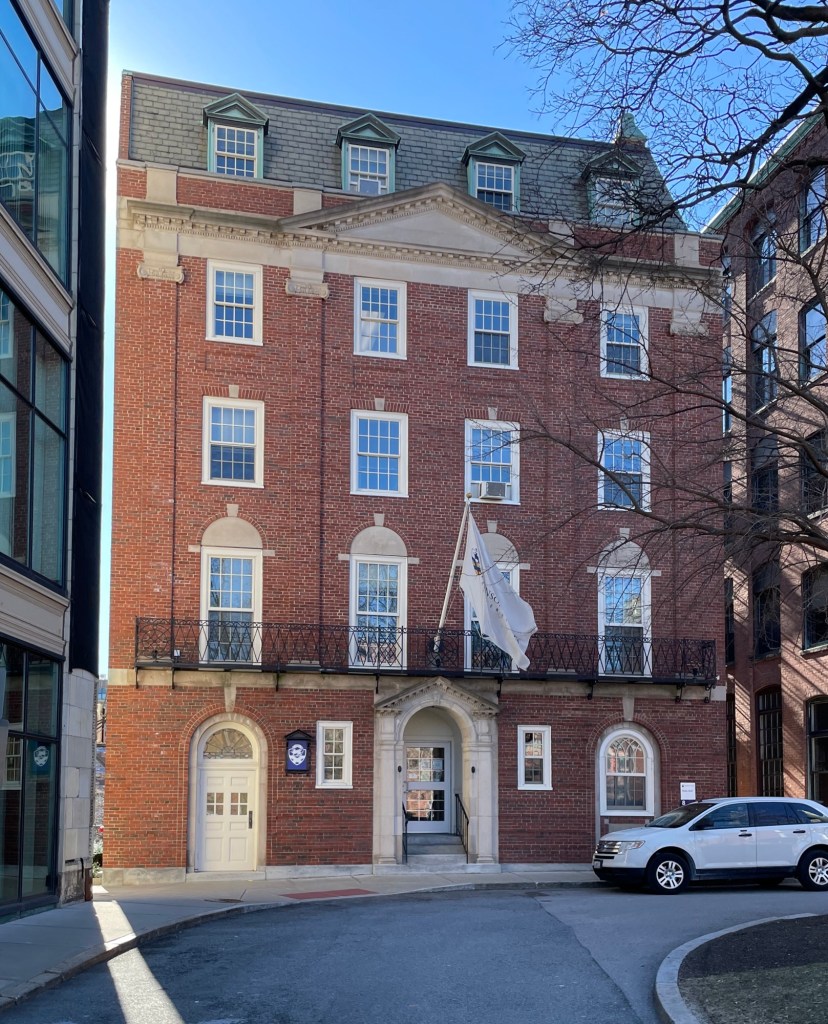
This iconic building at 84 Beacon Street in Boston’s Beacon Hill neighborhood, is best-known for its bar, which in 1982, became world-famous as the locale for the bar in the television sitcom Cheers, one of the most-watched programs in television history; but its history begins earlier. This five-story building was constructed in 1911 as a mansion for Bayard Thayer (1862-1916), who split his time between Boston and his country estate in his home-town of Lancaster, Massachusetts. Thayer hired architect, Ogden Codman Jr., a favorite designer of Boston and New York high-society, to design his Boston mansion, which is an expressive and overscaled example of a Colonial Revival style townhouse. Bayard Thayer died in 1916 and his widow, Ruth Simpkins Thayer, lived here with her granddaughter, Ruth, and nine domestic servants. After Ruth Thayer’s death in 1941, the property was conveyed to the Colonial Properties Trust in 1944, operating the building as a small luxury apartment hotel. From this point on, the hotel became known as Hampshire House. In about 1969, the basement space in the Hampshire House opened as the Bull & Finch Pub, which later became the inspiration of the iconic sitcom Cheers. Pictures of the exterior of the building were used in the show’s credits and scene changes, and the interior was faithfully replicated from the set in Hollywood, where the show was actually filmed. The Bull & Finch Pub has permanently been renamed Cheers Pub and visited by many who wish to visit the place where “everybody knows your name”.

Fleur-De-Lys Studios // 1885

The Fleur-de-Lys Studios is of the most architecturally significant and unique buildings in New England and can be found on Thomas Street in the College Hill section of Providence. Built in 1885 and a vivid expression of the Queen Anne style and showing the emergence of the Arts and Crafts movement movement in America, the handsome building blending is the result of a partnership between artist, Sydney Richmond Burleigh and architect, Edmund R. Willson as a dedicated creative hub for working artists, a purpose it still serves today under the stewardship of the Providence Art Club, who received the deed of the property in 1939 by Burleigh’s widow. Its design draws heavily on medieval English and Tudor Revival influences, with a striking half-timbered façade, stucco panels, carved heads as hanging pendants, and projecting casement windows that break dramatically from the surrounding colonial streetscape. What truly sets the structure apart, however, is its richly symbolic ornamentation—allegorical figures representing painting, sculpture, and architecture adorn the exterior. More than a century later, the Fleur-de-Lys Studios remains both a National Historic Landmark and a living workspace, preserving its original spirit as a place where art and architecture are inseparably intertwined.

Old Sharon Sanatorium – Former Kendall Whaling Museum // 1891

The old Sharon Sanatorium was built on former farmland in Sharon, Massachusetts, as a medical facility for the cure of pulmonary infectious diseases. The rural medical institution was designed in 1890 by the architectural firm of Longfellow, Alden and Harlow and completed a year later. The Sharon Sanatorium for Pulmonary Diseases opened formally in February 1891 with the purpose to provide affordable care for patients suffering from Tuberculosis and other pulmonary diseases. At the time, tuberculosis was a major health concern and treatment often included fresh air, so facilities such as this were designed with access to open air sleeping porches and forested surroundings. The Sharon Sanatorium was sited to catch the prevailing breezes on the side of Moose Hill, the second highest ascent between Boston and Providence. In 1916, the Sanatorium opened a Children’s Pavilion, which was reserved for children less than fourteen years of age suffering from tuberculosis. By 1938, the threat of tuberculosis was under control, and the Sanatorium began admitting patients suffering from arthritis and rheumatic fever until the facility closed in 1947. The Sanatorium integrated with the Boston Children’s Hospital in 1949 and soon after, the property was bought by Henry Plimpton Kendall (1878-1959), a wealthy entrepreneur and industrialist, for use as the Kendall Whaling Museum, showcasing his personal collection of paintings, prints, and tools of the whaling industry in New England. In 2001, the museum merged with the New Bedford Whaling Museum and today, the property is managed by the Trustees of Reservations as their Archives and Research Center.

Unitarian Church of Sharon // 1842

Sharon, Massachusetts, is a small suburban community south of Boston that is lesser known than its neighbors, but the community has some great old buildings! The Town of Sharon was originally part of a 1637 land grant given by the Dorchester Proprietors to encourage new settlement in areas southward. In 1726, the lands of the present towns of Sharon, Canton and Stoughton, were separated from Dorchester and called the Stoughton Territory. Settlers in present-day Sharon found it difficult to attend mandated church services centered around present-day Stoughton and petitioned the General Court in 1739 to set off as a separate precinct. The request was granted and the Second Precinct was established, and incorporated as Stoughtonham in 1765, changing its name in 1783 to Sharon, named after the Sharon Plain in Palestine. In 1813, the local congregationalists split due to theological differences and formed a Unitarian church. The Congregationalists moved and built a new church and the Unitarians remained on this site, but the larger building was too large for their needs. They demolished the original building and constructed this church in 1842, which somewhat resembles the 1839 Congregational Church of Sharon a stone’s throw away. Like its neighbor, the Unitarian Church too retains an original bell cast by the The Revere Copper Company of nearby Canton.

First Church of Christ Scientist, Sharon // 1928

Located on North Main Street in Sharon, Massachusetts, the community’s Christian Science Church was built in 1928 and is a great example of a diminutive chapel designed in the Colonial Revival style. Before it was completed, the Sharon Christian Science Society had been meeting and holding Sunday services in rooms at the Town Hall and other churches until funding was secured for their own house of worship. Customary of all Christian Science churches, the Christian Scientist in Sharon needed to have the building completely free of debt before being dedicated. The church was designed by architect Prescott A. Hopkins, who was likely the first person to receive a master’s degree in architecture at MIT before moving to Atlanta to became the first head of the Architecture Department at Georgia Tech. The building features a large Palladianesque window at the facade and twin curved entry porches at the facade.

Wrentham Congregational Church // 1834

The Wrentham Congregational Church is the oldest house of worship in the suburban community, and the fourth consecutive meetinghouse for the congregation at the town center that was originally established in 1692. The frontier town grew slowly as a largely agricultural community and three houses of worship were built nearby the town common until 1833, when it was decided that a church worthy of its historic congregation be built. It is not clear who designed the Greek Revival church, but timbers were transported to town in 1834 for the new edifice which was completed that year. Over the following century, the church was expanded and modernized, all-the-while retaining its historic character. The four-stage steeple toppled during the New England Hurricane of 1938, and was rebuilt. The congregation remains active in the community and is a visual landmark at the town center.

Draper Corporation Company Offices // 1910

After decades of growth of the Draper Corporation in Hopedale, Massachusetts, in the late 19th century, the company began a massive building campaign of larger, architecturally significant (and most importantly, fireproof) buildings for company use. The original company office building, constructed in 1880, was outgrown and it was decided a new, larger company office was needed. Designed by Milford-based architect, Robert Allen Cook in 1910, the former office building was located across Hopedale Street from the main plant. This massive two-story brick building on a raised basement is an example of the Renaissance Revival style built of brick and terra cotta. The building closed along with the company in the mid-20th century, but as opposed to the main complex, was adaptively reused through a renovation as a senior living facility.

Smith-Waterman House // c.1820

One of the many great examples of Federal period houses being “Victorianized” later in the 19th century, the Smith-Waterman House on Broad Street in Warren, Rhode Island, stands out as one of the most elaborate. The residence was originally built by 1820 and possibly owned by Nathaniel P. Smith (1799-1872). After his death, the house was inherited by his son, N. P. Smith Jr., who would later sell the property to John Waterman, the Manager and Treasurer of the Warren Manufacturing Company. It was under Mr. Waterman’s ownership that the once standard Federal style house was enlarged and given Italianate features, including the wrap-around porch, overhanging eaves with brackets, addition and the three-story tower at the rear.

The Old Carriage Shop // c.1790

The old Carriage Shop on Water Street in Warren, Rhode Island, is an early and surviving industrial building from the late 18th century that adds to the charm and history of the great waterfront town. The two-story building has a three-bay facade with a center entrance and 48-pane fixed sash windows on the first floor and 12-over-12 sash windows on the second floor. The stepped parapet masks the low gable roof of the building behind that extends far back in the lot. The building was a workshop and paint shop for Gardner & Hoar, builders and carpenters, in the mid-19th century, and later as a blacksmithing shop and carriage shop before the turn of the 20th century. Luckily for us, the building has been preserved and while not finding a place in architectural journals, the building is an important remaining building that strongly contributes to the character of the town.

Hall’s Block // 1883

This diminutive commercial building on Water Street in Warren, Rhode Island stands out as one of the state’s best examples of a historic Victorian-era wooden commercial building, and its preservation is notable. The late-Italianate style wooden block dates to 1883, and exhibits its original wooden storefronts, second floor round arched windows with stained glass, and ornate detailing including the brackets, parapet and period-appropriate paint colors which allow those details to pop. The shop was owned in its early days by the John C. Hall, a carpenter who built the house next door. The building was used as an antique shop on the ground floor with a studio for author and illustrator, David Macaulay on the second floor. These types of smaller-scale commercial spaces are some last remaining (relatively) affordable spaces for small businesses to operate, and they add so much intrigue to the streetscape, especially compared to suburban cookie-cutter banks and stores.