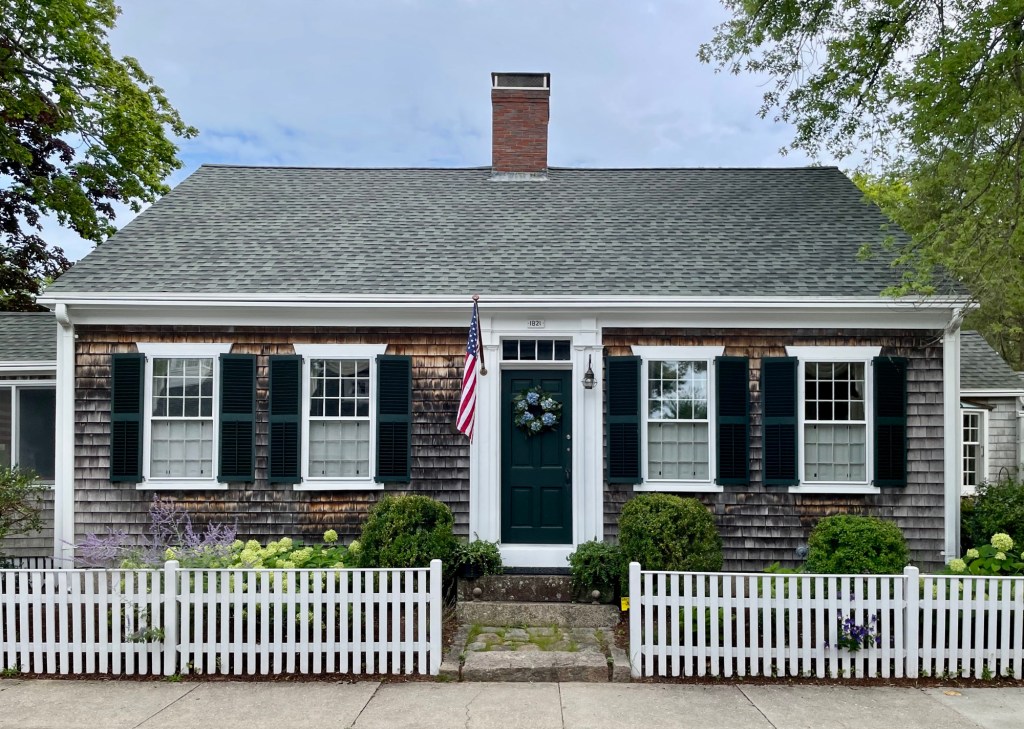
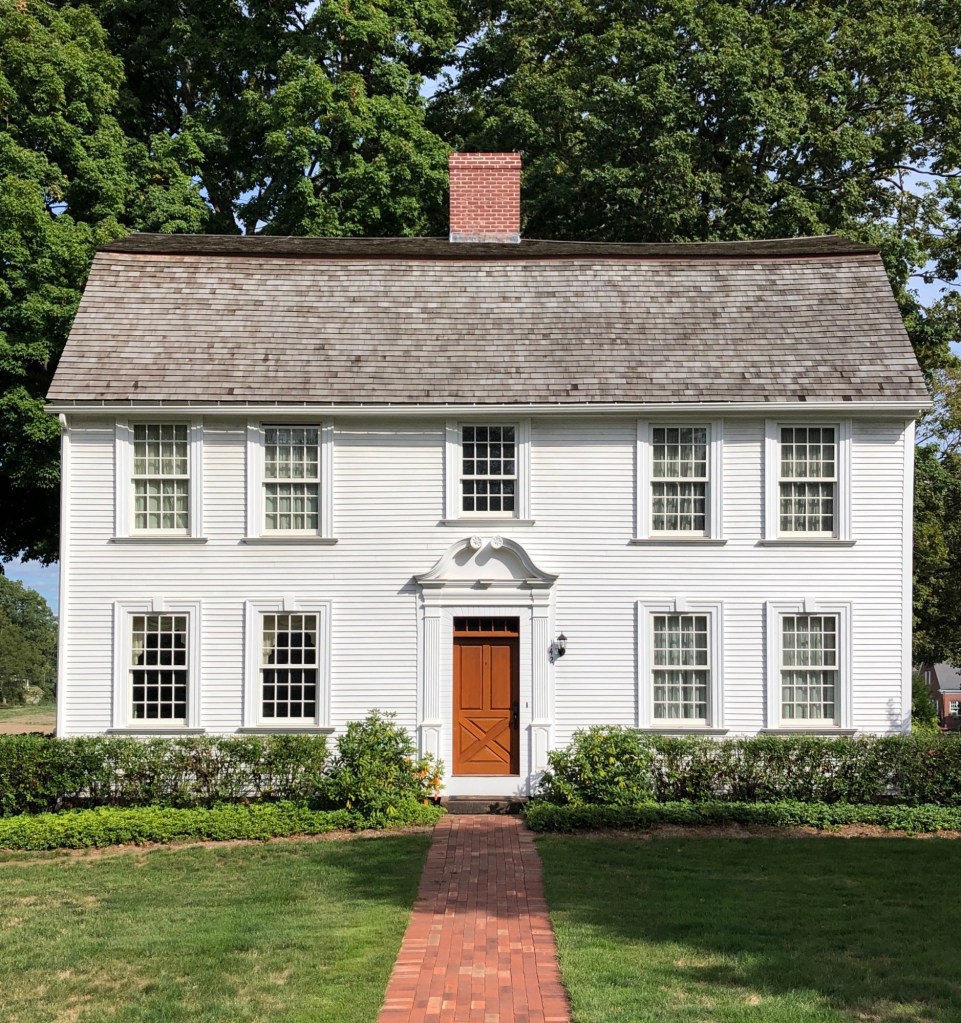
If you look closely, you will see that the two windows to the left of the door to this house are slightly farther than those to the right. This minor detail is a clue that this historic home on Main Street in Marion, Massachusetts, was originally built as a half-cape (with two windows and a door to the side) and later expanded to its present full cape form. The house was built in 1821 by Andrew M. Allen (1795-1874), a housewright for his own residence. Andrew and his wife Cynthia had five daughters, which likely necessitated the expansion of the family home by the mid-19th century.
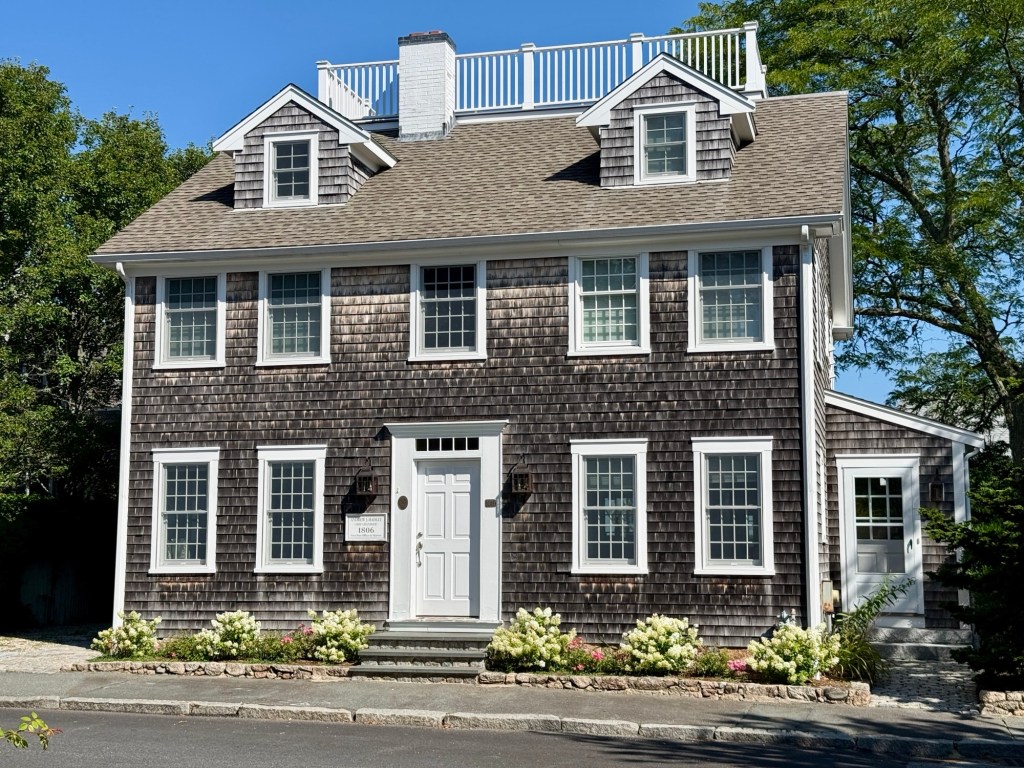
This late-Georgian style residence on Main Street in Marion’s Wharf Village is a stone’s throw from the harbor and has been conveniently located near the town’s Long Wharf since it was constructed around 1806. The building was constructed as a store for A. J. Hadley, where ships were outfitted for voyages. While Hadley’s store occupied the eastern half of the first story, the left side of the ground floor was Marion’s first post office. The second floor served as a clothes-making factory with the top floor operating as a sailmaker’s loft. By 1855, the structure was converted to a residence and owned by Sumner Ryder, who served as the Town Clerk and later joined the ranks of the Union Army during the Civil War. During the early 20th century, the property, with its widow’s walk, was owned by members of the Harwood family, including Ms. Sarah W. Harwood, who lived here with Margaret French (1860-1935) who was listed in the Census for decades as her partner, housemate, and boarder.
This charming building on the picturesque Main Street of Tamworth, New Hampshire, was originally built as a residence around the time of the marriage of owners, Nicholas and Abbie Varney. Nicholas Varney (1833-1900) was listed in the Census as a carpenter and likely constructed his own home here in Tamworth. The once Italianate style residence was modified later in the 19th century with the addition of the two-story tower in the Queen Anne style. After Nicholas’ death in 1900, the home was converted to a store and was known as the Pollard’s Store. Today, the building is occupied by a local bakery.
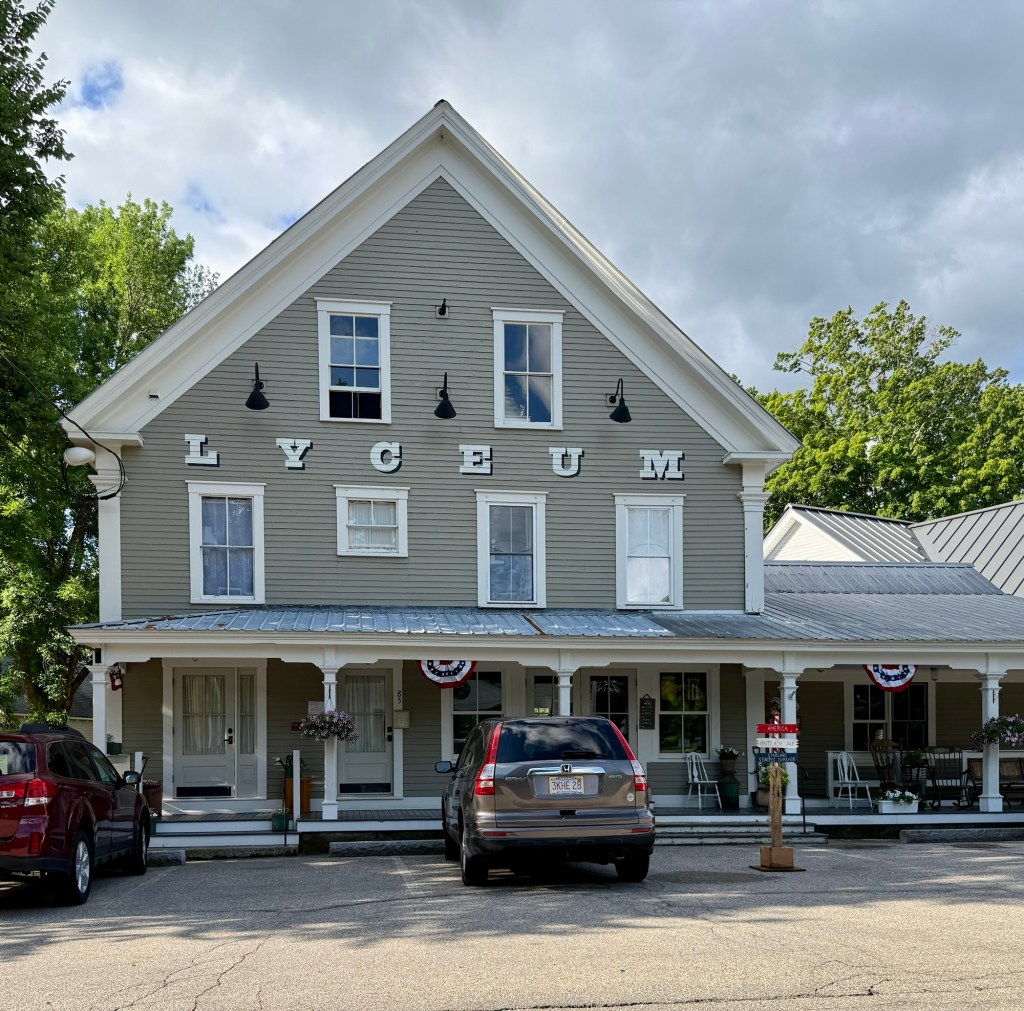
A stellar example of a vernacular commercial building in New England, the Remick Store on Main Street in Tamworth, New Hampshire, has been reinvisioned in the 21st century to suit the changing needs of the community. The block was built around the time of the Civil War by Levi Remick, who either modernized and enlarged his father’s store or built it anew. Levi’s father, Enoch Remick operated a stagecoach stop and inn in Tamworth Village and also worked as the county Sheriff from his large farmhouse. Levi & grandson, Charles ran the store under the name “Levi Remick & Son”, which later trasferred to Charles’ sons, Waddy and Earle. After successive ownership, the store closed its doors for business in early 2009 and was renovated and re-opened in 2011 as the Tamworth Lyceum, which besides containing a store, it includes a gathering space for lectures, wine and beer tastings, music and community events, and an art studio, serving as an informal community space.
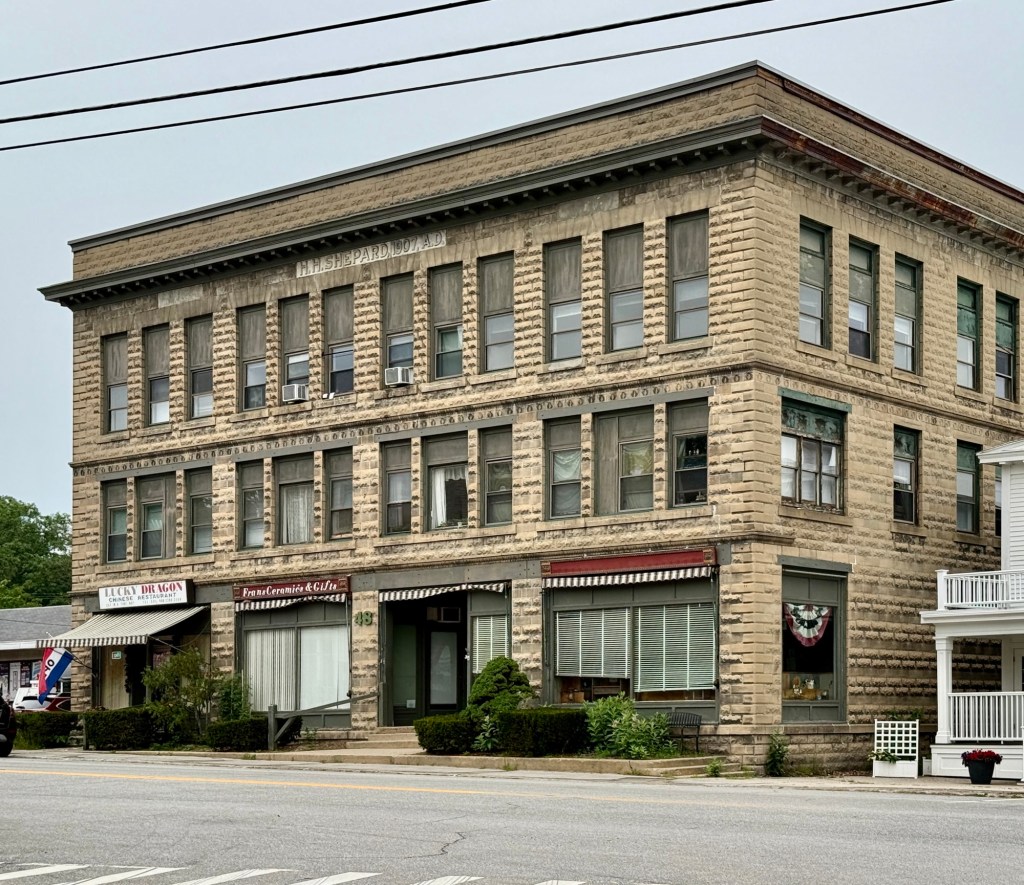
Located on Main Street in Ashland, New Hampshire, the Shepard Block is an architecturally distinctive mixed-use building constructed of a less common building material for commercial buildings, concrete blocks. Now known as concrete masonry units, concrete blocks exploded onto the building scene in the late 19thand early 20th centuries with a flurry of different patents for block designs and production. After Harmon Palmer invented the first commercially successful concrete block machine in 1900, the industry expanded rapidly with multiple manufacturers producing the blocks with their stone-like surface created through either a mold or the use of special aggregates in the concrete mix. Although stonelike concrete blocks were popular for the first quarter of the 20th century, they fell out of fashion following World War II. The Shepard Block in Ashland was built in 1907 by owner, Henry Harrison Shepard who, ironically, made his fortune as a lumber dealer. The upper floor contained a public hall space for the local Mount Prospect Lodge of Masons, and now the building contains 36 apartments and three retail spaces at the ground floor, a great way to provide housing without sacrificing history and character of a Main Street.
Ebenezer Gay (1718-1796), the third minister of the First Congregational Church of Suffield, was born in 1718 in Dedham. His father was a farmer and his uncle was the famous minister, Ebenezer Gay of Hingham. Ebenezer graduated from Harvard in 1737, and held his first preaching job three years later. Reverend Gay became a candidate for a pastor in the Suffield Congregation, becoming ordained in 1742. That same year he married his wife, Hannah, and they had this stately Georgian home built adjacent to the town’s church. When he was not traveling to preach in other parishes and visiting family, Gay supervised work on his farm, keeping slaves as was customary for ministers, magistrates, and tavern-keepers. Reverend Ebenezer Gay enslaved at least two people who were later freed by his sons after his death. One of the enslaved was “Titus”, who later was known as “Old Ti“. Titus was freed from enslavement in 1812, but continued to work for Ebenezer Gay Jr., the reverend of the Congregational Church in town, where he worked as a Sexton, janitor, and bell-ringer until his death in 1837. Ebenezer Gay Jr. also ran a school in one room of this home with a library in another. The gambrel roof Georgian mansion features a stunning Connecticut Valley doorway with swan’s neck pediment.
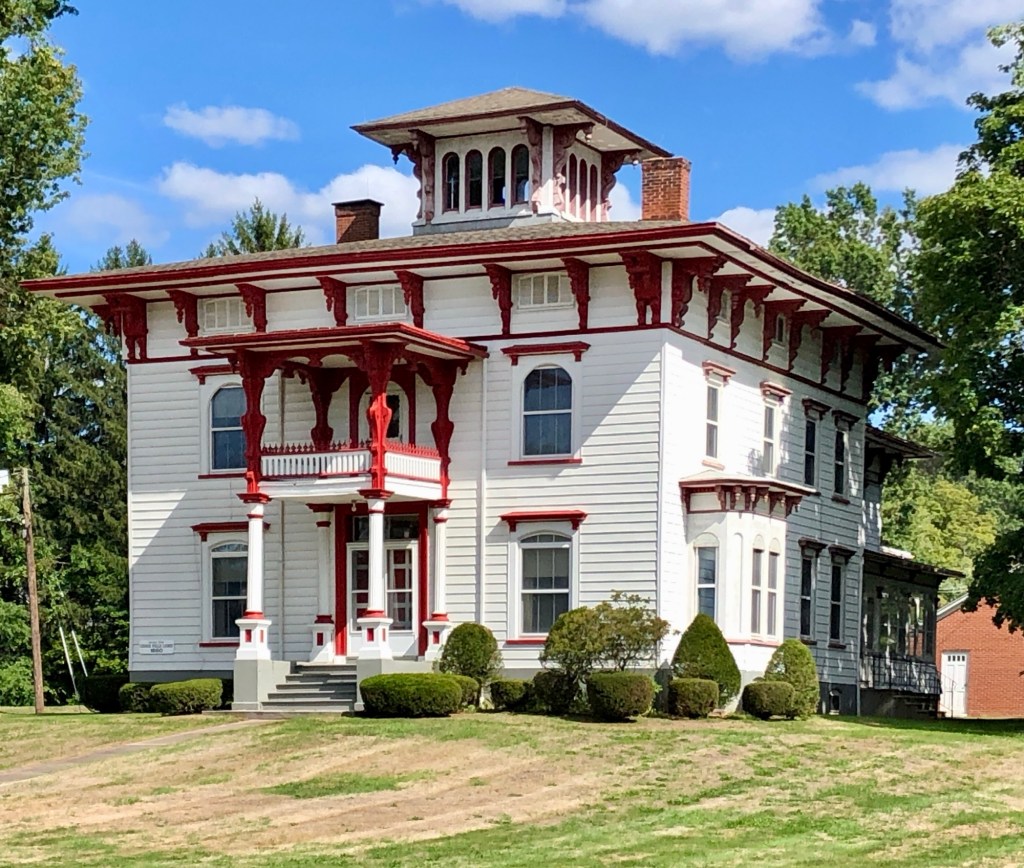
This large Italianate style residence on Main Street in Suffield, Connecticut, was built in 1860 by John Wells Loomis for his son, George. George ran a cigar shop in a separate building on the lot, selling rolled cigars from tobacco that his business harvested and rolled. The mansion features a belvedere atop the low sloped hip roof with broad overhanging eaves. George was set to run the family business after his father, George. In 1881, two years after his father’s death, George Loomis sold the tobacco business founded by his father and moved to New Haven. In 1912, Polish residents bought the house, and it became the rectory for St. Joseph Church.
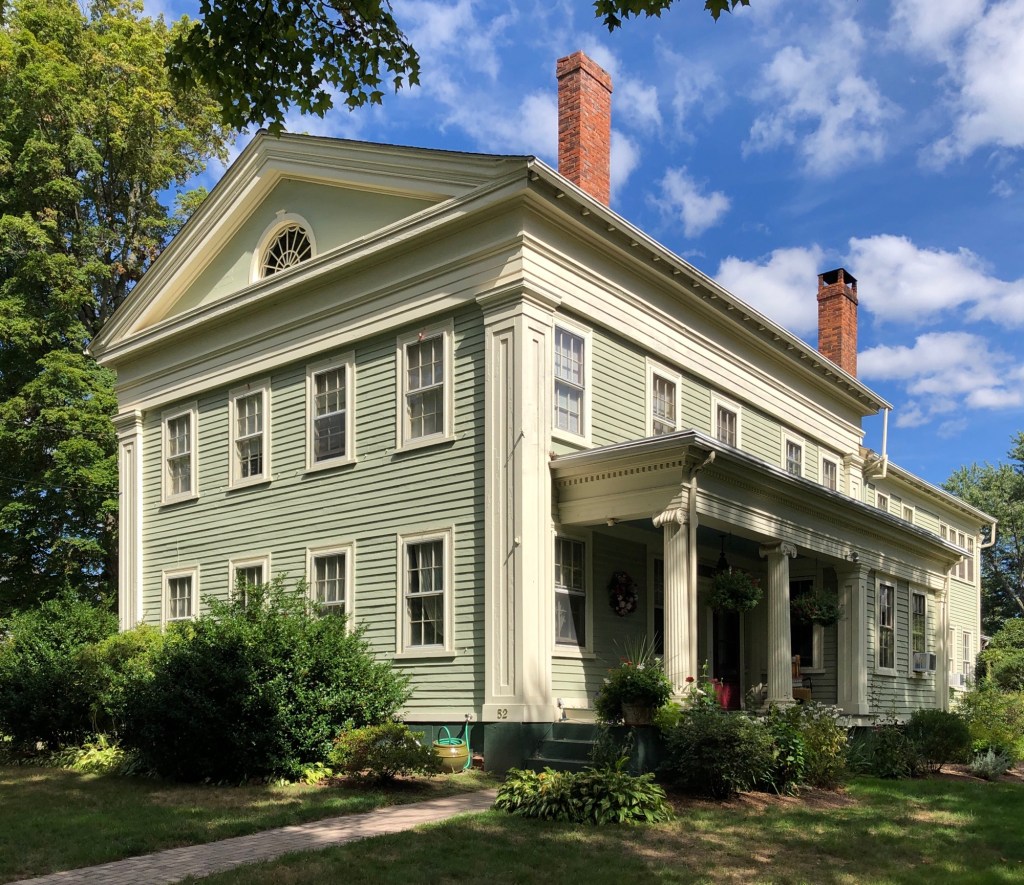
Dr. Asaph Bissell was born into the wealthy Bissell family which started here when John Bissell, the progenitor of the family in America, came from Somerset, England, and landed in Plymouth, Massachusetts, in 1628. He became one of the settlers of Windsor, CT. His descendant, Asaph Bissell (1791-1850) became one of Yale’s earliest medical graduates and built this stately Greek Revival style home on Main Street in Suffield, Connecticut, where he practiced medicine. Dr. Bissell often made house calls from his home right on Main Street until his death in 1850, after which, it was inherited by his eldest son, Charles Bissell. The house is Greek Revival in style with its entrance on the side elevation sheltered by a Classical porch, all facing southwards. The street-facing facade is four bays with large corner pilasters, a massive entablature, and pedimented gable-end with fanlight set within it.
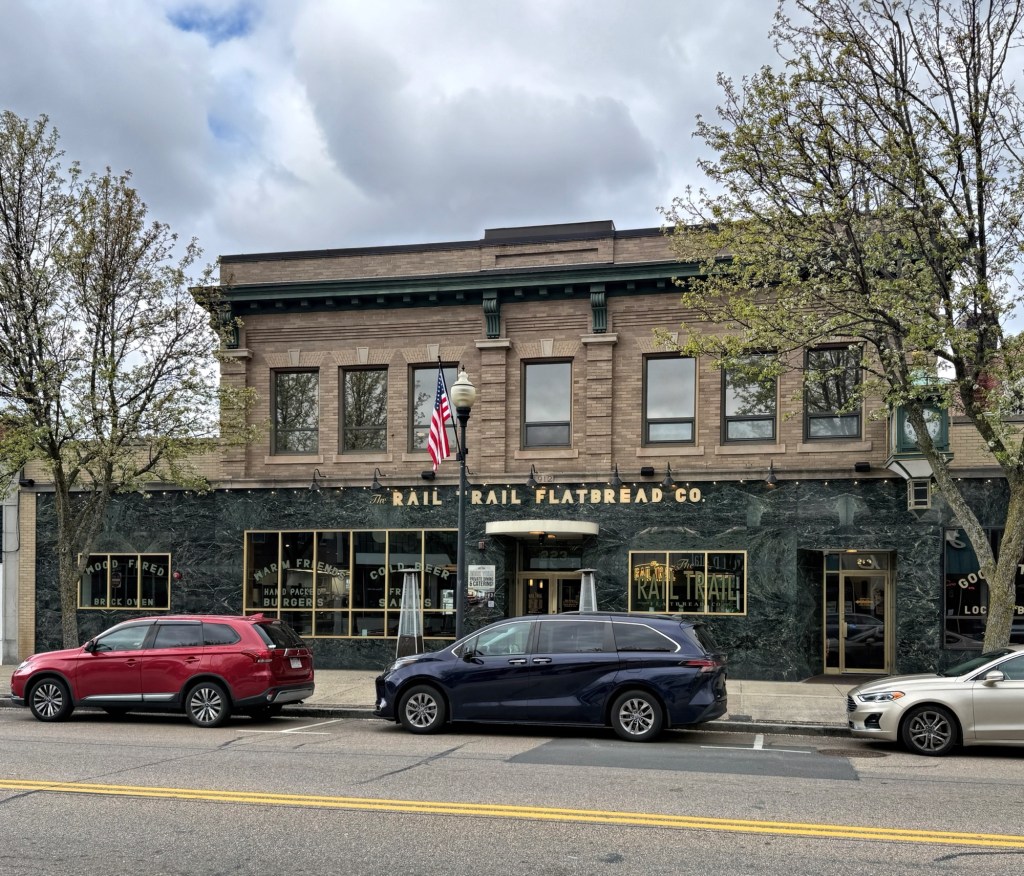
The Thayer Block and its twin, the Claflin Block, on Main Street in Milford, Massachusetts, stand as prototypical early 20th century commercial blocks commonly found in nearly any city in New England. The two-story commercial block was built in 1912 and was long the location of the Home National Bank of Milford. The bank added the iconic clock on the facade, which is one of the remaining clocks made by the McClintock-Loomis Clock Company or successive company, O.B. McClintock Co., which specialized in sidewalk clocks for banking and financial institutions. The green marble storefront was likely added in the 1950s or 1960s and is an eye-catching change to the building. Today, the bank space is occupied by the Rail Trail Flatbread Co., a local restaurant and bar.
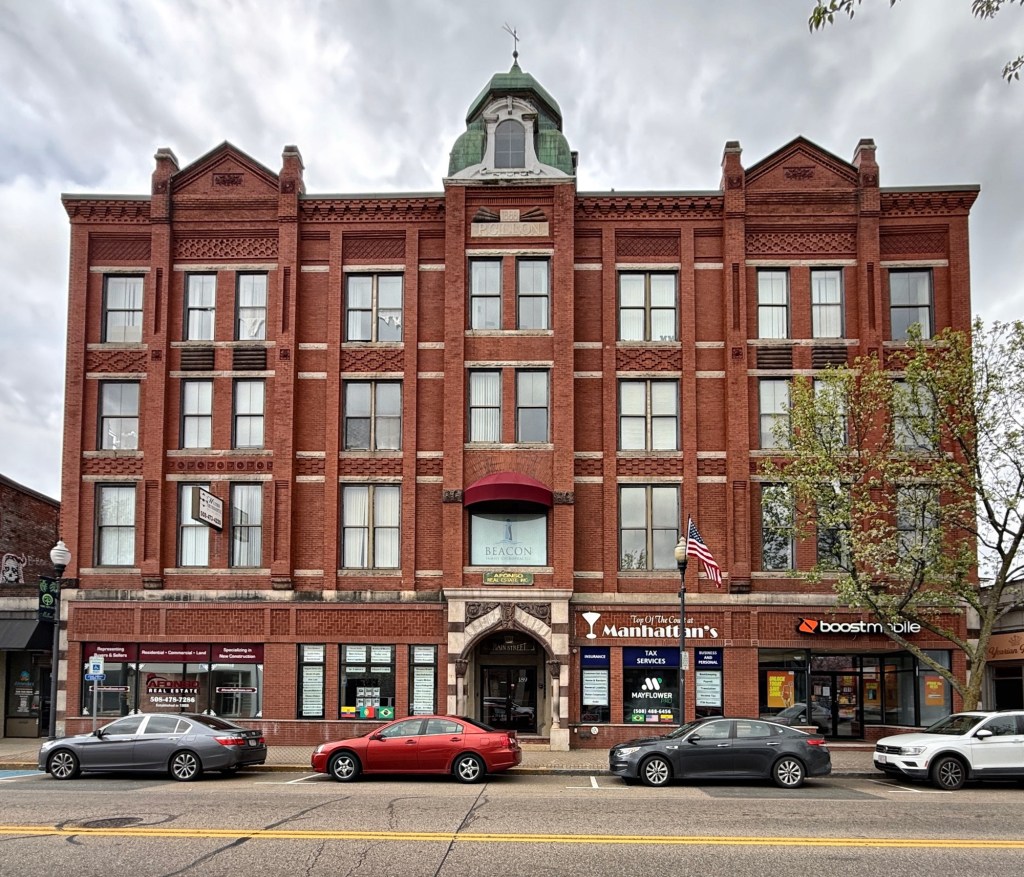
Located on Main Street in Milford, Massachusetts, the stately Gillon Block is one of the town’s finest buildings and an excellent example of eclectic, late Victorian commercial architecture. The block was erected in 1888-9 for owner Patrick Gillon (1843-1899), who inherited his late-father’s distillery and bottling business in Milford, and designed by local architect Rinaldo V. Carey. The panel brick facade is divided into seven sections with a central projecting section topped by a tower capped by a copper onion dome. The four-story block included retail space at the ground floor with offices and meeting halls on the upper stories, rented to tenants and organizations.
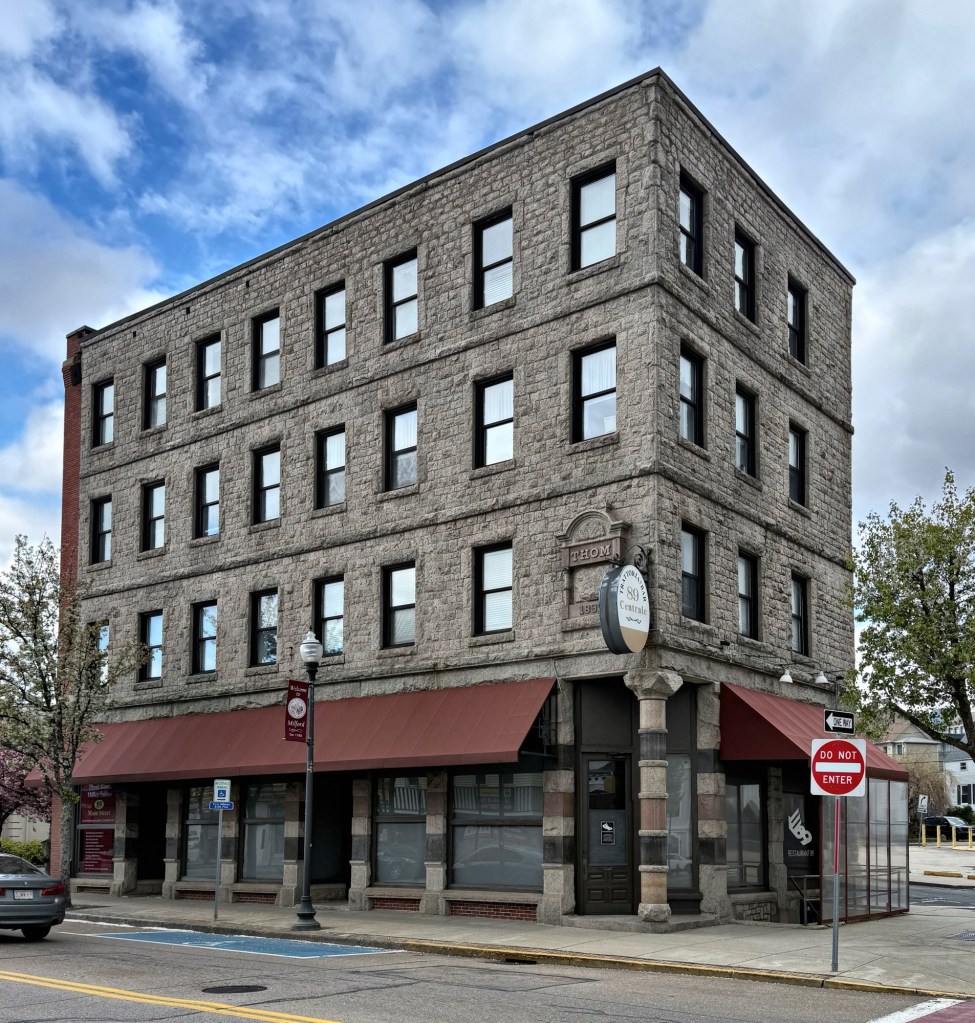
The Thom Block on Main Street in Downtown Milford, Massachusetts, is a historic mixed-use commercial block built of locally quarried Milford “pink” granite. The structure was constructed in 1891 by owner (and likely builder), James Thom, who arrived to Milford around 1889 and was hired by the Milford Pink Granite quarries as a foreman. Mr. Thom was the target of a vicious attack by a disgruntled quarry-worker and James would submit his resignation, turning his pursuits toward a local bicycle and horse racetrack and two of the town’s semi-professional baseball teams. He also got involved in real estate, in 1891 submitting plans for this building on Main Street that bears his name. Shortly after completion, a fire gutted the inside of the building and was rebuilt. Thom’s insurance did not fully cover the loss and he defaulted on the mortgage, selling the building and moved out of Milford. The Thom Block retains the polychromatic piers between storefronts and at the corner, which feature rounded granite blocks of polychromatic polished granite. The major ornament of the upper stories is a large plaque on the Main Street facade just above the recessed entrance with two Corinthian colonettes, spanned by a frieze and plinth on which “THOM” and “1891” are carved, respectively, showing us over a century later the original owner and his story.
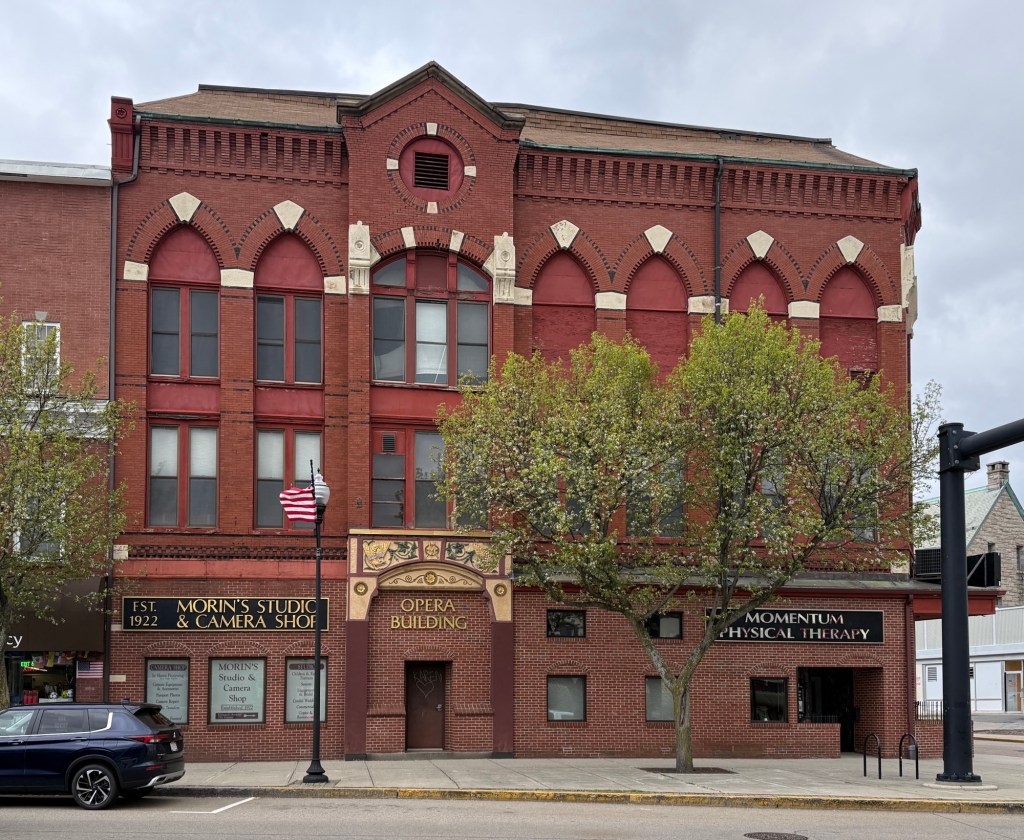
While altered, the Milford Opera House Block on Main Street, stands as one of the architecturally distinctive and significant 19th century buildings in Milford, Massachusetts. As the town prospered in the decades following the Civil War, and wealthy residents, including William F. Draper, an executive with the Draper Corporation in nearby Hopedale, sought to use their wealth to improve their community. In 1880, planning began to erect an opera house building, which would bring the arts to the community, and after months of discussion and planning, funding and a site on Main Street was secured. Architect, Frederick Swasey was hired by the association, who furnished plans for the Victorian Gothic building to contain five retail stores on the ground floor with an auditorium above capable of seating 1,100. The building suffered from a fire in 1912 and use as an opera house ceased and starting in the 1920s and the building began showing moving pictures. Later in the 20th century, the building was altered with the storefronts enclosed, windows on upper stories changed, iron cresting at the roof and clock face removed, but the building still retains its ornate entrance and is an important landmark on the town’s Main Street.
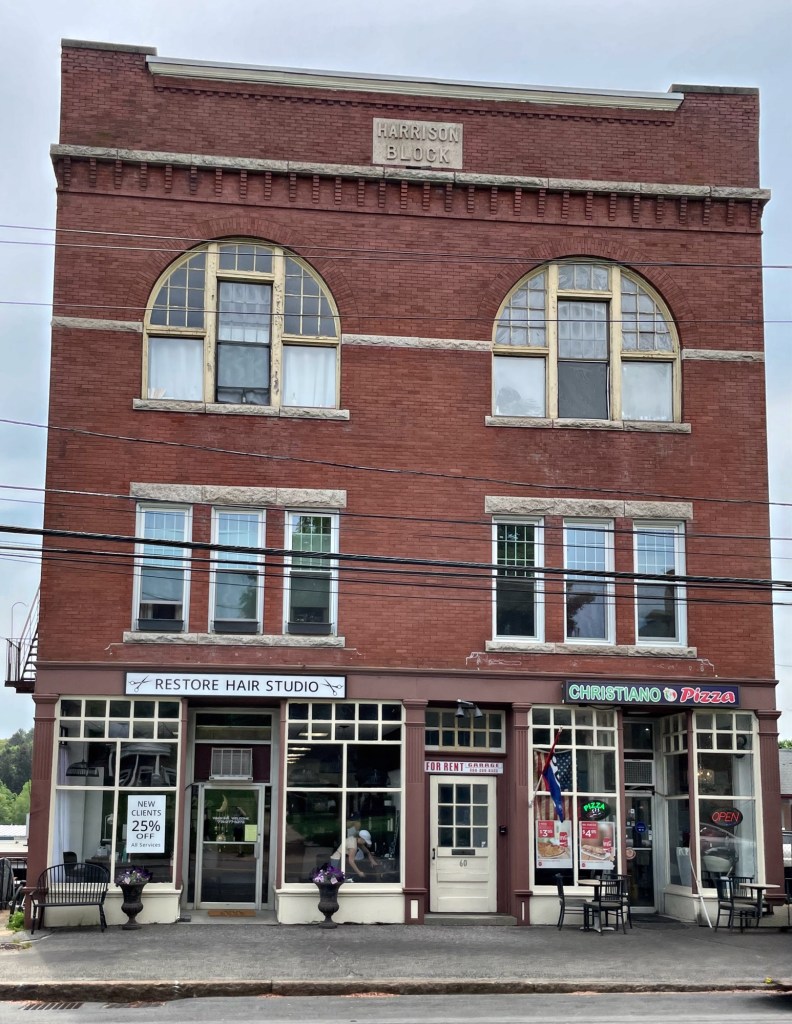
One of the few historic commercial buildings in Hopedale Village is this Romanesque Revival style example on Hopedale Street which, like so many other buildings in the village, was largely funded by members of the Draper Family. The commercial block was built in 1889 by Gen. William F. Draper and named in honor of President Benjamin Harrison, 23rd president of the United States, as a multi-use building, containing a drug store, a retail, a club house on the second floor, a storage and cobbler at the rear of the building in the basement, and a lodge on the third floor for large meetings. Less ornate than many other buildings in town built for the Draper’s, all decorative features on the Harrison Block are confined to the façade. With original storefronts of wood and glass display windows at the ground floor, tripartite windows at the second floor, and large, round-arched windows at the third floor, evoking the Romanesque style of the Town Hall (also funded by the Draper Family) nearby.
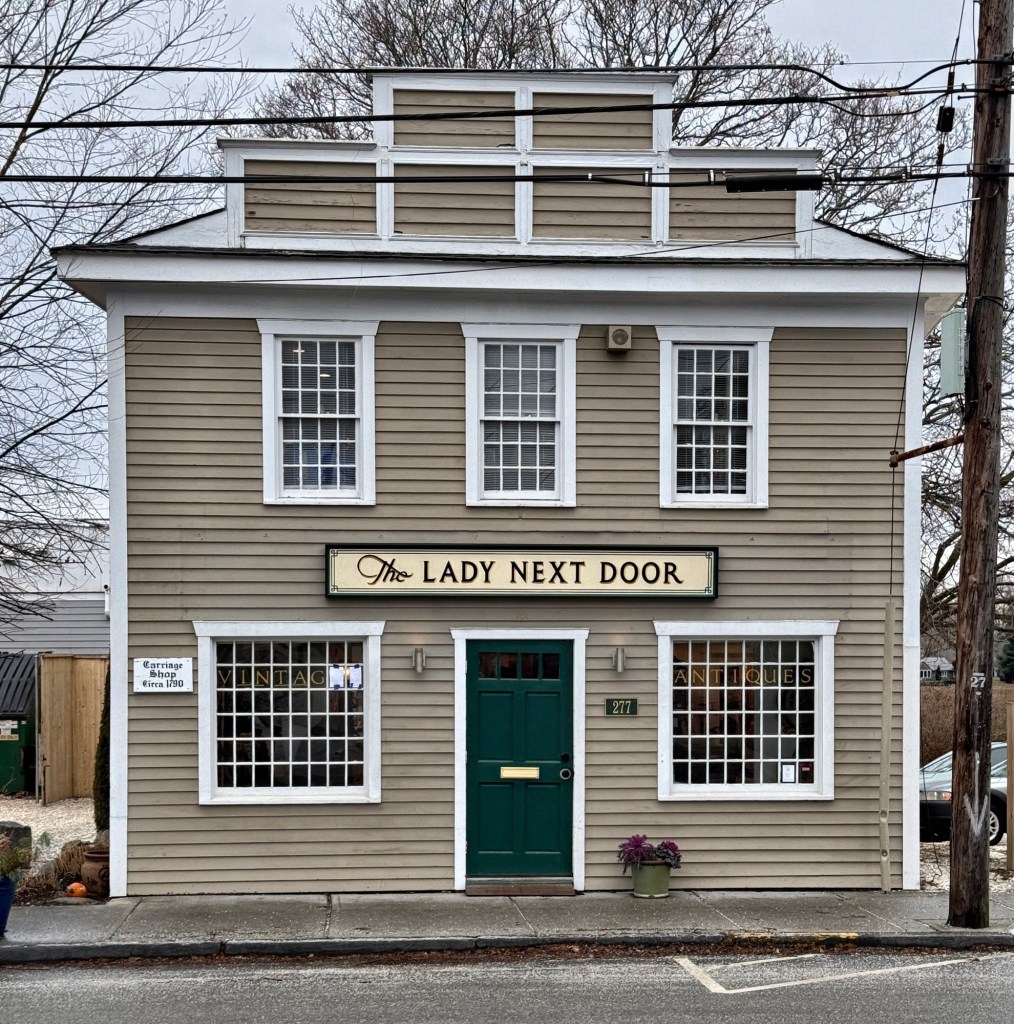
The old Carriage Shop on Water Street in Warren, Rhode Island, is an early and surviving industrial building from the late 18th century that adds to the charm and history of the great waterfront town. The two-story building has a three-bay facade with a center entrance and 48-pane fixed sash windows on the first floor and 12-over-12 sash windows on the second floor. The stepped parapet masks the low gable roof of the building behind that extends far back in the lot. The building was a workshop and paint shop for Gardner & Hoar, builders and carpenters, in the mid-19th century, and later as a blacksmithing shop and carriage shop before the turn of the 20th century. Luckily for us, the building has been preserved and while not finding a place in architectural journals, the building is an important remaining building that strongly contributes to the character of the town.
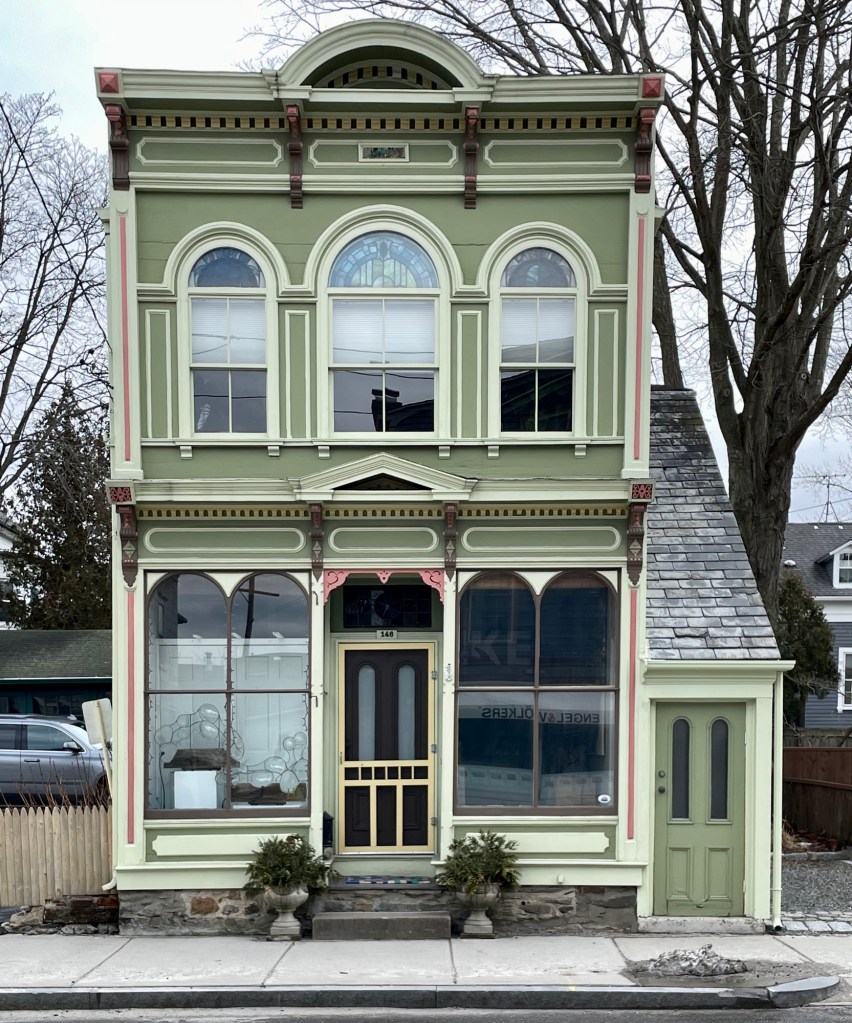
This diminutive commercial building on Water Street in Warren, Rhode Island stands out as one of the state’s best examples of a historic Victorian-era wooden commercial building, and its preservation is notable. The late-Italianate style wooden block dates to 1883, and exhibits its original wooden storefronts, second floor round arched windows with stained glass, and ornate detailing including the brackets, parapet and period-appropriate paint colors which allow those details to pop. The shop was owned in its early days by the John C. Hall, a carpenter who built the house next door. The building was used as an antique shop on the ground floor with a studio for author and illustrator, David Macaulay on the second floor. These types of smaller-scale commercial spaces are some last remaining (relatively) affordable spaces for small businesses to operate, and they add so much intrigue to the streetscape, especially compared to suburban cookie-cutter banks and stores.