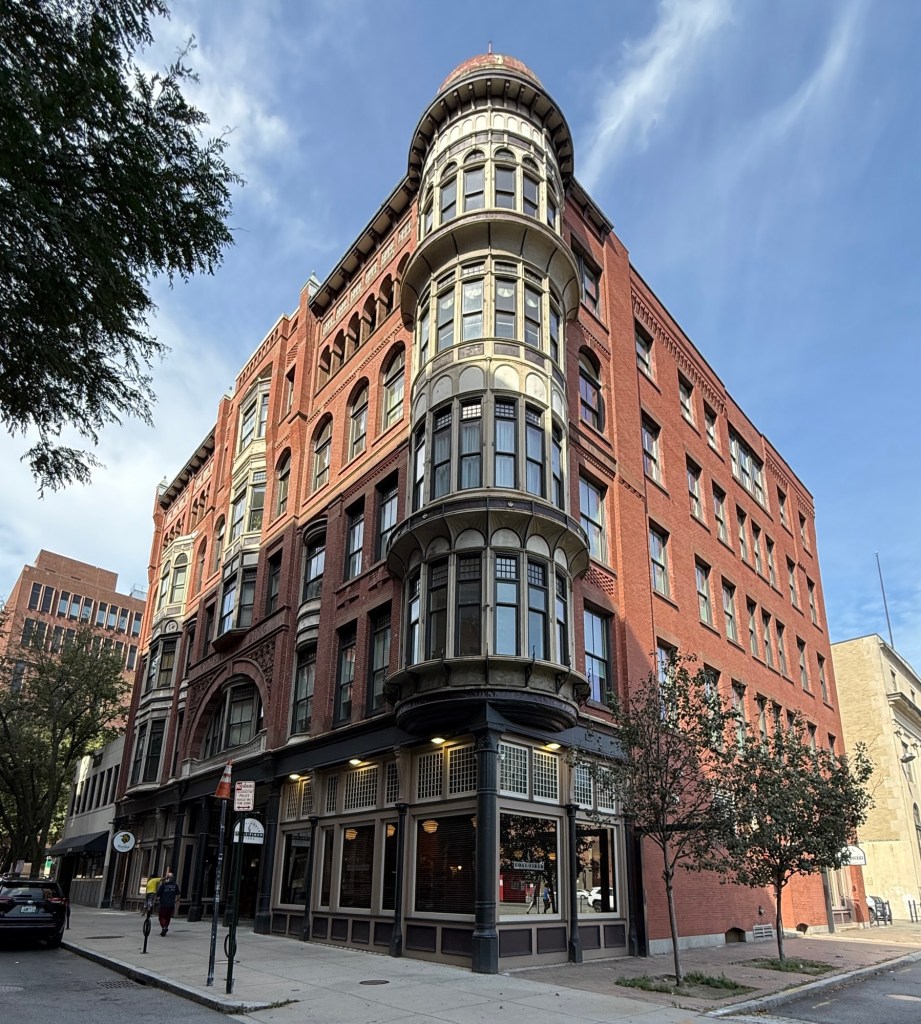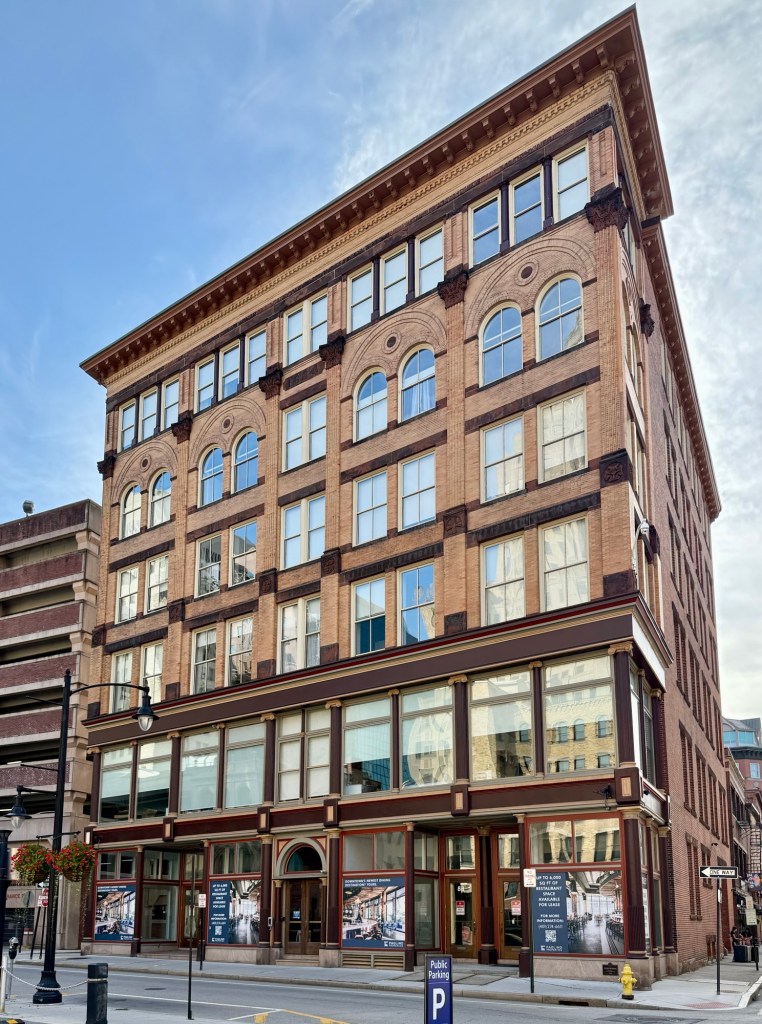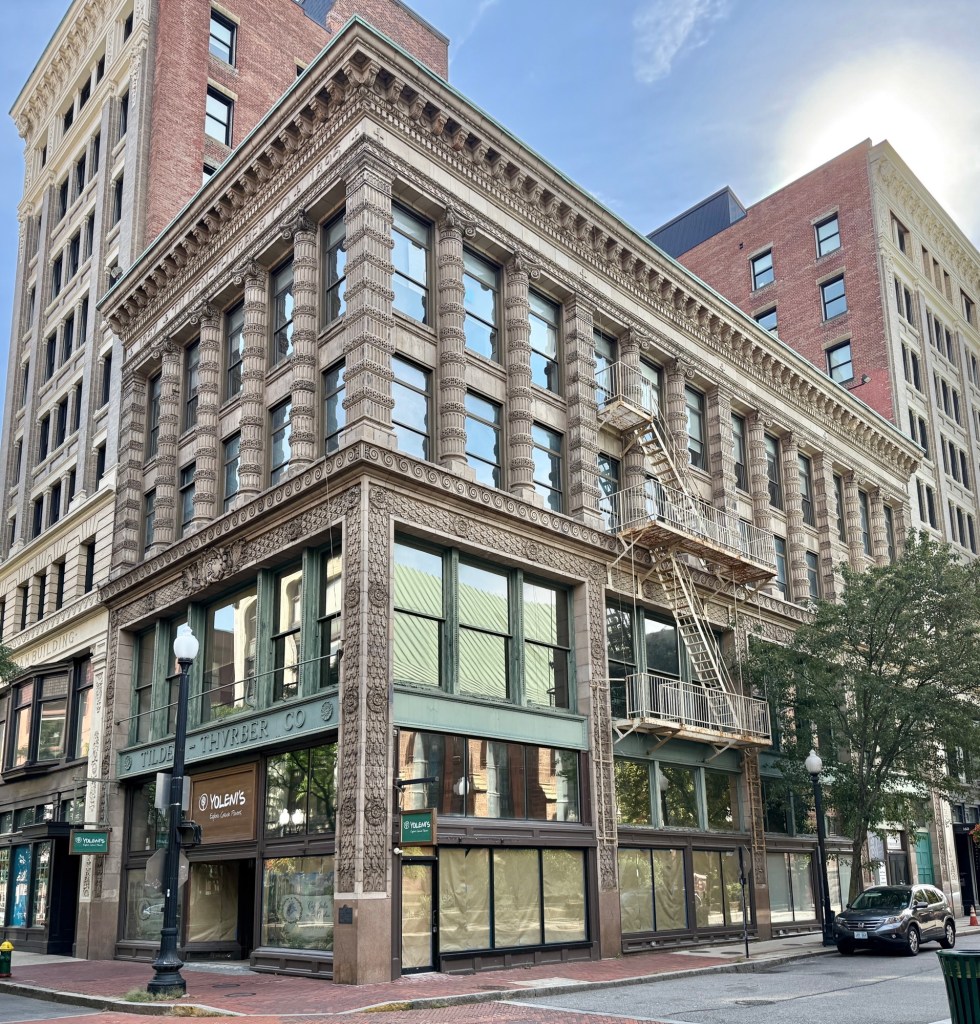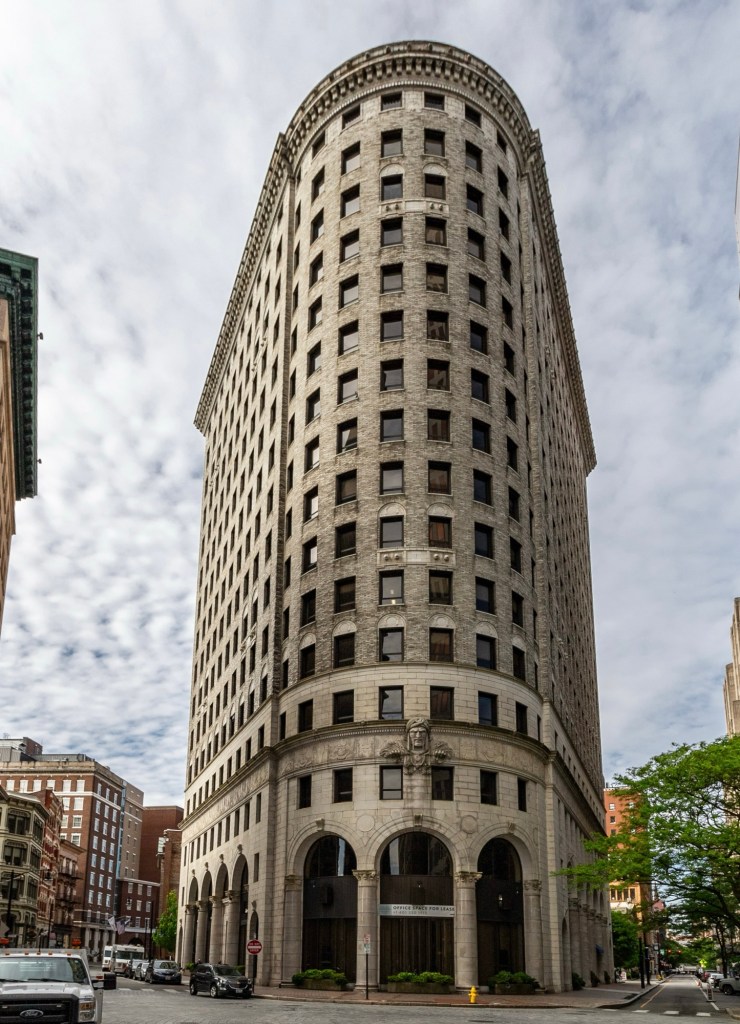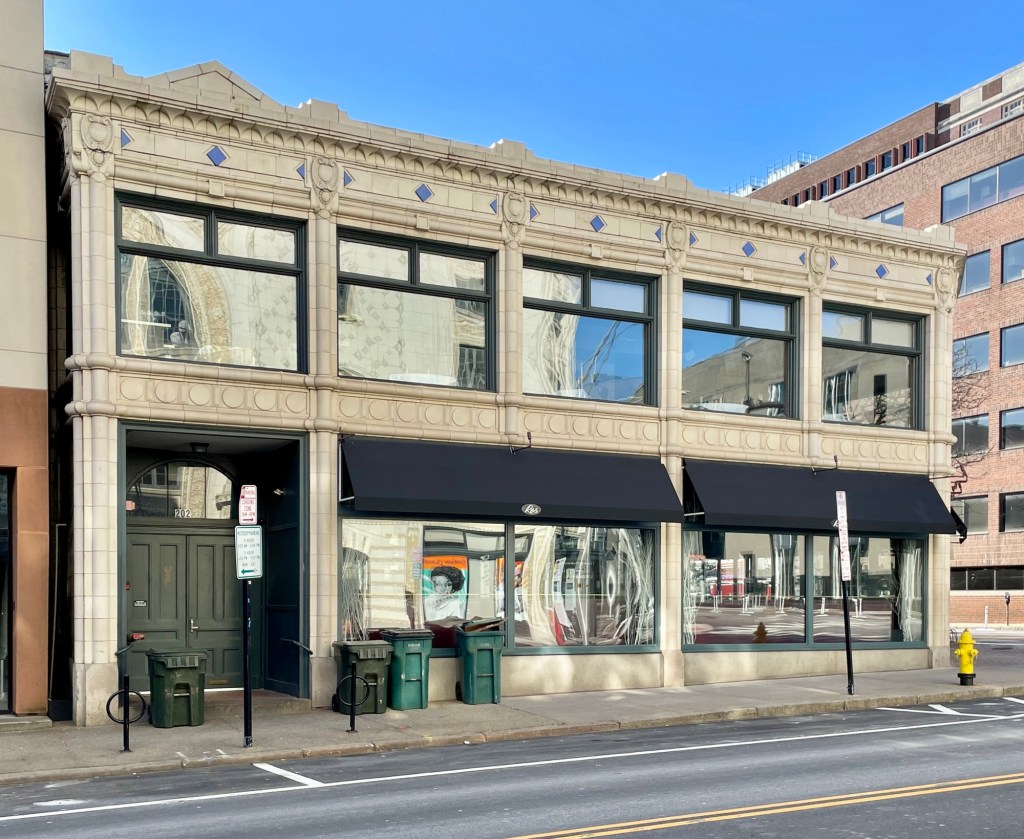
Thayer Block – Home National Bank of Milford // 1912

The Thayer Block and its twin, the Claflin Block, on Main Street in Milford, Massachusetts, stand as prototypical early 20th century commercial blocks commonly found in nearly any city in New England. The two-story commercial block was built in 1912 and was long the location of the Home National Bank of Milford. The bank added the iconic clock on the facade, which is one of the remaining clocks made by the McClintock-Loomis Clock Company or successive company, O.B. McClintock Co., which specialized in sidewalk clocks for banking and financial institutions. The green marble storefront was likely added in the 1950s or 1960s and is an eye-catching change to the building. Today, the bank space is occupied by the Rail Trail Flatbread Co., a local restaurant and bar.

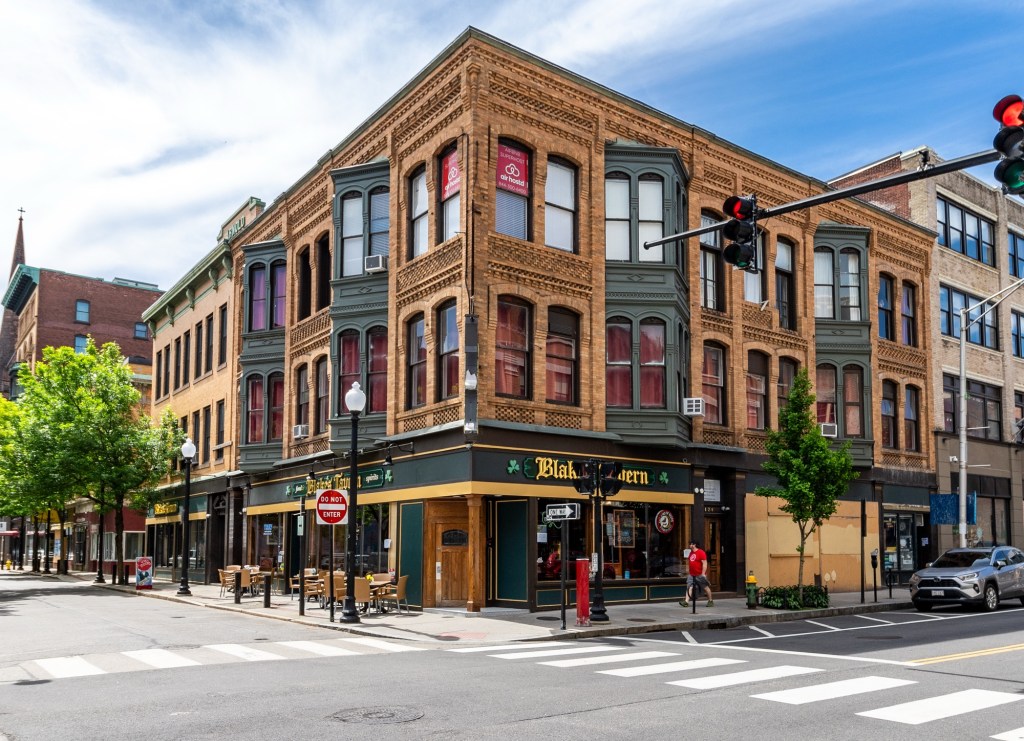
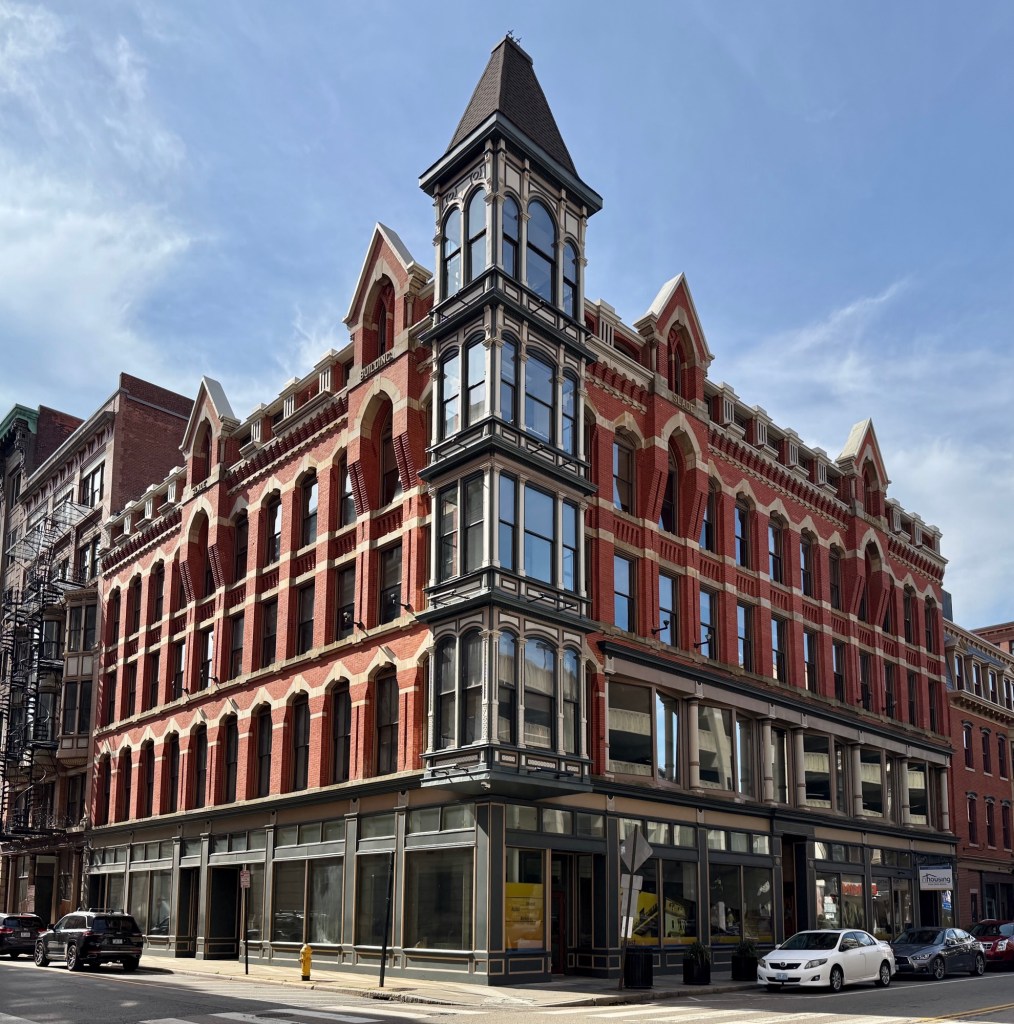
Gillon Block // 1888

Located on Main Street in Milford, Massachusetts, the stately Gillon Block is one of the town’s finest buildings and an excellent example of eclectic, late Victorian commercial architecture. The block was erected in 1888-9 for owner Patrick Gillon (1843-1899), who inherited his late-father’s distillery and bottling business in Milford, and designed by local architect Rinaldo V. Carey. The panel brick facade is divided into seven sections with a central projecting section topped by a tower capped by a copper onion dome. The four-story block included retail space at the ground floor with offices and meeting halls on the upper stories, rented to tenants and organizations.

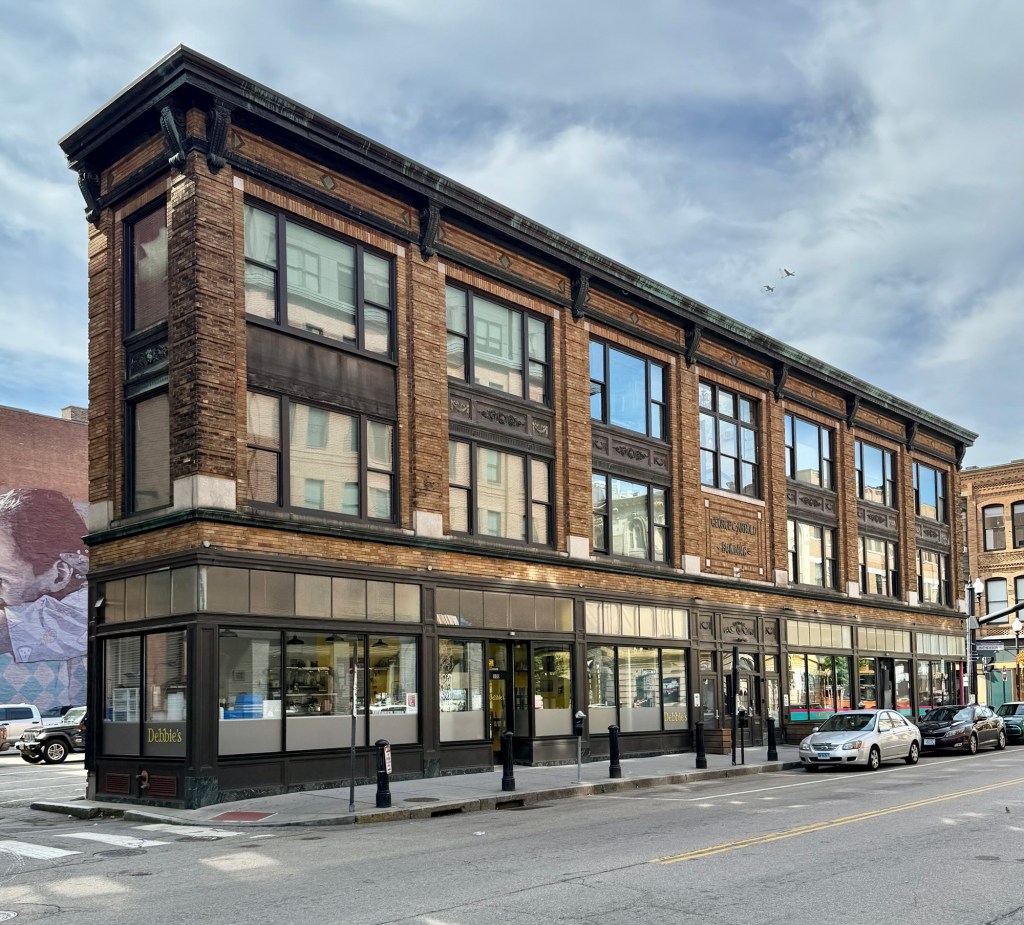
Thom Block // 1891

The Thom Block on Main Street in Downtown Milford, Massachusetts, is a historic mixed-use commercial block built of locally quarried Milford “pink” granite. The structure was constructed in 1891 by owner (and likely builder), James Thom, who arrived to Milford around 1889 and was hired by the Milford Pink Granite quarries as a foreman. Mr. Thom was the target of a vicious attack by a disgruntled quarry-worker and James would submit his resignation, turning his pursuits toward a local bicycle and horse racetrack and two of the town’s semi-professional baseball teams. He also got involved in real estate, in 1891 submitting plans for this building on Main Street that bears his name. Shortly after completion, a fire gutted the inside of the building and was rebuilt. Thom’s insurance did not fully cover the loss and he defaulted on the mortgage, selling the building and moved out of Milford. The Thom Block retains the polychromatic piers between storefronts and at the corner, which feature rounded granite blocks of polychromatic polished granite. The major ornament of the upper stories is a large plaque on the Main Street facade just above the recessed entrance with two Corinthian colonettes, spanned by a frieze and plinth on which “THOM” and “1891” are carved, respectively, showing us over a century later the original owner and his story.

Carpenter’s Shop – Fishelson House and Store // c.1860

A rare extant wood-frame building in Beacon Hill, this Second Empire style building at the corner of Chestnut and River streets is one of the neighborhood’s most charming. It is likely that some of the wood-frame structure was originally a rear ell to the 1830s Greek Revival house it adjoins at 34 Charles Street. By the 1860s, the building was renovated for use as a carpenter’s shop, with the mansard roof, quoins, and loft door added at that time. City records indicate that the house on Charles Street housed tradesmen and it was listed as “Temporary Home”, the predecessor to the city Overseers of the Poor Temporary Home, a charitable organization providing lodging and food to those in need. From the late 1920s, the property was owned by Max and Rebecca Fishelson, who resided in and operated their florist shop here. In 1936, the former carpenter’s shop was renovated to contain a retail store on the ground floor with a two-family dwelling above, one for the Fishelson’s and one for their daughter. for a renovation of the wood frame annex on
Chestnut Street, which involved changing the occupancy of that section from a store and carpenter shop to a store and two-family dwelling: one for the Fishelsons and one for their daughter.

Wrentham Village Hall – Daniel Cook Store // 1853

Arguably the most recognizable and beloved building in Wrentham, Massachusetts, is this eclectic mid-19th century commercial building, known as the Wrentham Village Hall. The structure was originally constructed for Daniel A. Cook where he operated a store in the ground floor retail space and rented a meeting hall to local organizations above. The building was constructed around 1853 as a more vernacular building, but given its current appearance decades later when the ornate Stick style porches were added to the facade. While the building has served many uses over its history, the structure is suffering from some deterioration, which hopefully will not impact the rare surviving exposed porch framing and trusses, which give the building so much character.

Harrison Block // 1889

One of the few historic commercial buildings in Hopedale Village is this Romanesque Revival style example on Hopedale Street which, like so many other buildings in the village, was largely funded by members of the Draper Family. The commercial block was built in 1889 by Gen. William F. Draper and named in honor of President Benjamin Harrison, 23rd president of the United States, as a multi-use building, containing a drug store, a retail, a club house on the second floor, a storage and cobbler at the rear of the building in the basement, and a lodge on the third floor for large meetings. Less ornate than many other buildings in town built for the Draper’s, all decorative features on the Harrison Block are confined to the façade. With original storefronts of wood and glass display windows at the ground floor, tripartite windows at the second floor, and large, round-arched windows at the third floor, evoking the Romanesque style of the Town Hall (also funded by the Draper Family) nearby. 

The Old Carriage Shop // c.1790

The old Carriage Shop on Water Street in Warren, Rhode Island, is an early and surviving industrial building from the late 18th century that adds to the charm and history of the great waterfront town. The two-story building has a three-bay facade with a center entrance and 48-pane fixed sash windows on the first floor and 12-over-12 sash windows on the second floor. The stepped parapet masks the low gable roof of the building behind that extends far back in the lot. The building was a workshop and paint shop for Gardner & Hoar, builders and carpenters, in the mid-19th century, and later as a blacksmithing shop and carriage shop before the turn of the 20th century. Luckily for us, the building has been preserved and while not finding a place in architectural journals, the building is an important remaining building that strongly contributes to the character of the town.

Hall’s Block // 1883

This diminutive commercial building on Water Street in Warren, Rhode Island stands out as one of the state’s best examples of a historic Victorian-era wooden commercial building, and its preservation is notable. The late-Italianate style wooden block dates to 1883, and exhibits its original wooden storefronts, second floor round arched windows with stained glass, and ornate detailing including the brackets, parapet and period-appropriate paint colors which allow those details to pop. The shop was owned in its early days by the John C. Hall, a carpenter who built the house next door. The building was used as an antique shop on the ground floor with a studio for author and illustrator, David Macaulay on the second floor. These types of smaller-scale commercial spaces are some last remaining (relatively) affordable spaces for small businesses to operate, and they add so much intrigue to the streetscape, especially compared to suburban cookie-cutter banks and stores.

Leet Store // 1909

The handsome rubblestone commercial block at the corner of Main and Water streets in Chester, Connecticut, was built in 1909 by Italian stone masons for Joseph H. Leet and contained a grain and feed store, with other spaces in the building rented out. Decades later, the old Leet Store became a auto repair shop and the upstairs space was used as a meeting hall and theater for the community. The building was restored in 1979 and expanded at the rear with a two-story wood-frame addition for additional commercial space.

Old Stone Store, Chester // 1809

Colloquially known as the “Stone Store,” this handsome stone structure in Chester Village, Connecticut, was built by William Buck in 1809, a merchant involved in the West Indies trade. The stone for the building is believed to have come from the Chester quarry in town and was likely more vernacular without the columned portico. The four-columned Doric portico was likely added in the 1830s or 1840s as the Greek Revival style surged in popularity. The two side wings were added in the 20th century. The Old Stone Store has held various uses from a store, tavern, post office and liquor store, while the upper floor has served as a private school, the town’s library and an apartment. The Old Stone Store today acts as the western terminus of the town’s Main Street commercial district.

Chester House Hotel // c.1840

This altered building in the center of Chester Connecticut’s village Main Street, has historically been known as the Chester House, a hotel and tavern to provide lodging and drinks to travelers passing through the area in the mid-late 19th century. The structure, built atop a raised stone foundation, was constructed in the Greek Revival style around 1840, and long had a sheltered two-story portico supported by four monumental columns under a gabled roof which resembled a pediment. In 1903, a fire destroyed the upper floor and the roof was removed, creating a flat roof design. Later in the 20th century, a shallow side gable roof replaced the flat roof and the columns on the facade were also removed, giving the building the appearance we see today. The hotel closed, but the historic structure remains an anchor to the town’s vibrant commercial center, and houses a local business.

Rhodes Building // 1905

The Rhodes Building in Brookline Village is an exuberant example of a Colonial Revival style commercial block in an playfully eccentric way. Built in 1905, the block feels almost Post-Modern in style, which highlights ironic elements through the use of historical references, like here with the oversized swan’s neck pediment. The structure was designed by architect, William C. Collett, and was rented to Edgar and Leonard Rhodes, dealers in groceries and provisions and housed the Rhodes Brothers grocery store.

Seamans Block // 1888

One of the more impressive commercial blocks in Brookline is located at the corner of Washington Street and Davis Avenue in Brookline Village. The Seamans Block was developed by its namesake, James Manning Seamans (1834-1908), a wealthy grocer who operated a store from the building. The handsome masonry block was built from designs by the firm of Shepley, Rutan and Coolidge, a successor firm to H.H. Richardson. As partner of the firm, Charles H. Rutan lived just down Davis Avenue, it is likely that he was in charge of this design. The structure follows the Richardsonian Romanesque style, popularized by Richardson through the rounded corner and heavy arches, but is done entirely in brick rather than adding brownstone or terracotta detailing. The building has long been an excellent example of a historic “mixed-use” block with ground floor retain and apartments above, something that many new developments try and emulate today. 

Robbins & Marsh Store // c.1858

Located in the Chester Depot Village, a commercial and civic assortment of buildings constructed in the mid-19th century between the often feuding North and South villages in Chester, Vermont, this handsome commercial building contributes to the character and history of the once thriving commercial center of town. Built across the tracks of the Central Vermont Railroad from the town’s depot, this Italianate style building dates to about 1858 when a P. H. Robbins opened an all-in-one store, selling everything from groceries to hardware and building products. Mr. Marsh was later joined by Frederick W. Marsh, who entered into the business, then named the Robbins & Marsh Store. The business thrived with the close proximity to the railroad depot with later alterations to the building including the addition of plate glass storefronts and a massive side awning porch. Business slowed after WWII, as rail service slowed and ultimately stopped in town. Today, the handsome building remains as an important visual anchor to the depot village. 

C & J Mauran Company Warehouse // c.1820

In Providence, even industrial warehouses are architecturally interesting to look at! This is the C & J Mauran Company Warehouse at 369 South Main Street in Providence’s East Side neighborhood. The building was constructed around 1820 for brothers, Carlo (1779-1844) and Joshua Mauran (1782-1847), who were wealthy merchants who stored goods from their ships trading in the Indies here. Before all of this, the site was home to an earlier structure from the 1770s, built by Deacon Joseph Sheldon, and the site was occupied by a warehouse, later owned by his son, Christopher Sheldon, and was known as the “Slave Pen” for its use of holding and transporting enslaved people. The “slave pen” burned in 1801 and the structure was later rebuilt by the Earle Brothers, and then again (the current structure) by Carlo and Joshua Mauran. Later in the 19th century, a brick façade and storefront were added to the building as the street shifted firmly to commercial uses, with noxious industrial buildings moving further to the periphery of the established College Hill neighborhood. From 1856 to 1939, the Ferry Coal Yard Company and the National Coal Company stored coal in the building After WWII, the City of Providence took the building and adjacent block by eminent domain to make way for urban renewal, and luckily for us, the building was rehabilitated rather than demolished at this time. The structure was converted to office use, and was again restored in the 2010s by Newport Collaborative Architects.