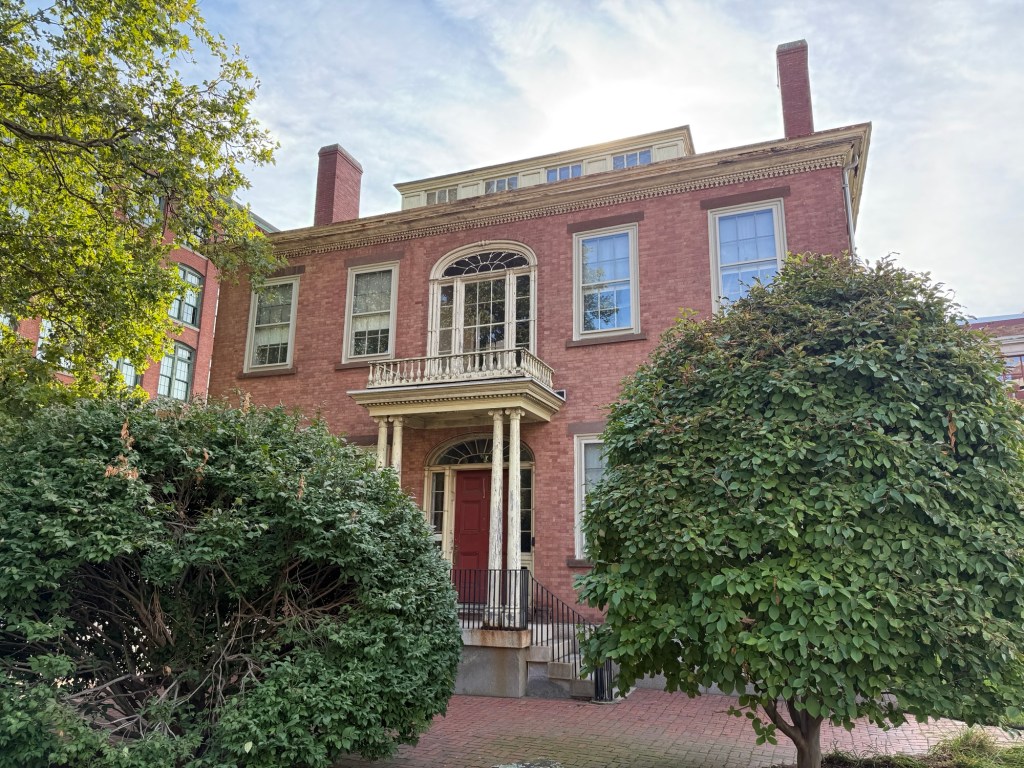
John H. Munroe House // c.1860

Built circa 1860 for Jonathan Harding Munroe, this stately Victorian house sits on Main Street in the up-scale community of Edgartown on Martha’s Vineyard. Jonathan Munroe was born in Bristol, Rhode Island and moved to Edgartown where he opened a store and worked as a high-end tailor, and became a successful businessman in town where he founded the Martha’s Vineyard Bank of Edgartown, and later financed successful whaling excursions making a large profit on his investments. With his ever-growing net worth, Mr. Munroe likely updated this house towards the end of the 19th century, with the ornate three-sided porch. Most recently, the property has operated as an inn, named after its original owner, the Jonathan Munroe House Inn.

Edgartown Town Hall – Old Edgartown Methodist Church // 1828

Edgartown, the historic whaling harbor village, is Martha’s Vineyard’s first colonial settlement and has prospered as one of the best-preserved collections of 19th century architecture in the United States. The streets of Edgartown’s village are lined by historic residences, shops and churches built by and for prosperous whaling captains and preserved today as part of New England’s elite summer destinations. Presently occupied by the local government of Edgartown as its Town Hall, this handsome Federal style building on Main Street was originally used as the community’s first purpose-built Methodist Church. Methodism on Martha’s Vineyard began after 1787, when a vessel commanded by Capt. Thomas Luce arrived to the island containing two stowaways escaping enslavement in Virginia; John Saunders and Priscilla, his wife. They were slaves to a Virginia planter, and both were zealous christians, and Methodist speakers, who helped foster a larger community on island. A methodist church was established in Edgartown in a building shared with Baptists until this handsome building was constructed in 1828 by local architect and builder, Frederick Baylies Jr. Just fifteen years later, the town grew in population and wealth and the local Methodists felt it necessary to build a much larger church, now known as the Old Whaling Church in 1843. This building was acquired by the Town in the 1840s and converted to a town hall with space for a fire engine and police. More recently, the building served as the fictional town hall of “Amity” in the 1975 film, Jaws, where the infamous chalkboard scratch scene took place.

Lewis-Zukowski Farm // 1781

Located on a back road in Suffield, Connecticut, the Lewis-Zukowski Farmhouse stands as one of the oldest and largest brick homes found in this part of the state. The Federal period farmhouse was built in 1781 for Hezekiah Lewis, he was a farmer of modest prosperity. The farm was owned by subsequent owners until 1905, when it was purchased by Michael Zukowski, who was born in Poland around 1867. He arrived in Suffield with his family in 1888 and found a job working on a tobacco farm for $8 a month. He married in 1898 and became a naturalized citizen in 1900. By 1905, he had saved enough money to purchase this farm property for $2,800. He grew tobacco on his farm and raised his family, who retained the property throughout the 20th century. The rural farmhouse is architecturally significant as well as historically significant for its connections with the local tobacco industry and immigration that helped the community thrive in the 20th century.

First Church of Christ, Suffield // 1869

Located adjacent to the Town Common, the First Church of Christ in Suffield showcases the grandiose architecture seen in many churches after the Civil War in New England. This brick edifice is the fifth in the history of the church which dates back to around 1680. This church building was designed by local architect John C. Mead, who designed other stately churches in the surrounding region. The church is a blending of Italianate and Romanesque Revival styles and originally featured a tall spire and secondary tower. In 1938, the New England Hurricane destroyed the tall spire (a similar event occurred to many New England Churches, including Old North in Boston). Even without the steeple, the church remains as a great architectural treasure in town.

Thaddeus Leavitt Jr. House // 1800

One of the many grand homes on Main Street in Suffield is this Federal style home built in 1800 for a 21-year-old Thaddeus Leavitt. Like his father, Thaddeus was a merchant with a store in Suffield and . Immediately after the home was completed, Thaddeus got married and moved into the home with his new wife, Jemima Loomis. The home was altered in the 1850s with Italianate features including a belvedere and bay windows, which lasted into the 20th century. Since then, the home was restored back to its original Federal style.

Alexander King House // 1764

Located on Suffield’s idyllic Main Street, the Alexander King House stands as a well-preserved example of a Georgian home in Connecticut. Alexander King (1737-1802) is a prominent figure in Suffield’s history. He was a graduate of Yale, and later practiced medicine in town, as well as serving as Selectman and Town Clerk for almost thirty years. He was also a Justice of the Peace, Representative to the Assembly, participant in agitation against British colonialism, and delegate to the Connecticut Ratifying Convention of 1788, when the state ratified the U.S Constitution. The home is owned and maintained today by the Suffield Historical Society, who operate the home as a house museum with exhibits on the town’s rich history.

Dr. Aretus Rising House // 1854

Aretus Rising (1800-1884) was born in Suffield, Connecticut, and tended to his father’s farm before graduating from the Berkshire Medical College in Western Massachusetts in 1826. Dr. Aretus Rising operated his medical practice in Suffield in the 1840s and would eventually build this unique home in 1854. Designed in the Greek Revival style with the emergence of the Italianate style, the home features a square form with broad overhanging eaves and a wrap-around porch supported by latticed columns.

Phelps-Hatheway House // c.1762

Set back from tree-lined Main Street in Suffield, Connecticut, the Phelps-Hatheway House stands as one of the largest, and best-preserved Colonial era homes in New England. The center-chimney residence was built by 1762 by Thomas “Shem” Burbank, where he and his wife, Anna Fitch Burbank, raised nine children. Due to the unstable national economy during and after the American Revolution, the family’s financial situation suffered and they would sell the residence in 1788 to Oliver Phelps. at the beginning of the Revolutionary War, Phelps joined the Continental Army and fought in the Battle of Lexington. He served as Deputy Commissary under George Washington and following the War, he became a prominent businessman and was elected to the Massachusetts Senate in 1785 and served on the Governor’s council in 1786 (Suffield was still a part of Massachusetts at this point). In 1794, Phelps commissioned the addition of a substantial wing designed by Thomas Hayden of Windsor. Under the employ of Hayden, a young Asher Benjamin, later to become one of the most important architects of the Federal period, was one of the workers on the new wing and is believed to have carved the Ionic capitals of the wing’s entryway. Inside, the addition was decorated with imported Parisian wallpaper. When Phelps died, the house was owned by the Hatheway family for a century and is currently open as a house museum, the Phelps-Hatheway House & Garden, administered by Connecticut Landmarks.

Israel L. Spencer House // c.1855

The Spencer family emigrated from Braintree, England to America in 1638, with Thomas Spencer settling in Hartford, Connecticut in 1640. Thomas Spencer Jr., the second generation in Connecticut moved to modern-day Suffield in the 1670s. Generations later, Israel L. Spencer (1833-1887) became a businessman and politician, later being employed at the First National Bank in Suffield, continuing the family’s successful legacy in town. Mr. Spencer had this Italianate house on South Main Street built for him and his family. Israel’s son Charles L. Spencer grew up in the home, later following in his father’s footsteps becoming the president of the local bank. The house has been restored since this photo was taken in 2020.

Elihu Kent Jr. House // 1787

In 1775, when news of the Battle of Lexington reached Suffield, Connecticut, Elihu Kent Sr. (1733-1814) at the age of 42, took command of a local militia of 59 men the next day. The militia, along with his son Elihu Kent Jr. (then 16 years old) and a person whom he enslaved, Titus Kent, marched to Springfield, before heading east to Boston. The troops would end up on Long Island and Elihu Kent Jr. was captured by British forces and confined for a long time as a prisoner of war in the old Rhinelander Sugar House in New York. After his return to Suffield, Elihu Kent Jr. had this Georgian home on Main Street built for his family, where he ran an inn and operated a farm.

New Kent Memorial Library // 1972

Between 1900 and 1970, the town of Suffield, Connecticut, saw a doubling of its population and its historic Kent Memorial Library building, constructed in 1899, was outgrown. The city gathered funds to construct a new library, knowing that the endowment for the day-to-day operations of the library by Sidney Kent, in memory of his parents, would transfer to a new building as long as the name carried with it. The town hired Warren Platner, an architect, interior designer and furniture designer, based out of New Haven to furnish designs for a new, Modern library. The handsome structure is one of the finest examples of a library designed in the Modern movement, with a concrete frame, faced with pink stone and white painted brick above. The form includes a landscaped, central garden court and a flat coffered concrete roof with broad overhangs to shelter the exterior courtyards. The interior is on five floor levels connected by gradual ramps with no stairs inside (at least at the time of construction). In 2008, the Town officials proposed a plan to demolish the library and replace it with a new structure, but the matter was voted down by residents who love the building, which is believed to be the only free-standing building designed by Warren Platner remaining in the country.

Old Kent Memorial Library // 1899

In 1897, Sidney A. Kent (1834-1900), a native of Suffield, Connecticut and later a successful Chicago businessman, sought to gift his hometown a library in the memory of his parents, Albert and Lucinda Kent, who died nearly a half-century earlier. A site was purchased from the Suffield Academy and funding was set aside for the new library before the turn of the 20th century. For the memorial building in Suffield, Sidney Kent hired architectural giant, Daniel Burnham, designer of the famous Flatiron Building in New York, who had also designed Kent’s home in Chicago. The Kent Memorial Library was dedicated in 1899 and is a stunning example of a library built in the Classical and Beaux Arts styles. Executed in smooth, granite ashlar, the facade has a central portico of two Ionic columns in antis and a shallow dome in the center of the copper clad roof. The library would eventually be outgrown and a contemporary library was built nearby on the town’s Main Street. The old Kent Memorial Library was acquired by Suffield Academy and renamed the S. Kent Legare Library.


Gay Mansion // 1795

In 1795, Ebenezer King Jr. (1762-1824) bought 26 acres of land on Main Street in Suffield, Connecticut, to build this stately manse. He at the time was at the height of his prosperity and lived lavishly from his new mansion until he sold his property in 1811. King’s estate was purchased by William Gay (1767-1844), a prominent lawyer and the son of Ebenezer Gay, who had been the longtime pastor of the Congregational church and lived nearby. Aside from his law practice, William Gay was also the postmaster of the town for 35 years, and for much of that time the post office was located here in his living room. The home remained in the Gay Family for generations until it was eventually purchased by Suffield Academy for use as the headmaster’s home. The symmetrical Federal style residence features a five-by-five-bay square form with center entrance. The facade is dominated by an elaborate Federal style entry with fanlight transom and Palladian stairhall window on the second floor, which is mimicked with a smaller version in the gabled peak at the roof.

Gay Manse // 1743

Ebenezer Gay (1718-1796), the third minister of the First Congregational Church of Suffield, was born in 1718 in Dedham. His father was a farmer and his uncle was the famous minister, Ebenezer Gay of Hingham. Ebenezer graduated from Harvard in 1737, and held his first preaching job three years later. Reverend Gay became a candidate for a pastor in the Suffield Congregation, becoming ordained in 1742. That same year he married his wife, Hannah, and they had this stately Georgian home built adjacent to the town’s church. When he was not traveling to preach in other parishes and visiting family, Gay supervised work on his farm, keeping slaves as was customary for ministers, magistrates, and tavern-keepers. Reverend Ebenezer Gay enslaved at least two people who were later freed by his sons after his death. One of the enslaved was “Titus”, who later was known as “Old Ti“. Titus was freed from enslavement in 1812, but continued to work for Ebenezer Gay Jr., the reverend of the Congregational Church in town, where he worked as a Sexton, janitor, and bell-ringer until his death in 1837. Ebenezer Gay Jr. also ran a school in one room of this home with a library in another. The gambrel roof Georgian mansion features a stunning Connecticut Valley doorway with swan’s neck pediment.

Suffield Academy – Fuller Hall // 1873 & 1953

The founding of Suffield Academy began in 1833 with the mission to educate young men for the ministry in the Baptist church. Despite its founding links to the Baptist Church, the institute quickly moved towards a non-denominational model and became the Connecticut Literary Institute. The school later rebranded as Suffield Academy serving as the only high school in town. The school received tax revenue from the community to allow boys outside the Baptist faith to study there. Later, with changing views of women’s right to education, the school allowed women into the school in 1843. Forty years later, the school constructed this building, then known as the ‘Ladies Building’, built next door to the school’s 1854 Memorial Hall. When built, the structure was Victorian Gothic and Second Empire in style but was heavily modified in 1953 in the Colonial Revival style, where the mansard roof and porch were removed and the building becoming a stripped-down version of a Colonial schoolhouse capped by a cupola on the roof.