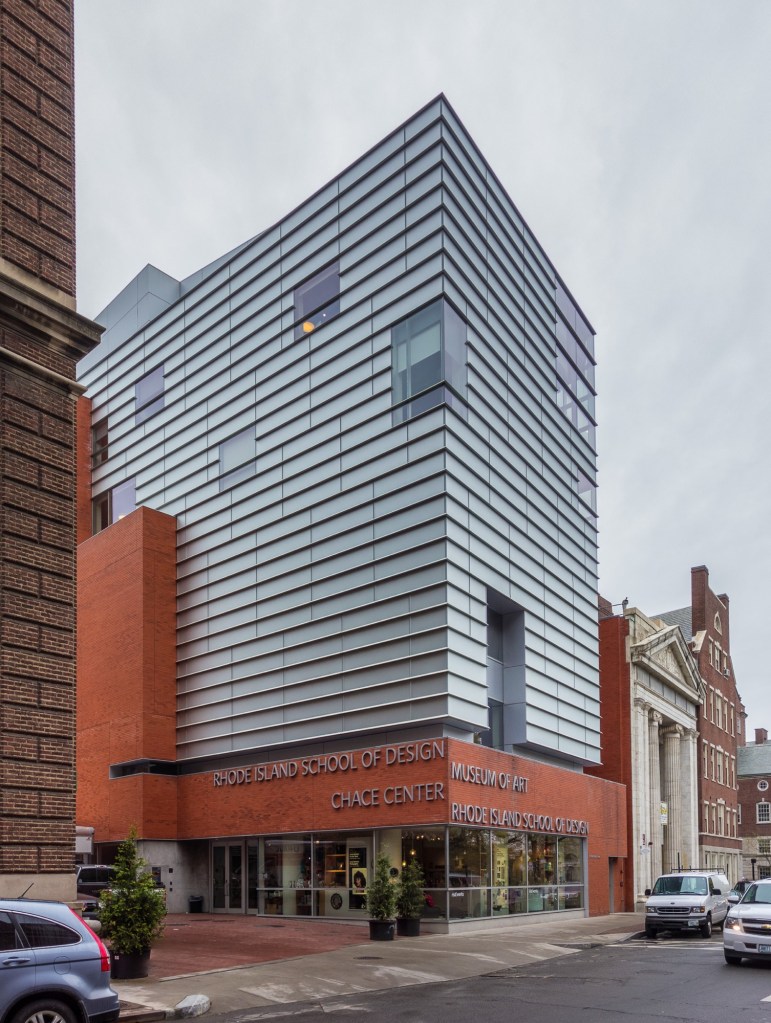
RISD Museum – Chace Center // 2008

The Chace Center, also known as the RISD Museum in Providence, Rhode Island, is a contemporary infill project that serves as both an expansion of one of the region’s premier art museums as well as a front-door to a prestigious world-class college. The college hired the firms of Rafael Moneo Arquitectos of Spain as design architect and Perry Dean Rogers as the architects on record, for the project, which includes an auditorium, student exhibit spaces, museum shop, cafe, and information center as well as being an important connector between various buildings within the block, including Memorial Hall, a significant former church built in the 1850s, and the People’s Savings Bank, a 1913 Neo-Classical building. The $34 million center was built on a former parking lot in one of the few remaining open spaces near RISD, and it was named in honor of the late Beatrice and Malcolm Chace. It is not easy to fit a contemporary museum on a tight site surrounded by historic brick buildings, but the RISD Museum does just that, with the use of contemporary brick to set the building within its context with the contrasting pearl-glass volume at the facade providing a face to the steel and glass towers in Downtown Providence.

Yale University – Yale Art Gallery Building // 1928

One of the most visually stunning and unique buildings in New England is the 1928 Yale Art Gallery building, which is connected to Street Hall (last post) via a skybridge over High Street. Completed in 1928, the Yale Art Gallery was designed by relatively little-known, but significant 20th century architect, Egerton Swartwout. Swartwout graduated from Yale College in 1891 with a B.A. degree and with no formal architecture training, was hired as a draftsman at the illustrious firm of McKim, Mead & White in New York before running his own office, Tracy and Swartwout. Built in a Gothic Renaissance style inspired by Italian buildings such as the Bargello in Florence, the sandstone masonry structure commands the prominent site with a corner tower and facade fronted by five gothic arched windows. Inside, visitors are transported to a historic Italian art museum within the Gallery Wing, with the full-height Gothic windows with walls, floors and ceilings restored and lined in stone.

Yale University – Street Hall // 1866

Closing out this series on Yale’s Old Campus, I present one of the finest Victorian Gothic collegiate buildings in the United States, Street Hall. Street Hall was designed by Peter B. Wight (who had just completed the Venetian Gothic style National Academy of Design in New York City) and opened in 1866. The building opened as the Yale School of the Fine Arts, which was the first art school on an American college campus. The building was named after Augustus Russell Street (1791–1866), a Yale graduate and New Haven businessman who donated the funds for the building’s construction on the condition that all residents of the city could enroll in the school, wanting a bridge between citizens of New Haven (“Town”) and the college “Gown”). Augustus Street and his wife, Caroline Leffingwell had seven daughters together, all of whom predeceased them. It was likely the fact he was around so many women in his life that he also required the Yale School of the Fine Arts to admit both male and female students (Yale would become co-educational and admit women to all programs in 1969.) Street Hall is a landmark example of the Victorian/Venetian Gothic style with lancet arches, polychromatic stone, and trefoil and quatrefoil stone medallions. Street Hall is now connected to, and is a part of the Yale University Art Gallery.