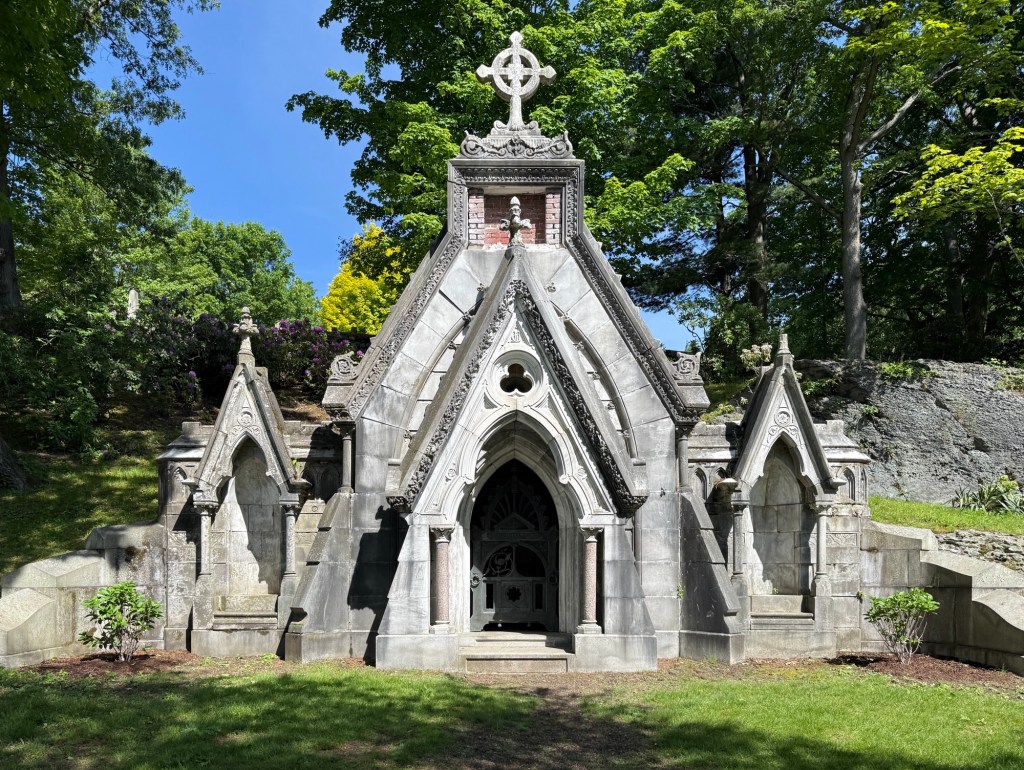
Forest Hills Cemetery – Chadwick Mausoleum // 1873

While many monuments in the Forest Hills Cemetery in Boston stand out for obvious reasons, there are many historic mausoleums dispersed throughout the cemetery, but none quite like the Chadwick Mausoleum. Mausoleums are above ground burial structures, where family can be interred together within the walls of the structure, that provides an interior space for family to mourn inside. Many mausoleums were designed by noted architects and are often outfitted with decorative bronze doors or stained-glass windows. The most visible and ornate at Forest Hills is the Chadwick Mausoleum, located at the west end of Lake Hibiscus. The structure was designed in the Gothic Revival style by William Gibbons Preston who designed the bridge over Greenwood Avenue. Nestled into the sloped hill in the rear, the stone mausoleum features a metal door bearing the name “Chadwick.” The structure was funded by Joseph Houghton Chadwick (1827-1902), following the death of his wife in 1872. Joseph was President of the Chadwick Lead Works in Downtown Boston and was a successful businessman, as a trustee of Boston University also serving as president and as a trustee of Forest Hills Cemetery where he was later interred. 
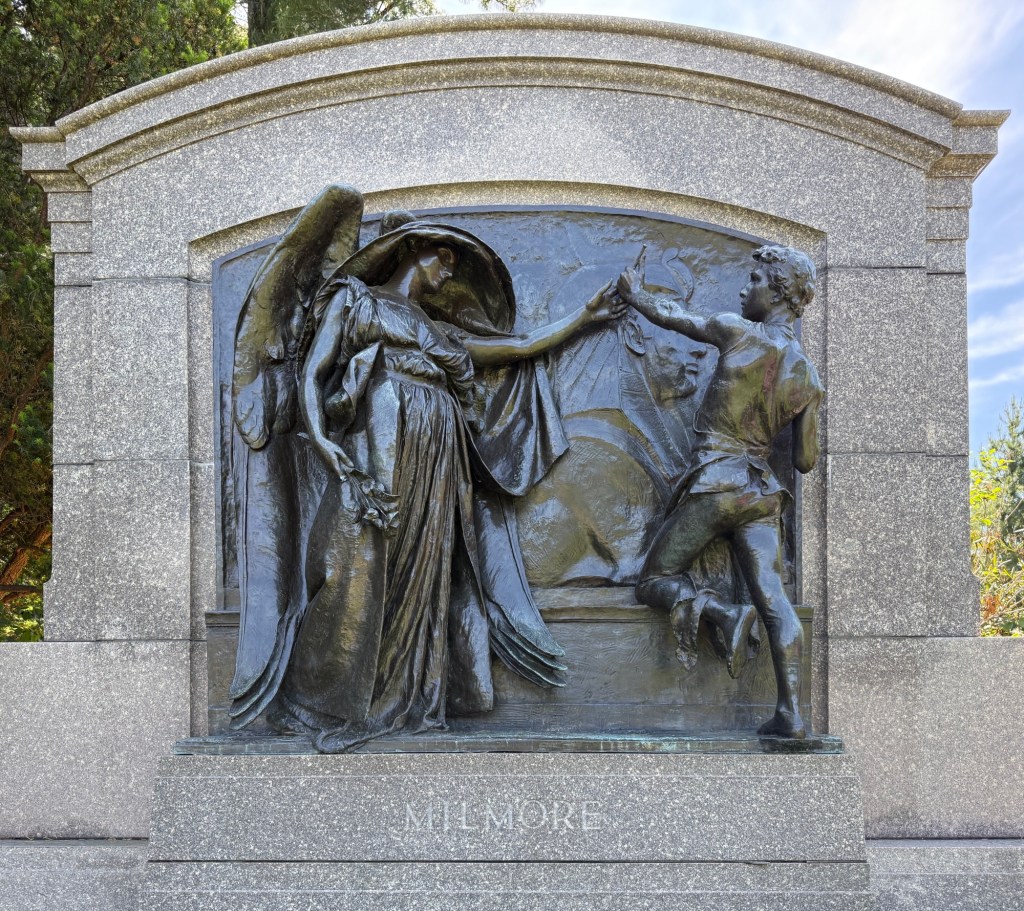
Milmore Memorial, ‘Death and the Sculptor’ // 1889

The haunting yet beautiful monument, “Death and the Sculptor” in Forest Hills Cemetery is quite possibly my favorite piece of sculptural art and a gentle reminder to not take life for granted. Commissioned in 1889 and dedicated in 1893, the bronze monument was designed by Daniel Chester French, a sculptor best known for his 1920 monumental statue of Abraham Lincoln at the Lincoln Memorial, to memorialize sculptor, Martin Milmore and his brother Joseph, a stone-cutter. Rather than portraying death as frightening or violent, French depicts a serene winged figure gently staying the hand of a young sculptor at work, suggesting a peaceful transition from earthly labor to eternal rest. The sculpture’s quiet grace, emotional depth, and masterful craftsmanship have made it a landmark of American memorial art, inviting visitors to reflect on mortality, creativity, and the enduring power of beauty in the face of loss. To tie the work to its subjects, the young sculptor is carving a Sphynx, modeled after the 1873 sculpture the brothers worked on together that is located at Mount Auburn Cemetery in Cambridge. A marble version of the work can also be found at the Metropolitan Museum of Art in New York, carved in 1917 by the Piccirilli Brothers.

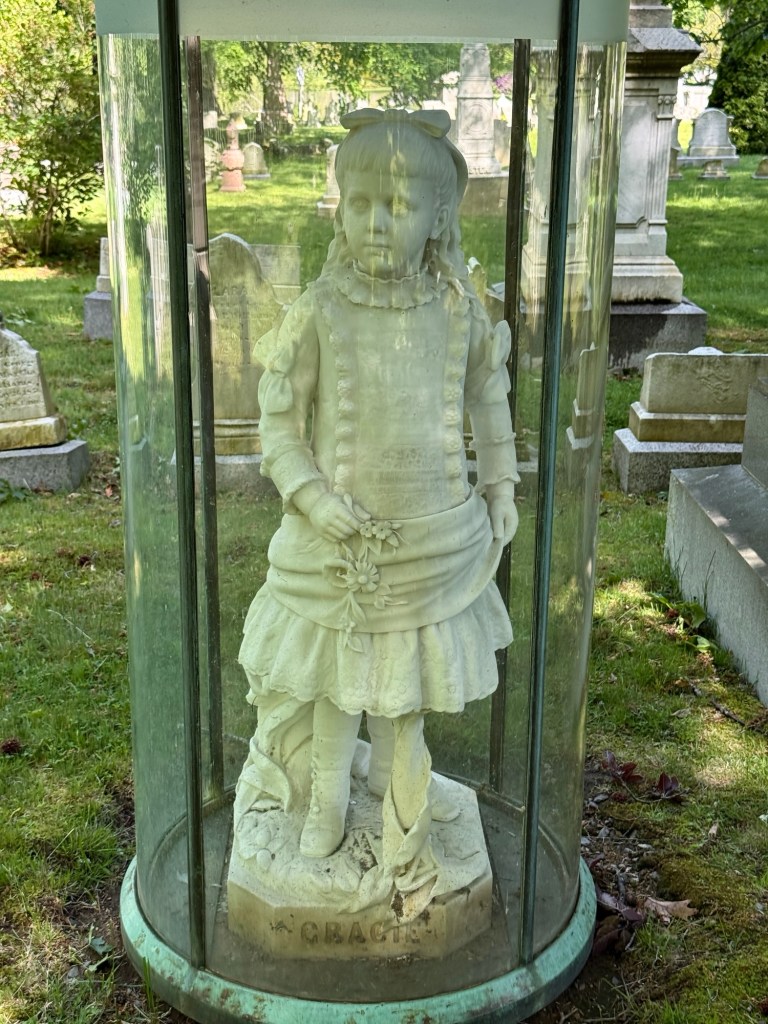
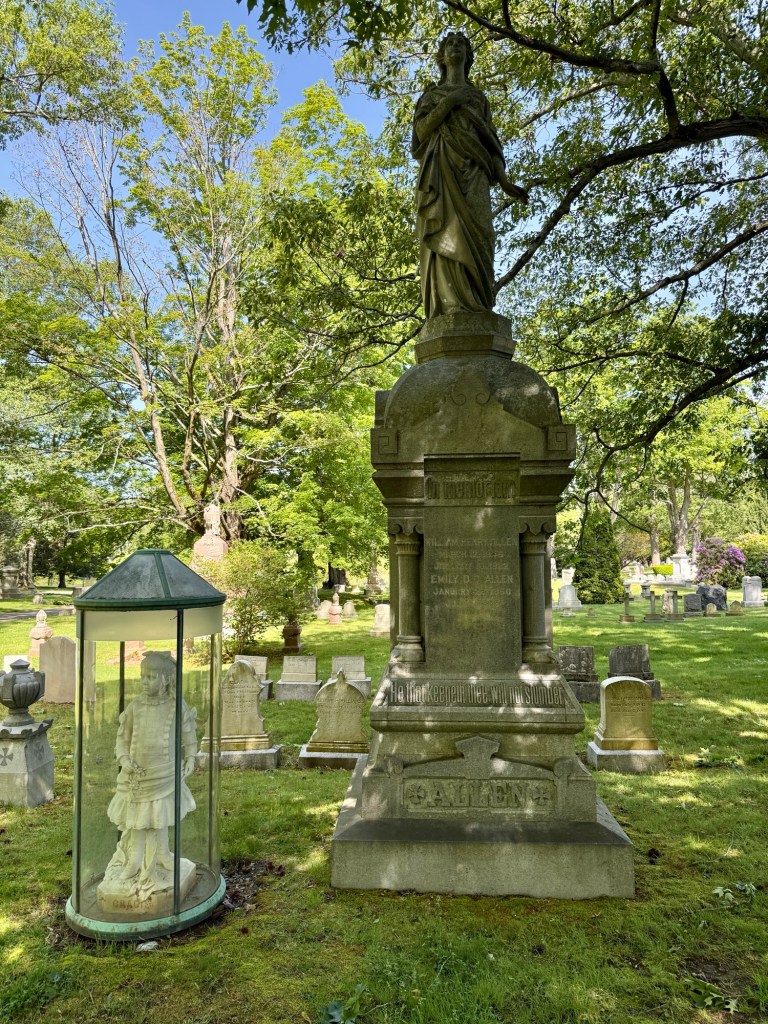
Forest Hills Cemetery – Grace Sherwood Allen Memorial, “Girl in the Glass” // 1880

Similar to the story of Louis Mieusset, the “boy in the boat” at Forest Hills Cemetery, the memorial of Grace Sherwood Allen stands as a testament to parent’s ever-lasting love of their children. “Gracie” Allen (1876-1880) was born in Boston, the only daughter of William H. and Emily Jones Allen. She died several months prior to her fifth birthday from whooping cough and was later immortalized by sculptor Sydney H. Morse, who depicted the young girl in a buttoned dress, boots and bow-tied hair. In her hand are drooping flowers, the petals of which have begun to fall, showing her life fading. The life-size white marble sculpture is covered in a bronze and glass vitrine, to protect the fragile stone from acid rain, which would stain and weather the delicate monument.

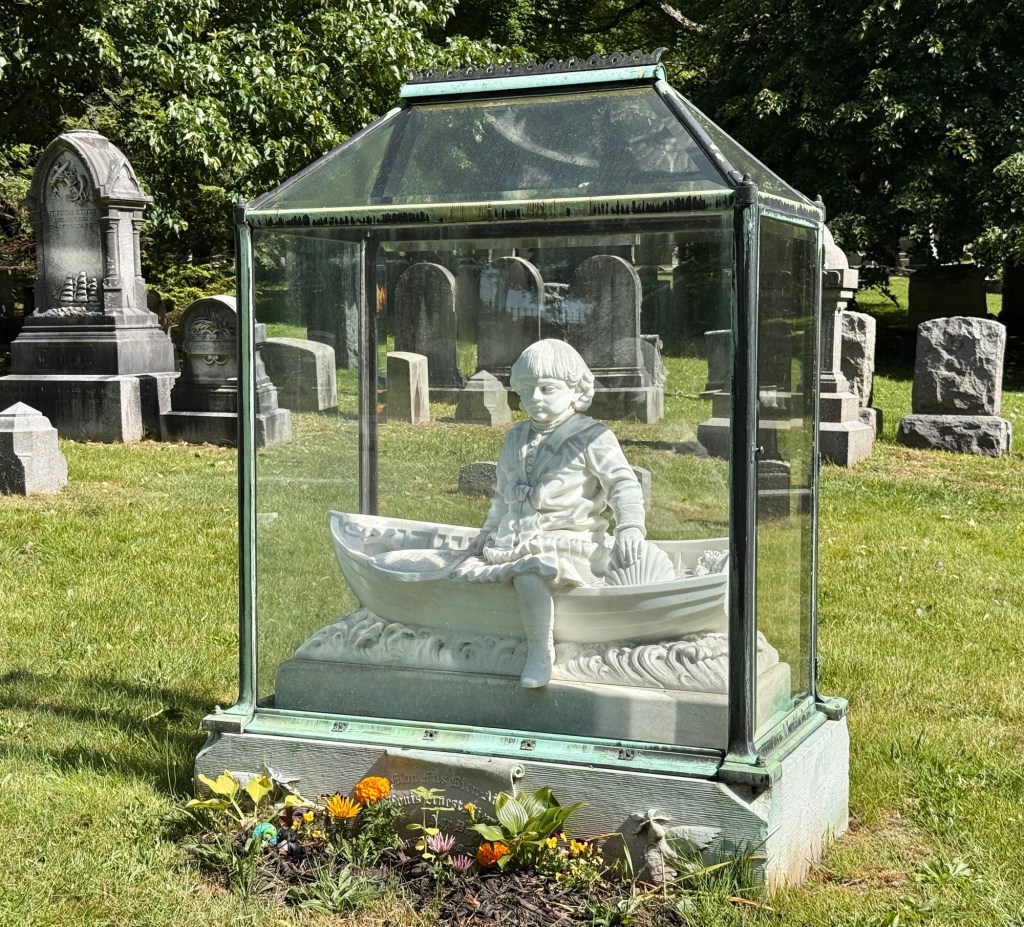
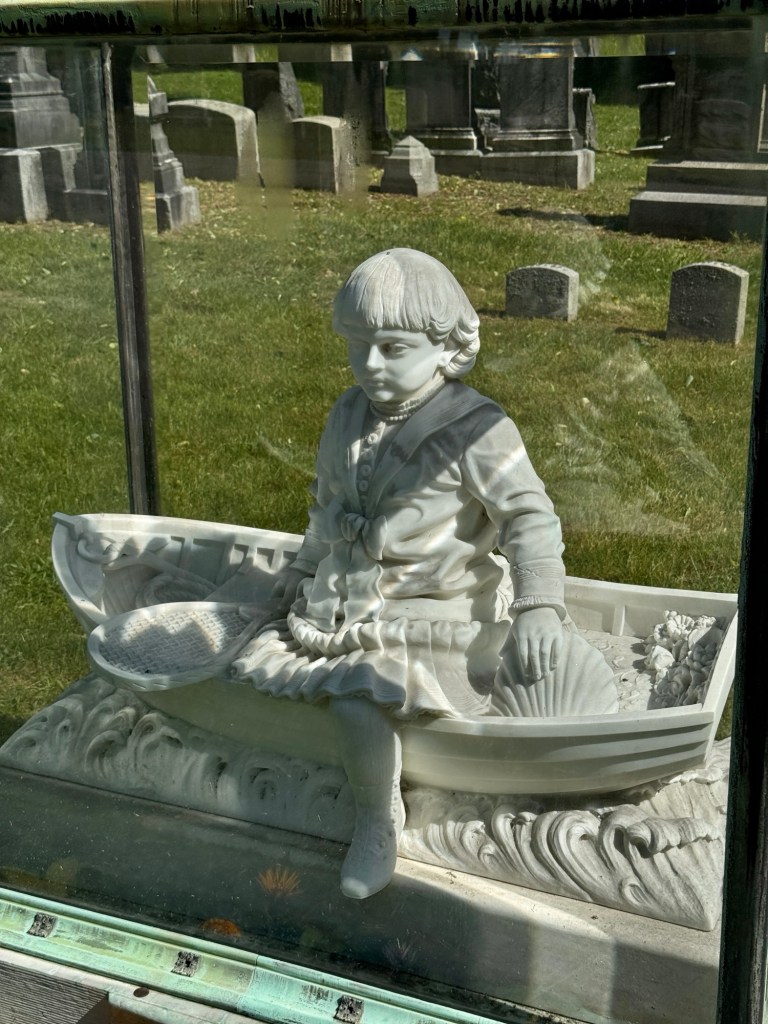
Forest Hills Cemetery – Louis Mieusset Memorial, “Boy in the Boat” // 1886

Louis Ernest Mieusset (1881-1886), just shy of his fifth birthday, died of Scarlet Fever and nephritis. His mother, Madame Louise Mieusset, took every penny she had saved for her son’s education and put it towards a commission of a funerary sculpture, depicting her late son’s playful spirit. The memorial of four-year-old Louis Mieusset is marked by a brilliant white marble figure depicting the young boy in a boat with a tennis racket in one hand and a shell in another. Marble was popular during the mid-19th century but it was understood that marble was too soft to stand up well outdoors, so it was additionally enclosed in a bronze and glass vitrine to protect it from acid rain and staining. Carved into the base, it states, “MY ONLY AND DARLING CHILD…A MOTHER’S TRIBUTE OF AFFECTION”. Madame Mieusset worked as a hat-maker in Boston, and after the death of her son, she struggled financially to support herself between frequent visits to mourn her son, even decades after his death. Louise planned to be buried next to her son, but died penniless in 1936. As she did not leave funds for burial in Forest Hills Cemetery, her body was buried in a pauper’s lot, until (legend says) Boston Mayor James Curley paid her burial expenses, funding the relocation of her body, allowing for her eternal rest with her late son Louis.

A similar monument, known as the “Girl in the Glass” is also found at Forest Hills.

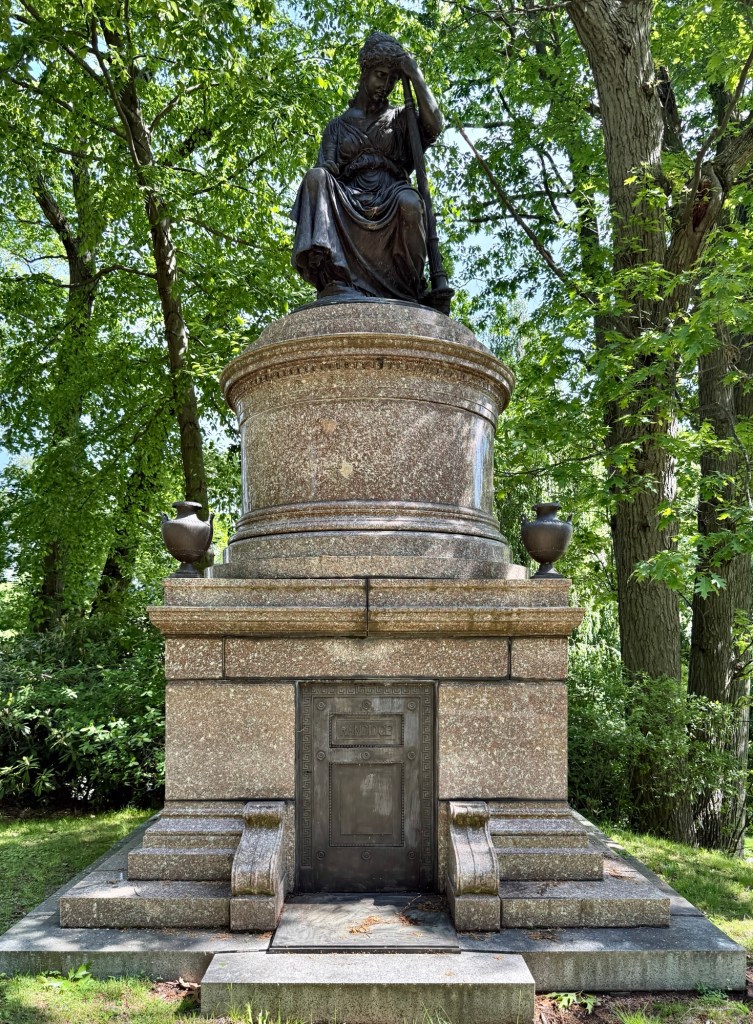
Forest Hills Cemetery – Randidge Monument, “Grief” // c.1891

Rural cemeteries are known for their beautiful grounds and winding pathways lined by sculptural monuments to the dead, and Forest Hills Cemetery in Boston is one of the best examples to stroll around and see some of the finest memorials in the country. Titled “Grief”, the Randidge Monument is located on Fir Avenue in Forest Hills Cemetery is the memorial to George and Caroline Randidge of Boston. George Randidge (1820-1890) was a merchant and tailor who died in 1890 and his widow, Caroline, appears to have funded the design and fabrication of this iconic monument. Executed in 1891 by sculptor Adolph Robert Kraus, a bronze seated figure of Grief in classical robes leans in sorrow on an inverted torch, atop the enormous granite base designed by the architectural firm of Fehmer and Page. In 1895, less than four years after the loss of her husband, Caroline Randidge joined George here and her grief was no longer.

Robert Gould Shaw Memorial // 1897

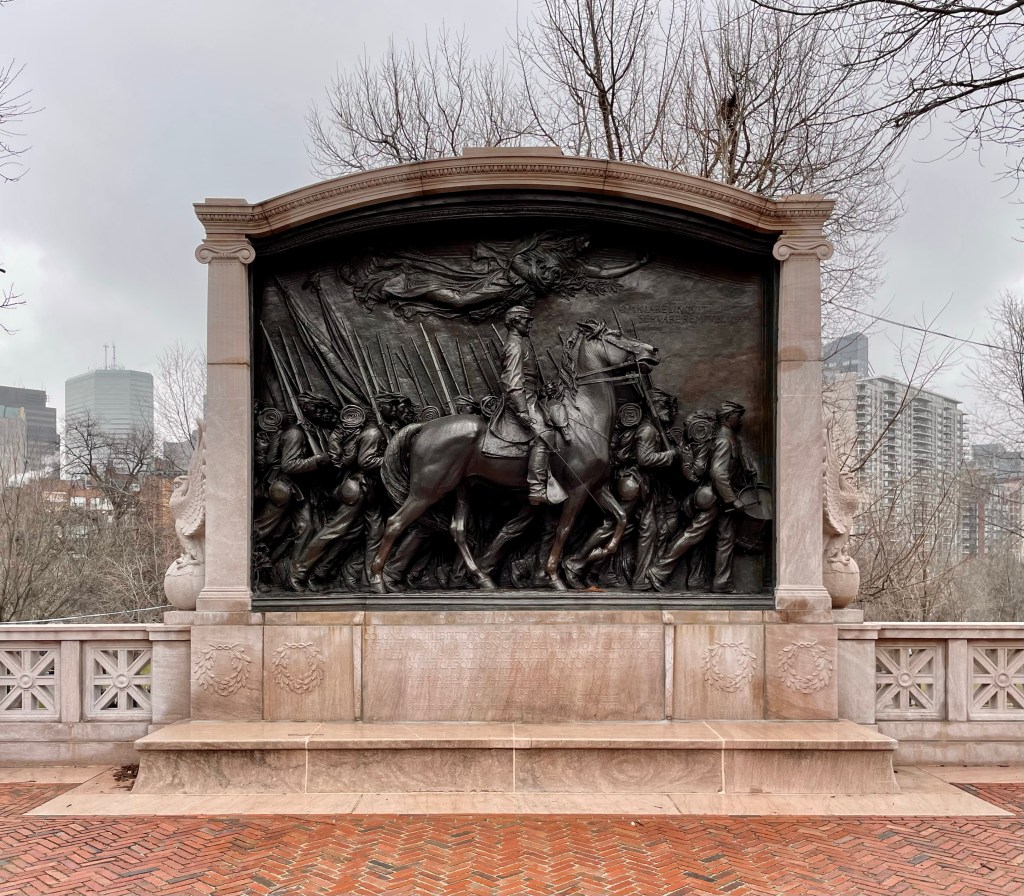
Commissioned from the celebrated American sculptor Augustus Saint-Gaudens in the early 1880s and dedicated in 1897, The Shaw 54th Regiment Memorial (aka the Robert Gould Shaw Memorial) has been acclaimed as the greatest American sculpture of the 19th century. The memorial was designed by famed artist Augustus Saint-Gaudens, and it is a stop on the Boston Black Heritage Trail, commemorating the valiant efforts of Colonel Robert Gould Shaw and the men of the 54th Massachusetts, one of the first Civil War regiments of African Americans enlisted in the North. In July 1863, the regiment was sent to South Carolina where an assault was planned on Fort Wagner guarding Charleston harbor. Shaw had asked to have 54th Regiment lead the attack. Of the 600 men in the attack that day, there were 285 casualties, and Col. Shaw was killed, but the men never wavered in the battle and demonstrated great courage and determination. Following this display of valor, other black regiments were formed, and by the end of the war, 10% of the union army was made up of African American soldiers.

The monument in Boston shows the 25-year-old Shaw seated on his horse, with his regiment as it marched down Beacon Street on May 28, 1863 to depart the city to fight in the South. The concept of Shaw on horseback with marching soldiers was inspired, at least in part, from a painting Saint-Gaudens saw in France, Campagne de France 1814, by Jean-Louis Ernest Meissonier, which depicts Napoleon on horseback with rows of infantry in the background.While Shaw is the centerpiece of the monument, the significance of the monument is the Shaw Memorial is the first civic monument to pay homage to the heroism of African American soldiers in the U.S.