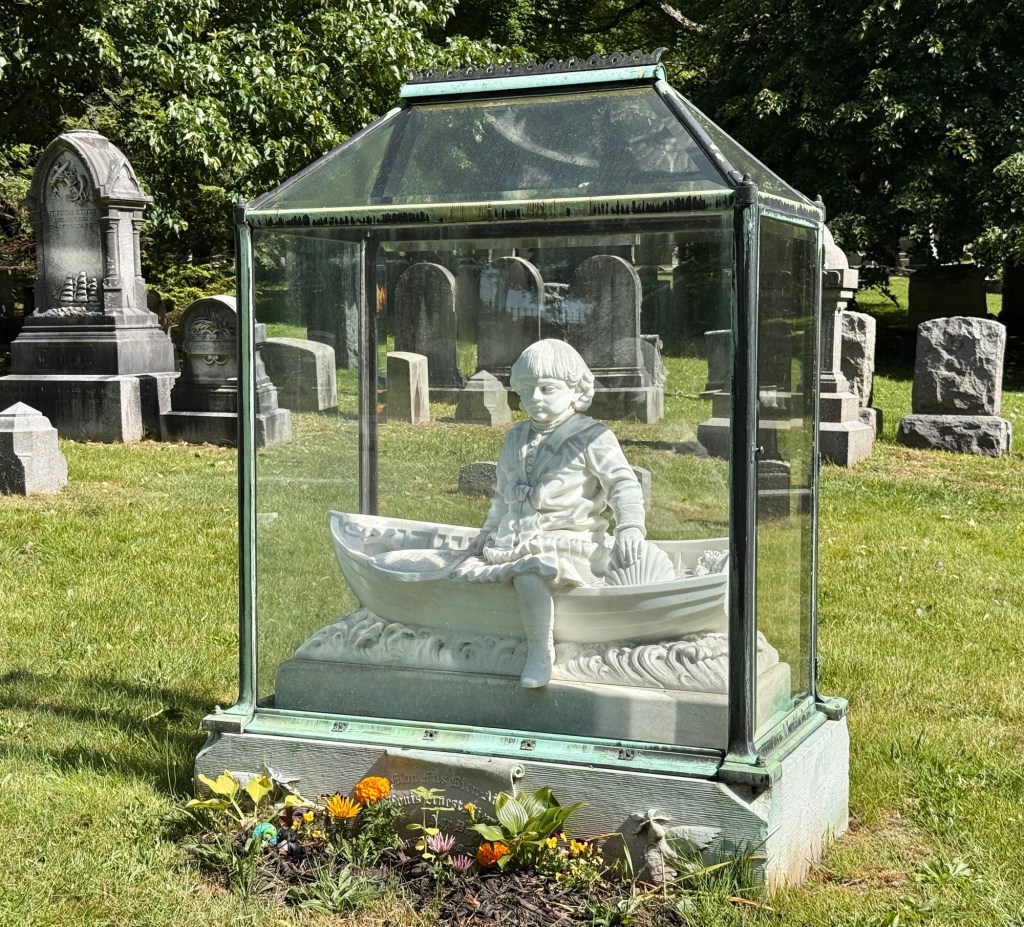
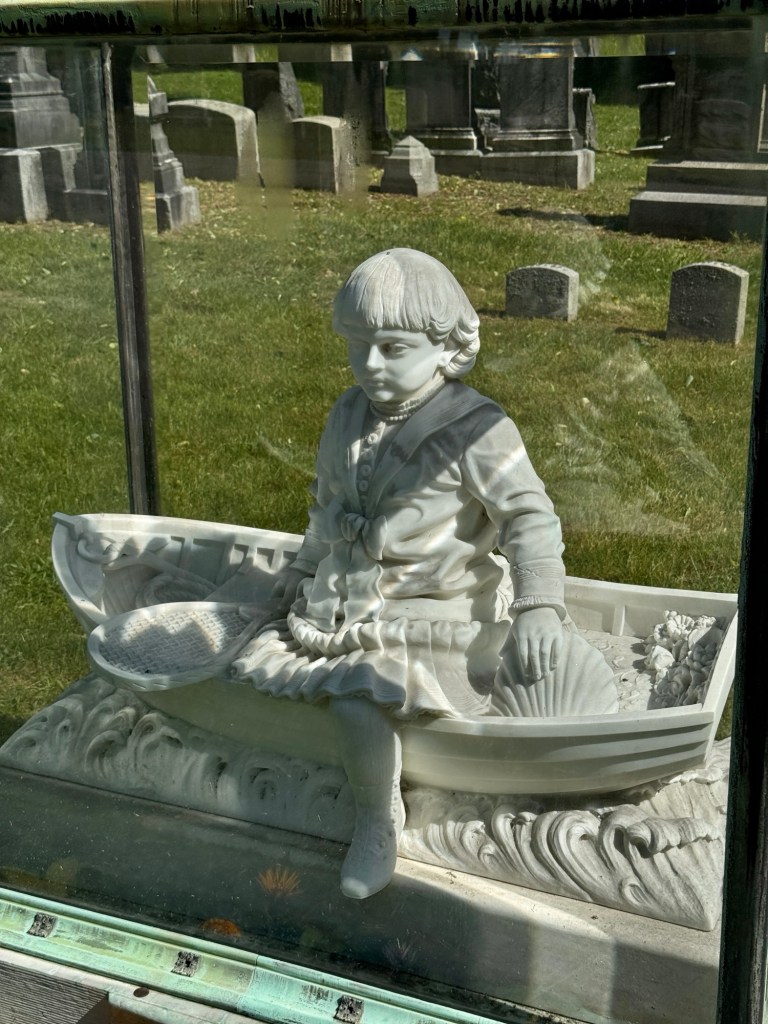
Louis Ernest Mieusset (1881-1886), just shy of his fifth birthday, died of Scarlet Fever and nephritis. His mother, Madame Louise Mieusset, took every penny she had saved for her son’s education and put it towards a commission of a funerary sculpture, depicting her late son’s playful spirit. The memorial of four-year-old Louis Mieusset is marked by a brilliant white marble figure depicting the young boy in a boat with a tennis racket in one hand and a shell in another. Marble was popular during the mid-19th century but it was understood that marble was too soft to stand up well outdoors, so it was additionally enclosed in a bronze and glass vitrine to protect it from acid rain and staining. Carved into the base, it states, “MY ONLY AND DARLING CHILD…A MOTHER’S TRIBUTE OF AFFECTION”. Madame Mieusset worked as a hat-maker in Boston, and after the death of her son, she struggled financially to support herself between frequent visits to mourn her son, even decades after his death. Louise planned to be buried next to her son, but died penniless in 1936. As she did not leave funds for burial in Forest Hills Cemetery, her body was buried in a pauper’s lot, until (legend says) Boston Mayor James Curley paid her burial expenses, funding the relocation of her body, allowing for her eternal rest with her late son Louis.
A similar monument, known as the “Girl in the Glass” is also found at Forest Hills.