Forest Hills Cemetery – Crematorium & Columbarium // 1893

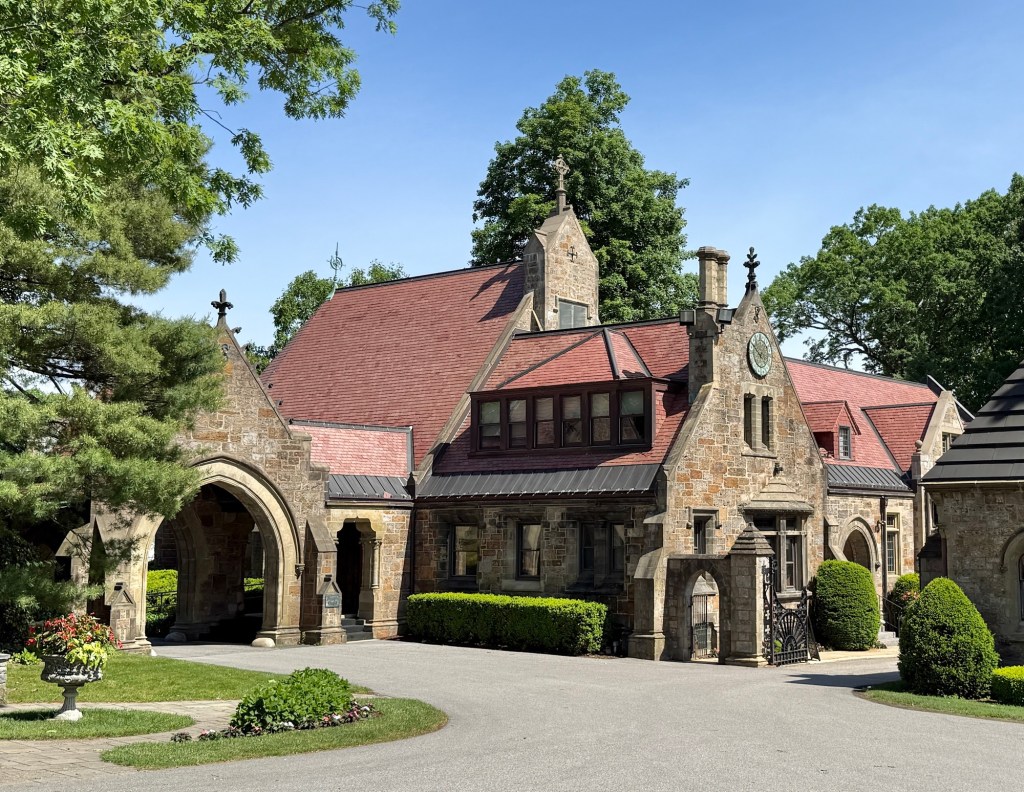
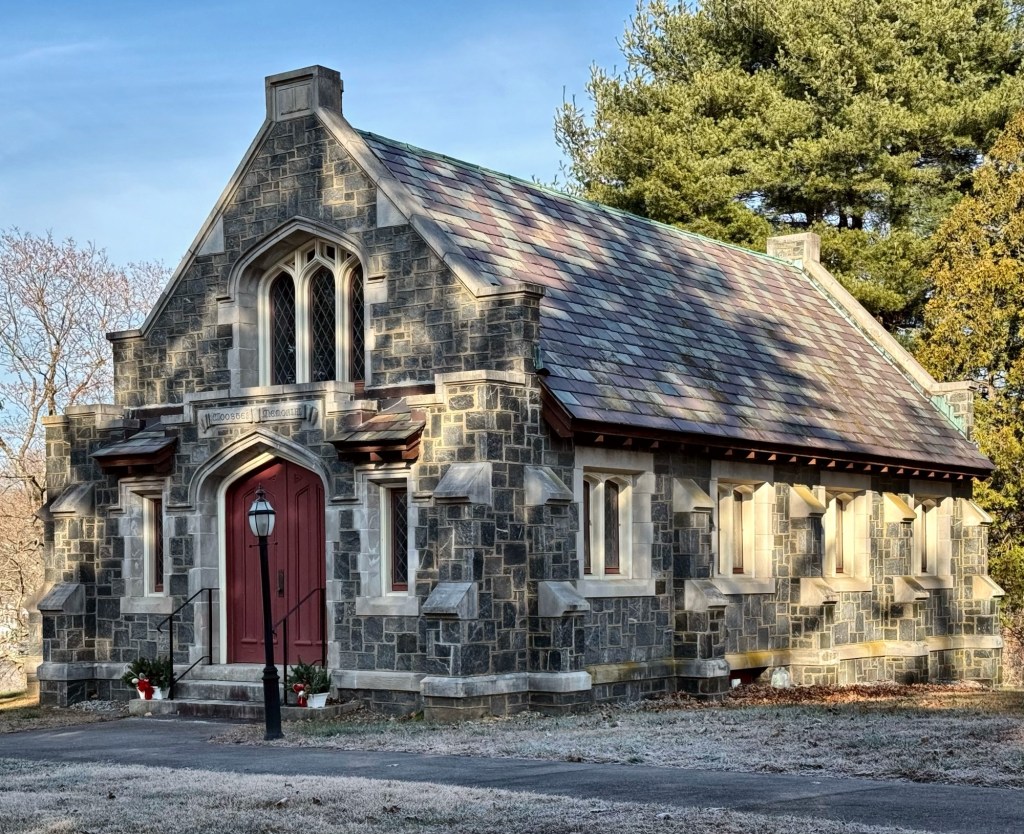
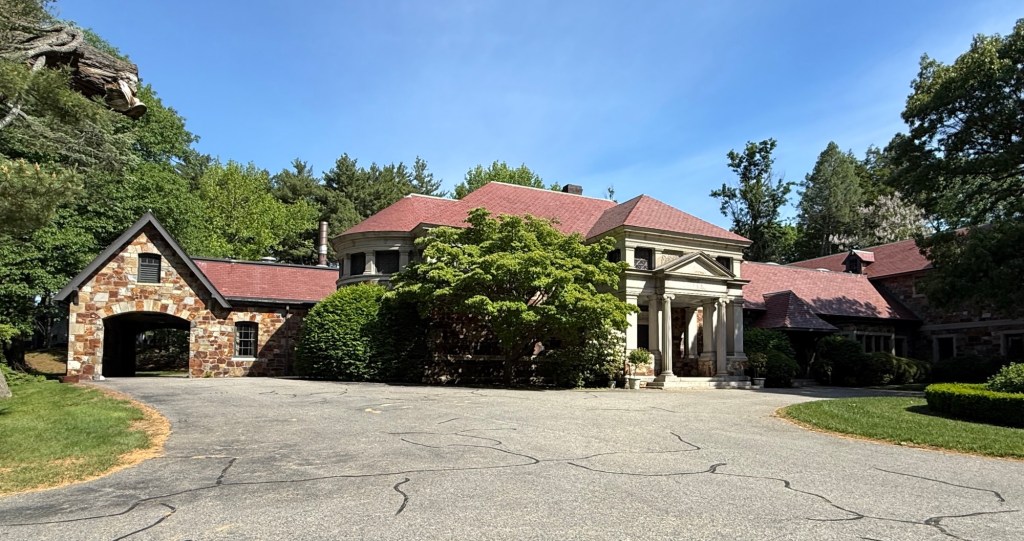
Separate from the main cemetery parcel, the Forest Hills Cemetery Crematory and Columbarium is architecturally significant and also historically significant as the the first crematory in New England. The cremation building was constructed in 1893 by the Massachusetts Cremation Society, an organization unaffiliated with the cemetery across the street. The original crematory building was designed by Ludvig Sandöe Ipsen, a Danish-American artist and designer who is best-known for his book illustrations. It is unclear why Ipsen, who had almost entirely given up architecture as a profession, was selected by the Massachusetts Cremation Society, but he showcased his design expertise for this handsome masonry building. The original crematory included a chapel, operating plant, guest area, and offices. Classical Revival in style, the building is constructed of granite with limestone trim and capped by a red slate roof. The first cremation in New England occurred here in 1894, when Lucy Stone, the important abolitionist and suffragist, passed away and was cremated here. The chapel inside the building was named after Lucy Stone. In 1905, the columbarium was added from plans by Ipsen, where cremated remains of the dead are stored and displayed in urns. In 1925, the property was sold to the Forest Hills Cemetery association and the building expanded to its current size.
Milmore Memorial, ‘Death and the Sculptor’ // 1889

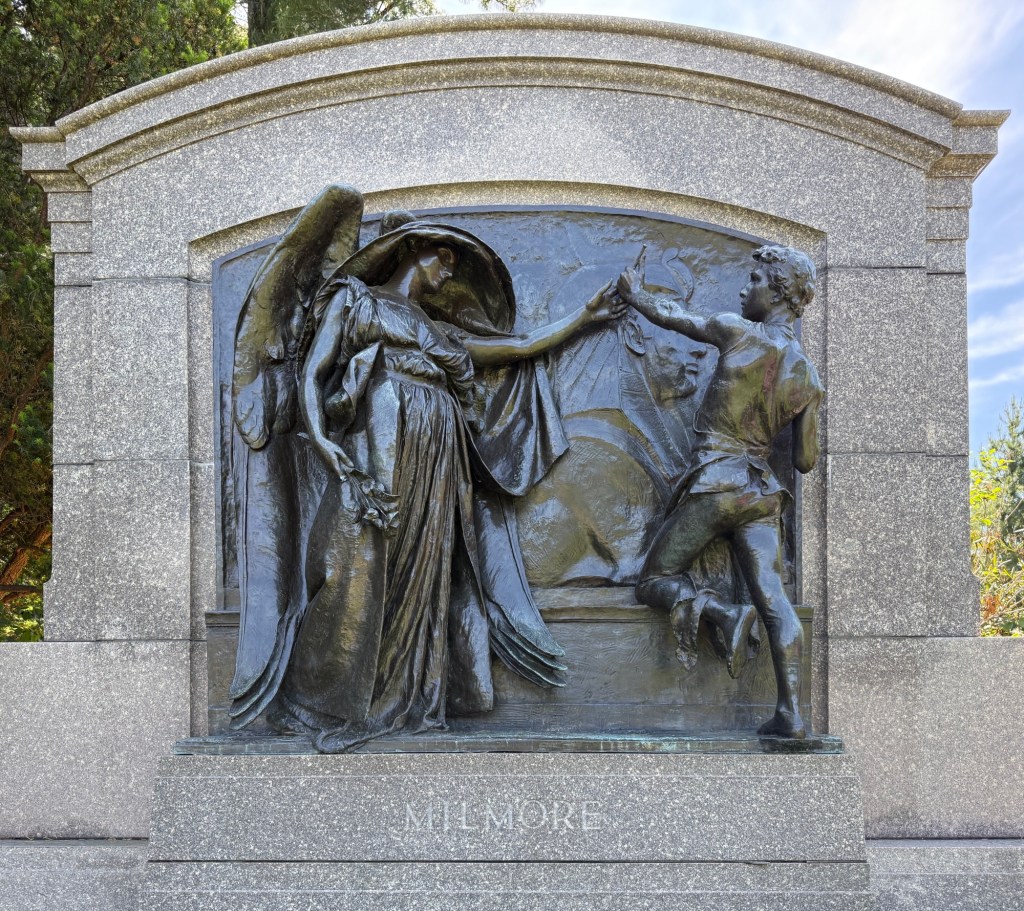
The haunting yet beautiful monument, “Death and the Sculptor” in Forest Hills Cemetery is quite possibly my favorite piece of sculptural art and a gentle reminder to not take life for granted. Commissioned in 1889 and dedicated in 1893, the bronze monument was designed by Daniel Chester French, a sculptor best known for his 1920 monumental statue of Abraham Lincoln at the Lincoln Memorial, to memorialize sculptor, Martin Milmore and his brother Joseph, a stone-cutter. Rather than portraying death as frightening or violent, French depicts a serene winged figure gently staying the hand of a young sculptor at work, suggesting a peaceful transition from earthly labor to eternal rest. The sculpture’s quiet grace, emotional depth, and masterful craftsmanship have made it a landmark of American memorial art, inviting visitors to reflect on mortality, creativity, and the enduring power of beauty in the face of loss. To tie the work to its subjects, the young sculptor is carving a Sphynx, modeled after the 1873 sculpture the brothers worked on together that is located at Mount Auburn Cemetery in Cambridge. A marble version of the work can also be found at the Metropolitan Museum of Art in New York, carved in 1917 by the Piccirilli Brothers.

Forest Hills Cemetery – Grace Sherwood Allen Memorial, “Girl in the Glass” // 1880

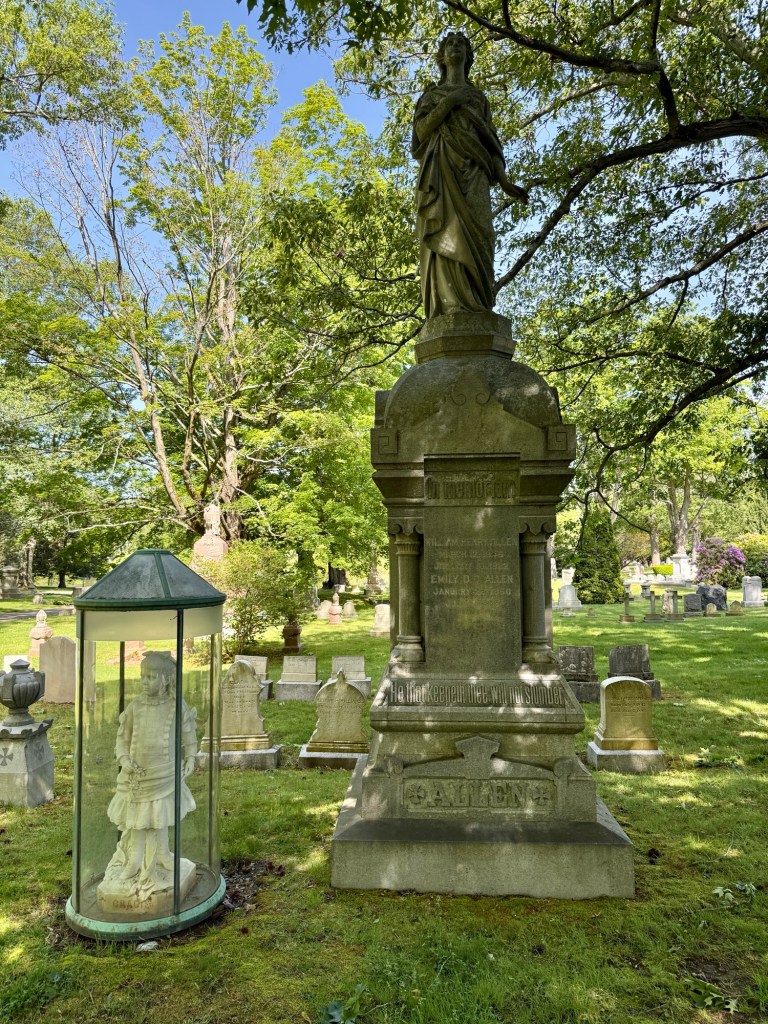
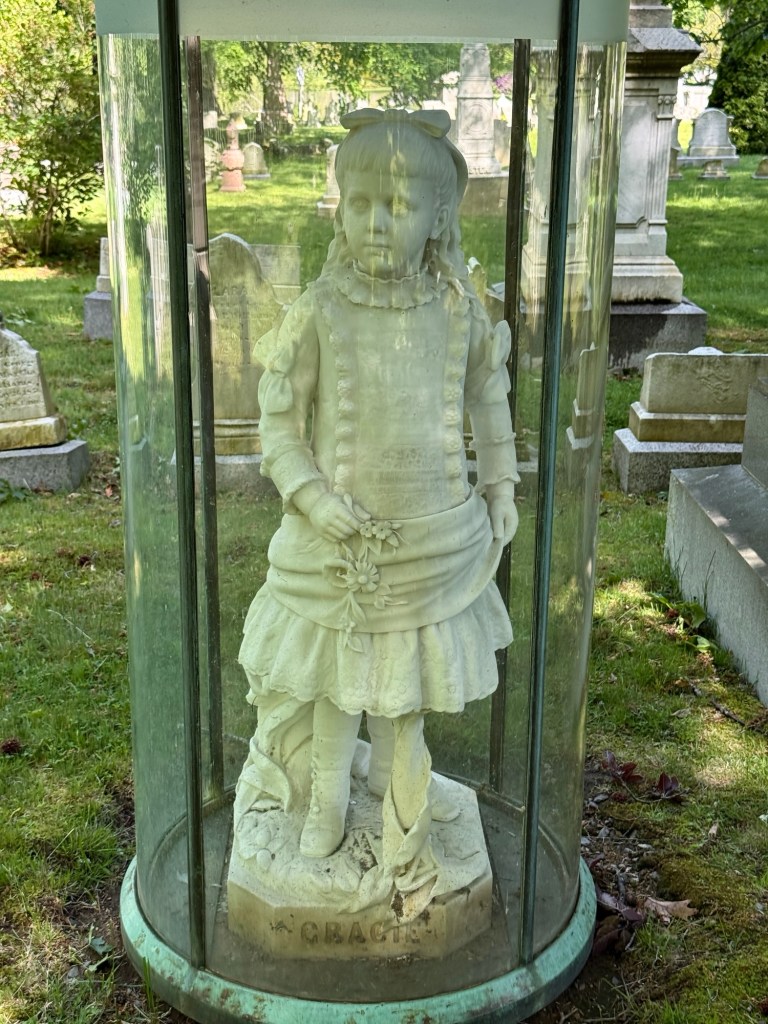
Similar to the story of Louis Mieusset, the “boy in the boat” at Forest Hills Cemetery, the memorial of Grace Sherwood Allen stands as a testament to parent’s ever-lasting love of their children. “Gracie” Allen (1876-1880) was born in Boston, the only daughter of William H. and Emily Jones Allen. She died several months prior to her fifth birthday from whooping cough and was later immortalized by sculptor Sydney H. Morse, who depicted the young girl in a buttoned dress, boots and bow-tied hair. In her hand are drooping flowers, the petals of which have begun to fall, showing her life fading. The life-size white marble sculpture is covered in a bronze and glass vitrine, to protect the fragile stone from acid rain, which would stain and weather the delicate monument.

Forest Hills Cemetery – Louis Mieusset Memorial, “Boy in the Boat” // 1886

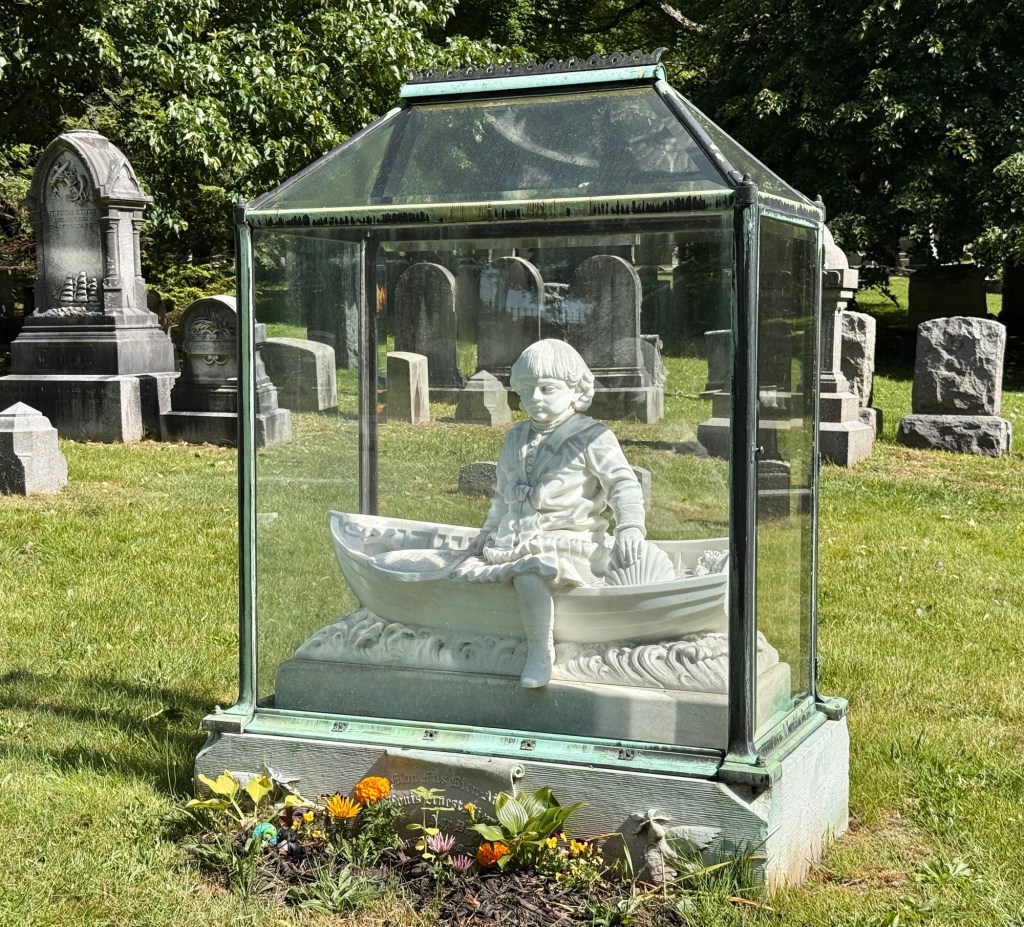
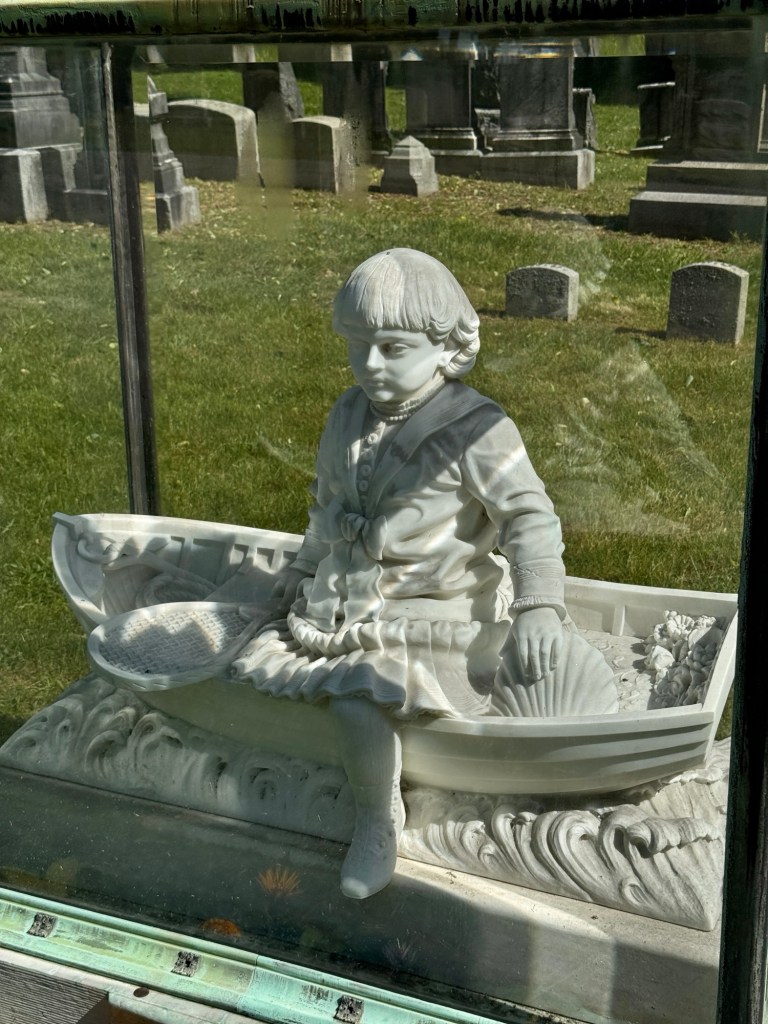
Louis Ernest Mieusset (1881-1886), just shy of his fifth birthday, died of Scarlet Fever and nephritis. His mother, Madame Louise Mieusset, took every penny she had saved for her son’s education and put it towards a commission of a funerary sculpture, depicting her late son’s playful spirit. The memorial of four-year-old Louis Mieusset is marked by a brilliant white marble figure depicting the young boy in a boat with a tennis racket in one hand and a shell in another. Marble was popular during the mid-19th century but it was understood that marble was too soft to stand up well outdoors, so it was additionally enclosed in a bronze and glass vitrine to protect it from acid rain and staining. Carved into the base, it states, “MY ONLY AND DARLING CHILD…A MOTHER’S TRIBUTE OF AFFECTION”. Madame Mieusset worked as a hat-maker in Boston, and after the death of her son, she struggled financially to support herself between frequent visits to mourn her son, even decades after his death. Louise planned to be buried next to her son, but died penniless in 1936. As she did not leave funds for burial in Forest Hills Cemetery, her body was buried in a pauper’s lot, until (legend says) Boston Mayor James Curley paid her burial expenses, funding the relocation of her body, allowing for her eternal rest with her late son Louis.

A similar monument, known as the “Girl in the Glass” is also found at Forest Hills.

Forest Hills Cemetery – Receiving Tomb // 1871

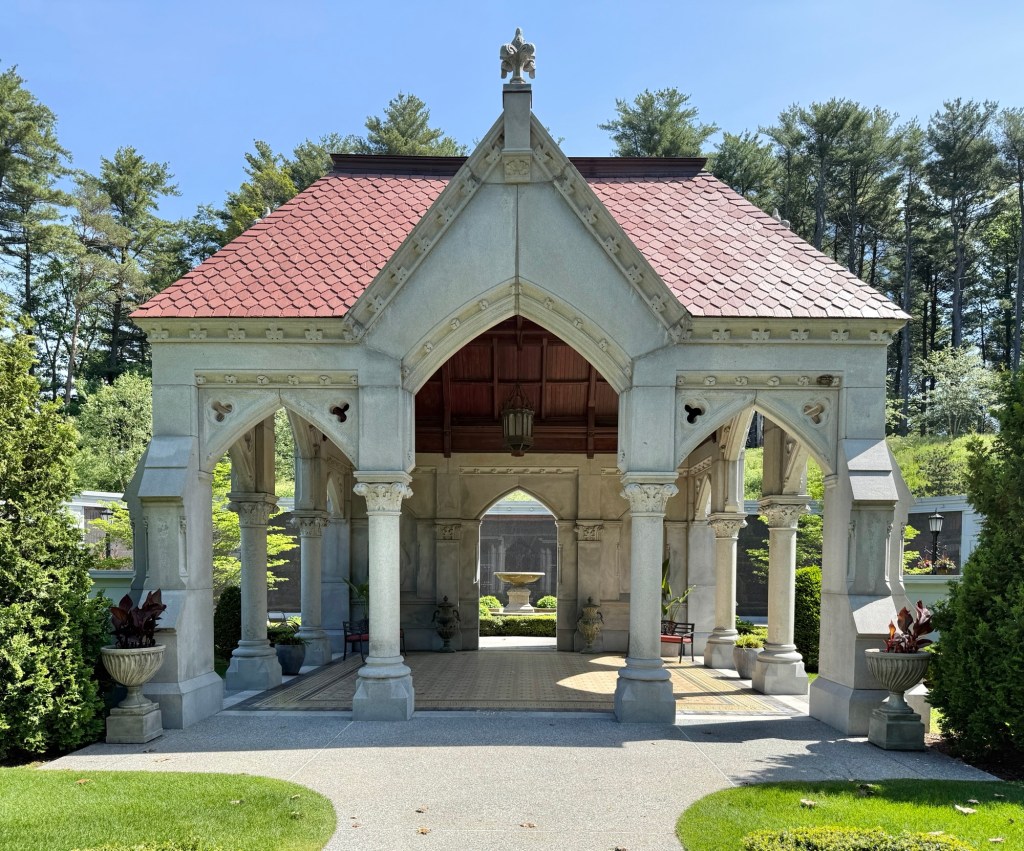
The Gothic Revival receiving tomb at Forest Hills Cemetery in Boston is located not far from the iconic entrance gate and chapel/offices. The structure was built in 1871 and designed by architects, Carl Fehmer and William R. Emerson in the Gothic style, a prevalent aesthetic that the overseers encouraged for the various 19th century buildings constructed on the grounds. Historically, the Gothic Revival structure served as the entrance to underground holding tombs for the temporary storage of bodies awaiting burial or relocation, typically stored when the ground was too frozen for burial. The structure features a granite structure with oak ceiling and painted tile flooring. A massive project began in 2016 to excavate and build a new Garden Mausoleum, built into the landscape with the restored Receiving Tomb serving as the focal point. The tomb portico was adapted as a gateway to an open-air courtyard flanked by walls set into the slope which contain internment chambers for burials, with a restored fountain in front and woman archer statue atop.

Forest Hills Cemetery – Stone Bridge // 1891

Forest Hills Cemetery in Boston was established in 1848 in the rural cemetery tradition, which followed Mount Auburn Cemetery, established in 1831 in nearby Cambridge and Watertown. The site was a municipal cemetery in Roxbury until it was annexed into Boston in 1868, becoming a private, non-denominational burial place for the who’s who of the area. The cemetery was envisioned by Henry A. S. Dearborn, who was the mayor of Roxbury in 1847 and first president of the Massachusetts Horticulture Society, who had also been instrumental in creating Mount Auburn. Since its creation in 1848, Forest Hills has grown from its original 72 acres to a total of approximately 250 acres today and is known for the rich topography and vegetation, dotted by thousands of beautiful monuments to the deceased and some iconic architectural landmarks tucked away in its winding paths. Forest Hills Cemetery was located on this site due to its varied natural features, which included hills, valleys and lakes, which together were preserved to enhance the experience of those visiting nearly 200 years later. The site’s topography consists of a series of geological drumlins of Roxbury puddingstone, an important material that was used in building projects all over the region (and for some of the buildings and monuments in Forest Hills). It is the burial place of a remarkable cross-section of people that reflect almost every aspect of American life — from statesmen to soldiers to industrialists to abolitionists to artists to poets. Forest Hills Cemetery is a somewhat hidden gem and is one of the best places in the area to walk and explore. 

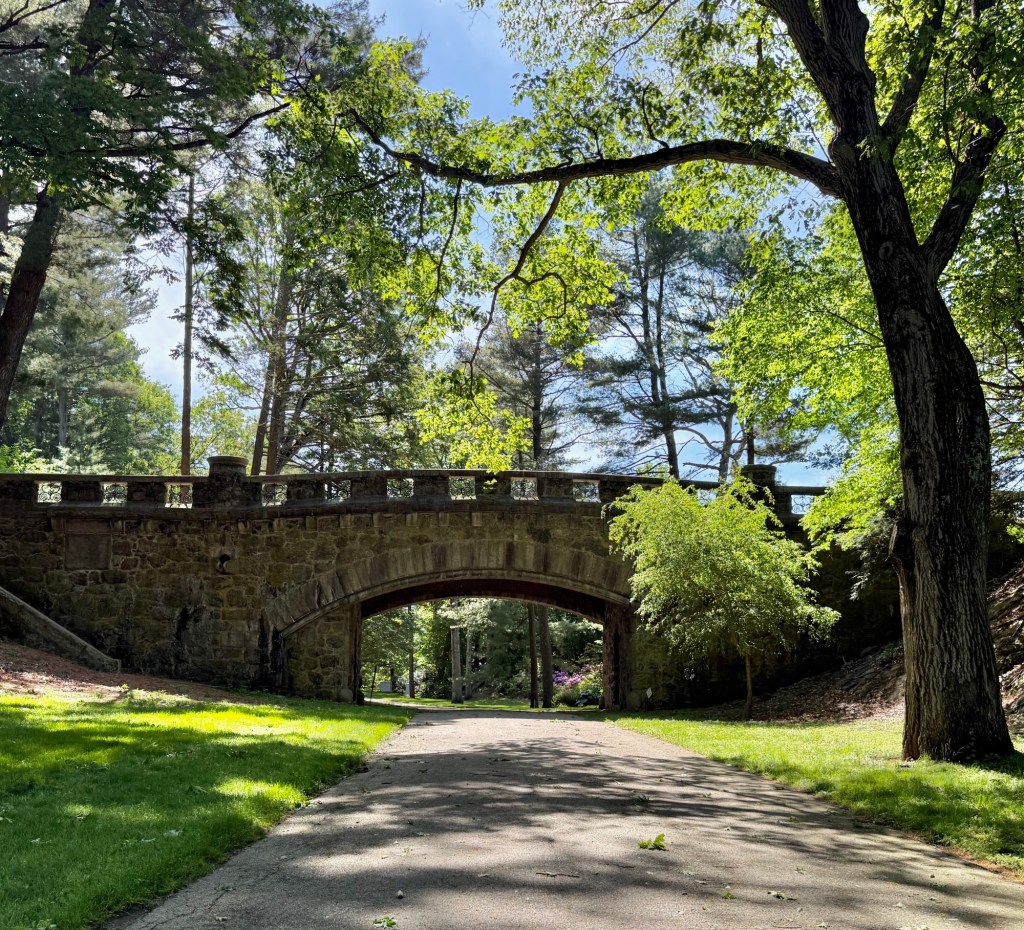
The stone bridge in Forest Hills spans over Greenwood Avenue, linking Consecration Hill to Milton Hill, was designed by William Gibbons Preston and built in 1891-1892. It is 180’ long and 23’ wide and was constructed of random laid Roxbury puddingstone with granite trim and is capped by a stone balustrade inlaid with decorative cast iron. The bridge shows that even a traditionally functional structure in the cemetery was designed with intent and was a vessel to enhance the experience of those visiting. Stay tuned for more sites in this iconic landscape!

Forest Hills Cemetery – Bell Tower // 1876

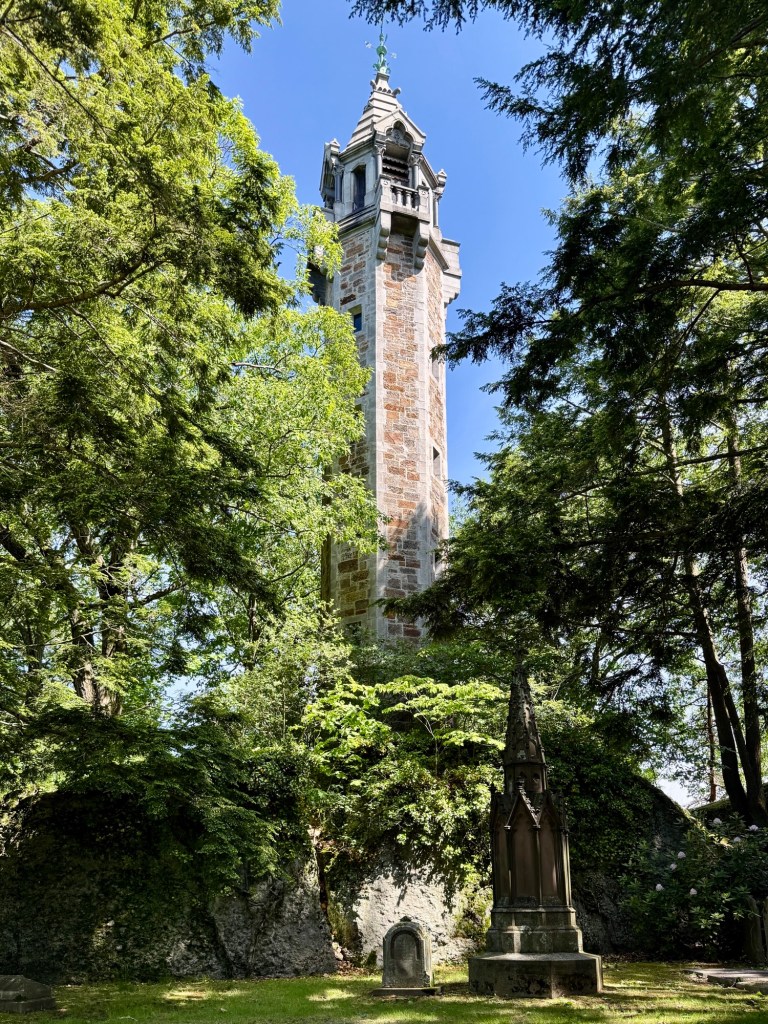
Built atop Snowflake Hill just inside the entrance of the Forest Hills Cemetery in Boston, the cemetery’s bell tower stands as an architectural landmark in the iconic historic landscape. Completed in 1876, the octagonal, Victorian Gothic Revival style tower stands 100 feet tall and is built atop an outcropping of Roxbury puddingstone. The structure is also built of local Roxbury puddingstone blocks and trimmed with granite. The roof is clad with granite tiles and topped with an ornate copper weathervane. Originally, a swinging bell was rung in the tower, but it was replaced by an electronic carillon. The architect is not known for the handsome structure, but the contractors were the Concord and Roxbury Granite Railway Company, and the builders were Jacobs & Kelly of Boston.

Forest Hills Cemetery – Forsyth Chapel and Office // 1884 & 1921

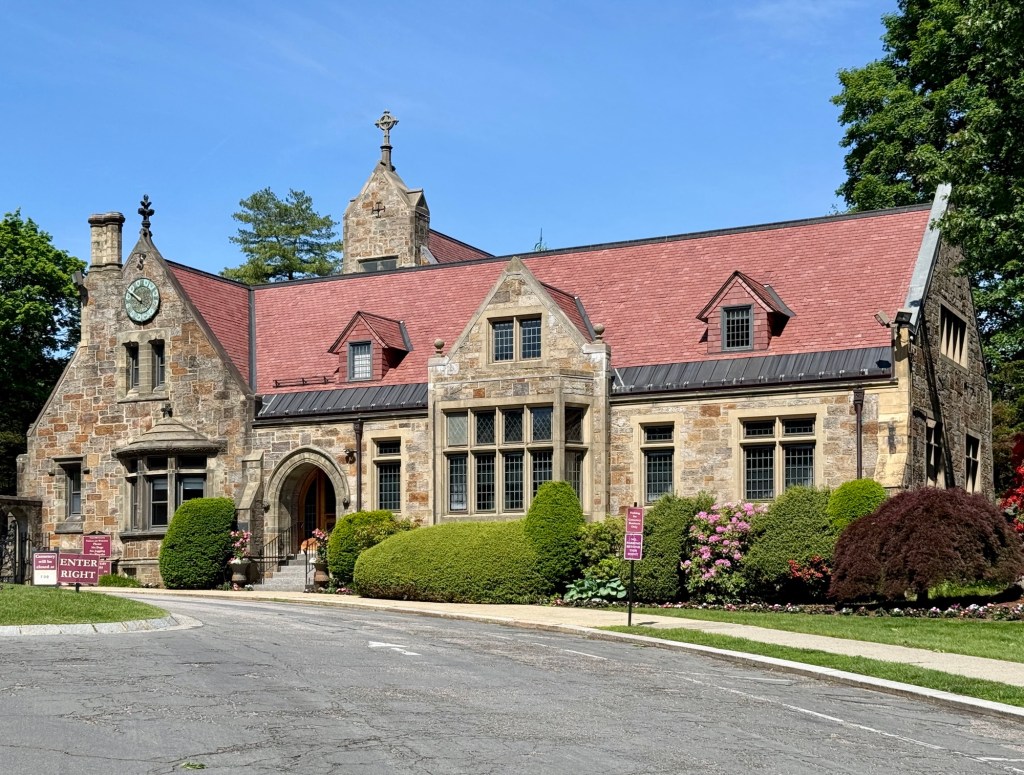
Adjacent to the Entrance Gate at Forest Hills Cemetery, the Forsyth Chapel and Cemetery Office building stands at the ceremonial entrance to the iconic landscape and architecturally compliments the adjacent structure and surrounding grounds. The Forsyth Chapel was designed by the firm of Van Brunt and Howe and completed in 1884 as a space for mourners and for celebration of lives well-lived. The chapel was expanded in 1921-22 when the Boston firm of Andrews, Jacques & Rantoul, was commissioned to expand the building perpendicular to the gateway, and expand the offices in the building, to serve the greater administrative needs of the busy cemetery and burial planning. The Neo-Gothic addition continues the architectural aesthetic of the cemetery, while being clearly of its time, a well-intentioned and designed addition.

Forest Hills Cemetery – Entrance Gate // 1865

Forest Hills Cemetery in Boston was established in 1848 in the rural cemetery tradition, which followed Mount Auburn Cemetery, established in 1831 in nearby Cambridge and Watertown. The site was a municipal cemetery in Roxbury until it was annexed into Boston in 1868, becoming a private, non-denominational burial place for the who’s who of the area. The cemetery was envisioned by Henry A. S. Dearborn, who was the mayor of Roxbury in 1847 and first president of the Massachusetts Horticulture Society, who had also been instrumental in creating Mount Auburn. Since its creation in 1848, Forest Hills has grown from its original 72 acres to a total of approximately 250 acres today and is known for the rich topography and vegetation, dotted by thousands of beautiful monuments to the deceased and some iconic architectural landmarks tucked away in its winding paths. Forest Hills Cemetery was located on this site due to its varied natural features, which included hills, valleys and lakes, which together were preserved to enhance the experience of those visiting nearly 200 years later. The site’s topography consists of a series of geological drumlins of Roxbury puddingstone, an important material that was used in building projects all over the region (and for some of the buildings and monuments in Forest Hills).

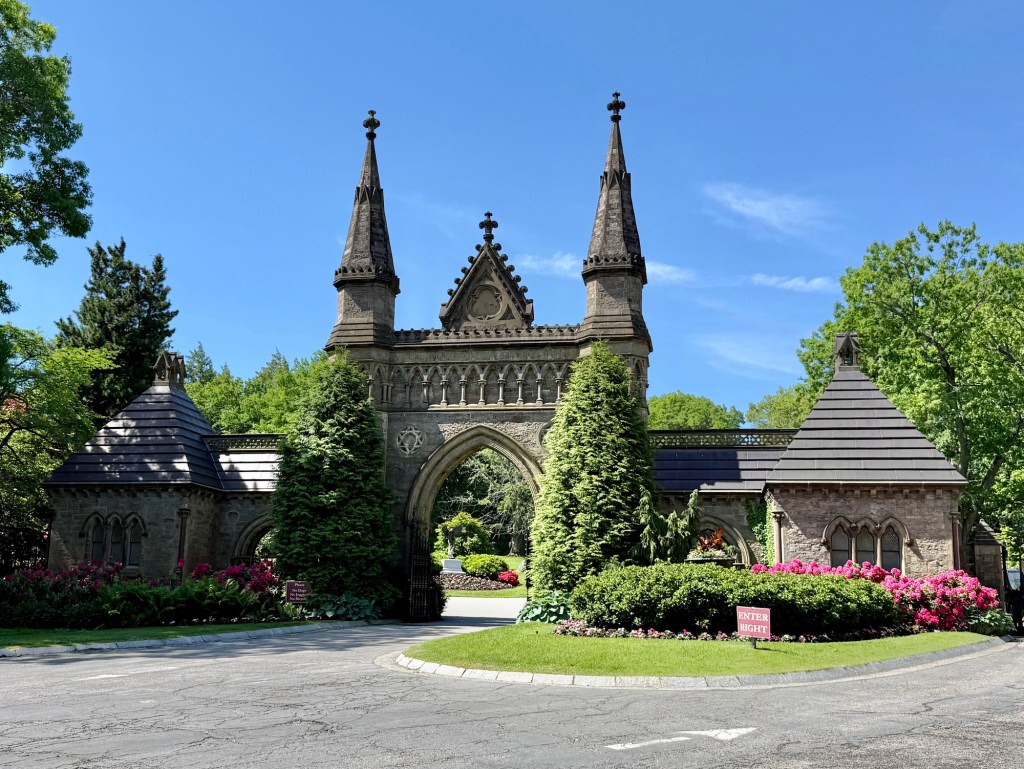
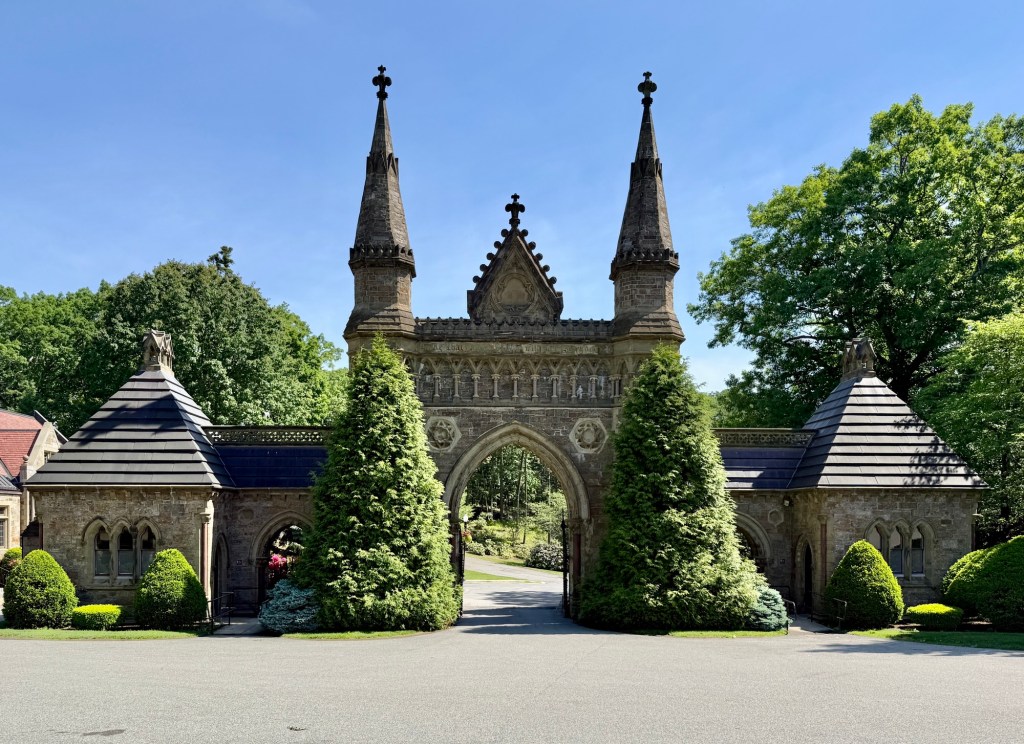
Visitors to the Forest Hills Cemetery are greeted by its iconic Gothic Revival main gate, a sculptural and ceremonial entranceway constructed from Roxbury puddingstone and sandstone. The structure replaced an original 1840s Egyptian Revival, wooden gateway designed by Henry Dearborn, following inspiration from Mount Auburn’s entrance gate. Designed by architect Charles W. Panter of Brookline and was completed in 1865, the present stone entrance gate features three portals with arched openings and ornate iron gates surmounted by decorative scrolled ironwork. The central gateway is framed by two conical spires and a central stone pediment, all topped with stone crosses. Beneath the pediment is the biblical inscription, “He that keepeth thee will not slumber.” The Entrance Gate remains the cemetery’s most iconic landmark.

Irish Round Tower, St. Mary’s Cemetery // 1894

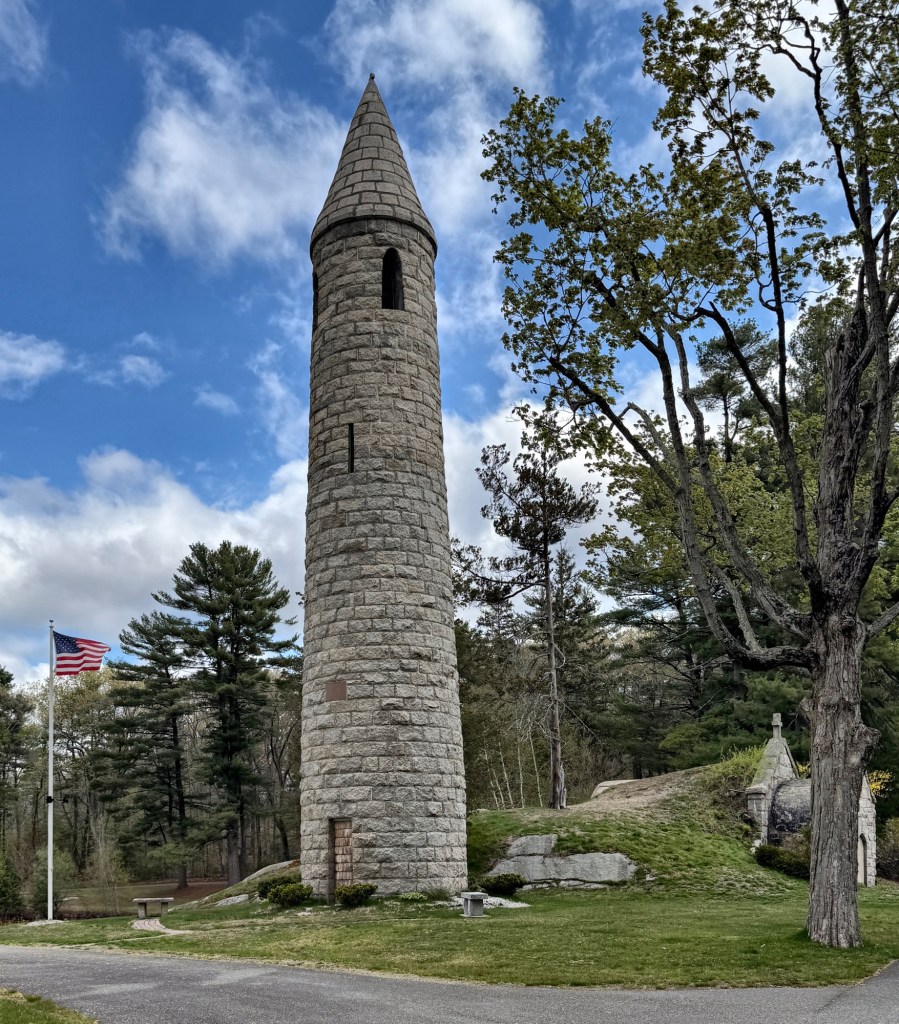
Thought to be the only example of an Irish Round Tower in the United States, the obscure Irish Round Tower in the St. Mary’s Catholic Cemetery in Milford, Massachusetts, stands as a piece of local history and an architectural landmark. The tower was envisioned by Father Patrick Cuddihy (1809-1898), the pastor of the St. Mary of the Assumption Catholic Church of Milford, who was born in County Tipperary, Ireland, and oversaw a largely Irish-born congregation here in the States. In 1893, Father Cuddihy sought to expand the existing St. Mary’s Cemetery which had been running out of space for the ever-growing Catholic population of Milford. For the cemetery, he envisioned an Irish Round Tower as a symbol of the Emerald Isle, his land of birth and that of most of his parishioners. Irish Round Towers were historically used in Ireland as bell towers, but for the cemetery in Milford, it would serve the purpose of beautification of the new grounds of the cemetery. Local workers began construction on the tower in 1894. Constructed of locally quarried Milford granite, the tower stands 73.5′ with a conical roof and walls two feet thick. The Milford tower is said to have been modeled after the tower on Devenish Island in Ireland and stands just 10 feet shorter than its inspiration.

Hopedale Village Cemetery Tool House // 1894

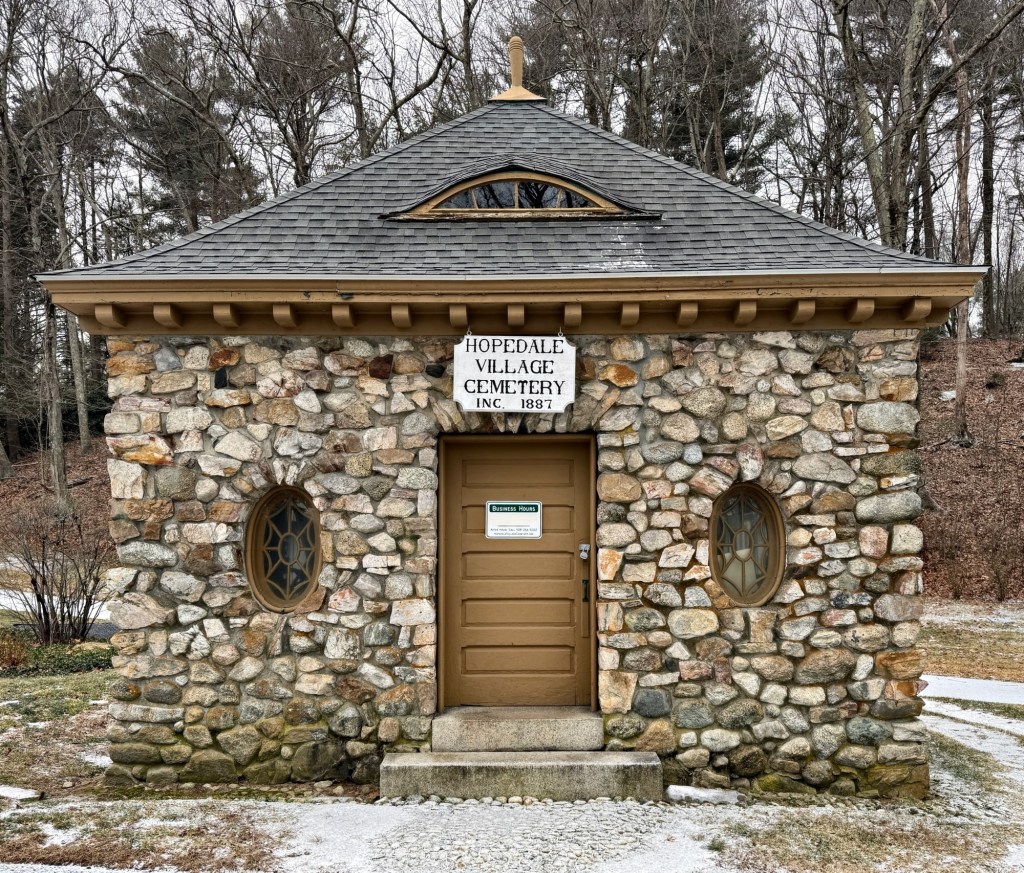
At the heart of the Hopedale Village Cemetery, this diminutive historic tool shed and office showcases that even for functional buildings set within a cemetery, high-quality materials and good design can enhance the landscape. The cemetery was laid out in 1845 in connection with Hopedale’s Utopian settlement, but expanded later in the 19th century as a formal landscaped cemetery in about 1887. The growth and investment of the cemetery coincides with the growth of the community as it prospered with the success of the Draper Corporation factories in town. Landscape architect, Warren Henry Manning updated the landscape here, with scenic vistas and hills, which followed the popular Rural cemetery movement of the 19th century. The cemetery contains many graves and mausoleums of the wealthy factory managers and benefactors of the community, which dot the sprawling landscape. In 1894, architect, Robert Allen Cook, designed this stone tool shed, which may have also contained a small office with cemetery records. The one-story, hip-roofed building features rough rubblestone walls with an eyebrow dormer centered on the façade, and has been preserved by the community for well over 100 years.

Wooster Memorial Chapel, Fountain Hill Cemetery // 1915

Located in Fountain Hill Cemetery, which has become a sort of Rural Cemetery in the small town of Deep River, Connecticut, this handsome gothic chapel graces the entrance and has provided a place of solemn memorials and celebrations of life for over 100 years. The Fountain Hill Cemetery was originally established in 1851, but after a half-century of use, Miss Mary McCellan Wooster (1839-1911), sought a non-denominational chapel for the grounds to not only beautify the local cemetery, but provide a place to honor the dead. In her will, Miss Wooster left $10,000 for a new chapel. The cemetery board of directors hired architect, Isaac Allen, Jr. of Hartford, Connecticut, to design the structure. The Neo-Gothic chapel was built of local stone and opened to the public in April 1915.

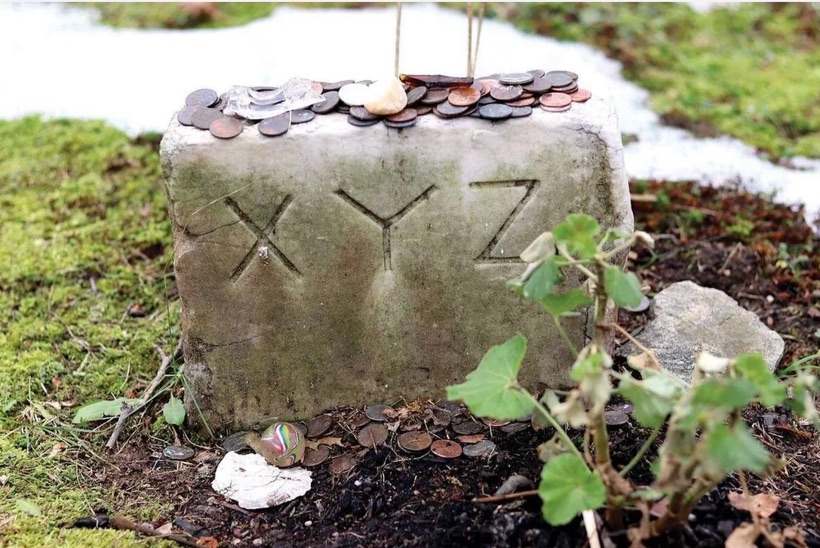
Another interesting story in the cemetery is the mysterious ‘XYZ’ gravestone. Legend says that in the evening of December 13, 1899, an unnamed man arrived in Deep River, Connecticut (along with three other male accomplices), to rob the local bank. This unnamed individual was confronted by the night security guard with a sawed-off shotgun, firing at the robber, blowing away part of his face. The other three robbers fled, leaving their accomplice in Deep River. In the hope that someone could identify him, his body was laid out for viewing at the local funeral parlor. During this time, an anonymous letter arrived, requesting that the man be buried with the headstone only marked as XYZ. The odd request was accorded, but was never fully explained. To this day, many locals leave stones and coins at the marker in Fountain Hill Cemetery.

Chester Public Tomb and Hearse House // 1850

Near the entrance to the Brookside Cemetery in the charming village of Chester, Vermont, these two very different looking buildings were constructed for one purpose, death. Before the proliferation of funeral homes and cremation, infrastructure for the dead was a necessary piece of the built environment for towns and cities all over the region. The wood-frame building seen here was built as a hearse house, which would shelter the horse-drawn hearse for the town. Prior to the advent to funeral homes, most wakes were held at the home of the deceased, after-which, the body would be transported by the horse-drawn hearse to the cemetery for burial. This was followed by a memorial service at the nearby church. If the ground was frozen or if the family did not yet have the funds to bury their family member, the body would be held in the public tomb until the burial. The Chester Public Tomb dates to 1850 and was built by local mason, Arvin Earle from stone  quarried near Gassetts, a hamlet in the north part of Chester that was shipped to Chester Depot by the newly completed railroad. While no longer in use, these two vernacular buildings hold a very important history of the town and have been lovingly preserved by local residents. 

Pine Grove Cemetery Mausoleum & Chapel // c.1875 & 1904

Mausoleum

The mausoleum and the Jonas A. Stone Memorial Chapel are two historic structures located in the Pine Grove Cemetery of Westborough, Massachusetts. Land here was acquired in 1746 by the Reverend Ebenezer Parkman, and it comprised of a pine lot of sixteen acres on the road to Mendon (now South Street). Nearly 100 years later, in 1844, the lot was deeded to the town as a new cemetery, as the older cemeteries were quickly becoming crowded. It was named Pine Grove after the historic use of the grounds. Due to the rural cemetery movement, which sought to reimagine cemeteries as a beautiful park-like setting, not a simple burial ground, many Westborough families purchased plots here and some even moved their loved ones to the new family plot, in the “new” Pine Grove Cemetery.

Chapel

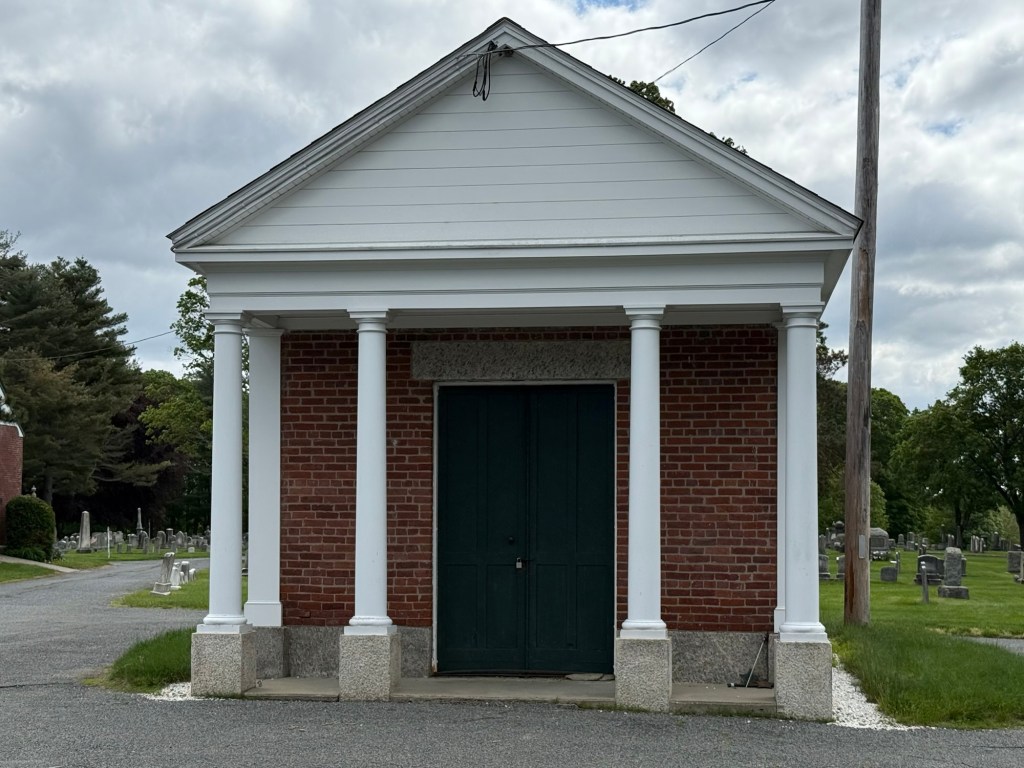
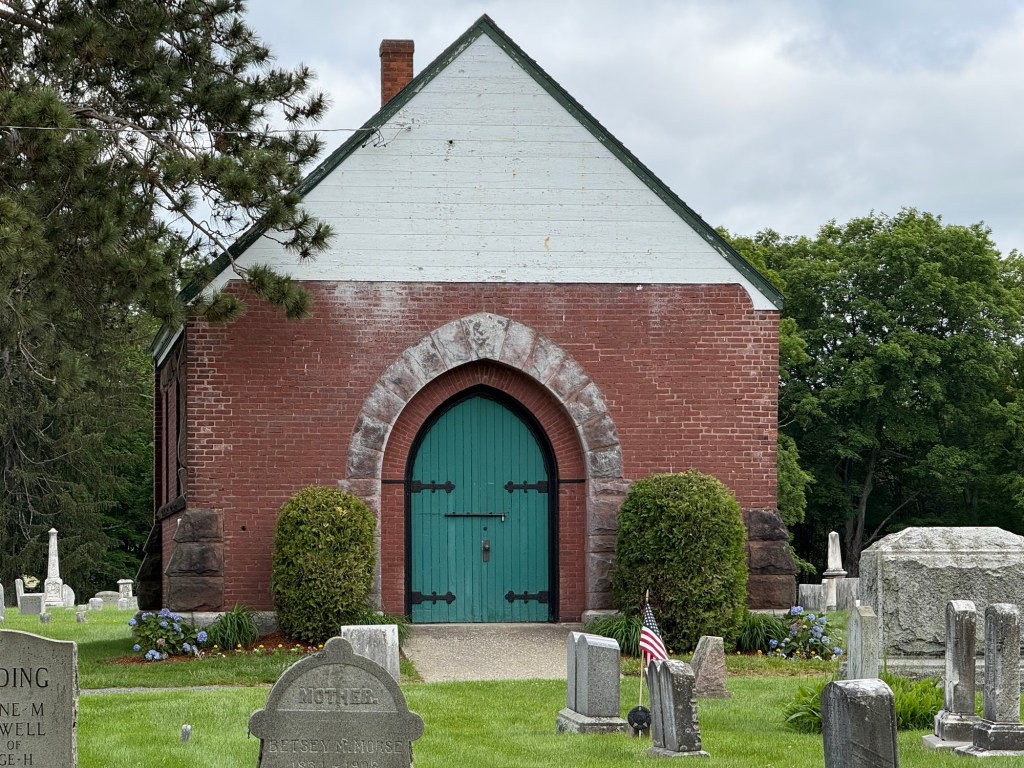
The Mausoleum was built sometime in the mid-19th century and is a modest, Greek Revival style structure of granite and brick construction. Four Doric columns support the portico and wooden roof which serves as a pediment above. The Jonas A. Stone Memorial Chapel was built in 1904 following a bequest to the town from the will of Jonas Adams Stone (1821-1900), and additional donation by his brother, Nymphas Stone. The Victorian Gothic chapel is built of brick and brownstone with a wooden gable and roof. The structure was damaged during the destructive 1938 New England Hurricane, but restored and is an important local landmark today.

St. Peter’s Episcopal Church // 1833

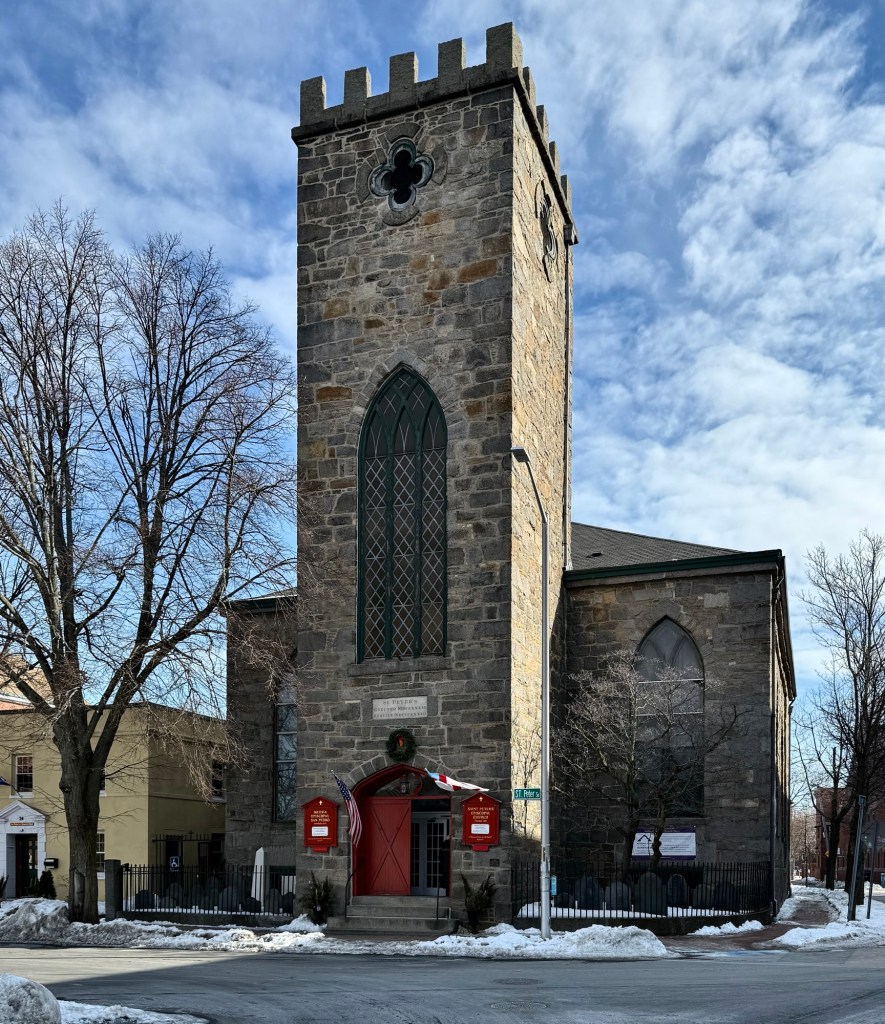
The St. Peter’s Episcopal Church of Salem, is a landmark example of a granite, Gothic Revival church of the 19th century. The present church, which is constructed of Cape Ann granite, was the second church on the site built for local Episcopalians, replacing a wood-frame building constructed there 100 years prior. Designed by architect Isaiah Rogers, the Gothic church features a prominent entry tower with a quatrefoil window in each elevation, large lancet-arched windows in the tower and lining the sanctuary, and a crenelated parapet. When completed, St. Peter’s had Salem’s first church bell, an 1740 English bell that supposedly still graces the tower today and is said to be the oldest church bell in the United States! In 1871, the rear chapel was added to the building, from plans by George E. Harney. The chapel was built directly over the old parish cemetery, requiring some of the tombstones to be placed inside the chapel walls, while others were moved to the front of the church, creating a really unique “garden cemetery” in front of the church.