Chestnut Street Townhouse // 2016

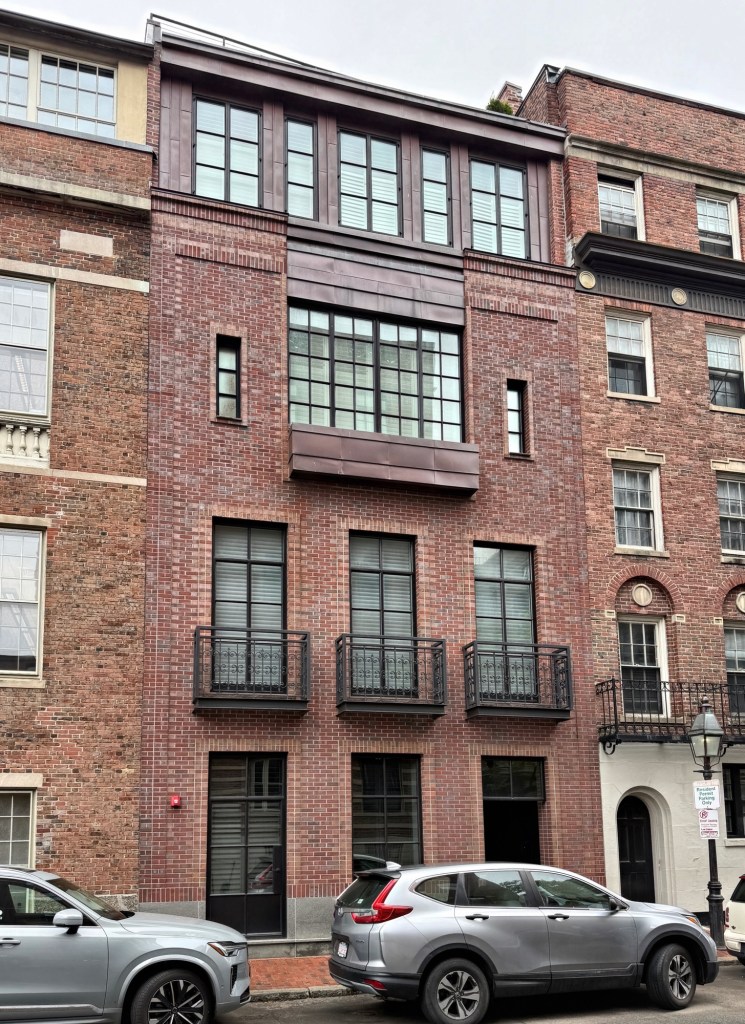
It is uncommon to see new construction in Boston’s historic Beacon Hill, but when it happens, hundreds of eyes closely scrutinize and analyze the design to belong in one of America’s most coveted neighborhoods. The rare opportunity for infill construction occurred on this site on Chestnut Street. An 1860s stable building that was later converted into a residence and art studio in the 1920s as Beacon Hill Flat gentrified as an artist enclave, was listed for sale in 2013. The townhouse featured leaded-glass windows and Tudor elements at the interior and on its rear facade and was purchased by a developer who, after inspection, noted structural deficiencies in the building. After inspections by the City and a request to the Beacon Hill Architectural Commission, it was approved for demolition, but the replacement design would be scrutinized. Hacin, architects, brought forward plans for a new townhouse, which employed similar materials, massing, and fenestration typical for this area of Beacon Hill, but with contemporary finishes that blends old with new in a way that the new structure does not stand out nor detract from the surrounding streetscape. Through hearings, details like the window types and color of the brick were analyzed to slightly deviate from the existing fabric of the neighborhood, distinguishing the new construction as contemporary. What do you think of this new townhouse on the Flat of Beacon Hill?

RISD Museum – Chace Center // 2008

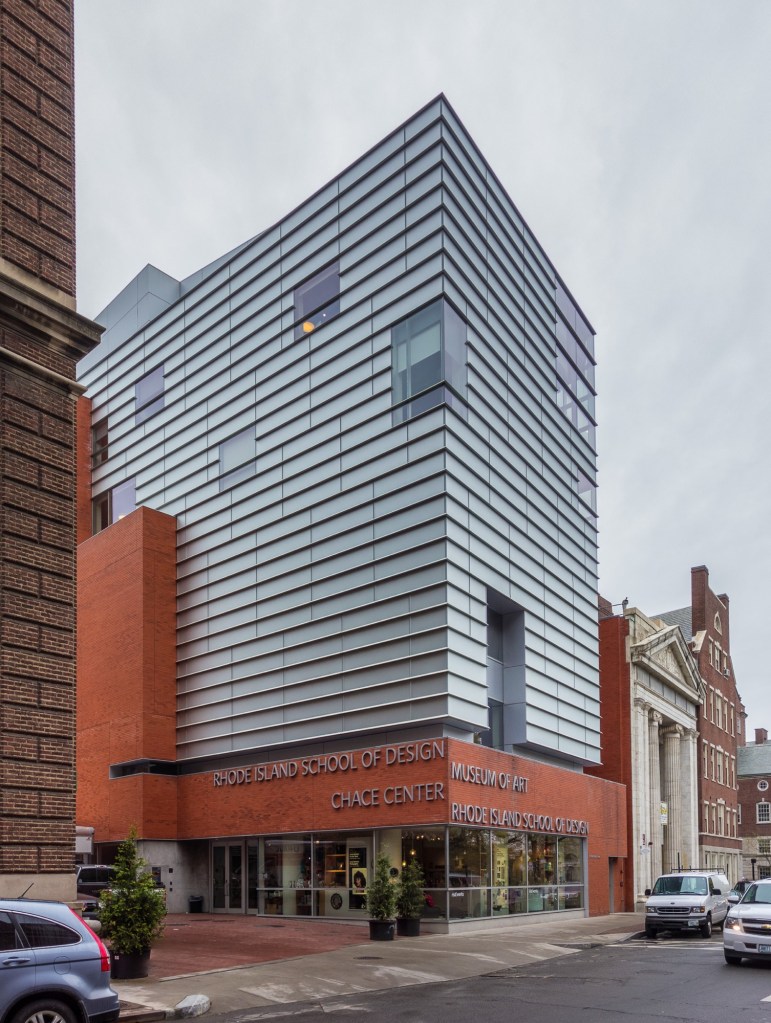
The Chace Center, also known as the RISD Museum in Providence, Rhode Island, is a contemporary infill project that serves as both an expansion of one of the region’s premier art museums as well as a front-door to a prestigious world-class college. The college hired the firms of Rafael Moneo Arquitectos of Spain as design architect and Perry Dean Rogers as the architects on record, for the project, which includes an auditorium, student exhibit spaces, museum shop, cafe, and information center as well as being an important connector between various buildings within the block, including Memorial Hall, a significant former church built in the 1850s, and the People’s Savings Bank, a 1913 Neo-Classical building. The $34 million center was built on a former parking lot in one of the few remaining open spaces near RISD, and it was named in honor of the late Beatrice and Malcolm Chace. It is not easy to fit a contemporary museum on a tight site surrounded by historic brick buildings, but the RISD Museum does just that, with the use of contemporary brick to set the building within its context with the contrasting pearl-glass volume at the facade providing a face to the steel and glass towers in Downtown Providence.

Max Katz House // 1947

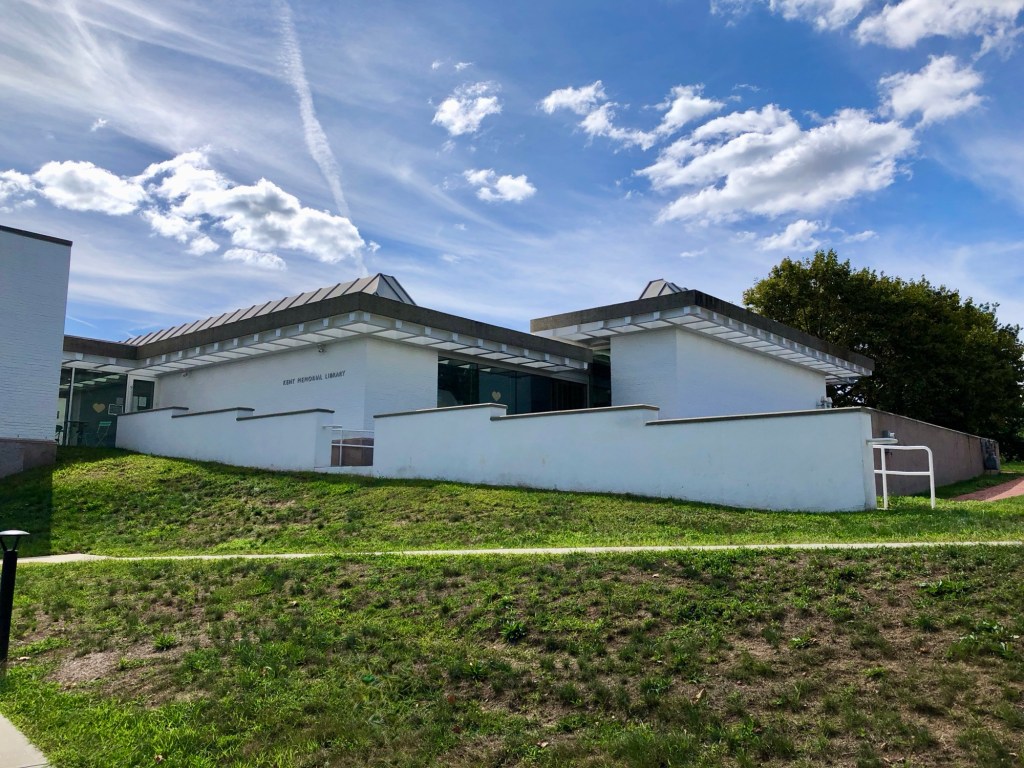
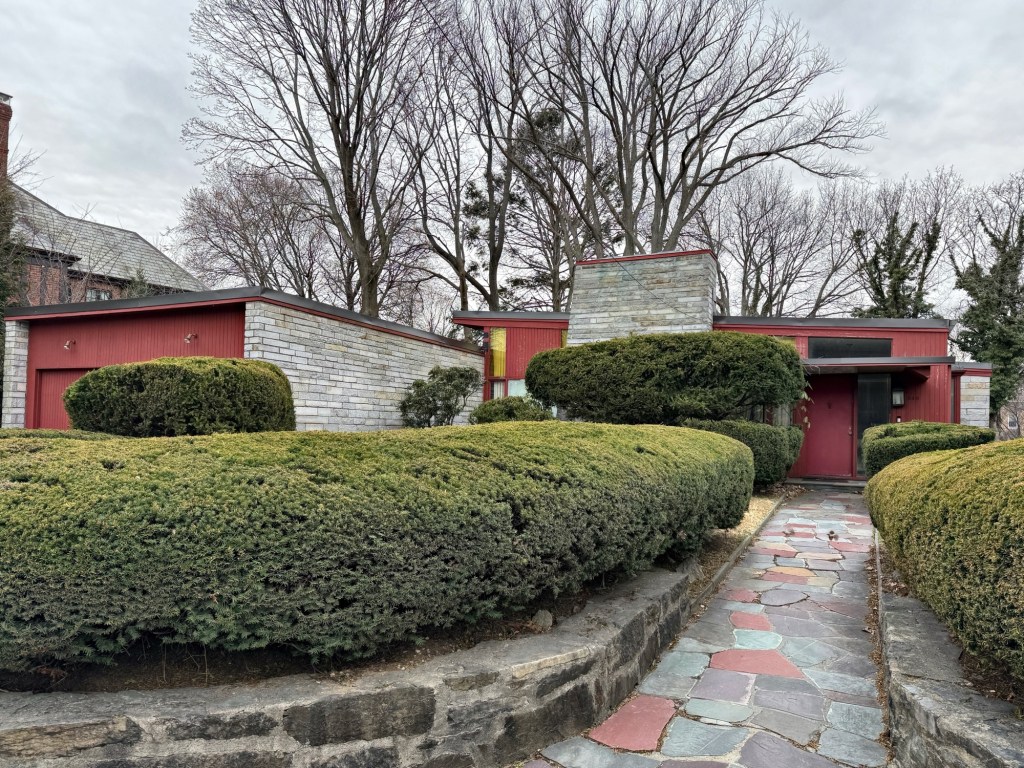
Built in 1947, the Max Katz House on Kent Street in Brookline, Massachusetts, is one of the area’s best examples of Mid-Century Modern residential architecture. The main block of the house has an angle roof line with its facade dominated by a massive stone chimney. The residence was designed by architect Samuel Glaser, one of the earliest practitioners of Modern architecture in the Boston area, for Max Katz (1895-1996). Katz was born in Lithuania and came to Boston with his mother when he was nine years old. He founded the Merchant Tire Company in 1922 and was also one of the original organizers of Brandeis University. He and his wife, Augusta, lived in this Modern home for much of their lives. The Katz residence retains much of its architectural integrity and is an excellent and well-preserved example of 1940s Modernism.


Town House on the Park // 1964

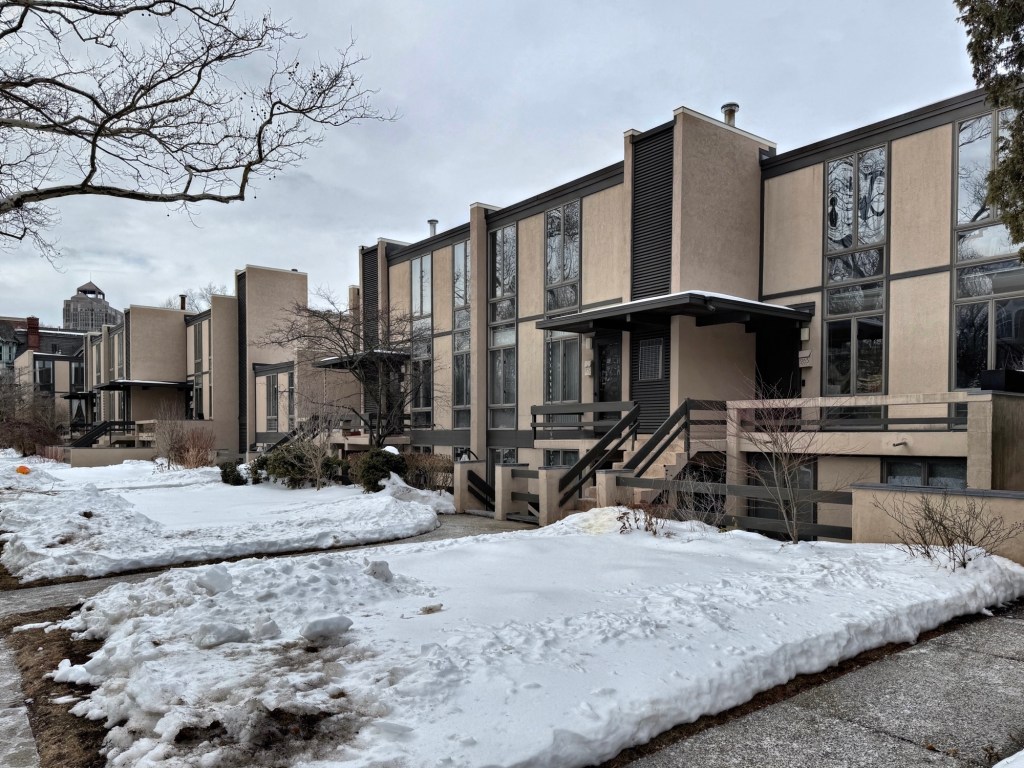
By the turn of the 20th century, the growth of industry around Wooster Square neighborhood of New Haven, Connecticut, forced out the wealthy residents which had lived there, to be replaced by recently arriving Lithuanian, Italian, and Italian-American families who established a thriving immigrant community here, which still exists today. After WWII, suburbanization saw families leaving urban centers, and to attempt to draw back in tax dollars, city officials began to plan for urban renewal areas, where “slum clearance” would redevelop areas with new and modern housing and offices with federal tax dollars. Strong neighborhood support for preservation of the area, paired with a sympathetic Planning Department, saved much of the core of the Wooster Square neighborhood with a few exceptions. The former Greene Street School and a number of residences along Greene Street and Hughes Place were razed in the 1960s and replaced by Town House on the Park, a Mid-Century Modern townhouse development. The project is comprised of thirty-six, three-story dwellings in a rowhouse configuration designed with their ground floor below grade as so to reduce their scale from the street. The development was designed by architect William Mileto and was given an award by House+Home Magazine in 1964 and featured in other publications as a good example of infill housing in a dense urban environment. What do you think about Town House on the Park?

Tower Records Building // 1918 & 1986

New England is home to just three projects by world-renowned (and sometimes maligned) architect Frank Gehry. To me, architecture is best when it makes you stop, look, critique, and comment on it. Architecture is an art, and it should evoke emotion and discussion. Gehry’s work does just that. His only project to date in Boston is located at the corner of Newbury Street and Massachusetts Avenue in the Back Bay, a project I would assume most don’t realize was a Frank Gehry design. The building was originally built as a seven-story office building (originally planned as eight stories) over an MBTA station lobby in 1918. Designed by Arthur Bowditch, the building was completed a year later, built of buff brick and concrete. The Boston Elevated Railway Company (BERy) moved into the top floors of the building and it became known as the Transit Building. The construction of the Massachusetts Turnpike in the 1960s removed neighboring buildings to the south, exposing the southern, unadorned façade of the building. By 1986, owner-developer Richard Cohen began a major renovation of the building with Tower Records as the main tenant. Gehry worked with local architects Schwartz-Silver who added an eighth floor with a cornice support by angled struts. The south and east sides of the building were sheathed in lead-coated copper with the street-facing west and north sides retaining their original brick and stone, but with added glass canopies supported by more angled struts. As housing became more desirable, the top five floors were converted into 54 condominiums. The design is timeless and showcases how new and old can work together in a juxtaposition of styles well! What do you think of the building?

Knoll International Furniture Showroom // 1980

An exemplar of late International Style, this stucco-clad concrete building stands apart from its traditional Back Bay neighbors and is located on one of the city’s most busy streets, Newbury Street. Built as the showroom and offices for Knoll International furniture, its crisp design is an elegant statement in form and details of Bauhaus- and Le Corbusier–inspired architecture, including its asymmetrical composition, curvilinear lower facade, horizontal window bands, and stairwell located behind a glass brick wall. The building was designed by Gwathmey, Siegel and Associates who have a great diversity of commissions, all with thoughtful site-specific designs. The building reinforced the positive qualities of modernist architecture at a time when some architects were advocating for historic revivals and Post-Modernism. The building was later occupied by DKNY and is presently rented out by Lenscrafters.

424 Massachusetts Avenue // 2002

Modern architecture can often compliment and blend into the context of historic neighborhoods, and this example in Boston’s South End neighborhood is one of the best examples locally. In 2002, developers eyed a long-vacant lot on the busy Mass. Ave corridor through the South End and began designs of a contextual addition to the streetscape. Dolezal Architecture was tasked with designing a modern residential building that would comply with local historic district regulations, a balance that can be difficult to accomplish. Employing traditional masonry, solid-to-void ratios, massing, and bays, but in a modern context, the building blends in with its surroundings yet is architecturally interesting. The building contains ten condos in a single building which reads more like two distinct structures.