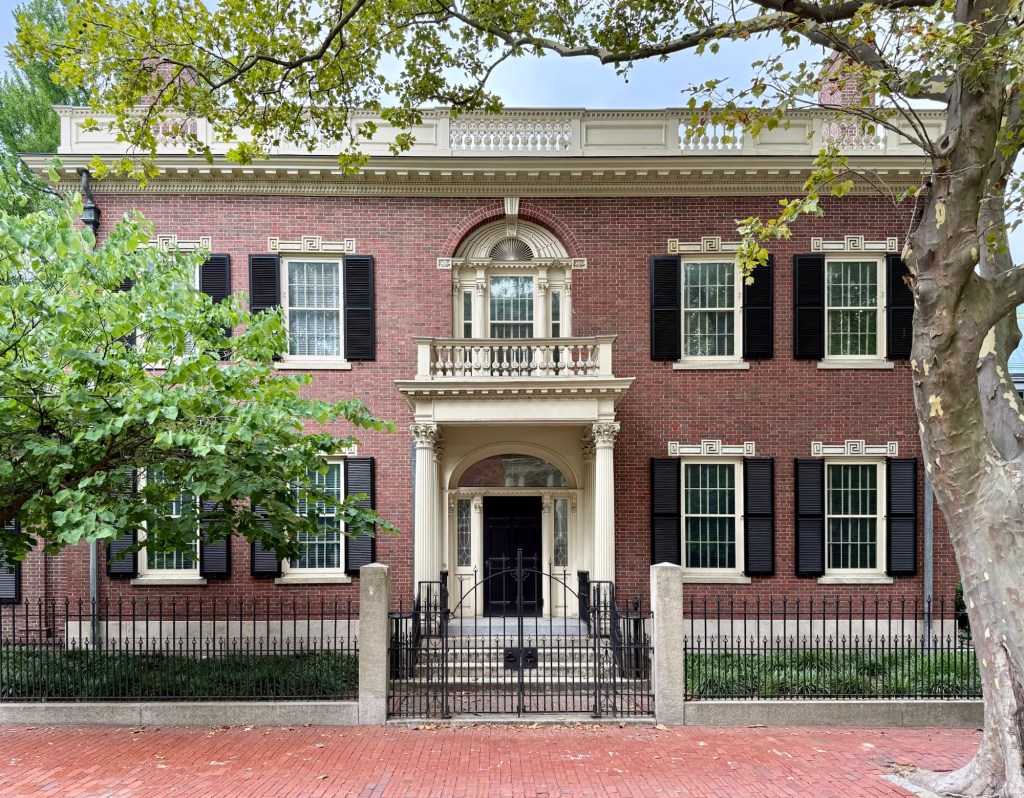
Pendleton House – RISD Museum // 1904

Although the Pendleton House on Benefit Street in Providence, gives the appearance of a domestic residence, it was actually built for the purpose of displaying the once private collections of Charles L. Pendleton (1846-1904), which were given to the RISD Museum in 1904. Pendleton’s bequest, which included American and European furniture, silver, glass, ceramics, textiles, and paintings, came with the stipulation that the collection remain intact and on display in a suitable building for the benefit of the public. The stipulation occurred just before Mr. Pendleton’s death in 1904 and the Rhode Island School of Design immediately hired the local architect, Edmund Willson of the local firm of Stone, Carpenter and Willson, to furnish plans for a wing to the museum. Willson was an expert in the Colonial Revival style and sought to make the private collection of the Pendleton House befitting of a grand Providence mansion. It was Willson’s last major commission before his death. The building is crafted in a refined Colonial Revival style with symmetrical facade, traditional fenestration and Palladian motif, but is beefed up internally for is museum use with brick walls over a fireproof, reinforced concrete frame. The RISD museum has continually grown over the subsequent decades with wings connecting the Pendleton House with more contemporary buildings, all-the-while retaining the residential scale of Benefit Street in this iconic structure.
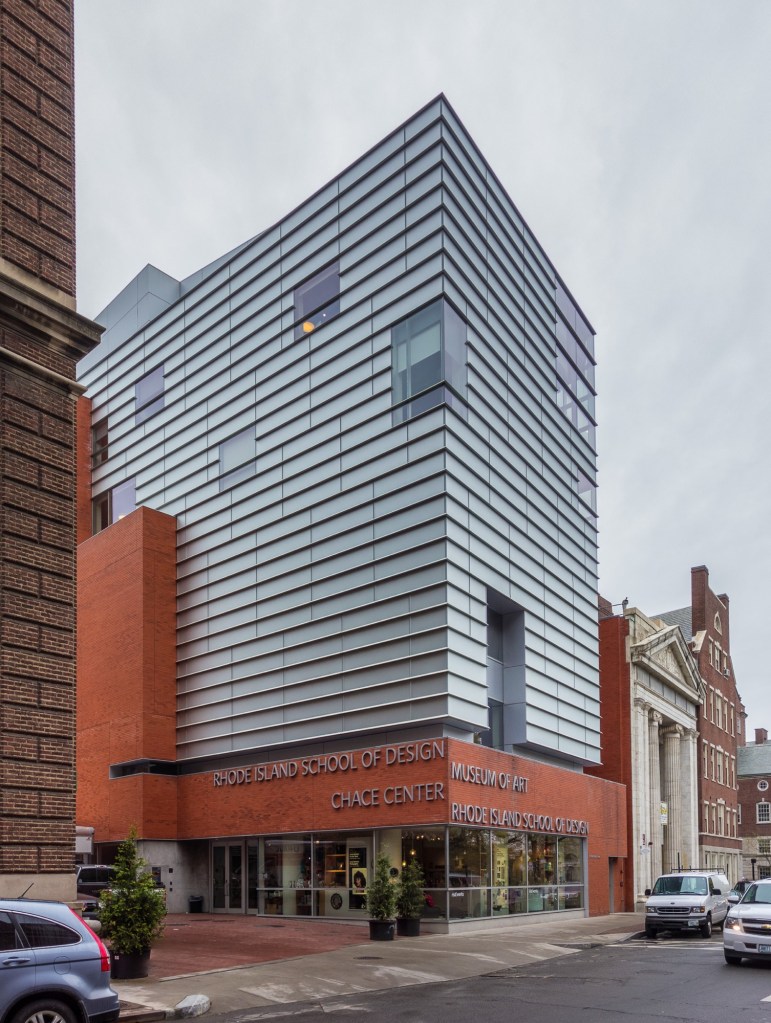
RISD Museum – Chace Center // 2008

The Chace Center, also known as the RISD Museum in Providence, Rhode Island, is a contemporary infill project that serves as both an expansion of one of the region’s premier art museums as well as a front-door to a prestigious world-class college. The college hired the firms of Rafael Moneo Arquitectos of Spain as design architect and Perry Dean Rogers as the architects on record, for the project, which includes an auditorium, student exhibit spaces, museum shop, cafe, and information center as well as being an important connector between various buildings within the block, including Memorial Hall, a significant former church built in the 1850s, and the People’s Savings Bank, a 1913 Neo-Classical building. The $34 million center was built on a former parking lot in one of the few remaining open spaces near RISD, and it was named in honor of the late Beatrice and Malcolm Chace. It is not easy to fit a contemporary museum on a tight site surrounded by historic brick buildings, but the RISD Museum does just that, with the use of contemporary brick to set the building within its context with the contrasting pearl-glass volume at the facade providing a face to the steel and glass towers in Downtown Providence.

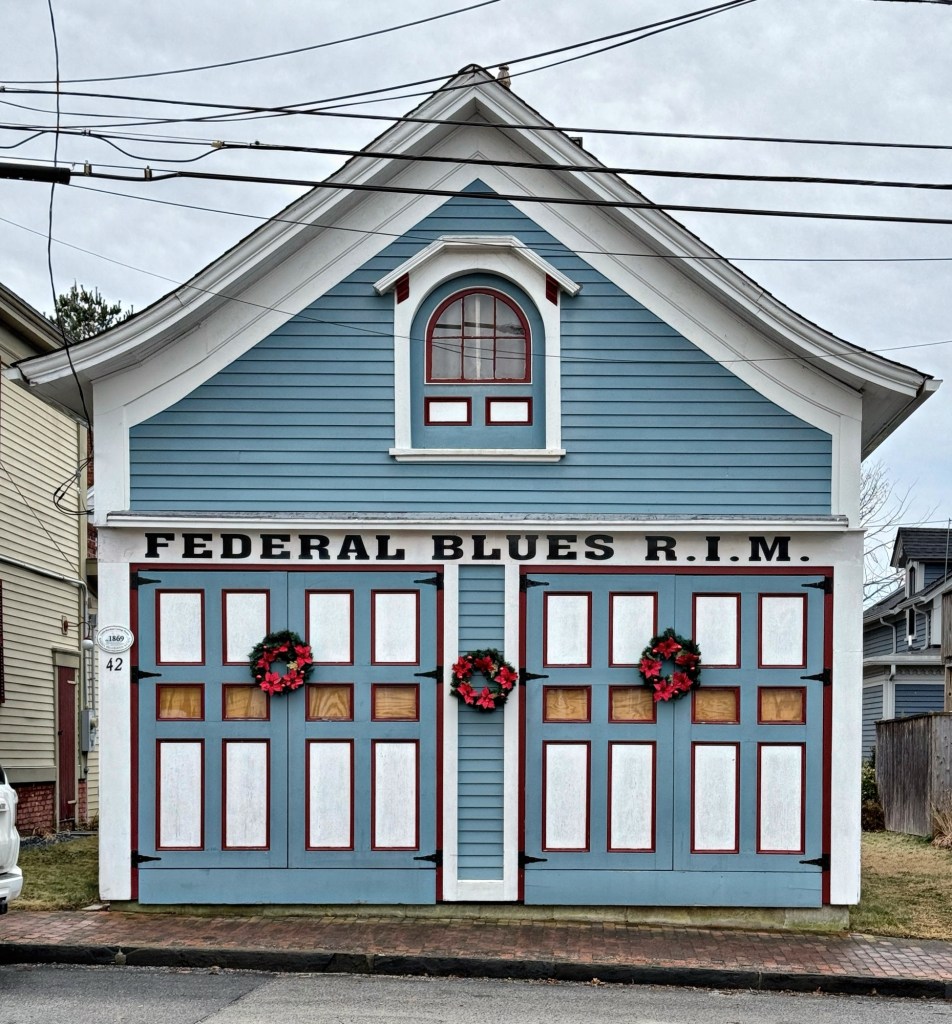
Warren Federal Blues Stable // c.1860

The Warren Federal Blues is an active independent military organization of the Rhode Island militia that was founded in 1798 and today, serves primarily as a ceremonial honor guard and as historic educational organization in Warren, Rhode Island. Members originally served as marines to police navy seamen on the USS General Greene (1799), which was commanded by Christopher Raymond Perry, the father of Oliver Hazard Perry, who also served aboard the ship. The Warren Federal Blues still remain part of the Rhode Island militia but serve in a largely ceremonial and educational role using period muskets and cannon for special events. The organization purchased the historic barn of the Baker-Merchant House on Main Street in about 1990, saving it from demolition for expansion of church parking, and moved the former barn to this site, adjacent to the old Narragansett Engine House, creating a unique composition of diminutive, but spectacular buildings. The former barn, which dates to around 1860, though is likely older, features paired double-leaf doors on the facade, round-arch window in the attic, and a flared roof with cupola centered on the ridge. 

Coggeshall Farm // c.1750

Located on the Poppasquash Peninsula, in my favorite Rhode Island town of Bristol, the Coggeshall Farmhouse showcases the historic rural farming character of the town, which saw much development by the 19th century. In 1723, Samuel Viall (1667-1749 purchased farmland from Nathaniel Byfield, who had acquired most of the north part of Poppasquash as one of the original “founders” of Bristol (though the Wampanoag people had been already living here for centuries). Viall or a descendent likely had this small Georgian farmhouse built on the land, along with outbuildings to farm the beautiful land here. In the early nineteenth-century Wilbour and Eliza Coggeshall were tenant farmers at the farm. The Coggeshall’s son, Chandler Coggeshall, later became a politician and helped to found the Rhode Island College of Agriculture and Mechanic Arts in 1888, which became known as the University of Rhode Island. The farm eventually was acquired by industrialist Samuel P. Colt, nephew of firearms manufacturer Samuel Colt, who created a massive estate on the land. In 1965 the State of Rhode Island purchased the Colt Estate for use as a state park, and the Bristol Historical Society petitioned the state for permission to preserve the old Coggeshall farm house on the property as a museum. Coggeshall Farm Museum was established in 1973 to educate modern Americans about eighteenth century New England farm life.