This charming building at 16 Lime Street on the Flat of Beacon Hill, Boston, has seen a variety of uses from carpentry shop and stable, to working theater, and finally to a residence. Let’s dive in!
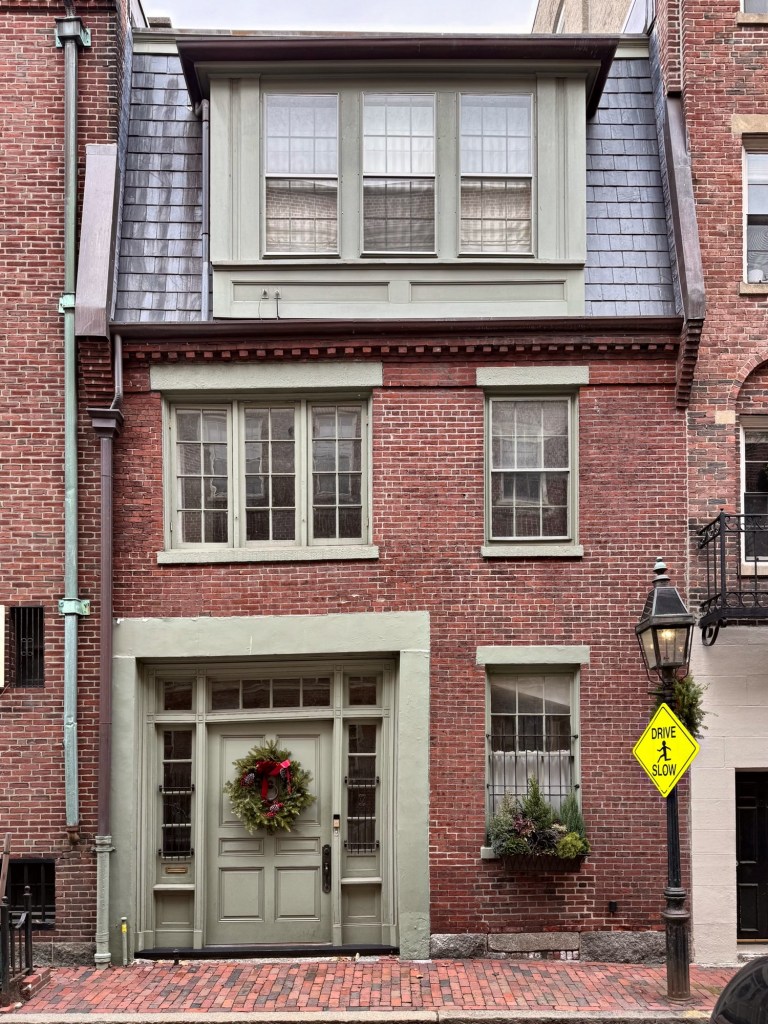
The early ownership is murky, but by the 1870s, this two-story with mansard roof stable was owned by a “Nathan Thayer”, either Nathaniel Thayer Jr. or Nathaniel Thayer III of Lancaster, who also retained city residences in Boston. The building features two portals on the first-floor that originated as doorways, the wider on the left for horses and a carriage, and the smaller for access to residential space for the stable-keeper and likely a hay loft over the carriage door. After the turn of the 20th century, the Flat of Beacon Hill gentrified into an exclusive enclave of residences, antiques shops, and artist studios and the former Thayer Stable was purchased by Frederick Oakes Houghton, an agent for transatlantic steamers. Houghton rented the building to an amateur theatrical group who organized as the Toy Theatre, that was founded in 1911 to present plays that had not been presented professionally in Boston. The founding group consisted of the usual, artistic, high society types, and had seating for 129 with no standing room. Houghton hired architect, Harold Symmes Graves, to convert the building into its theater use, enclosing the former carriage door and hay loft with multi-light windows, and creating a larger space inside for productions. The Toy Theatre did very well (due in part to its membership of upper-class Boston residents) and a new, purpose-built Toy Theatre was built in the Back Bay by 1914. In 1917, the former stable and theatre was purchased by Richard B. Platt, a musician and music teacher, and converted to a residence, a use that has remained ever since.


One thought on “Thayer Stable – Toy Theatre – Richard Platt House // c.1865”