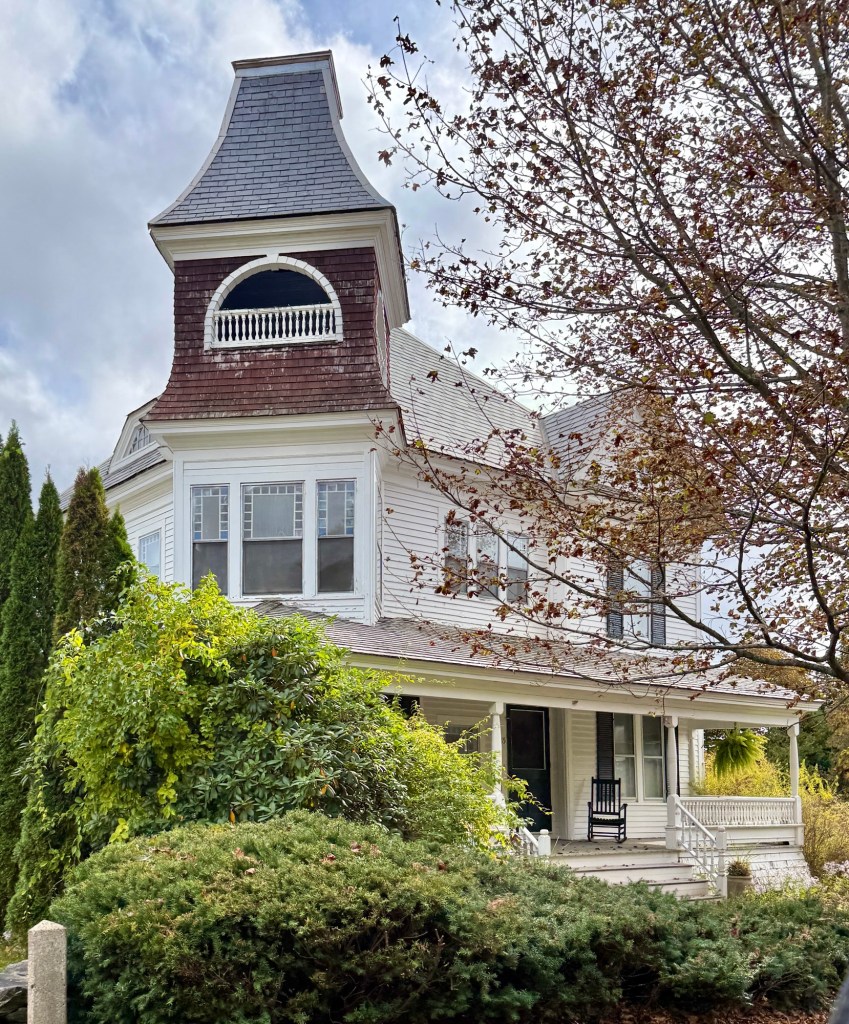
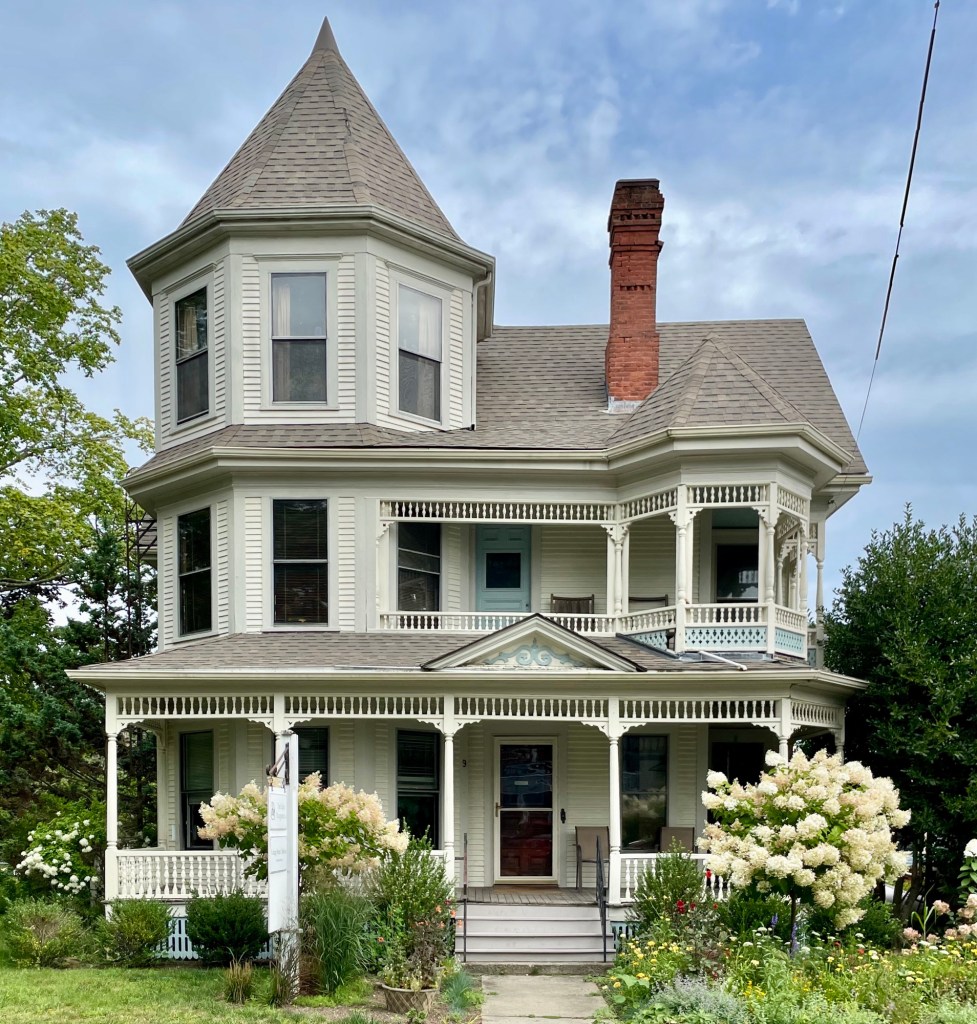
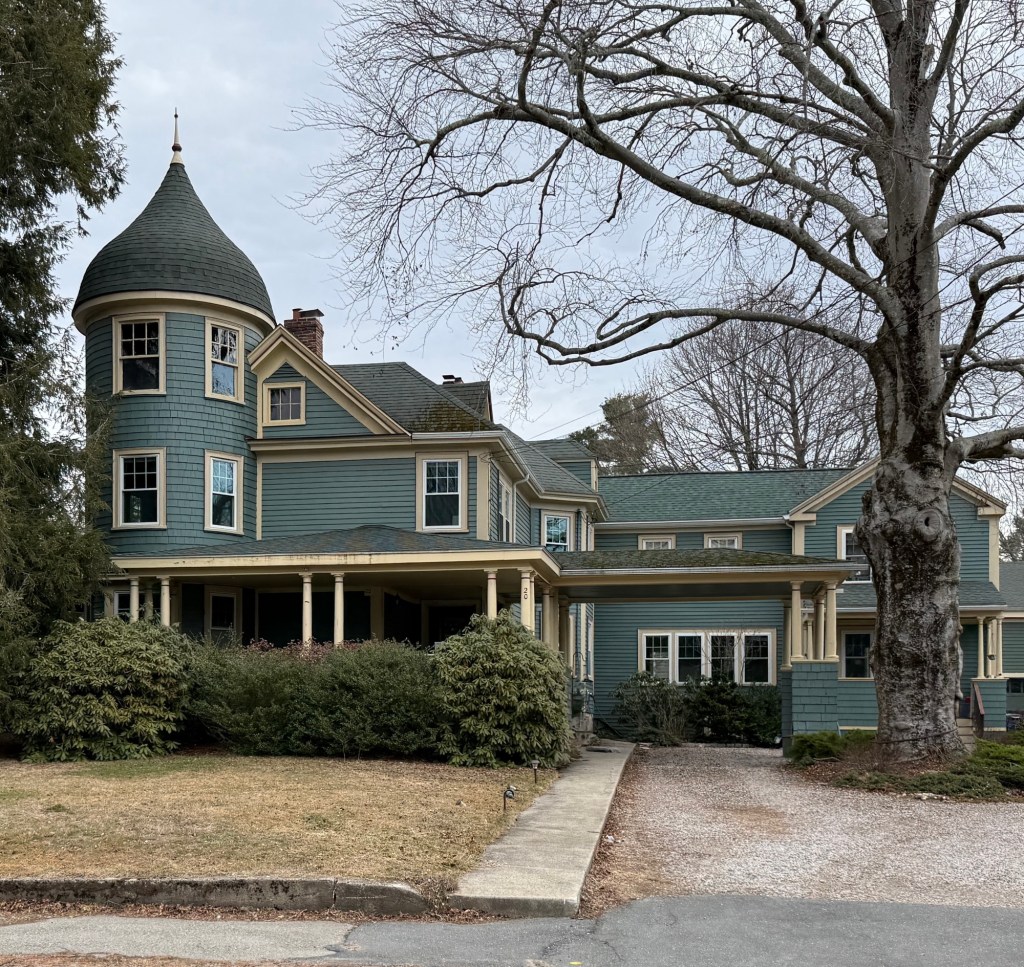
A stunning example of the Queen Anne style, the Dr. Charles E. Parker House on Worcester Road in Princeton, Massachusetts, showcases the unique forms and architectural details that can make these homes so enchanting. The residence was built for its namesake, Dr. Charles Parker (1864-1905), a local physician who was educated in Vermont and settled in Princeton where he found ample work. For their residence, the large Victorian house features an asymmetrical form with prominent corner tower with recessed porch inside which provides sweeping views of the rolling hills in all directions.
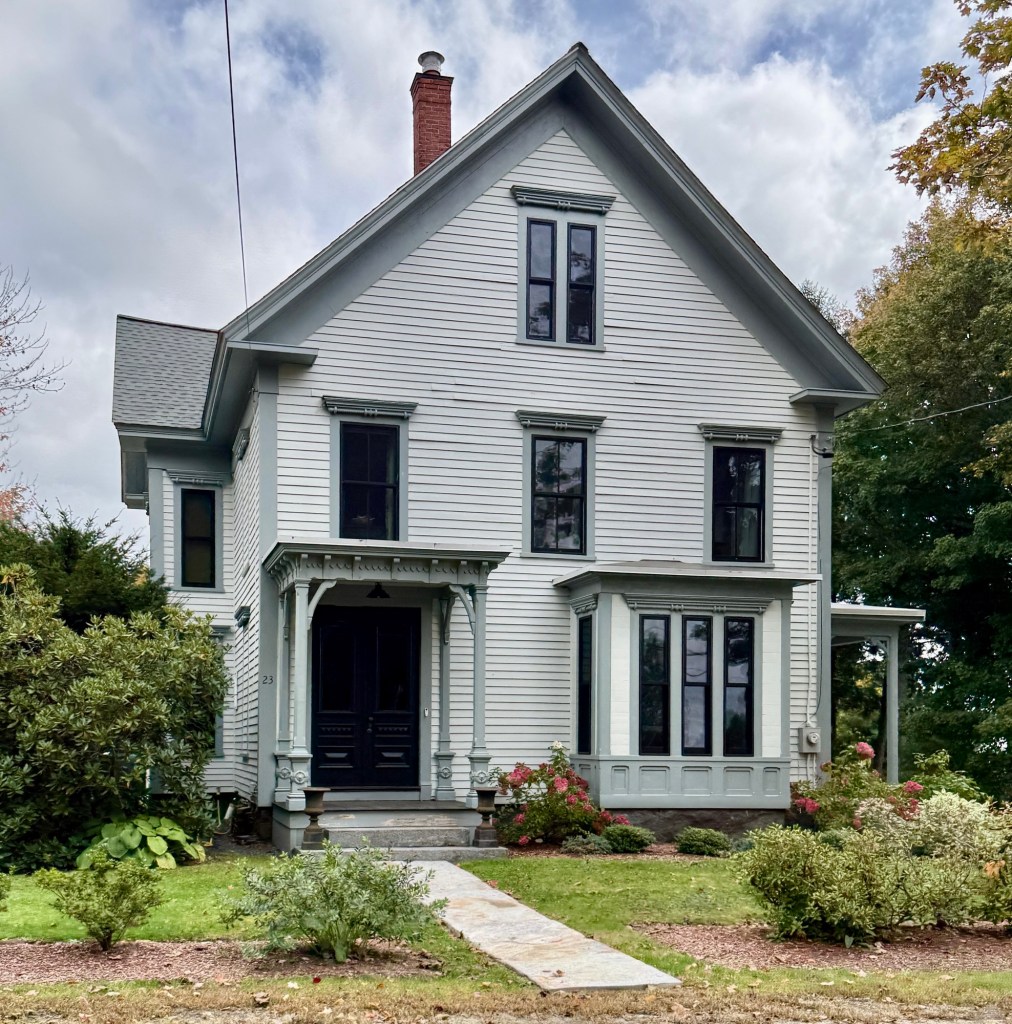
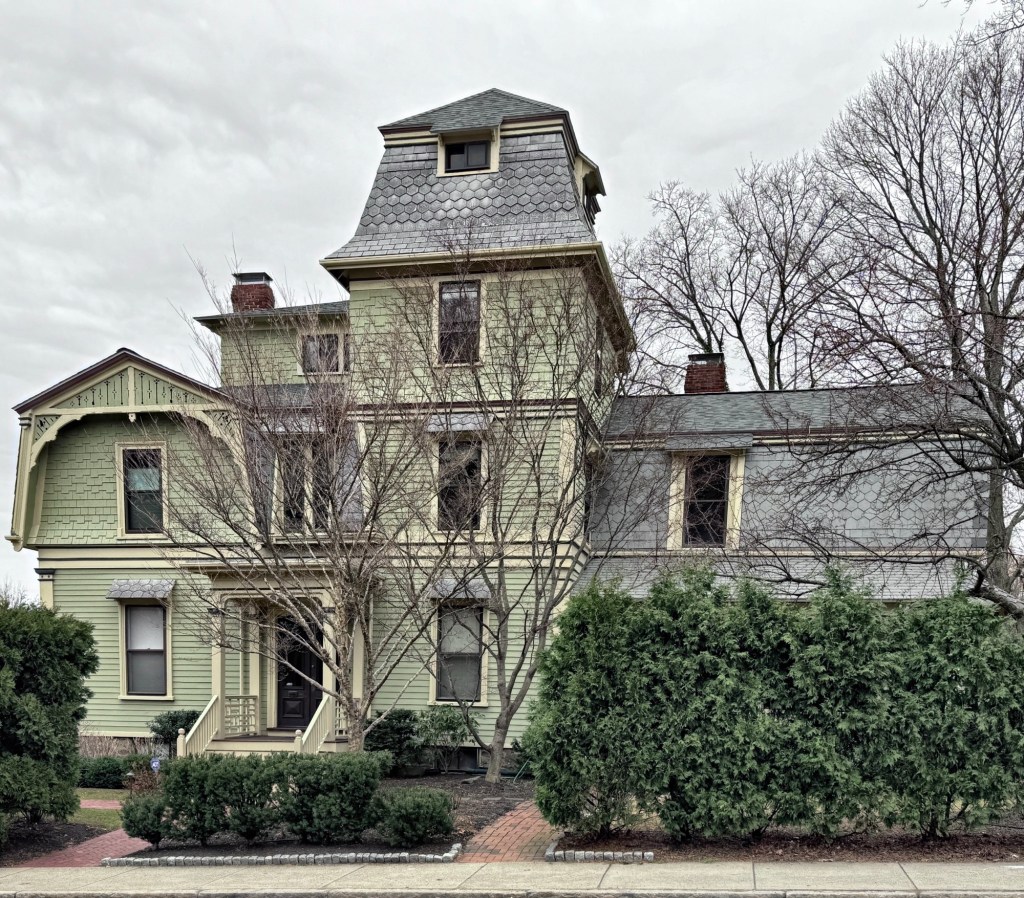
Isaac Franklin Thompson (1823-1900) was a descendant of one of the earliest settlers of Princeton, Massachsuetts. He and his brother-in-law, Phineas Beaman, were early proprietors of the Wachusett House, a hotel in Princeton that catered to visitors arriving to town to take in cool mountain breezes and views during the summer months. In 1860, Isaac Thompson purchased the Greek Revival style Baptist Church in town and converted it into the Prospect House, a large summer hotel with expansive porches to provide visitors with sweeping views near the village. When Isaac Thompson retired from his role as a hotelier in 1874, he had this home built on the outskirts of the main village to enjoy his retirement. The handsome residence operated as the Dutchess Tea House from the 1930s-1950s, and was converted back to a single-family residence later in the 20th century.
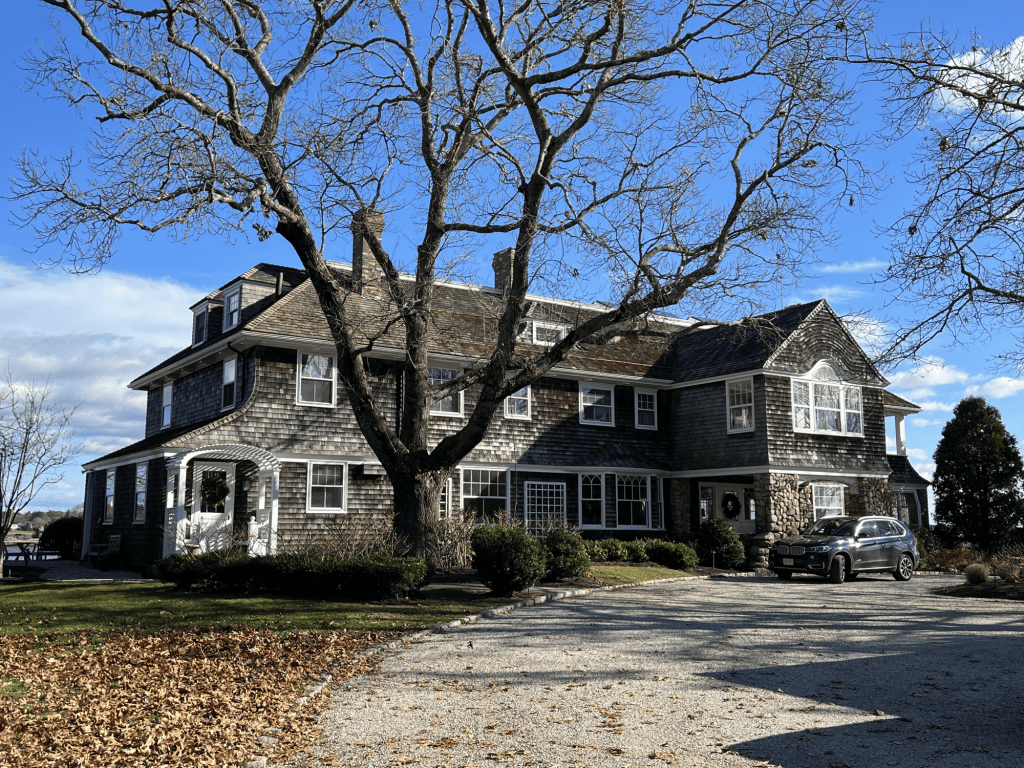
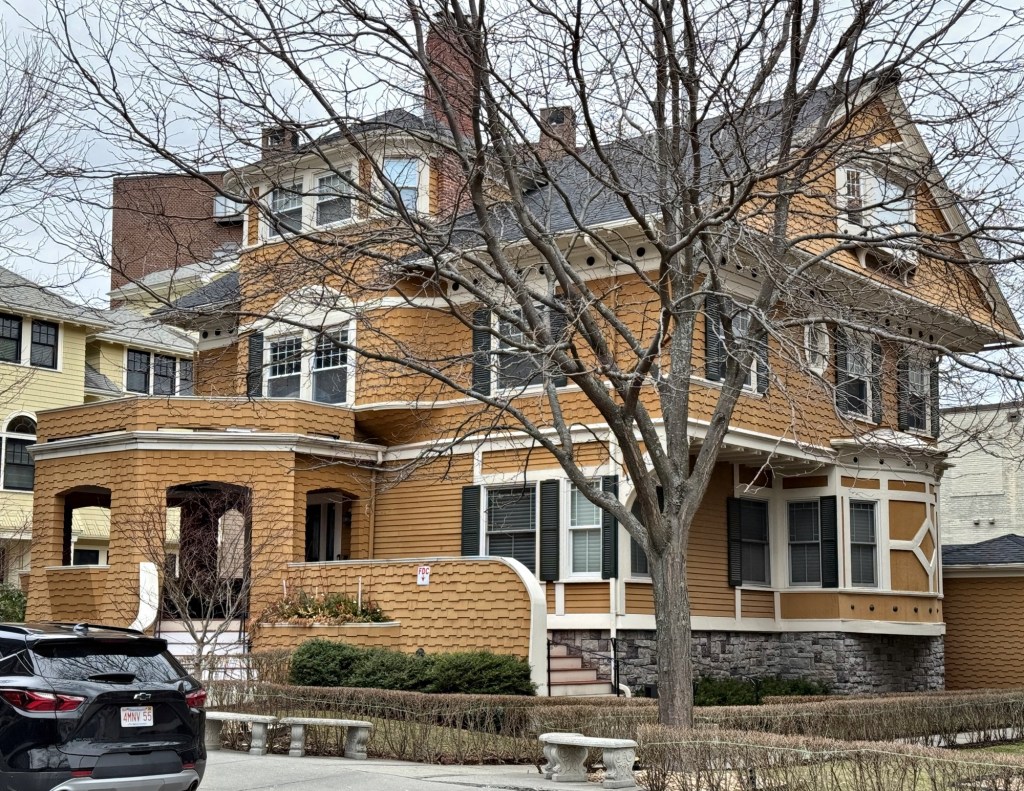
This historic summer cottage on Water Street represents one of the more sophisticated examples of the Shingle Style in Marion, Massachusetts, and is evocative of the type of houses built for the wealthy in the late 19th and early 20th century as their summer retreats. The “cottage” was built around 1898 as a summer residence for George Peabody Hamlin (1867-1935) and wife, Mary Farnsworth Tappan, of Boston. George P. Hamlin was a successful coal merchant who’s family business became part of the Metropolitan Coal Company in the late 1890s. George P. Hamlin was treasurer of the company until his retirement in 1927, when he turned to commercial real estate and worked in that field until his death. It is likely that for his summer residence, Hamlin hired Boston architect and Marion summer resident, William Gibbons Preston, who also designed a house for George’s brother further up Water Street. After Hamlin’s death in the 1930s, the Marion cottage was purchased by Ms. Katherine Hobart Ames Spalding (1874-1949), the daughter of Oakes Angier Ames (1829-1899) and granddaughter of Oakes Ames (1804-1873), a Massachusetts Congressman and leading figure in the development of the Transcontinental Railroad, who was one of the wealthiest men in America. Katherine Ames married Philip Leffingwell Spalding (1871-1938), President of the New England Telephone & Telegraph Company. The shingled cottage with its rubblestone base, remains one of the best-preserved in Marion and a landmark of the style.
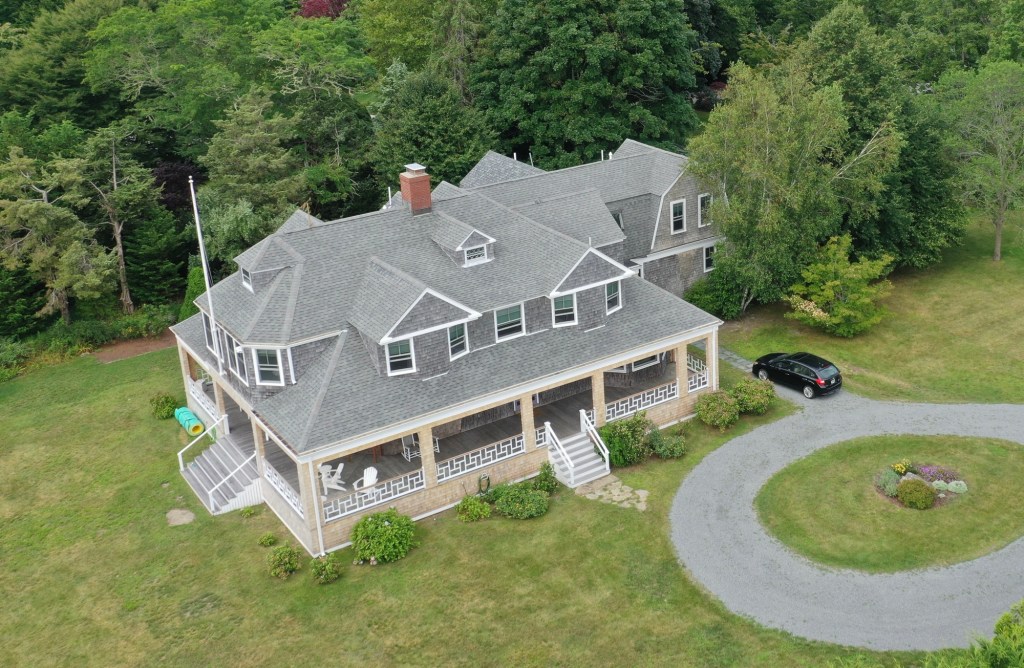
One of the many beautiful late 19th century shingled “cottages” overlooking Sippican Harbor in Marion, Massachusetts, Point Rock Cottage stands out not only for its siting on the waterfront, but also for its preservation. As any good summer cottage must have a name, Point Rock Cottage derives its name from its location overlooking the rocky coast and Sippican Harbor on the tip of the village. The Shingle style cottage was built for David W. Lewis (1833-1915) of Boston, who purchased the land in 1893 and had the house built soon after. Lewis began his career in the retail shoe business in Vermont until he enlisted in the Union Army in 1862, serving in the 9th Vermont Volunteer Regiment. Lewis rose to the rank of major and saw action in several major campaigns of the war. After the war, David Lewis married Elizabeth T. Willett and they moved to Hyde Park in Boston where he shifted professions and became a dealer in building materials, which he saw immediate success as many Boston areas saw development in the late 19th and early 20th centuries. The architect is not presently known, but it is probable that the cottage was designed by William Gibbons Preston or Charles Allerton Coolidge, both Boston architects who designed many of Marion’s summer homes and both of whom summered in Marion themselves. Architecturally, the residence is a blending of Shingle and Arts and Crafts styles with the low-pitched roof and continuous shingled cottage encircled by a one-story integrated porch supported by wood shingle clad rectangular posts with a Chinese-fret work railing.
Built in 1896 by Dr. A.W. Rice, this quintessential example of a Queen Anne style Victorian residence has stood on Marion’s Cottage Street, preserved and contributing to the town’s rich history. Alger W. Rice (1855-1914) was born in Vermont and moved to Marion after graduating medical school and operated his medical office from his home here and lived with his family until his death. Dr. Rice also raised and bred award-winning Russian Wolfhounds and pigeons. Between 1921 and 1979 the property was owned by two generations of the Petersen family, beginning with Viggo Valdemar Petersen (1869-1941), a native of Bornholm, Denmark, who worked as a chef before entering the ice cream manufacturing business in the early 20th century. Peterson operated a popular ice cream parlor out of the rear carriage house during the 1930s until his death in 1941. When Viggo died in 1941, his son, Viggo C., attempted to carry on, until wartime cream rationing forced him to close for the duration of the conflict. Thereafter, Petersen’s ice cream resumed production and remained a Marion fixture until its final closing in the 1970s. The former residence remains commercial today, but maintains its charm.
The Dr. Jonathan M. Cheney House in the town of Ashland, New Hampshire, is significant as a well-preserved example of Queen Anne architecture with all the flourish and asymmetry expected in the iconic style. The residence was built around 1895 for Jonathan Morrison Cheney (1863-1918), a prominent physician in Ashland and also served as a member of the General Assembly in 1909 and a member of the State Senate in 1911. Dr. Cheney was the son of Col. Thomas P. Cheney, a well-known New Hampshire politician, and enjoyed his connections and success from family, eventually being able to afford such an ornate mansion in his hometown. While the architect is unknown, the Cheney House stands out for its use of varied materials including a brick ground floor and clapboards above, decorative porch frieze, and the four-story square tower with mansard roof and paneling at the third floor. The residence today serves as a bed & breakfast, appropriately named the Cheney House.
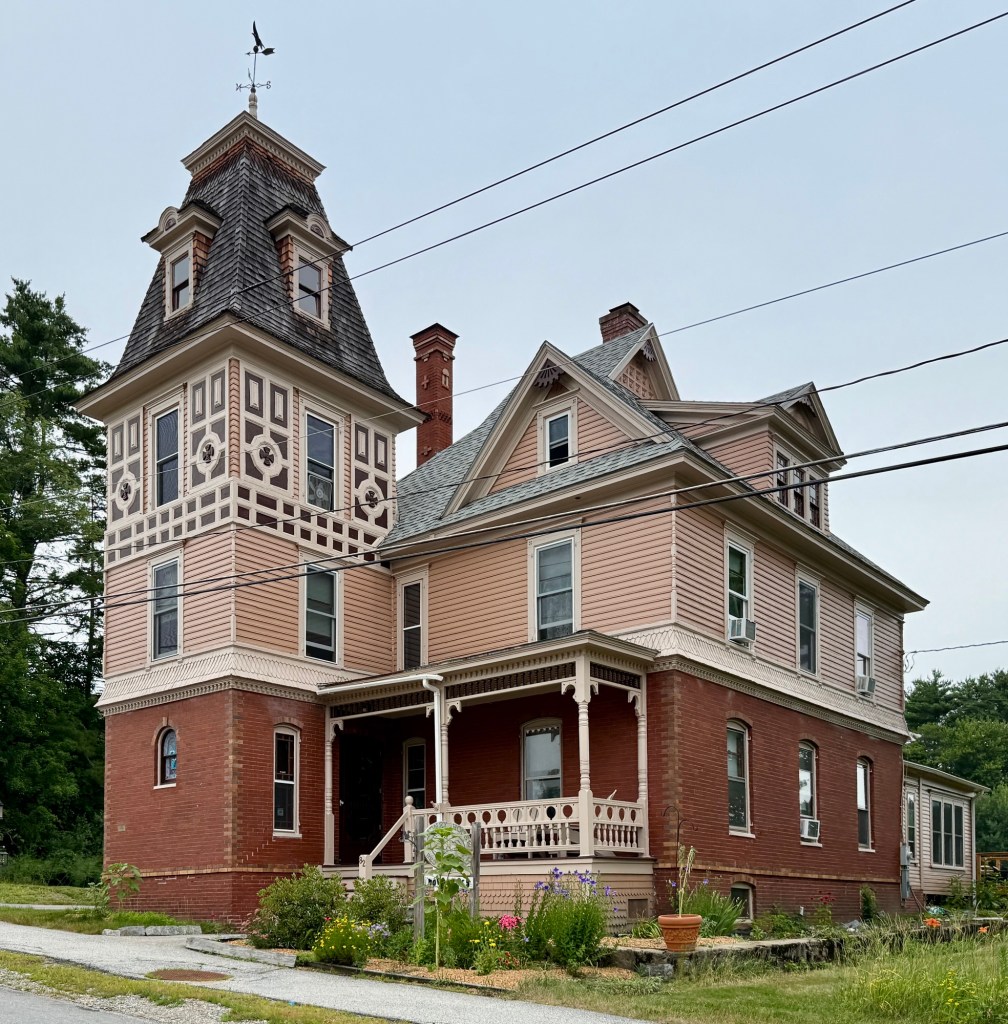
The Rufus Underhill House in Billerica, Massachusetts, is an excellent example of the eclectic nature of residential architecture seen in the United States during the Victorian period following the conclusion of the Civil War. Without a clear distinguishing style, the house stands out for its unique form, architectural details, lancet windows and side four-story tower, all with paint colors to highlight and accentuate its distinctive features. The house and accompanying stable were built around 1870 for Rufus K. Underhill (1819-1894) and his wife, Deborah, as a place to spend their retirement. Rufus Underhill was born in Chester, NH and worked as a blacksmith, later establishing the Underhill Edged Tool Co. in Nashua later expanding to sales in Boston.
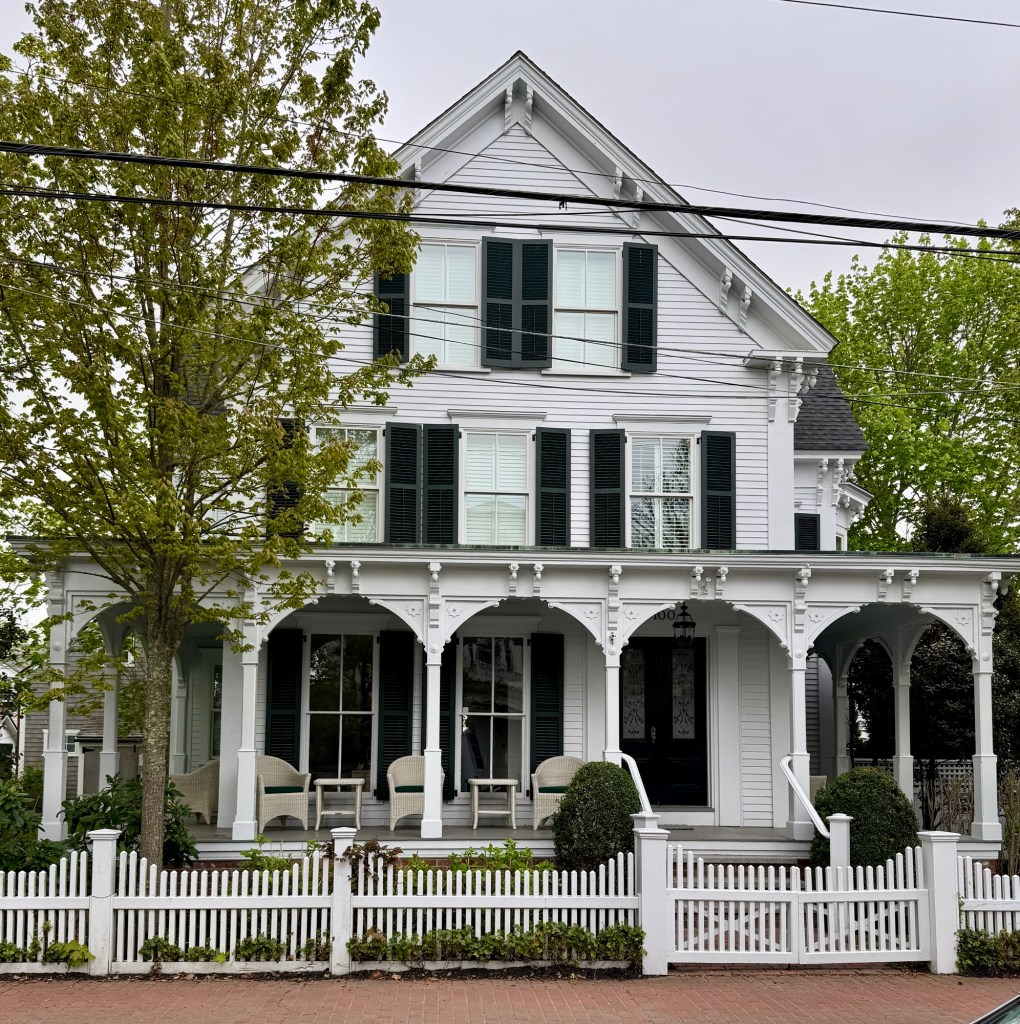
Built circa 1860 for Jonathan Harding Munroe, this stately Victorian house sits on Main Street in the up-scale community of Edgartown on Martha’s Vineyard. Jonathan Munroe was born in Bristol, Rhode Island and moved to Edgartown where he opened a store and worked as a high-end tailor, and became a successful businessman in town where he founded the Martha’s Vineyard Bank of Edgartown, and later financed successful whaling excursions making a large profit on his investments. With his ever-growing net worth, Mr. Munroe likely updated this house towards the end of the 19th century, with the ornate three-sided porch. Most recently, the property has operated as an inn, named after its original owner, the Jonathan Munroe House Inn.
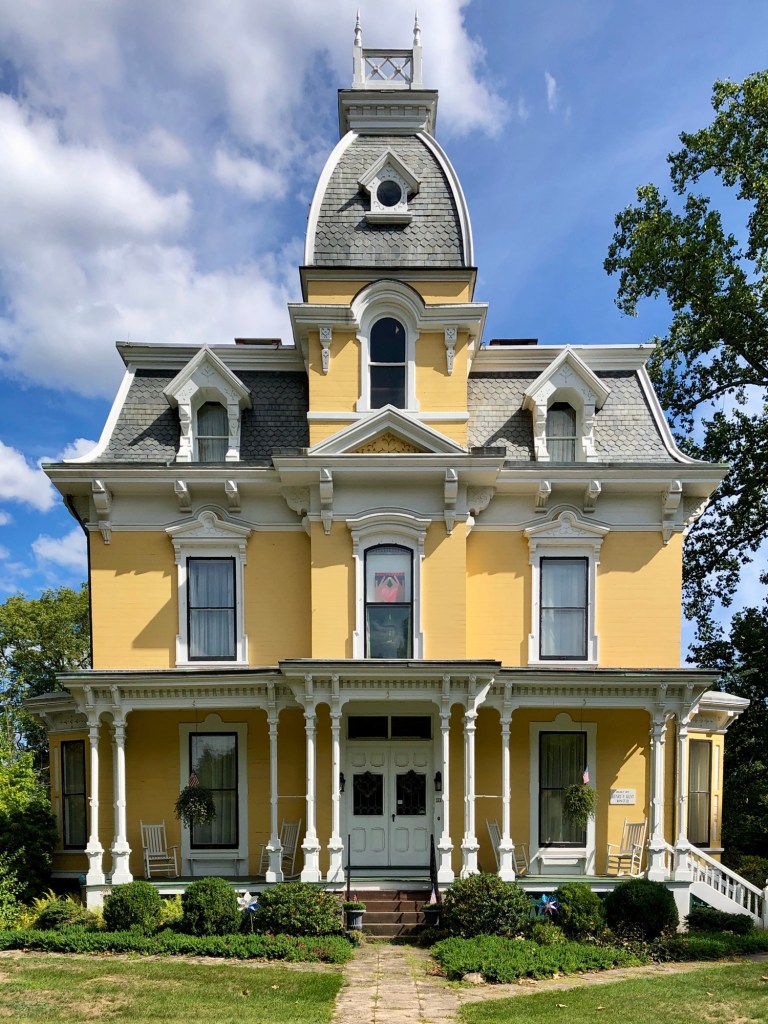
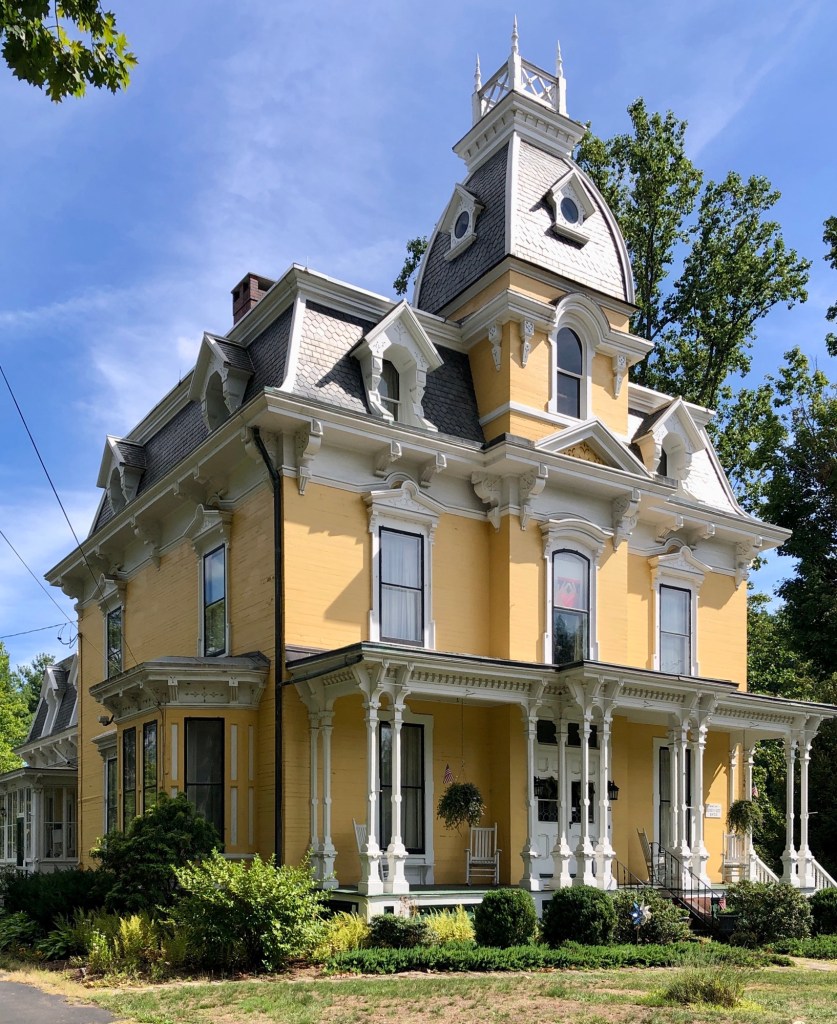
Located on South Main Street in Suffield, Connecticut, this stunning Second Empire mansion showcases the tobacco wealth seen in the town in the mid-to-late 19th century. Local legend states that in the early 1800s, a Cuban man arrived into town and was hired by a local farmer to grow tobacco and roll cigars for sale. Decades later, dozens of farmers in Suffield erected tobacco barns and cultivated tobacco to be rolled in cigars and shipped to communities all over the east coast. One of the first men in Suffield to box the cigars as a pack for shipping and sale was Henry Phelps Kent (1803-1887). With his success, Henry Kent purchased a large lot on the town’s Main Street and hired local architect, John C. Mead, to design a mansion to display his success in business. The large Second Empire mansion features flush-board siding, a full length porch, and a projecting mansarded tower with convex roof. The home was later owned by Samuel R. Spencer, a politician who served as a Lieutenant Governor of Connecticut, the first as a blind man. The home is now operated as a bed & breakfast “Spencer on Main”, named after its second owner.
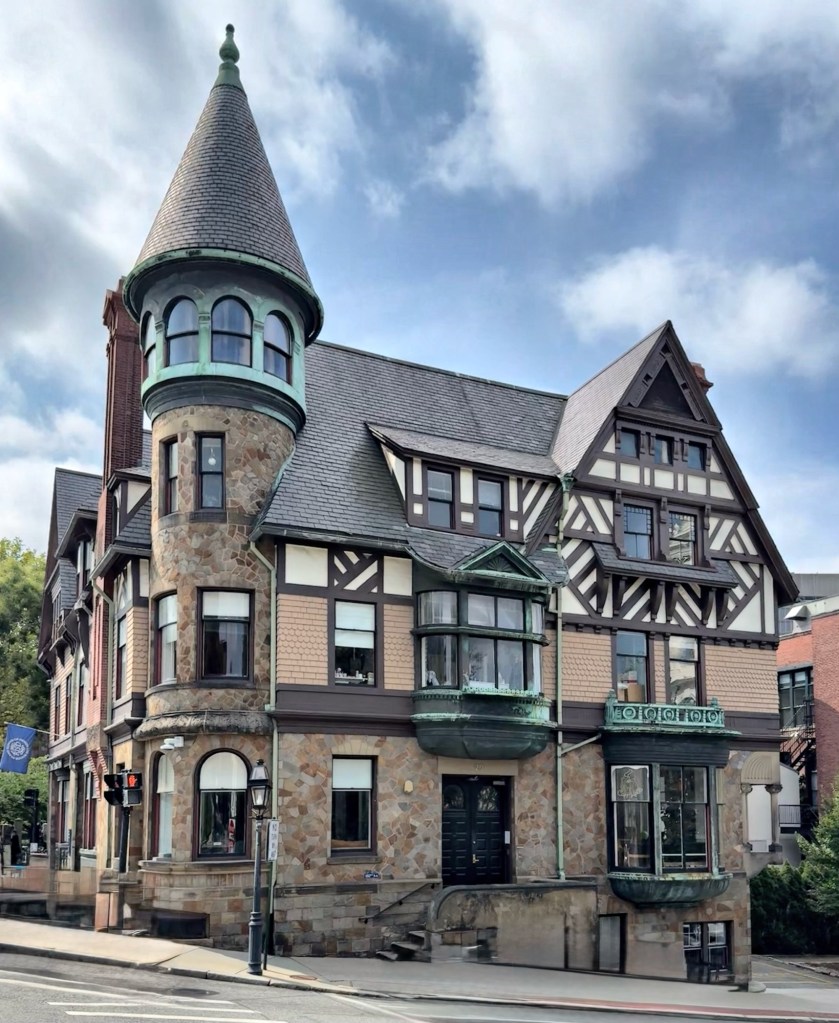
Perched on College Hill in Providence, Rhode Island, the Dr. George W. Carr Mansion at the corner of Benefit and Waterman streets, stands as one of the most attractive and interesting interpretations of the Queen Anne style in New England. The stately home was built in 1885 for George Wheaton Carr (1834-1907) a medical doctor who served as a surgeon during the Civil War and later as head surgeon for multiple Providence-area hospitals. For his Providence home, Dr. Carr hired architect, Edward I. Nickerson, to furnish plans, which resulted in this mansion with irregular plan, four-story corner corner capped with a conical roof, varied materials in stone, wood shingles, half-timbering, and copper bays. The Carr Mansion was purchased by the Rhode Island School of Design (RISD) in 1916, and has served a variety of roles for the school including as student housing and a cafe/lounge.
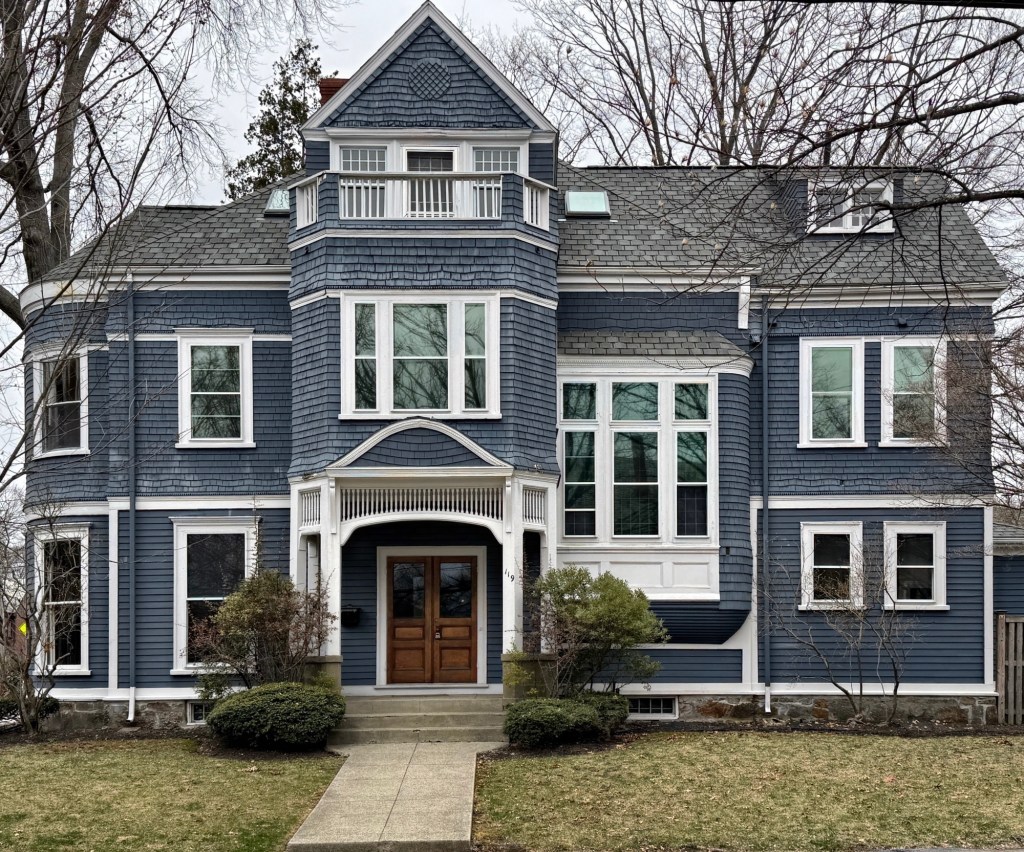
The Harrison Gardner House on Colchester Street in the Longwood section of Brookline is a stunning late Victorian residence that was “modernized” in 1887 to its current configuration. Harrison Gardner (1841-1899) was a Civil War veteran who arrived back in Boston becoming a wealthy dry goods wholesaler, later investing in Massachusetts mills. On January 20, 1871, Harrison was a founder and treasurer of the Boston Red Stockings of the new National Association of Professional Base Ball Players (NABBP). The team’s name changed multiple times, eventually landing on the Boston Braves, which would later move to Atlanta to become the Atlanta Braves in the MLB. With increased wealth and status, Harrison Gardner in 1887, hired the prestigious architectural firm of Hartwell and Richardson, to update his Brookline residence with additions and renovations in the Queen Anne and Shingle styles. Years after his death in 1899, Harrison’s widow, Laura Perkins Harrison, moved out of the large Longwood home and into a new, Arts and Crafts style stucco residence on Amory Street, designed by William Gibbons Rantoul.
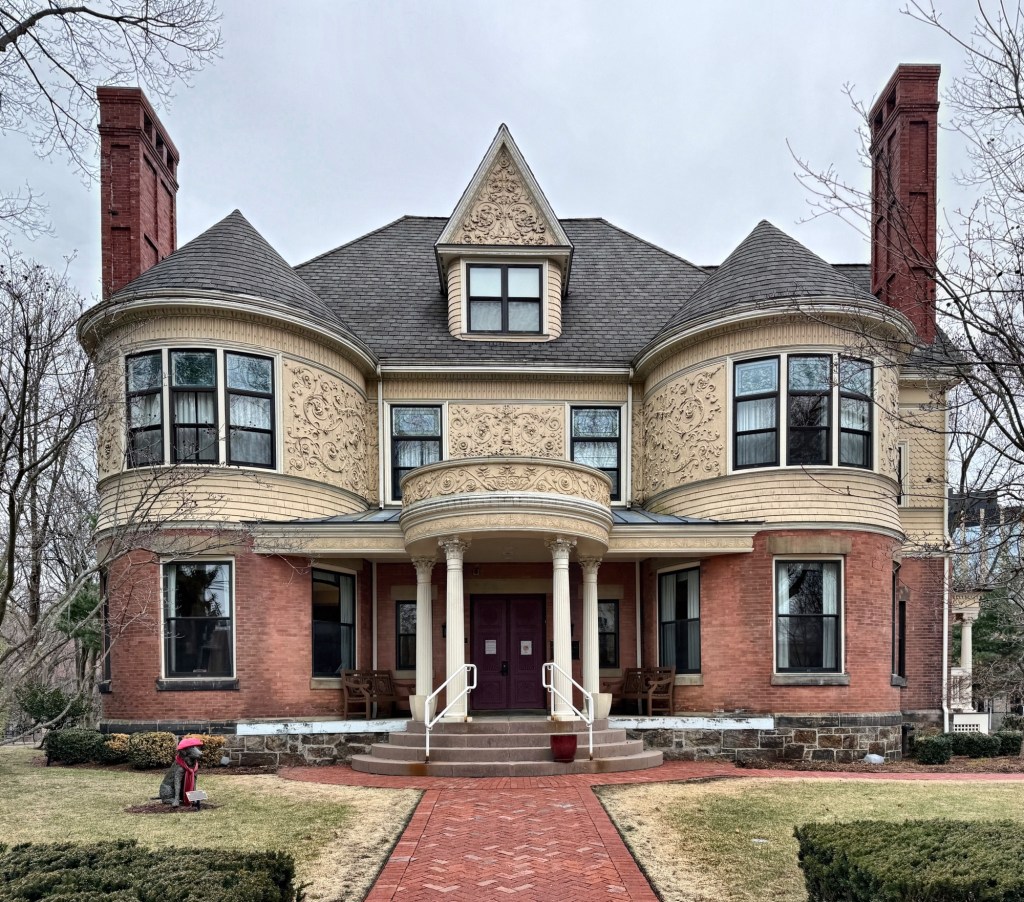
Built on the site of an earlier house at 241 Kent Street in Brookline, this grand, Queen Anne style house has seen a life as a single-family home, fraternity house, and ultimately, the Yawkey Family Inn, a temporary residence for patient families undergoing procedures and treatments at Boston Children’s Hospital. A landmark example of the Queen Anne architectural style, the handsome near-symmetrical residence has paired conical towers at the facade, a brick first floor, paneled chimneys, and elaborate carvings in the entry portico, second-story bays, wall surfaces and gabled dormer. Planning for the new mansion began in 1889 when owners, Harriet and Andrew Jackson Houghton, owner of the Vienna Brewery in Boston, hired architect, James Templeton Kelley, to furnish plans for their new suburban mansion. Sadly, Andrew Houghton died in 1892, shortly after the house was completed, and Harriet remained here until her death in 1925. After this, the property was sold to the Beta Upsilon Association for use as a Fraternity House for the Beta Theta Pi Fraternity of MIT and later as a fraternity house for a Northeastern University frat. In 2009, the property was purchased, renovated and expanded to the rear as the Yawkey Family Inn, ensuring its preservation and remaining as a quieter neighbor to the surrounding residents than its previous use.
In 1868, James Wilkinson Clapp (1847-1931) married Eliza Tuckerman and they soon after moved into this large Victorian-era house on St. Paul Street in Brookline. James was the second son of Otis Clapp, a politician, publisher, and promoter of homeopathy. Otis Clapp operated a large homeopathic pharmacy, Otis Clapp & Son, which continued as a business after his death, evolving to encompass different areas of medical technology. It was one of the oldest-operating pharmaceutical manufacturers in the United States by the time it was acquired by Medique in 2008. James Clapp was also a medical doctor and at the young age of 22, acquired a house lot here on St. Paul Street and had this large Second Empire style residence built for his family. Dr. James W. Clapp worked as a pharmacist and taught courses at the Boston University School of Medicine. He spent summers at his gentleman’s farm in Bolton, Massachusetts, until his death in 1931. The Clapp House was later used as a doctor’s residence and office and a nursing home, suffering from neglect, but was ultimately restored in the early 21st century.
An expression of the Shingle style in all her beauty, the George B. Dexter House on Sewall Avenue in Brookline was built in 1885 both as a residence and a billboard advertising the owner’s business, really. The residence was built for George B. Dexter (1854-1935) a partner in the Dexter Brothers Company a paint and stain manufacturer that was a favorite of architects in the late 19th and early 20th centuries. For his Brookline residence, George Dexter hired architect S. Edwin Tobey to design this Shingled masterpiece with continuous shingle siding with rounded bays and a shingled piazza to showcase the stain products of his company. According to articles, Dexter also stained and painted the interior a variety of colors to showcase the wide range of options his company had. George Dexter would move to Pill Hill neighborhood in a new home just a decade after having this residence built, likely caused by the development of apartments and commercialization in the Coolidge Corner area by the turn of the century. The Dexter House was converted to a two-family in the 1920s and today has three condominium units, with owners clearly taking great pride in this significant residence.
A fine example of the Queen Anne style of architecture, this late 19th century residence in Sharon, Massachusetts, is equally significant for one of its owners, Dr. Caroline Hastings. Caroline Eliza Hastings (1841-1922) was born in Barre, Massachusetts, and after attending public schools there, would enroll at the New England Female Medical College (later absorbed into the Boston University Medical School), graduating with an MD degree in 1868. She conducted a private practice and additionally worked as an instructor at her alma mater. She was affiliated with the Talitha Cumi Home in Jamaica Plain, Boston, a medical facility run by women to treat and house unmarried mothers and their young children. Doctor Hastings was an amazing woman who also established and was president of Boston’s first women’s medical society, and while on the Boston School Committee, implemented the first free school lunch program for poor children in the country. In the early 20th century, Dr. Hastings and her husband, Charles Printer, purchased this house built in 1890 and moved here together, where they likely enjoyed retirement. Dr. Caroline E. Hastings died in 1922, and her Sharon home has been preserved by later owners and resembles the property when she resided here.