Burnham Townhouse – Engineer’s Clubhouse // 1911

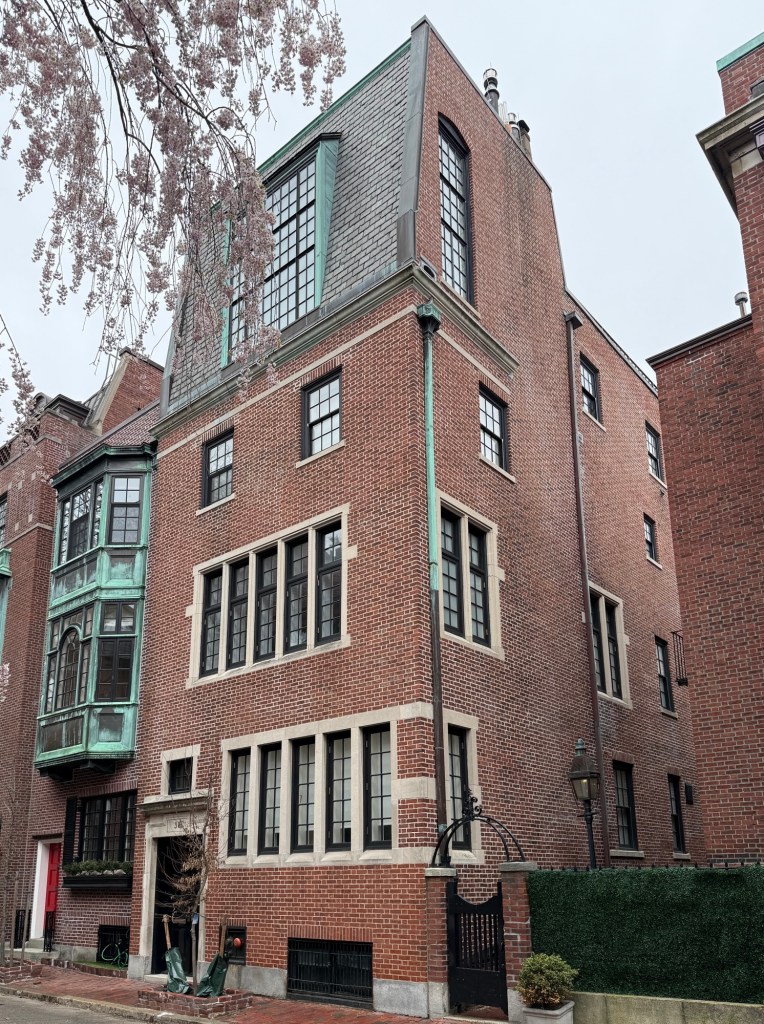
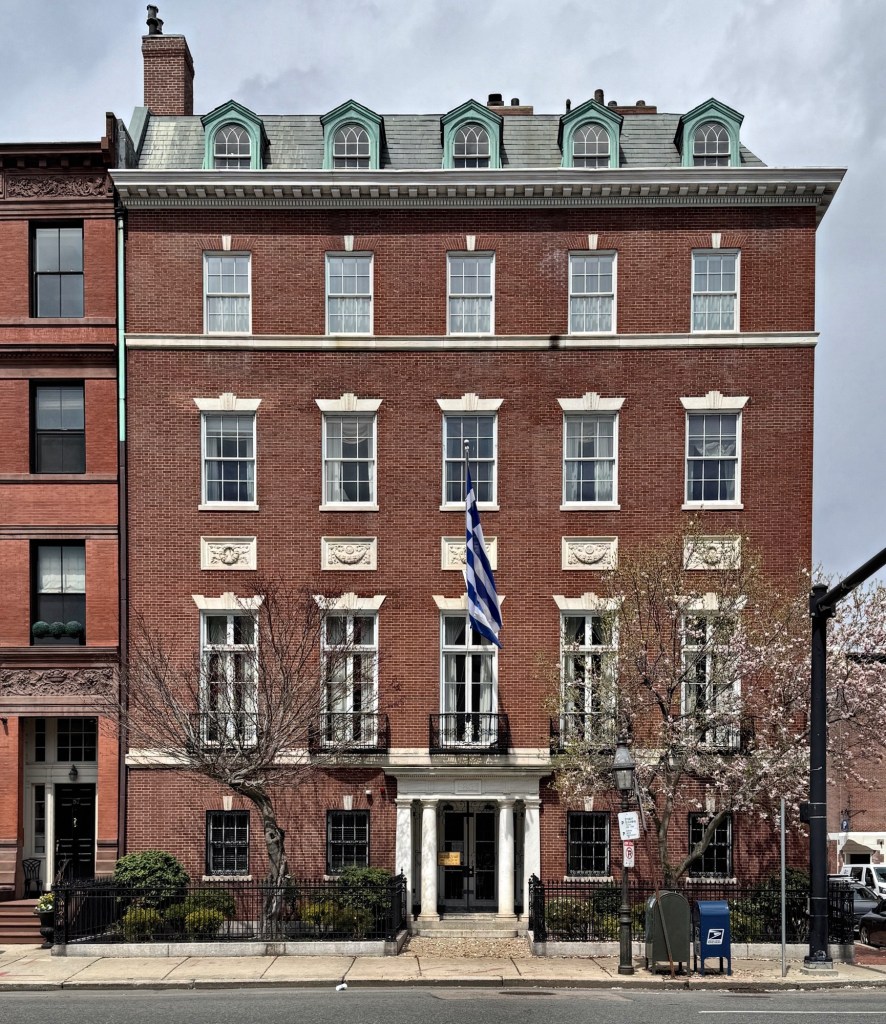
Located at the boundary of the Beacon Hill and Back Bay neighborhoods, this prominent townhouse on a corner lot at Beacon Street and Mugar Way was built in 1911, replacing an 1840s townhouse of the same form. The Colonial Revival style townhouse was built for Henry D. and Johanna H. Burnham from plans by the architectural firm of Wheelwright, Haven & Hoyt. Henry Burnham was the son of cotton broker, John Appleton Burnham and was in the real estate business. Henry and Johanna lived at 96 Beacon Street through at least 1938. The house was bought by the Engineer’s Club, a social and professional organization, in 1947. In the 1950s, the formerly mid-block townhouse suddenly became a corner lot with the construction of Storrow Drive, its off ramp as Mugar Way, and the addition of the Fielder Footbridge connecting Beacon Hill to the Esplanade. The Engineer’s Club took over renovations at the interior, which were done to adapt the former single-family residence for clubhouse functions, including a large banquet hall. In the 1960s, the property was acquired by Emerson College and used it as a college center and cafeteria until the early 2000s when it was converted into condominiums by Grassi Design Group, adding new openings to the formerly solid brick side wall.

Bayard Thayer House – Hampshire House // 1911

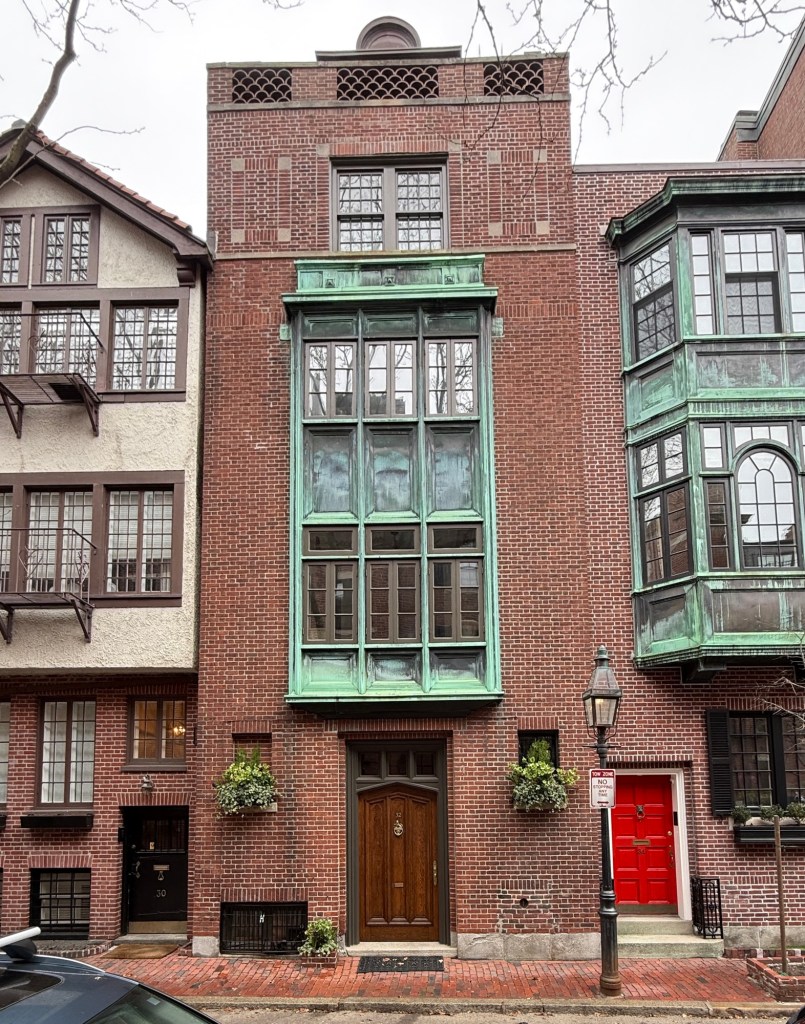
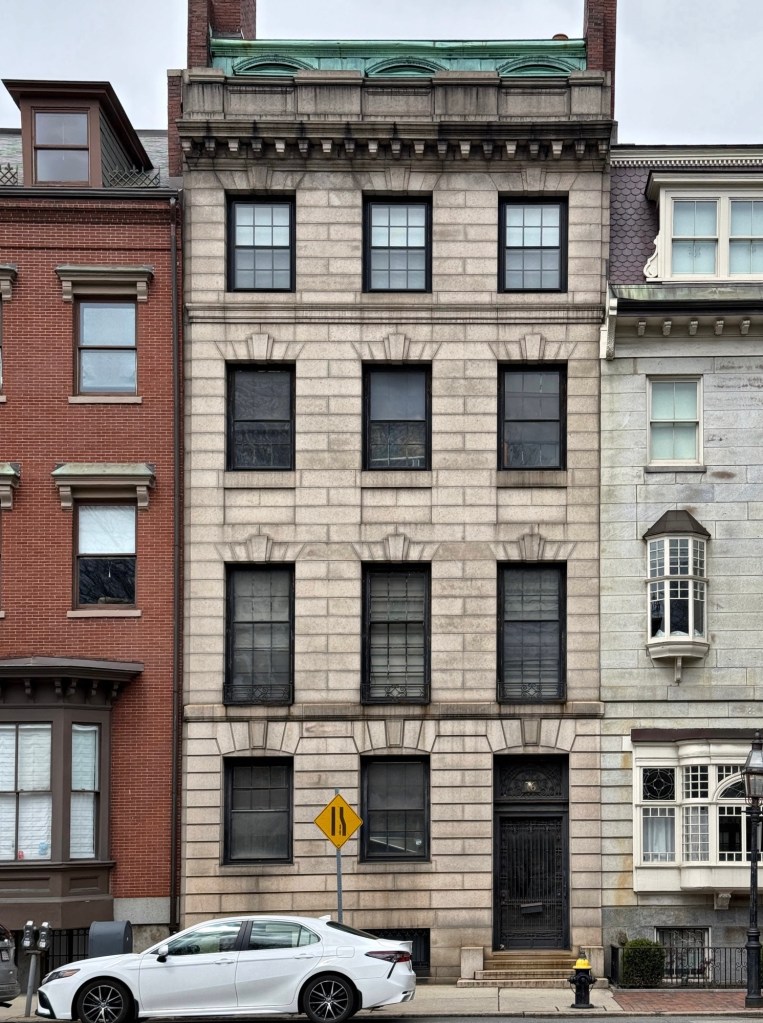
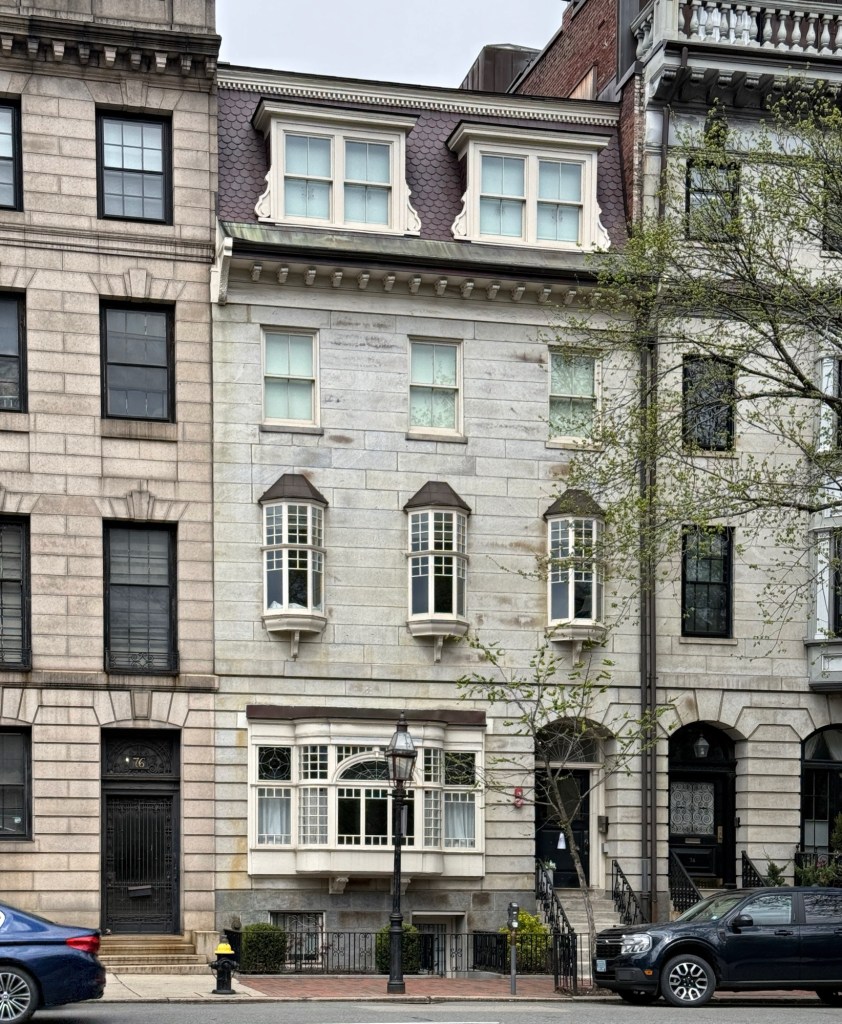
This iconic building at 84 Beacon Street in Boston’s Beacon Hill neighborhood, is best-known for its bar, which in 1982, became world-famous as the locale for the bar in the television sitcom Cheers, one of the most-watched programs in television history; but its history begins earlier. This five-story building was constructed in 1911 as a mansion for Bayard Thayer (1862-1916), who split his time between Boston and his country estate in his home-town of Lancaster, Massachusetts. Thayer hired architect, Ogden Codman Jr., a favorite designer of Boston and New York high-society, to design his Boston mansion, which is an expressive and overscaled example of a Colonial Revival style townhouse. Bayard Thayer died in 1916 and his widow, Ruth Simpkins Thayer, lived here with her granddaughter, Ruth, and nine domestic servants. After Ruth Thayer’s death in 1941, the property was conveyed to the Colonial Properties Trust in 1944, operating the building as a small luxury apartment hotel. From this point on, the hotel became known as Hampshire House. In about 1969, the basement space in the Hampshire House opened as the Bull & Finch Pub, which later became the inspiration of the iconic sitcom Cheers. Pictures of the exterior of the building were used in the show’s credits and scene changes, and the interior was faithfully replicated in a set in Hollywood, where the show was actually filmed. The Bull & Finch Pub has permanently been renamed Cheers Pub and visited by many who wish to visit the place where “everybody knows your name”.

Brimmer Street Terrace // 1912

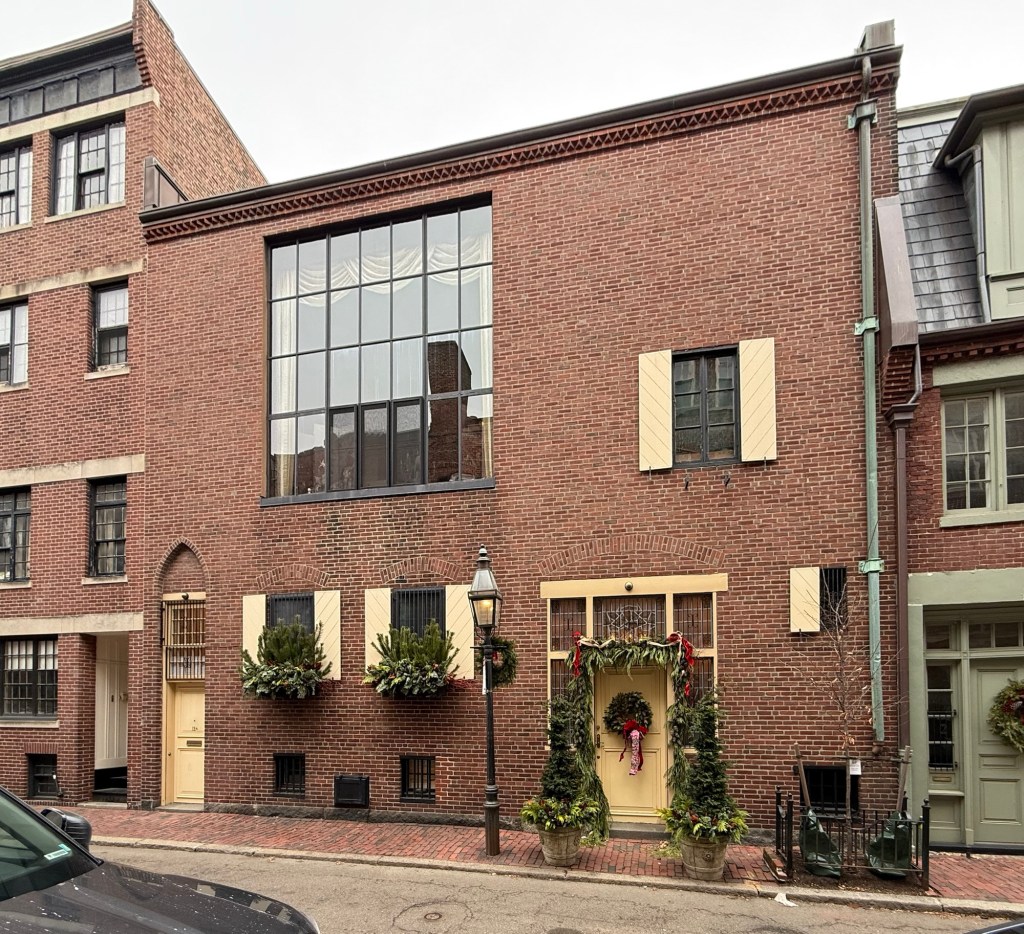
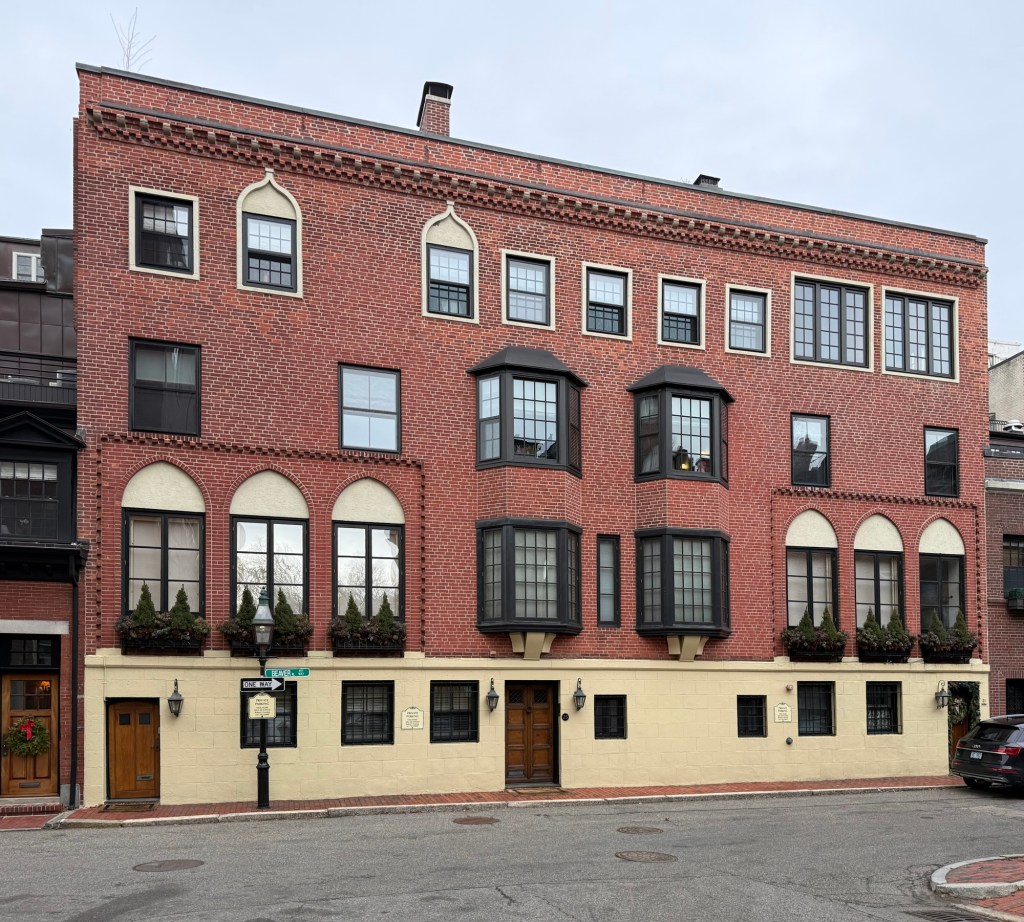
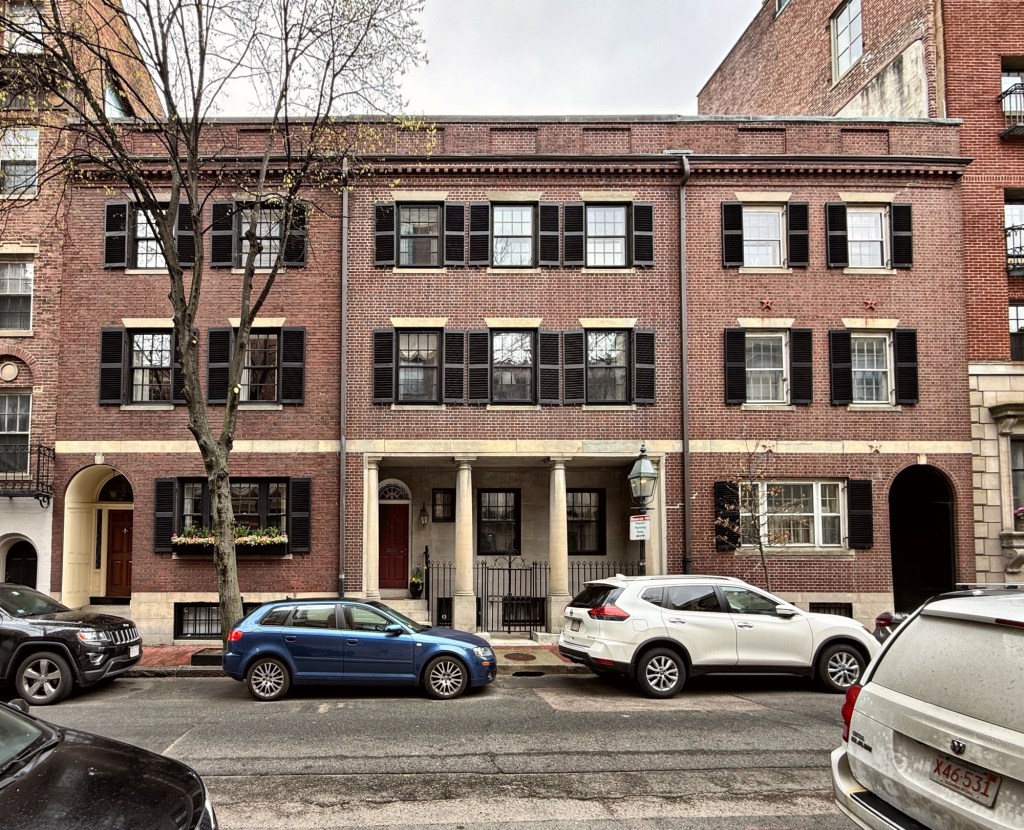
An interesting ensemble of seven rowhouses running along Brimmer Street in Beacon Hill, the Brimmer Street Terrace development showcases the rebirth the “Flat” of Beacon Hill encountered in the early 20th century from livery stables and carpentry shops to high-end housing and artist’s studios. Built on the site of a large livery stable, Brimmer Street Terrace was developed in 1912 by Gerald G. E. Street and William C. Codman, developers who sought to enhance this section of Beacon Hill and protect it from unsympathetic development, and hired architect Richard Arnold Fisher to design the houses. The rowhouses were originally rented to upper-class families but later were sold off as individual properties. Colonial Revival in style, the row is built of the iconic Boston red brick, Federal Revival style fanlight transoms over the entrances, include shutters, and all sit atop a stone basement. The row is anchored on each end by residences facing north and south with large symmetrical facades with the five more narrow rowhouses connecting them along Brimmer Street. 

Miss Grace Nichols House // 1913

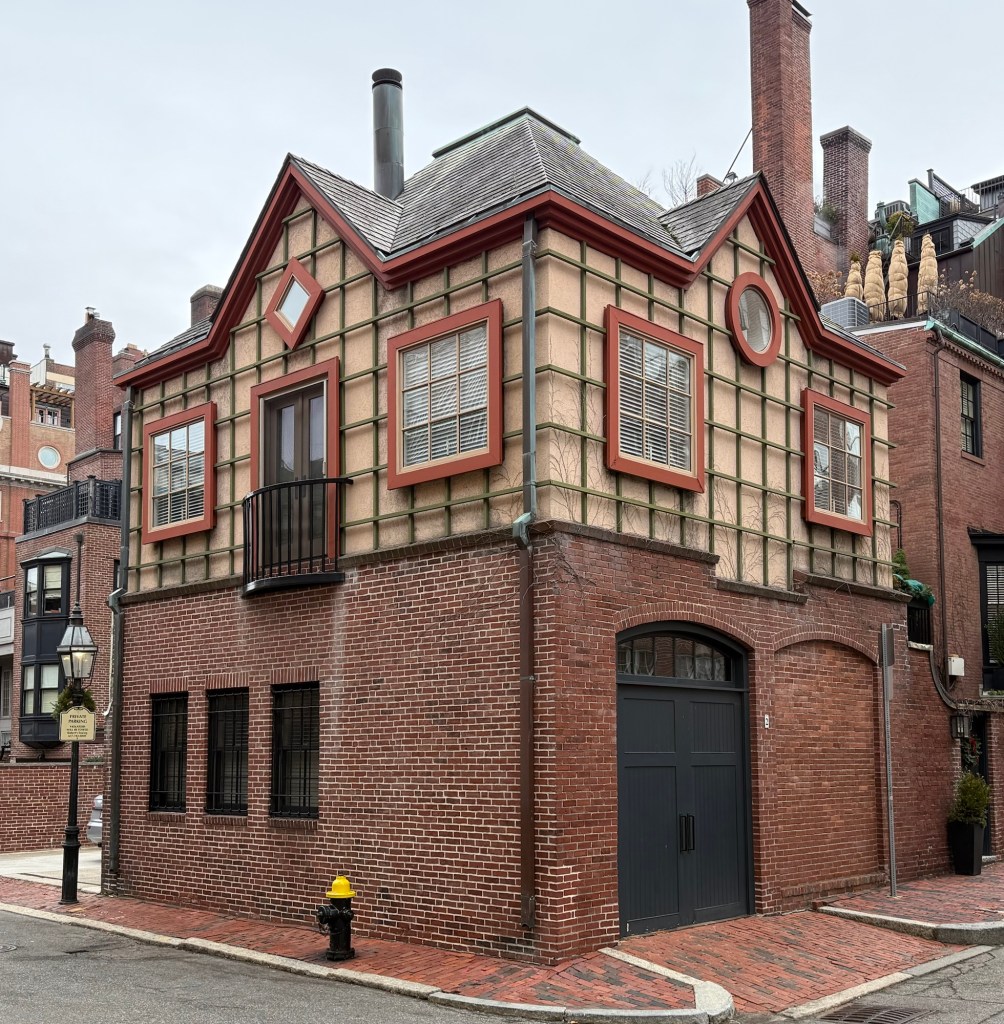
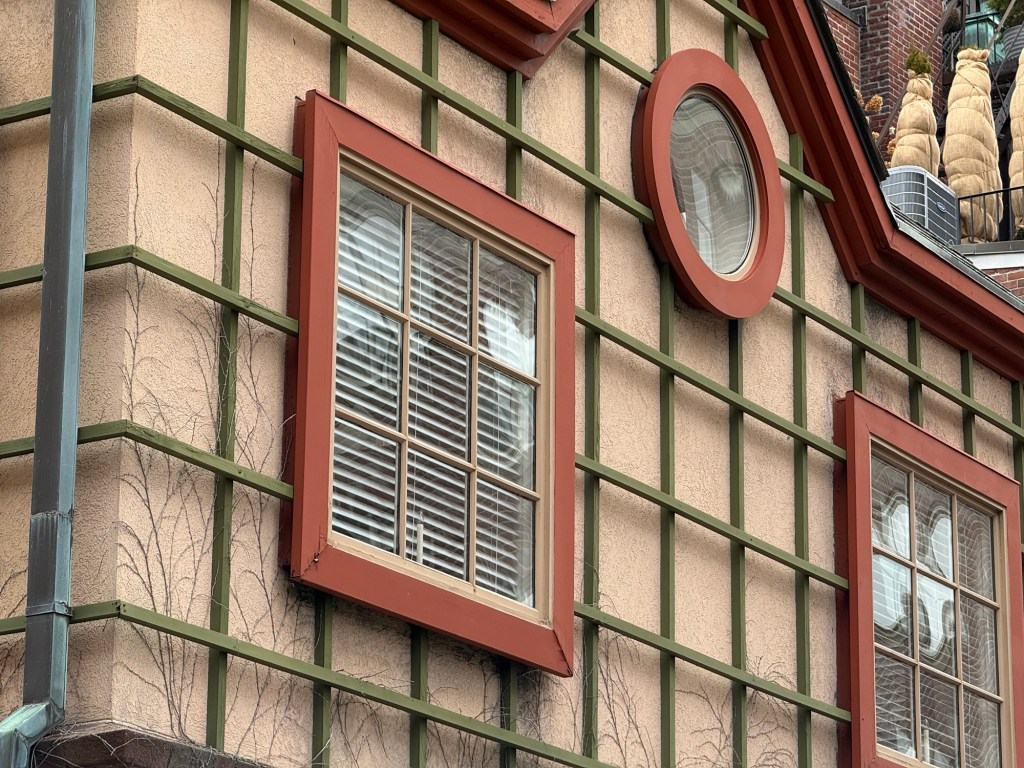
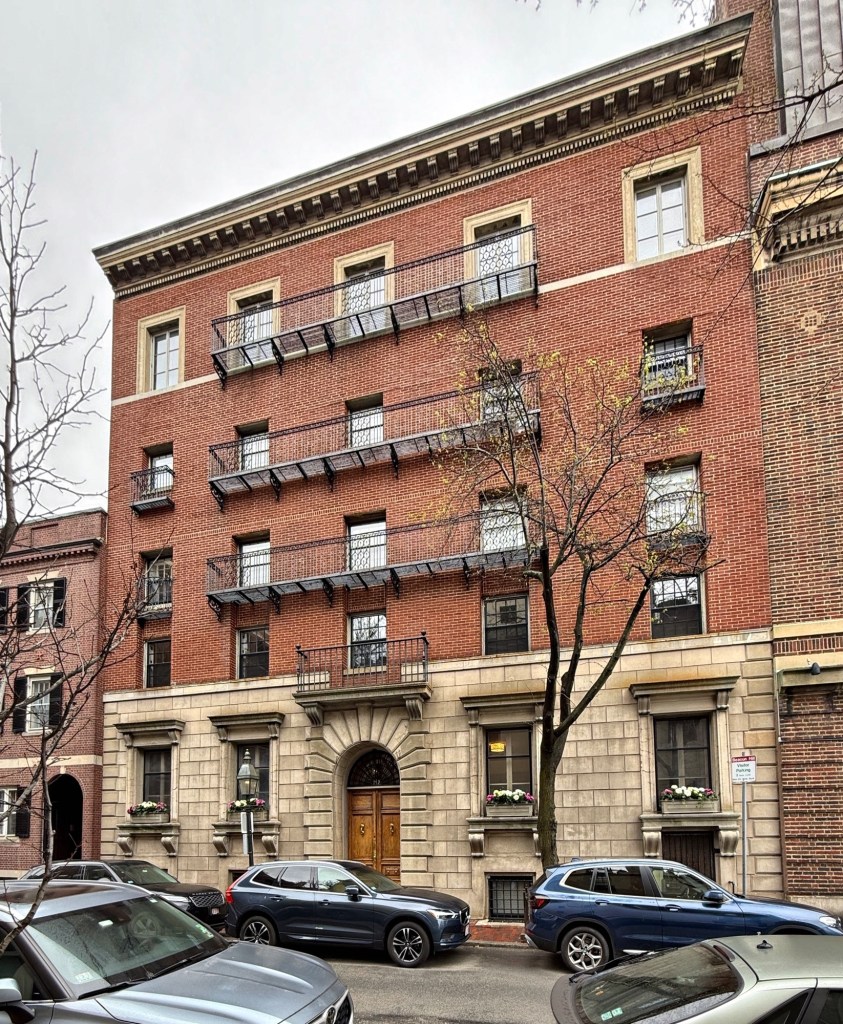
Located at the western end of Chestnut Street in the Flat of Beacon Hill, you will find this stucco residence, one of the finest mansions in Boston. The four-story residence with two entrances is built of brick and covered with stucco and was constructed for Miss Grace Nichols (1874-1944), the daughter of John Howard Nichols, who worked for John Lowell Gardner (the husband of Isabella Stewart Gardner) as a merchant transporting goods between Boston and Chinese markets, before overseeing mills. As a single woman, Grace inherited much of her parents wealth upon their deaths, and in 1913, hired architect, William Chester Chase, to design her Beacon Hill home in the Italian Renaissance Revival style, similar to Isabella Stewart Gardner’s Fenway Court mansion (1903). Grace Nichols married Richard Pearson Strong, a Harvard professor and medical researcher, in 1936 and the couple lived here with servants until their deaths in 1944 and 1948 respectively. After their death, the building was either purchased by or willed to the Boston Society of Natural History and the New England Museum of Natural History, which moved out of their Berkeley Street location in 1946. The Nichols Mansion served as the new Boston Museum of Science until 1951, when the new and current museum was built between Boston and Cambridge. Today, the former Nichols mansion is five condominium units, with owners having one of the most enchanting and unique properties in the exclusive Beacon Hill neighborhood.

Elizabeth G. Evans – Edward A. Filene House // 1883

This unique brick house at 12 Otis Place in Beacon Hill was built in 1883 by the architect, Carl Fehmer for attorney Glendower Evans and his wife, Elizabeth Gardiner. Mr. Evans died in 1886 of Hodgkin’s Disease at just 30 years of age. His widow, Elizabeth Glendower Evans (1856-1937) was greatly influenced by her husband during their brief marriage, even taking her husband’s first name as her middle name after his death. Elizabeth Glendower Evans became a prominent social activist, studying child labor conditions in the South and took up the cause of women’s suffrage and the associated problems of tenements and factory work arising from disenfranchisement in the late 19th and early 20th centuries. In 1915 Evans served as a delegate to the International Congress of Women at the Hague. She was the first National Organizer of the Woman’s Peace Party. From 1920 until 1937 she served as a national director of the American Civil Liberties Union. In the 1910s, Elizabeth sold the home to Edward Albert Filene (1860-1937), who, together with his younger brother Abraham Lincoln Filene, reorganized his father’s department store into “William Filene’s Sons Company”, which would later become Filene’s. He was a supporter of credit unions to help ordinary American workers to access loans at reasonable rates and allow workers to save their money so that when hard times hit, they were prepared.

William and Octavia Apthorp Mansion // 1885

This unique four-story brick townhouse on Otis Place in Beacon Hill, Boston, was built in 1885 by the architectural firm of Rotch & Tilden for Mrs. Octavia L. Apthorp and her husband, William F. Apthorp. Elevated on a tall brick basement, the exterior of the house is richly detailed with masonry decoration in what has become known as the “panel brick” style; with an elaborate brick entrance archway, paneled pilasters at the third floor, and vertical brick lintels above the windows. Over the ground floor windows near the entrance, iron grates with spear-like finials give the design a Medieval/English Queen Anne presence. William F. Apthorp was the only son of Robert Apthorp, a prominent Boston attorney and abolitionist who lived across the street at 2 Otis Place. William was a pianist and teacher at the New England Conservatory of Music and writer who married Octavia (sometimes spelled Octavie) Loir Iasigi in 1876, she was also from a well-connected Beacon Hill family.

Pickering-Apthorp Houses // 1870

These two near-identical townhouses at 1 & 2 Otis Place in Beacon Hill are significant architecturally and as they are bounded by four streets. The unique lots were created when Otis Place was laid out on made land in 1869 and were built the following year as an identical pair sharing a party wall and with their front facades facing south on Otis Place. The two residences were designed by the firm of Ware and Van Brunt, who blendedSecond Empire and Victorian Gothic styles with gothic arched windows, bracketed cornices, slate mansard roof, and later Colonial Revival porticos added in 1916 by architect, Frank A. Bourne. No. 1 Otis Place (right side with the oriel bay window) was first owned by Henry G. Pickering, a dealer in engines and machinery at the height of New England’s industrial revolution. No. 2 Otis Place (left with later fanlight entry), was originally owned by Robert E. Apthorp, an attorney and realtor, who decades earlier, was an active member of the Boston Vigilance Committee, the group established to harbor and assist fugitives from slavery after the passage of the Fugitive Slave Act in September 1850.

Martin-Ware House // 1872

One of the most interesting houses in Beacon Hill is this unique Second Empire style townhouse with towering two-story mansard roof at 3 Otis Place/49 Brimmer Street. When walking around Boston and exploring other cities, it is always fun to delve into research and learn about the built environment and the stories that brought these places to be! This residence was constructed in 1872 on land that was filled here between 1867 and 1869 formerly occupied by the Charles River. Creating the land at and around Otis Place was one of a series of responses to the need for more physical space in Boston and to cover the pollution of the Charles River along the West End and what would become the Back Bay. The houses at 3-4 Otis Place were originally owned and designed by architect, Abel C. Martin, who resided next door to the topic of this post until his death. In the early 20th century, this house was owned by Charles Eliot Ware Jr. a publisher, who in 1929, hired architect, Charles Greely Loring to add the copper-clad oriel window on the north elevation and elevate the mansard roof to create the unique two-story mansard. The old Martin-Ware house has been apartments since at least the 1960s.

Samuel and Emily Eliot Rowhouses // 1871

These three identical three-story houses at 156, 158 & 160 Mt. Vernon Street in Beacon Hill Flat were built in 1871 as income producing properties for Samuel and Emily Otis Eliot who lived next door on the corner of Brimmer Street. The architect is not evident from my research, but they were likely designed by Abel C. Martin, who furnished speculative housing for the Eliot’s elsewhere in the neighborhood. All three residences feature brick facades with off-center recessed entries on raised stoops. The use of brownstone lintels and sills, decorative brick cornice, and second-story hexagonal oriel windows add intrigue to the design, along with the slate mansard roofs. The three houses were sold or rented and all were owned by various families, but notable owners of the central house include the architect George Russell Shaw (1848-1937) of the firm Shaw and Hunnewell through the early 1900s. Later in the 20th century, the house was owned by Kevin White (1929-2012), who served as the mayor of Boston for four terms from 1968 to 1984.
All three residences are well-preserved and look much as they did when constructed over 150 years ago.

Sunflower Castle // 1878

This absolutely unusual and enchanting cottage on Mount Vernon Street in Beacon Hill, Boston, was originally was constructed in the 1840s but completely altered decades later in its distinctive English Queen Anne style. In 1878, Frank Hill Smith, an artist and interior designer, worked with architect, Clarence Luce to renovate what was originally a two-story Greek Revival house into one of the most eclectic and unique residences in New England. The Sunflower Castle, a name reputedly coined by Oliver Wendell Holmes, features a yellow stucco first floor with the upper floors covered with red fish-scale shingles. Further detail includes the half-timbering, decorative panels depicting a gryffin and a sunflower in the gable, and carved wood frieze over the doorway. Clarence Luce was likely so inspired by this project, that he built an even more extravagant example of this house for Edward Stanwood in Brookline soon after. By 1903, the property was sold to the painter, Gertrude Beals Bourne and her husband, architect, Frank A. Bourne, who were both key players in the revival and gentrification of the Beacon Hill Flat neighborhood west of Charles Street in the early 20th century. The Sunflower Castle was used as their home and as an artist’s studio for the couple, with Frank adding the side garden wall with tile-roofed gateway to enclose a private open space. The property remains as a private residence.