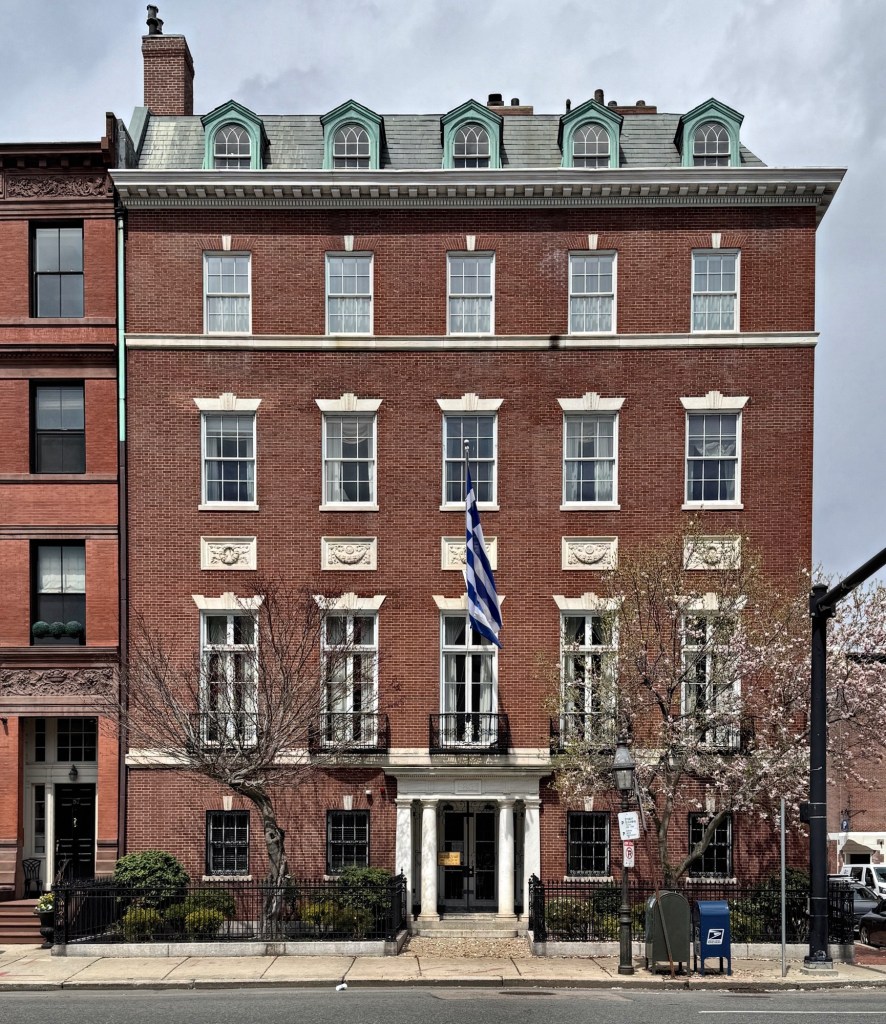
David Sears Mansion – Greek Consulate // 1911

The David Sears Mansion (now the Greek Consulate) at 86 Beacon Street in Boston, is a large, architecturally significant example of a mansion built in Beacon Hill in the early 20th century for a member of a prominent local family. In 1910, Dr. Henry Francis Sears (1862-1942), who had inherited his father’s property on this site, that included two townhouses and a double-stable at the rear, demolished the two houses and built a new mansion on the double lot. The architectural firm of Wheelwright & Haven was hired to furnish plans, which resulted in the symmetrical, four-story mansion with fifth floor mansard punctuated by dormers. The brick structure is trimmed with marble, including at the entry portico, keystones and headers at the windows, and the ornamental panels between the second and third floors in alternating wreath and swag motifs. In the 1920 census, Henry F. Sears lived here with his wife Jean, their four children, his older brother David Sears, and nine domestic servants. After Dr. Sears’ death in 1942, the property was conveyed to the Charlotte Cushman Club of Boston, a boarding house for touring actresses needing respectable, inexpensive, safe lodgings as single women performers were unwelcome in many hotels. In the 1950s, the property became the Katherine Gibbs School, a satellite campus of the higher education institution founded by Katharine Gibbs with the goal to provide educational opportunities to women, eventually becoming Gibbs College. The most-recent chapter of the mansion’s history began in 1993 when the building became home to the Consulate General of Greece in Boston, with the consulate occupying the first two floors of the interior, with condominium units above.
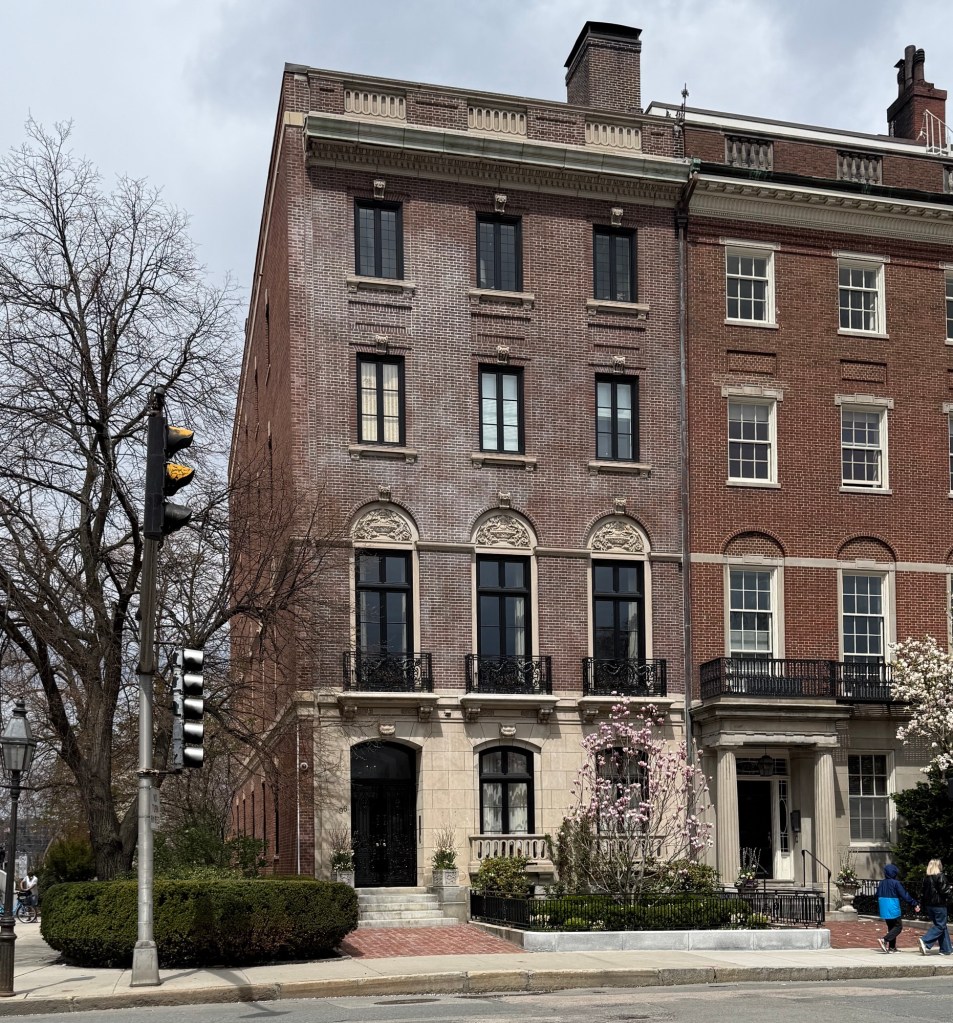
Burnham Townhouse – Engineer’s Clubhouse // 1911

Located at the boundary of the Beacon Hill and Back Bay neighborhoods, this prominent townhouse on a corner lot at Beacon Street and Mugar Way was built in 1911, replacing an 1840s townhouse of the same form. The Colonial Revival style townhouse was built for Henry D. and Johanna H. Burnham from plans by the architectural firm of Wheelwright, Haven & Hoyt. Henry Burnham was the son of cotton broker, John Appleton Burnham and was in the real estate business. Henry and Johanna lived at 96 Beacon Street through at least 1938. The house was bought by the Engineer’s Club, a social and professional organization, in 1947. In the 1950s, the formerly mid-block townhouse suddenly became a corner lot with the construction of Storrow Drive, its off ramp as Mugar Way, and the addition of the Fielder Footbridge connecting Beacon Hill to the Esplanade. The Engineer’s Club took over renovations at the interior, which were done to adapt the former single-family residence for clubhouse functions, including a large banquet hall. In the 1960s, the property was acquired by Emerson College and used it as a college center and cafeteria until the early 2000s when it was converted into condominiums by Grassi Design Group, adding new openings to the formerly solid brick side wall.

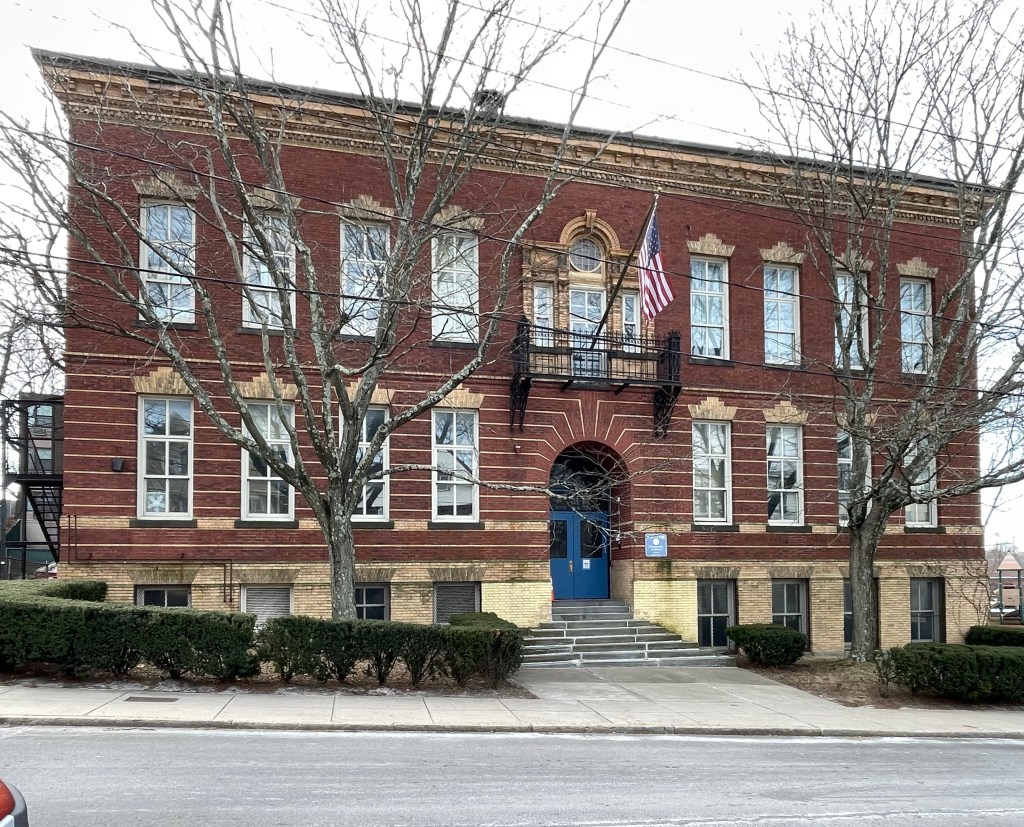
Margaret Fuller Primary School // 1891

The Margaret Fuller Primary School (now Community Academy) is a public school in Boston that shows how much attention to detail the school department and the city architect paid when designing these structures in the late 19th and early 20th centuries. The Fuller School was constructed in 1892 to alleviate an overcrowded school district resulting from rapid urbanization. Jamaica Plain was one of Boston’s first streetcar suburbs largely spurred by the growth of the Boston and Providence Company Railroad between 1860 and 1890, when the area saw a shift from large bucolic estates to subdivided urban housing (largely triple-deckers and apartment buildings along major routes). With the surge in population, many new schools were built city-wide, including this primary school which was designed by Edmund March Wheelwright (1854–1912), a prominent Boston-based architect who served as City Architect for Boston from 1891 to 1895. Architecturally, the building is a stunning example of the Colonial Revival style with red and buff brick walls which are laid in a Flemish bond and rusticated at the first story with single recessed courses of buff brick. An arched entrance and Palladian window with iron false balcony sit at the central bay. The school was named after Margaret Fuller Ossoli (1810-1850) an early transcendentalist and writer advocating for women’s rights born in Cambridge.