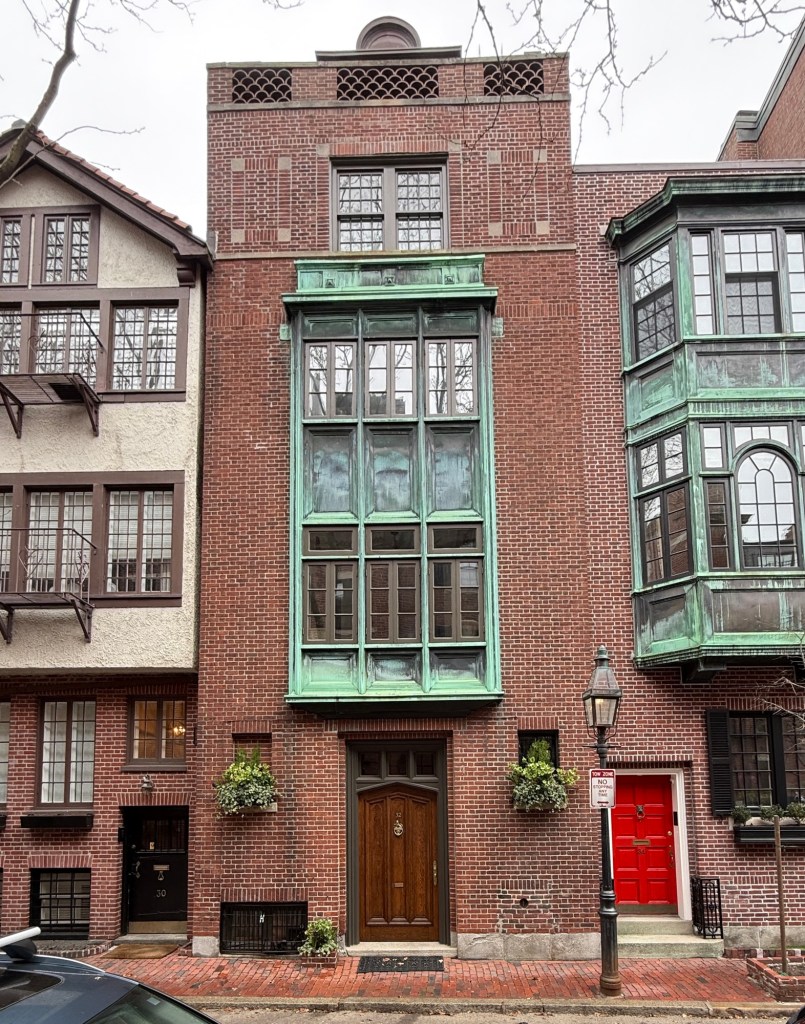
This charming townhouse on Lime Street on the Flat of Beacon Hill, was built in 1912 for the Brimmer Realty Trust by architect, Richard Arnold Fisher, who lived two houses down the street. After the developers built the house on speculation, the townhouse was purchased by an A. G. Burgess, and soon after by Odin Roberts, a prominent patent lawyer with Roberts, Roberts & Cushman. After WWII, the townhouse was purchased by Jacob Wirth Jr., who took over his father’s iconic German restaurant, Jacob Wirth’s after his death. Jacob Wirth Jr. lived here until his death in the 1960s and it remained as the residence of his widow, Dorothy Wirth until 1995. The brick townhouse stands out for its two-story projecting copper oriel and the unique parapet at the roof.
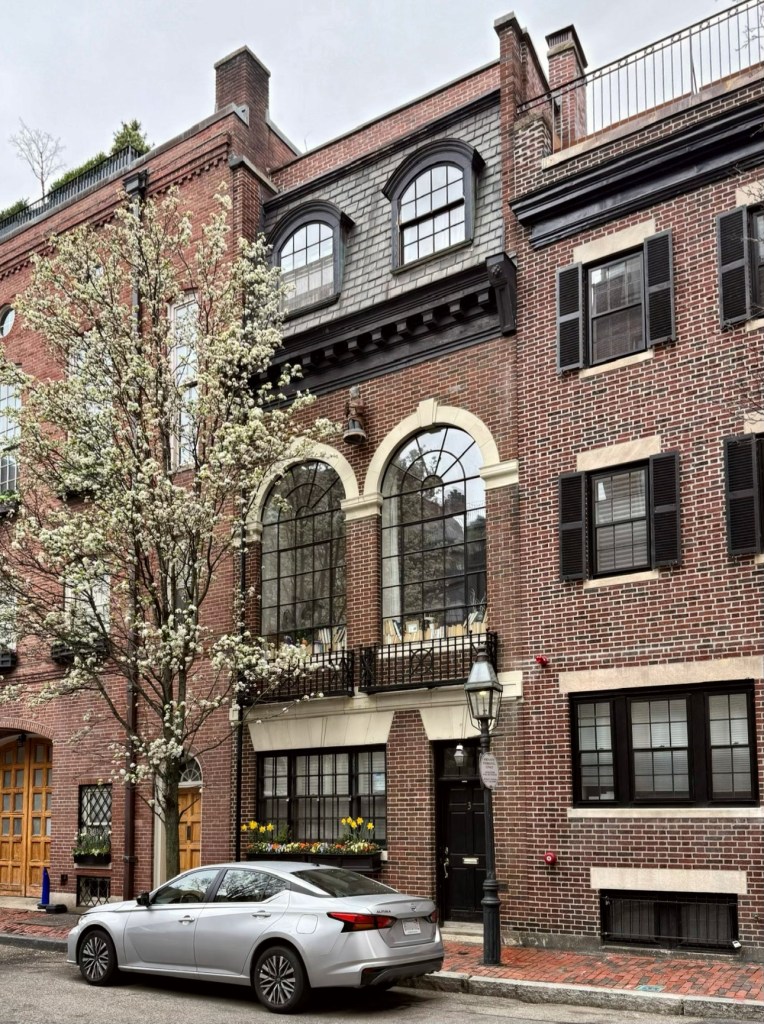
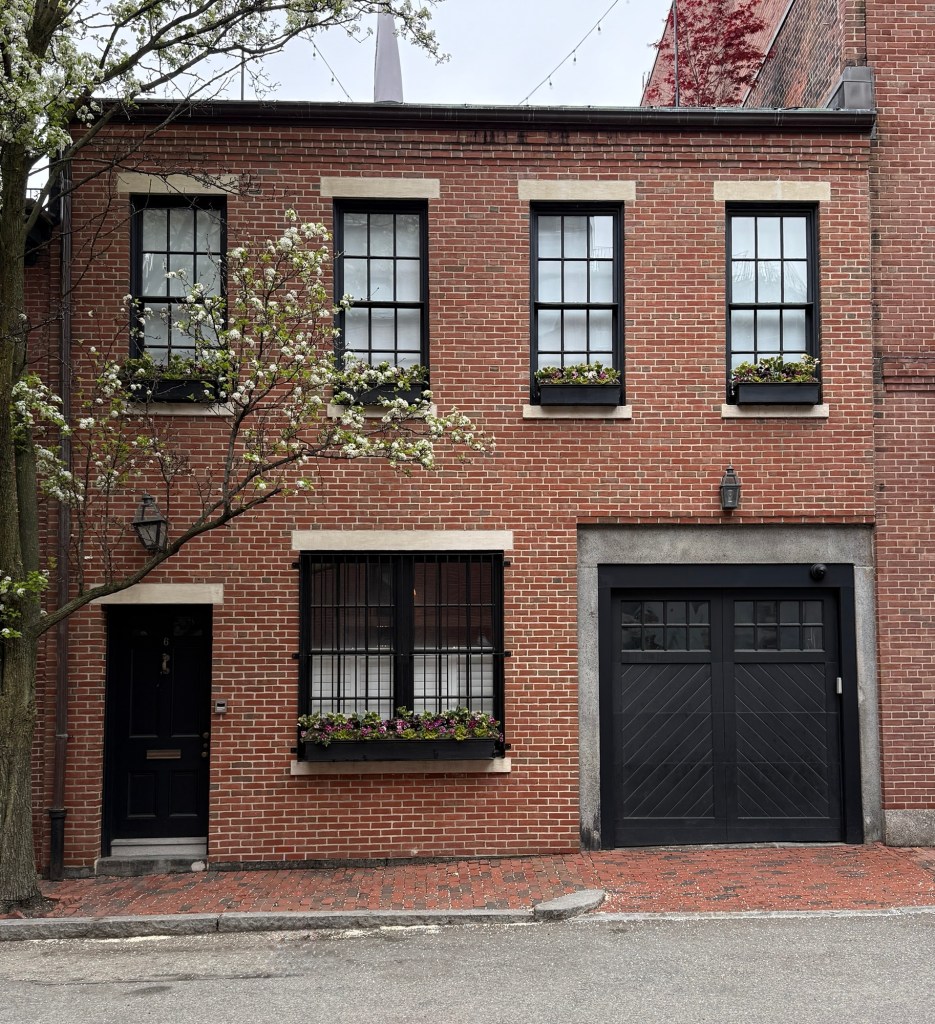
This narrow three-story, two-bay brick house on Byron Street on the Flat of Beacon Hill, is one that I had never noticed before, but it instantly became one of my favorite houses in Boston. Built in 1914 as a two-story residence for Charles Lewis Harding (1879-1944) a wool merchant and agent for mills in the New England area. It appears that Mr. Harding had the building constructed but never resided here and may have rented out space or kept his vehicle inside. After his death in 1944, the property was owned by Ariel Hall and her husband, painter and etcher Frederick Garrison Hall. She removed the garage replacing it with a large window, and added the mansard roof, converting the entire building into a single-family residence from plans by architect, William Chester Chase. They likely expanded the second-floor windows to the present configuration for an art studio for Mr. Hall before his death in 1946. It is unclear the vintage, but the building also features a painted statuette of a Chinese figure, mounted on a pedestal in the space between the arches of the windows at the second floor.
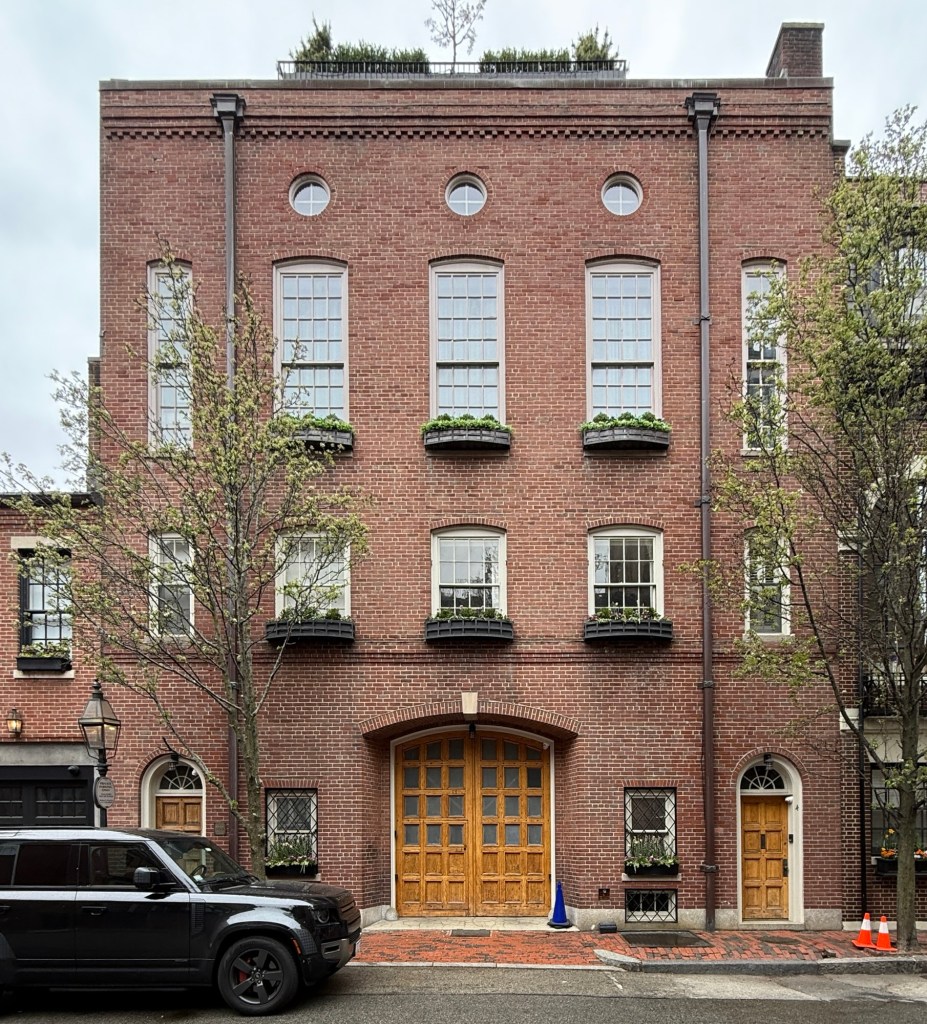
In 1929, Eleonora R. Sears (1881-1968), a tennis champion and great-great-great granddaughter of President Thomas Jefferson, had a 19th century stable she inherited from her late father, demolished and replaced with this stunning residence with garage on Byron Street in Boston’s Beacon Hill neighborhood. The present three-story building was designed by Henry Forbes Bigelow, who lived a few blocks away in his own mansion, as a unique Colonial Revival style building with symmetrical facade. Eleonora Sears was one of the first American women to drive an automobile and fly a plane and lived here with her chauffeur when she was not at one of her other properties. After Eleonora died in 1968, her Beacon Hill residence was converted into condominiums, while the facade retains its architectural features when built nearly 100 years ago.
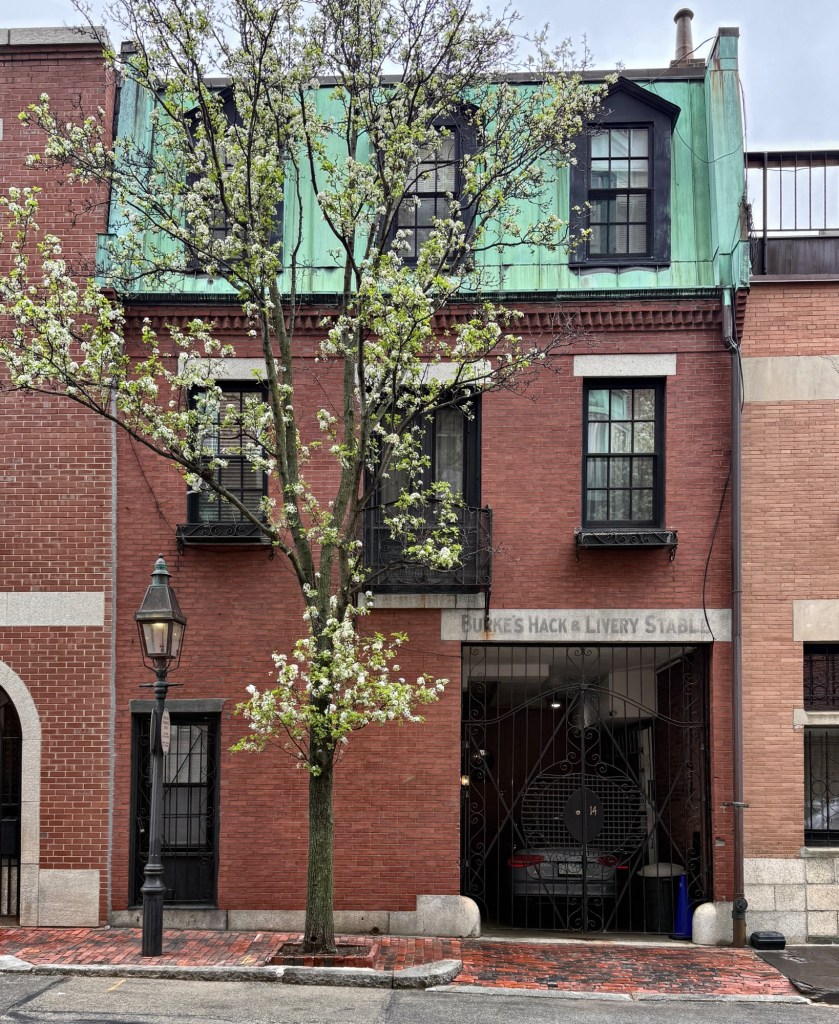
This handsome two-story brick stable on Byron Street in Boston’s Beacon Hill neighborhood was built around 1865 for the Sigourney family, and its front façade retains a distinctive appearance associated with that period. The brick façade sits on a granite base, and the first story contains two entrances characteristic of its stable use: a vehicle door providing access to ground floor and a domestic entrance connecting to stairs leading to upper levels including stableman’s quarters on the top floor. Around the time of WWI, the property was owned by James F. Burke, who added the painted sign over the carriage entry. The stable was converted to a residence in about 1964 for owner, Jay Schrochet by architect, Benjamin S. Fishstein and remains a single-family home today.
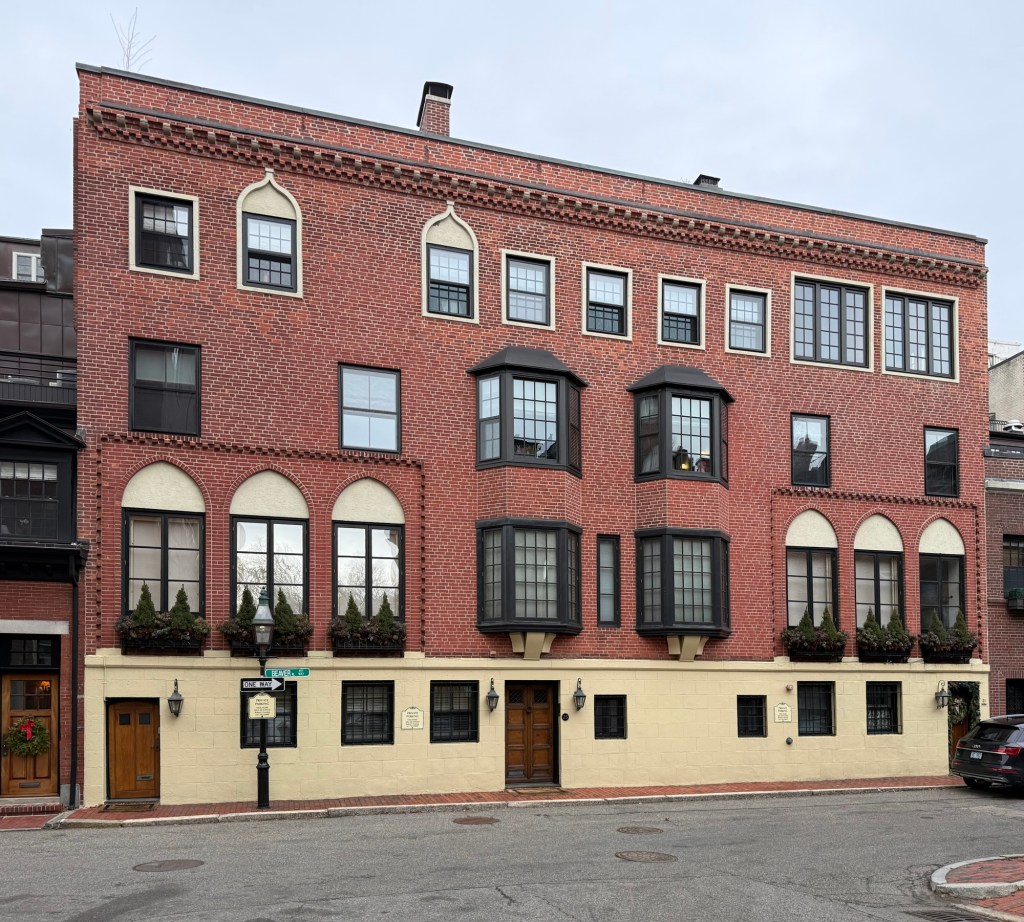
The four-story brick residence on Beaver Street in Beacon Hill was constructed in 1919 in the style of a Venetian palazzo for Harris Livermore, president of the Coastwise Transportation Corporation, and his wife, Mildred. The large home was designed by the firm of Richardson, Barott & Richardson, an office founded by Philip and Frederic Richardson, sons of famed architect Henry Hobson Richardson. The large mansion was featured in architectural publications, highlighting the popularity for Italian styles and the interior design of the home. The facade is finished in brick a stone base, with notable lancet windows with blind arches in groups of three and projecting oriel bays. At the fourth floor, two windows are surmounted by Venetian arches. After Harris Livermore died in 1929, the property was inherited by his daughter, Elizabeth, and her new husband F. Murray Forbes Jr., a prominent Boston attorney.
This handsome vernacular building on Byron Street on the Flat of Beacon Hill is one of a row of 19th century stables converted to residences. The building typifies the scale and appearance of many private stables in Boston of teh period and is built of brick with stone lintels over the openings. Due to its form and lack of ornamentation and sans mansard roof, the stable was likely built in the mid-19th century for an owner who resided in a mansion along Beacon Street. By 1874, the stable was run by Alsom Garcelon (1815-1881), a stable keeper who was born in New Brunswick, Canada and arrived in Boston by 1860 quickly making a business operating stables for wealthy Boston residents. He ran at least a half-dozen stables on the Flat of Beacon Hill and became a fixture in the community until his death in 1881. The building operated as a stable and later as a blacksmith shop until 1925, when owner, Andrew N. Winslow, bought the building and hired the firm of Putnam & Cox, to convert the building into a clubhouse. The site became home to the Byron Street Hall, a small public hall. It was later known as the Byron Street House and was connected to the Community Church in Boston. In 1940, the former stable was converted to the Bishop-Lee School, founded by stage actress Emily Perry Bishop, as a school for speech and acting. The school relocated by 1960, and after successive business uses, the building was converted to a residence, which it has remained ever-since.
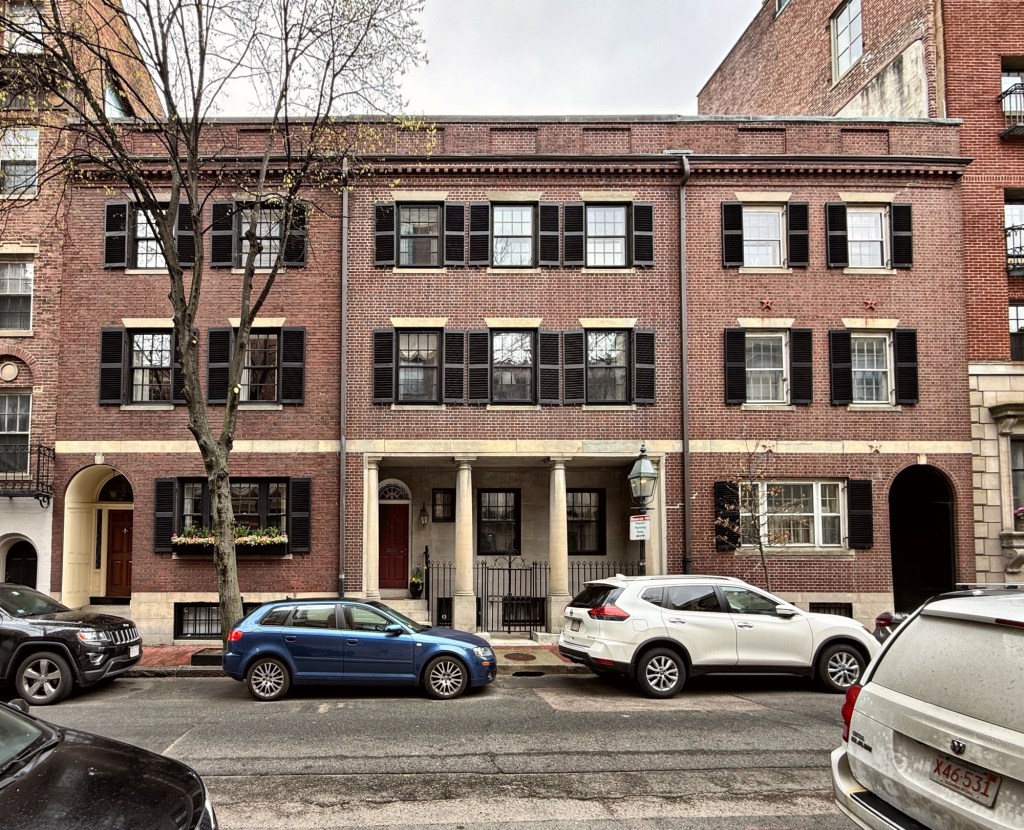
Similar to the Brimmer Street Terrace development nearby, this set of three rowhouses on Chestnut Street on the Flat of Beacon Hill, is an excellently designed development of residences as a collection rather than individually designed townhomes. The Chestnut Street Rowhouses replaced a stable formerly on the site, and were designed by the architectural firm of Richardson, Barott & Richardson, made up of Philip Richardson, Chauncey Edgar Barott, and Frederic Leopold William Richardson. Philip and Frederic Richardson were sons of architect Henry Hobson Richardson, but they did not reach the same level of notoriety as their late father, and charted their own course. The rowhouses read as a single composition with a unique center section flanked by two matching wings. The center house has a three bay front façade with the first-story clad in limestone which is all recessed and supported by Doric columns.
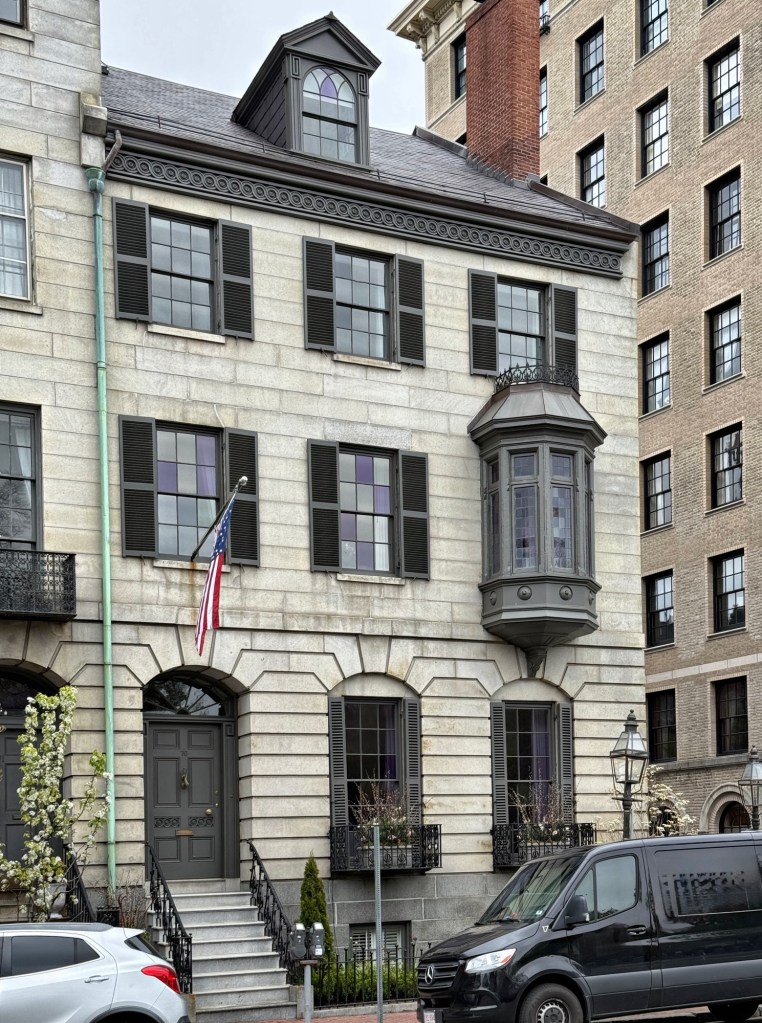
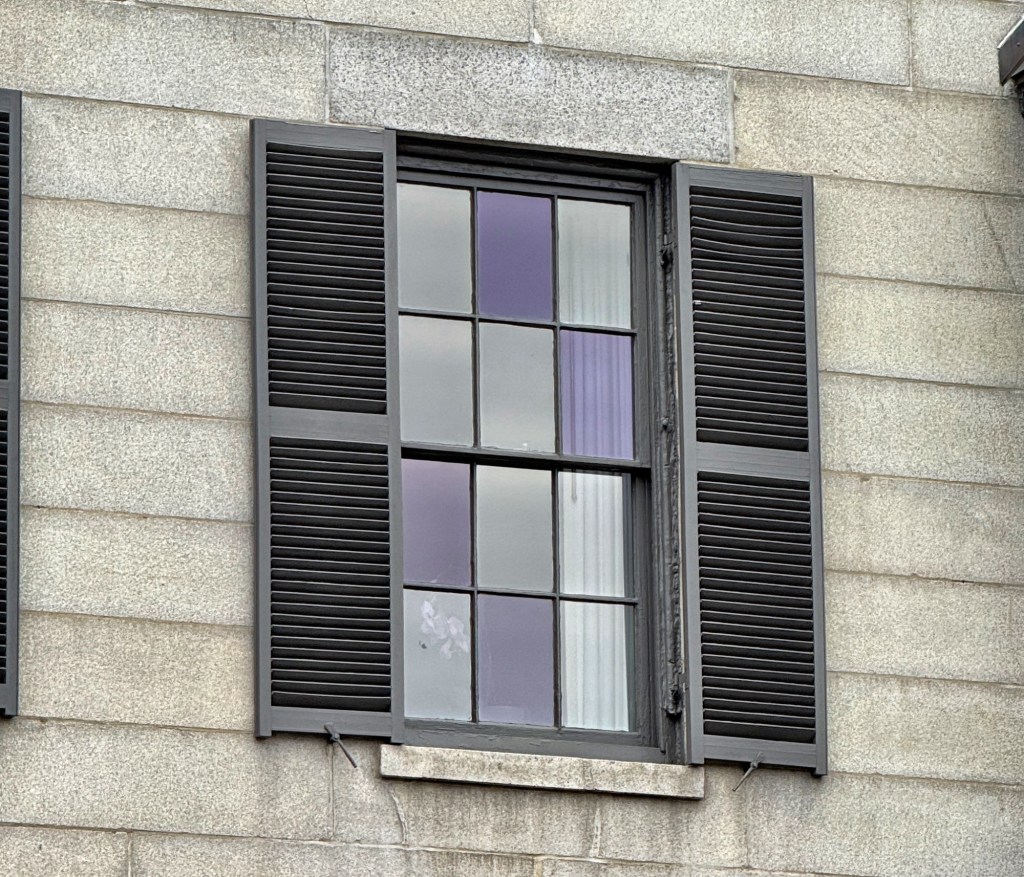
One of six attached houses townhouses between 70-75 Beacon Street, this stately granite-faced residence was built concurrently with its neighbors in 1828 on speculation for the Mount Vernon Proprietors, a group of wealthy Boston businessmen who helped develop Beacon Hill into the posh, architecturally significant neighborhood it is today. The Mount Vernon Proprietors knew how important Beacon Street was as the entry into the neighborhood, and thus, hired Boston’s premier architect, Asher Benjamin, to design the row. When completed, all of the houses were identical, but throughout the 19th and 20th centuries, they all deviated from the original design, some gaining additional floors, others adding bay windows, but all together form a cohesive and architecturally significant span of houses. Completed in 1829, the corner dwelling is known as the Greenough-Dwight House and it retains its original three-story rusticated granite façade with segmental arch openings. The major change to the exterior of the Greenough-Dwight House is the addition of the ornate wood oriel window with iron cresting in 1874, the oriel and facade feature the iconic purple windows, which became a status symbol in the 20th century. The story goes, that between 1818 and 1824, an English company sent shipments of glass that contained too much manganese oxide into Boston Harbor. After being exposed to sunlight for an extended period of time, the manganese oxide in the glass began to turn purple creating the colored panes we love today. Over time, many panes broke or were replaced, creating the checkerboard appearance on so many windows, but many owners in the 20th century had imitation purple glass installed as a marker of wealth and prestige, like in this house and bay, which were built after the period that the glass was brought over from England. My favorite in the row, the Greenough-Dwight House shines with its granite facade and brick end wall, with panes reflecting the sun off her violet glass windowpanes.
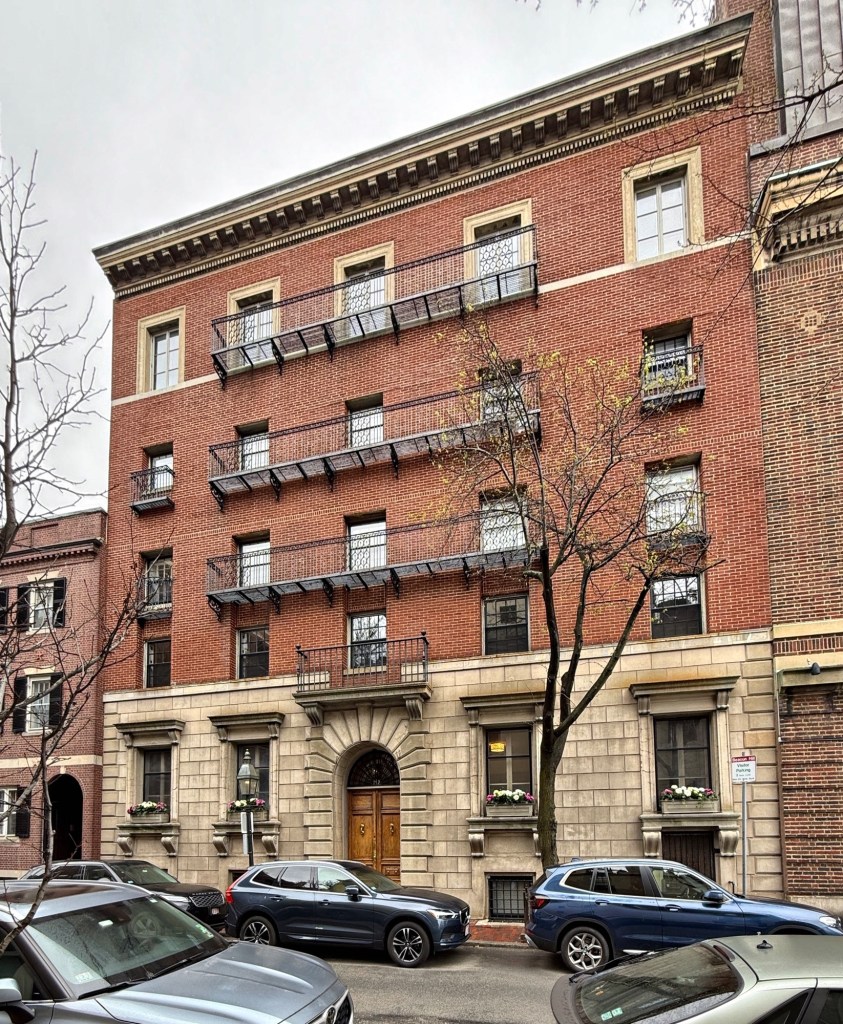
This massive five-story, five-bay building at 142 Chestnut Street on the Flat of Beacon Hill is today, an 11-unit condominium building, but it was originally built as a single-family home, designed by a prominent Boston architect as his own residence. Henry Forbes Bigelow (1867-1929) was born in Clinton, Massachusetts and graduated from the Massachusetts Institute of Technology in 1888. He was hired by the firm of Winslow & Wetherill and soon became a partner of the same firm, which changed its name to Winslow, Wetherill and Bigelow. The firm designed many commercial buildings, hotels, stately mansions, and academic buildings in the New England area. Henry F. Bigelow purchased a two-story stable and cleared the site to erect his home in 1915-1916. This building remained his primary residence until his death in 1929. After his death, the Bigelow heirs sold the Chestnut Street mansion to Bernard Brooker, President and Treasurer of the Building Finishing Corporation, a real estate development company, who converted the building into apartments, which were later converted again into the 11 condominium units. The handsome structure could be classified as Renaissance Revival in style with its cubic form, recessed central entrance, cornice-like window headers, limestone base and entry, iron balconies, and corbeled cornice. The building was designed with an enclosed courtyard with fountains, which today, provide a private space for residents.
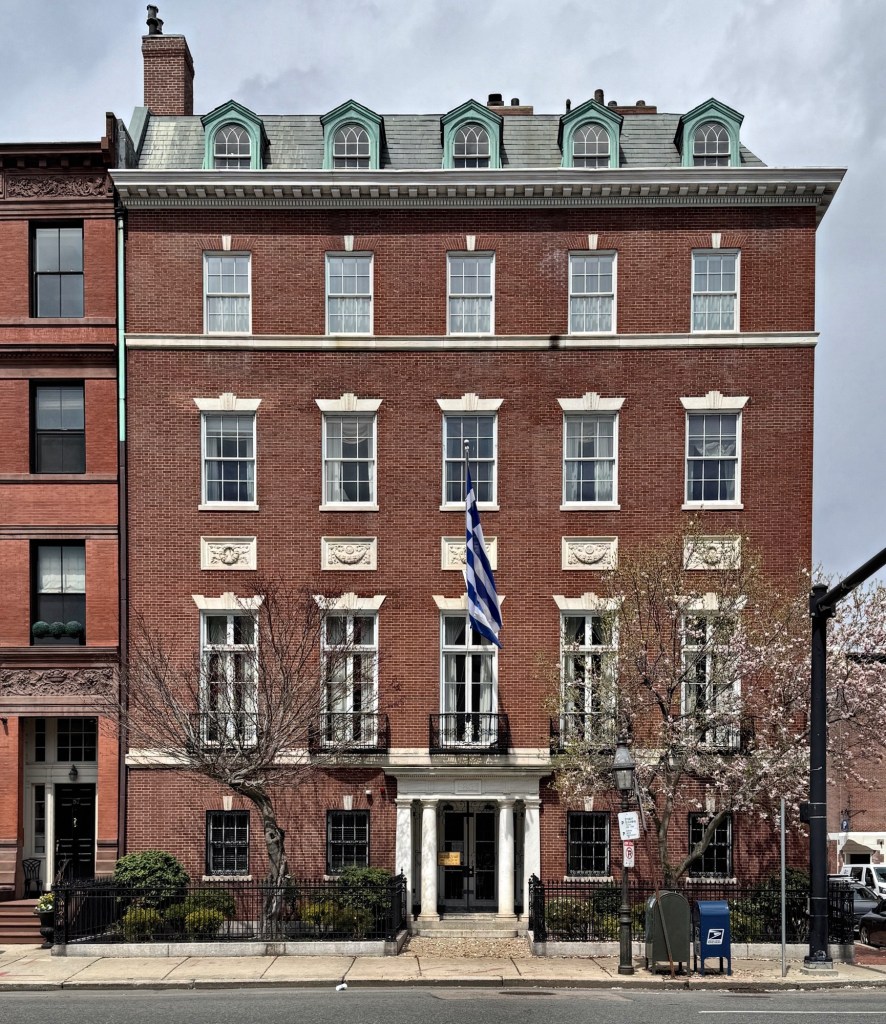
The David Sears Mansion (now the Greek Consulate) at 86 Beacon Street in Boston, is a large, architecturally significant example of a mansion built in Beacon Hill in the early 20th century for a member of a prominent local family. In 1910, Dr. Henry Francis Sears (1862-1942), who had inherited his father’s property on this site, that included two townhouses and a double-stable at the rear, demolished the two houses and built a new mansion on the double lot. The architectural firm of Wheelwright & Haven was hired to furnish plans, which resulted in the symmetrical, four-story mansion with fifth floor mansard punctuated by dormers. The brick structure is trimmed with marble, including at the entry portico, keystones and headers at the windows, and the ornamental panels between the second and third floors in alternating wreath and swag motifs. In the 1920 census, Henry F. Sears lived here with his wife Jean, their four children, his older brother David Sears, and nine domestic servants. After Dr. Sears’ death in 1942, the property was conveyed to the Charlotte Cushman Club of Boston, a boarding house for touring actresses needing respectable, inexpensive, safe lodgings as single women performers were unwelcome in many hotels. In the 1950s, the property became the Katherine Gibbs School, a satellite campus of the higher education institution founded by Katharine Gibbs with the goal to provide educational opportunities to women, eventually becoming Gibbs College. The most-recent chapter of the mansion’s history began in 1993 when the building became home to the Consulate General of Greece in Boston, with the consulate occupying the first two floors of the interior, with condominium units above.
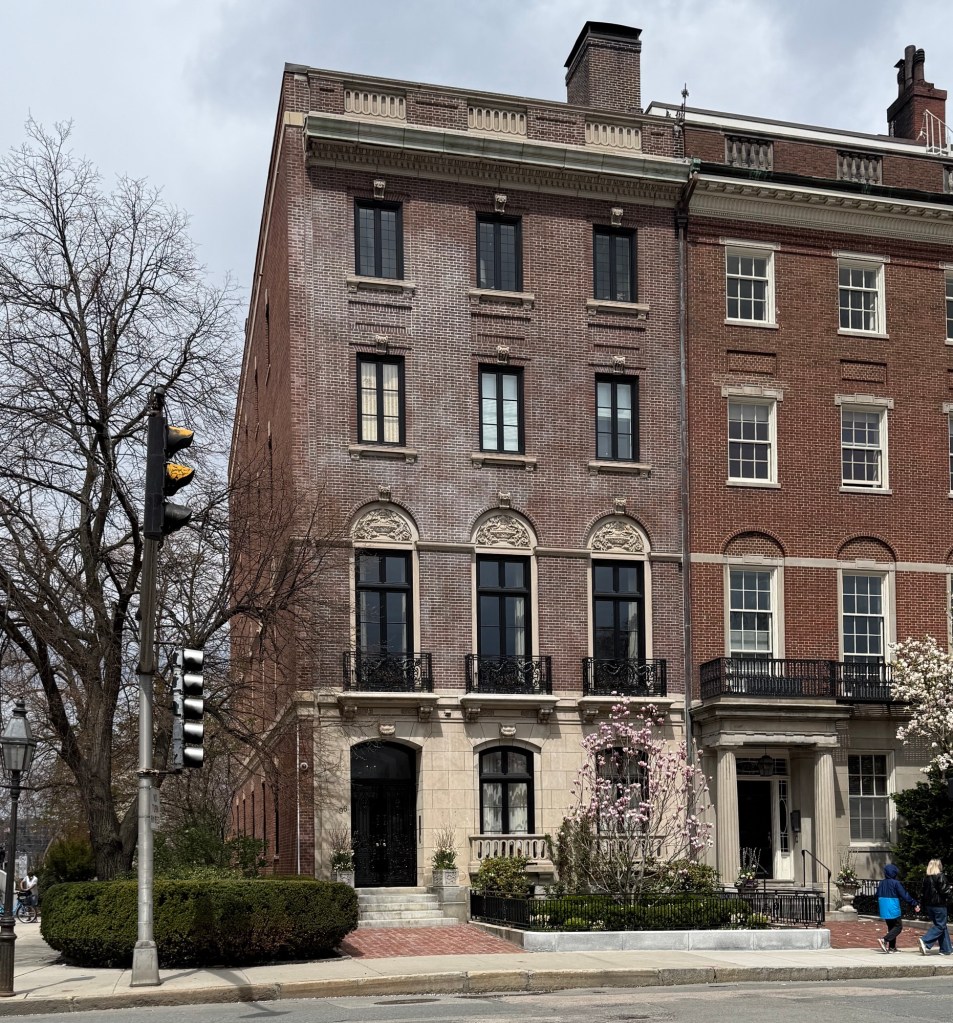
Located at the boundary of the Beacon Hill and Back Bay neighborhoods, this prominent townhouse on a corner lot at Beacon Street and Mugar Way was built in 1911, replacing an 1840s townhouse of the same form. The Colonial Revival style townhouse was built for Henry D. and Johanna H. Burnham from plans by the architectural firm of Wheelwright, Haven & Hoyt. Henry Burnham was the son of cotton broker, John Appleton Burnham and was in the real estate business. Henry and Johanna lived at 96 Beacon Street through at least 1938. The house was bought by the Engineer’s Club, a social and professional organization, in 1947. In the 1950s, the formerly mid-block townhouse suddenly became a corner lot with the construction of Storrow Drive, its off ramp as Mugar Way, and the addition of the Fielder Footbridge connecting Beacon Hill to the Esplanade. The Engineer’s Club took over renovations at the interior, which were done to adapt the former single-family residence for clubhouse functions, including a large banquet hall. In the 1960s, the property was acquired by Emerson College and used it as a college center and cafeteria until the early 2000s when it was converted into condominiums by Grassi Design Group, adding new openings to the formerly solid brick side wall.
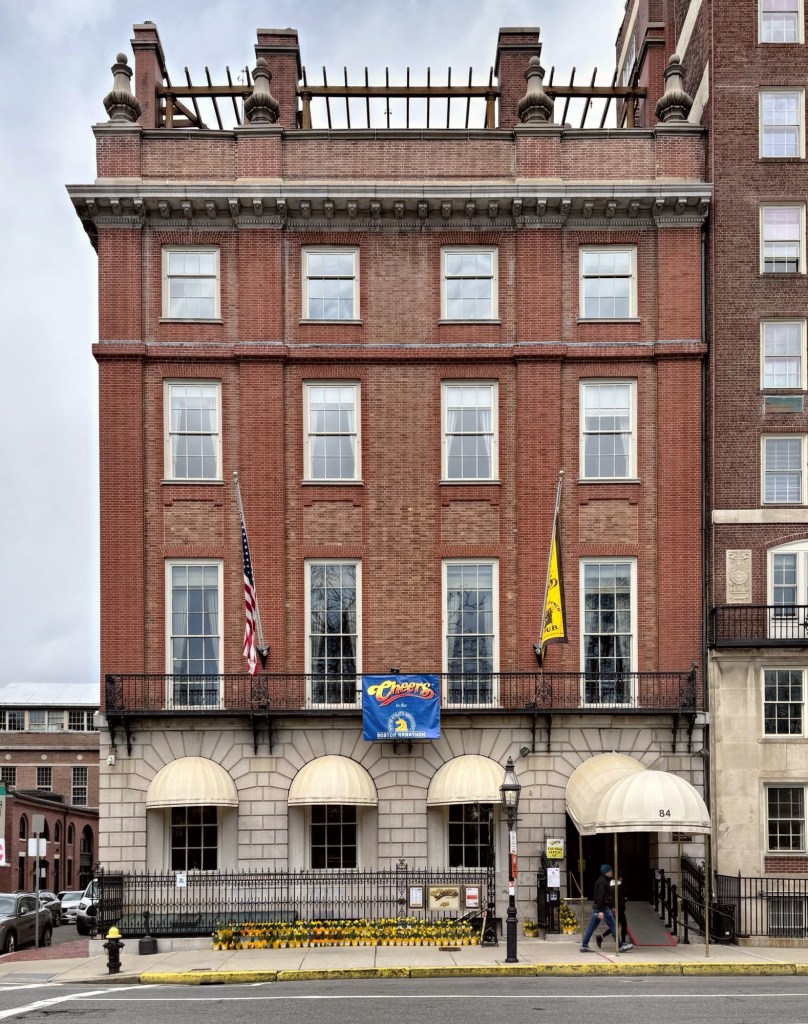
This iconic building at 84 Beacon Street in Boston’s Beacon Hill neighborhood, is best-known for its bar, which in 1982, became world-famous as the locale for the bar in the television sitcom Cheers, one of the most-watched programs in television history; but its history begins earlier. This five-story building was constructed in 1911 as a mansion for Bayard Thayer (1862-1916), who split his time between Boston and his country estate in his home-town of Lancaster, Massachusetts. Thayer hired architect, Ogden Codman Jr., a favorite designer of Boston and New York high-society, to design his Boston mansion, which is an expressive and overscaled example of a Colonial Revival style townhouse. Bayard Thayer died in 1916 and his widow, Ruth Simpkins Thayer, lived here with her granddaughter, Ruth, and nine domestic servants. After Ruth Thayer’s death in 1941, the property was conveyed to the Colonial Properties Trust in 1944, operating the building as a small luxury apartment hotel. From this point on, the hotel became known as Hampshire House. In about 1969, the basement space in the Hampshire House opened as the Bull & Finch Pub, which later became the inspiration of the iconic sitcom Cheers. Pictures of the exterior of the building were used in the show’s credits and scene changes, and the interior was faithfully replicated from the set in Hollywood, where the show was actually filmed. The Bull & Finch Pub has permanently been renamed Cheers Pub and visited by many who wish to visit the place where “everybody knows your name”.
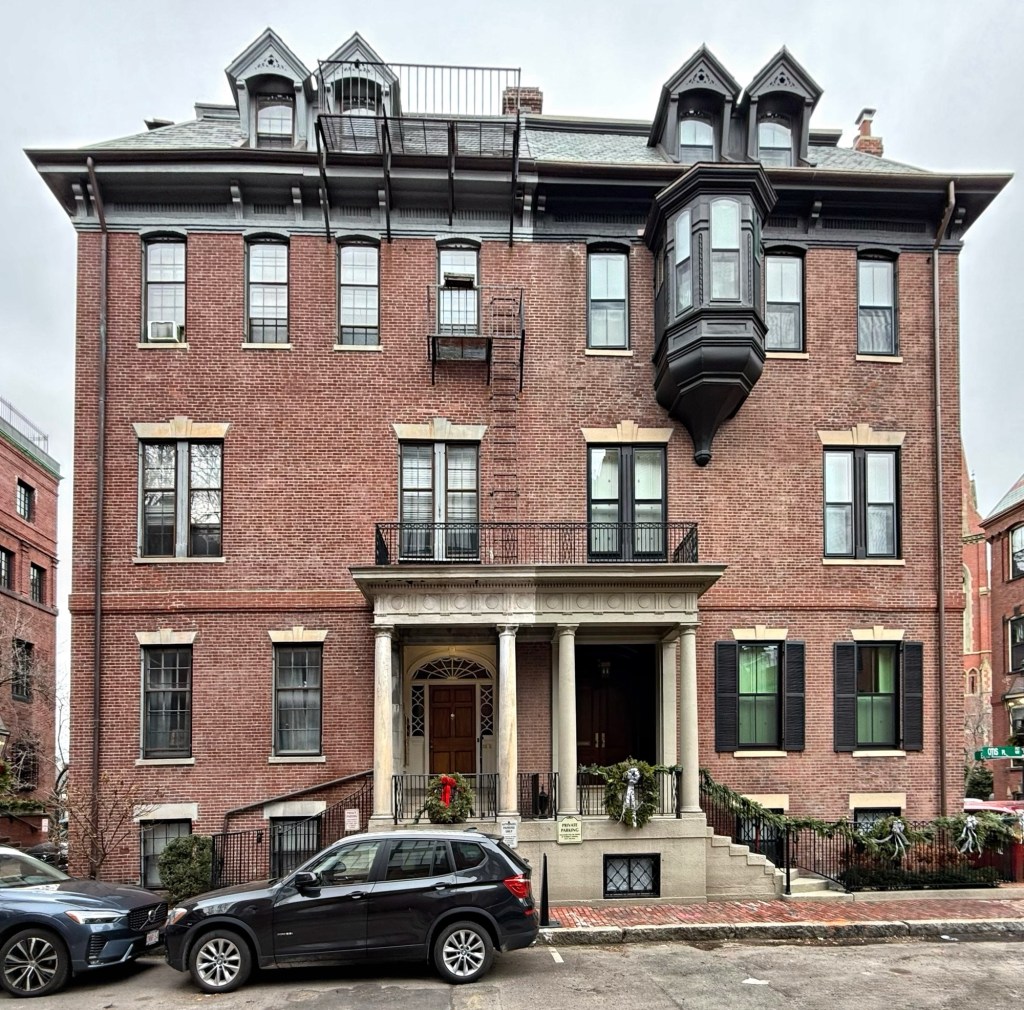
These two near-identical townhouses at 1 & 2 Otis Place in Beacon Hill are significant architecturally and as they are bounded by four streets. The unique lots were created when Otis Place was laid out on made land in 1869 and were built the following year as an identical pair sharing a party wall and with their front facades facing south on Otis Place. The two residences were designed by the firm of Ware and Van Brunt, who blendedSecond Empire and Victorian Gothic styles with gothic arched windows, bracketed cornices, slate mansard roof, and later Colonial Revival porticos added in 1916 by architect, Frank A. Bourne. No. 1 Otis Place (right side with the oriel bay window) was first owned by Henry G. Pickering, a dealer in engines and machinery at the height of New England’s industrial revolution. No. 2 Otis Place (left with later fanlight entry), was originally owned by Robert E. Apthorp, an attorney and realtor, who decades earlier, was an active member of the Boston Vigilance Committee, the group established to harbor and assist fugitives from slavery after the passage of the Fugitive Slave Act in September 1850.
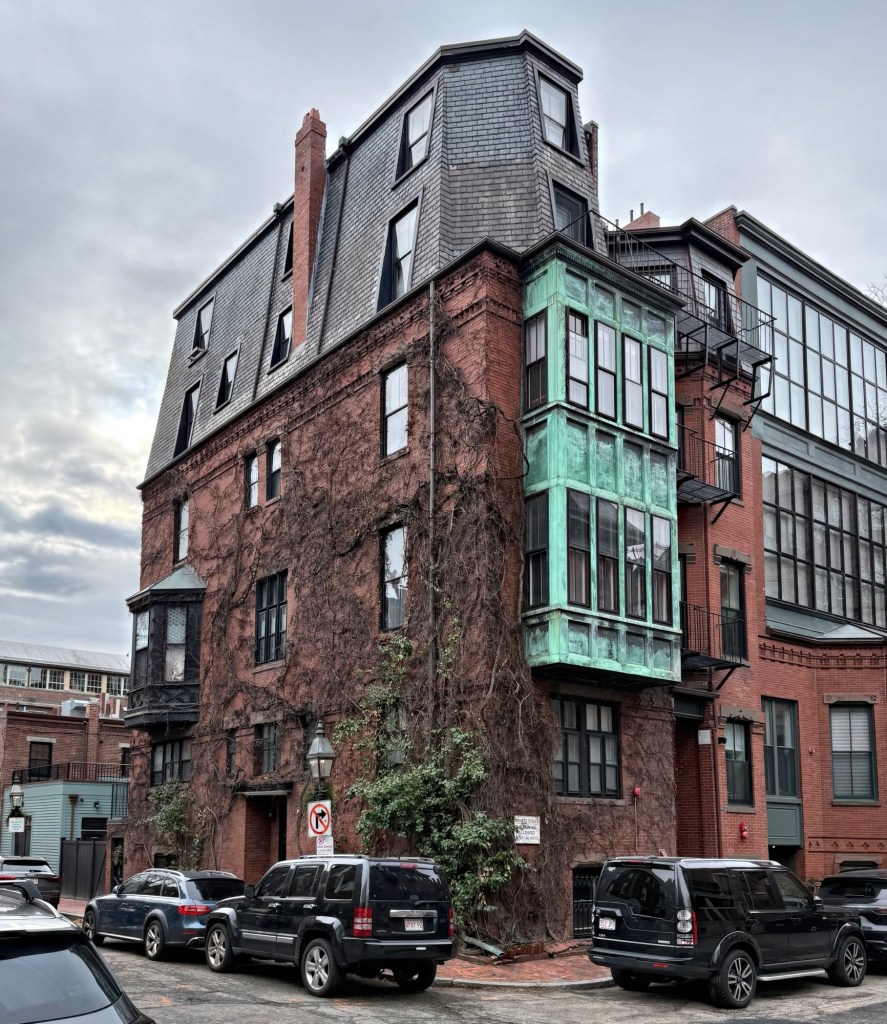
One of the most interesting houses in Beacon Hill is this unique Second Empire style townhouse with towering two-story mansard roof at 3 Otis Place/49 Brimmer Street. When walking around Boston and exploring other cities, it is always fun to delve into research and learn about the built environment and the stories that brought these places to be! This residence was constructed in 1872 on land that was filled here between 1867 and 1869 formerly occupied by the Charles River. Creating the land at and around Otis Place was one of a series of responses to the need for more physical space in Boston and to cover the pollution of the Charles River along the West End and what would become the Back Bay. The houses at 3-4 Otis Place were originally owned and designed by architect, Abel C. Martin, who resided next door to the topic of this post until his death. In the early 20th century, this house was owned by Charles Eliot Ware Jr. a publisher, who in 1929, hired architect, Charles Greely Loring to add the copper-clad oriel window on the north elevation and elevate the mansard roof to create the unique two-story mansard. The old Martin-Ware house has been apartments since at least the 1960s.
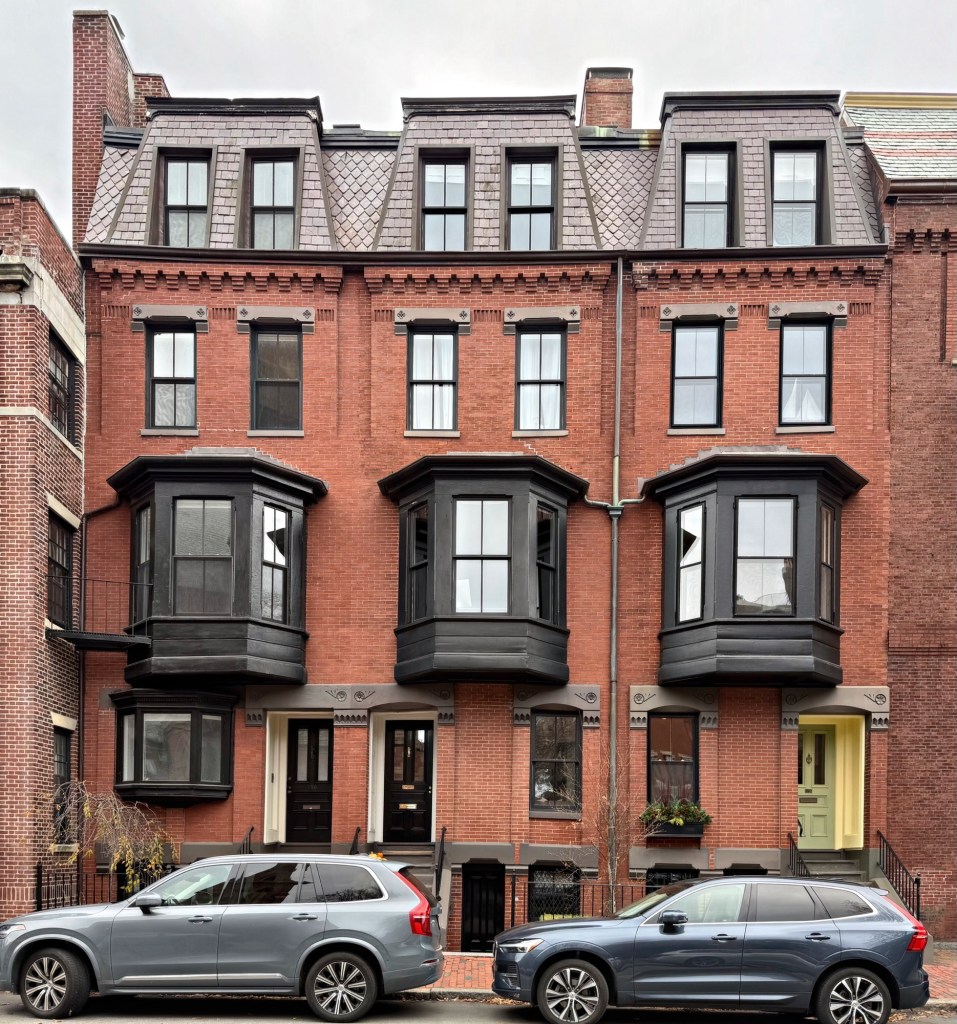
These three identical three-story houses at 156, 158 & 160 Mt. Vernon Street in Beacon Hill Flat were built in 1871 as income producing properties for Samuel and Emily Otis Eliot who lived next door on the corner of Brimmer Street. The architect is not evident from my research, but they were likely designed by Abel C. Martin, who furnished speculative housing for the Eliot’s elsewhere in the neighborhood. All three residences feature brick facades with off-center recessed entries on raised stoops. The use of brownstone lintels and sills, decorative brick cornice, and second-story hexagonal oriel windows add intrigue to the design, along with the slate mansard roofs. The three houses were sold or rented and all were owned by various families, but notable owners of the central house include the architect George Russell Shaw (1848-1937) of the firm Shaw and Hunnewell through the early 1900s. Later in the 20th century, the house was owned by Kevin White (1929-2012), who served as the mayor of Boston for four terms from 1968 to 1984. All three residences are well-preserved and look much as they did when constructed over 150 years ago.