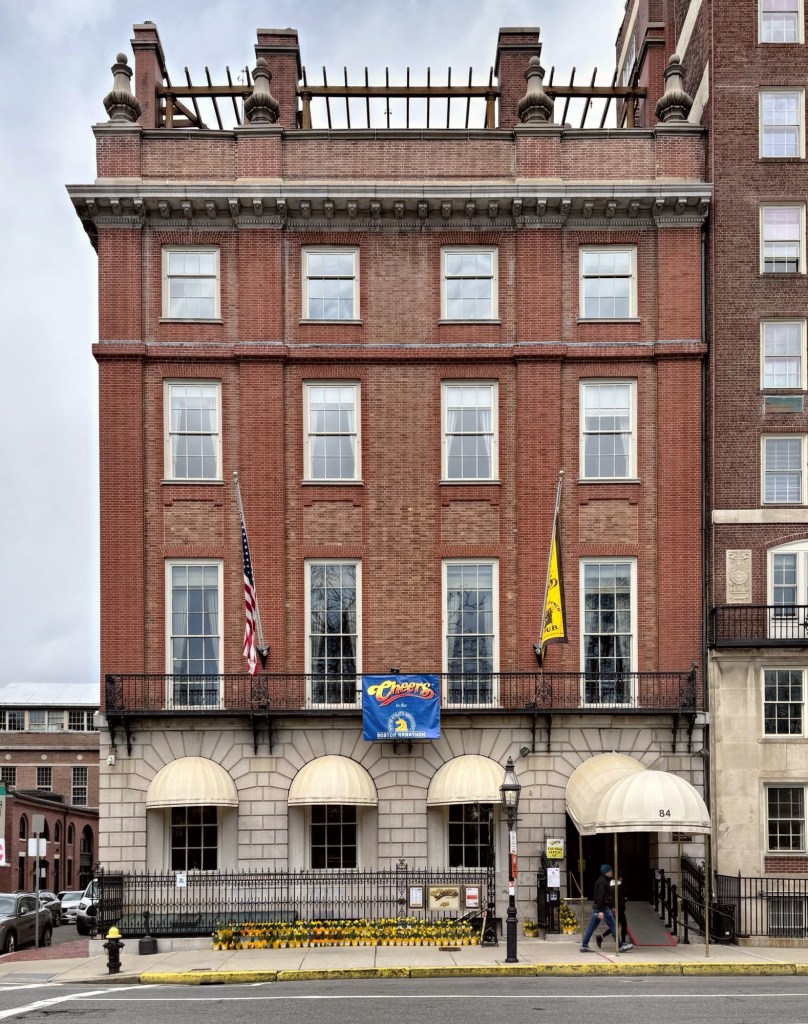
Bayard Thayer House – Hampshire House // 1911

This iconic building at 84 Beacon Street in Boston’s Beacon Hill neighborhood, is best-known for its bar, which in 1982, became world-famous as the locale for the bar in the television sitcom Cheers, one of the most-watched programs in television history; but its history begins earlier. This five-story building was constructed in 1911 as a mansion for Bayard Thayer (1862-1916), who split his time between Boston and his country estate in his home-town of Lancaster, Massachusetts. Thayer hired architect, Ogden Codman Jr., a favorite designer of Boston and New York high-society, to design his Boston mansion, which is an expressive and overscaled example of a Colonial Revival style townhouse. Bayard Thayer died in 1916 and his widow, Ruth Simpkins Thayer, lived here with her granddaughter, Ruth, and nine domestic servants. After Ruth Thayer’s death in 1941, the property was conveyed to the Colonial Properties Trust in 1944, operating the building as a small luxury apartment hotel. From this point on, the hotel became known as Hampshire House. In about 1969, the basement space in the Hampshire House opened as the Bull & Finch Pub, which later became the inspiration of the iconic sitcom Cheers. Pictures of the exterior of the building were used in the show’s credits and scene changes, and the interior was faithfully replicated from the set in Hollywood, where the show was actually filmed. The Bull & Finch Pub has permanently been renamed Cheers Pub and visited by many who wish to visit the place where “everybody knows your name”.
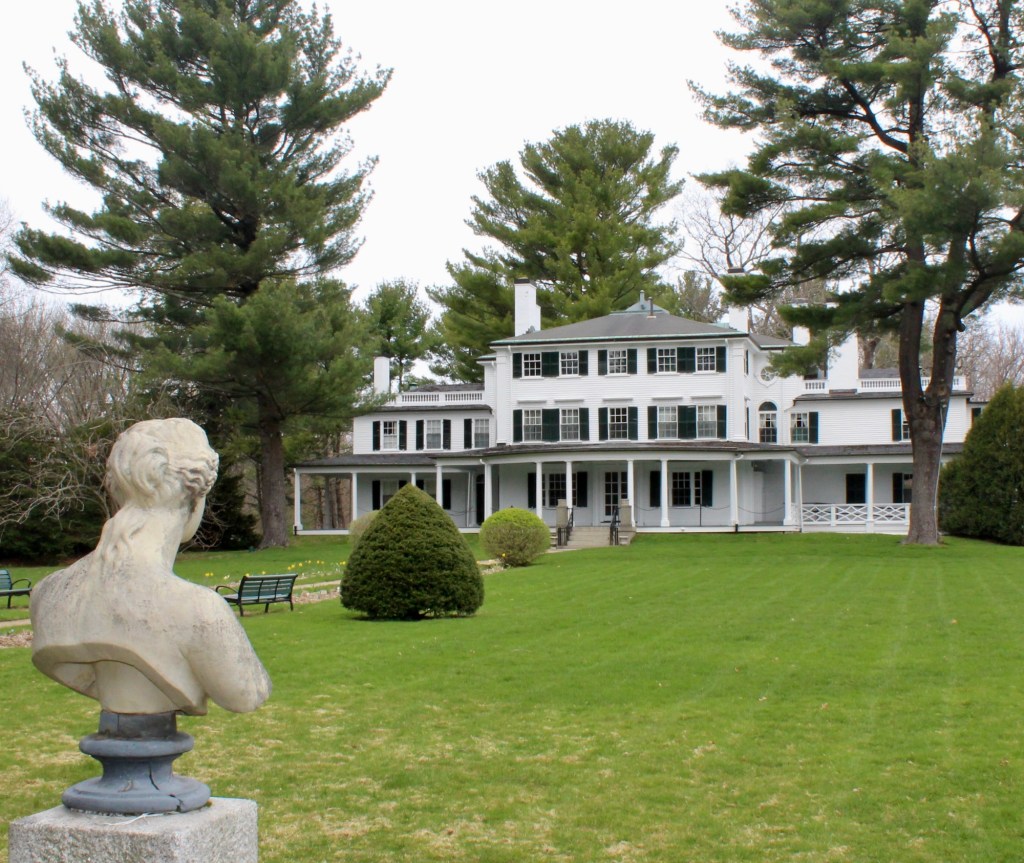
Glen Magna Farms // c.1790

Glen Magna Farms is a historic estate located in Danvers, Massachusetts, and it is one of the lesser-known historic properties of this stature. During the War of 1812, Joseph Peabody, the wealthiest Salem shipping merchant of his day, bought a 20-acre Danvers farm with a dwelling house. The c.1790 house was likely updated at this time in a higher example of the Federal style, and used as a summer residence the family would escape to during the warmer months. Peabody purchased additional property and Glen Magna grew to over 130-acres. William Crowninshield Endicott, who served as Secretary of War during the Grover Cleveland administration, married Ellen Peabody, granddaughter of Joseph Peabody in 1859. The couple would inherit Glen Magna and later hire the firm of Little, Browne, and Moore in the 1890s to renovate the mansion and update the gardens. Ellen Peabody Endicott would also have the Derby Summer House added to the grounds by 1901. In 1963, the Danvers Historical Society purchased the house and eleven acres of surrounding gardens which they painstakingly restored to their early 20th century condition. Glen Magna can now be rented out for weddings and other events!

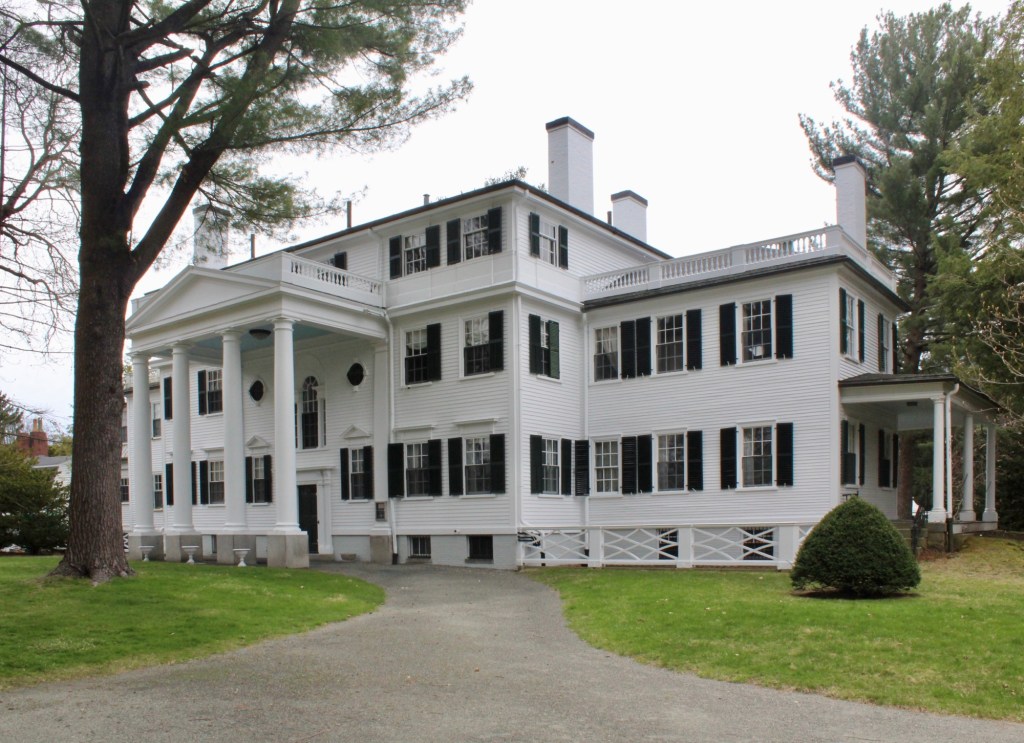
Asa Waters Mansion // 1829

In 1824, prosperous gunsmith Asa Waters II set out to build the stateliest residence in the country. It took two full years to amass the necessary materials for what is now known as the Asa Waters Mansion and Mr. Waters spared no expense. Asa Waters II (1769-1841) was born in Millbury in 1813 to Asa Sr. and Sarah Waters. Asa earned the art of gunsmithing from his father, and in 1808 the junior Asa and his brother Elijah opened the Waters & Co. Armory along the banks of the Blackstone River, in what is now Millbury Center. Following the untimely death of his brother in 1814, Asa Waters carried on the business solo and secured lucrative arms contracts with the United States government. His invention of a lathe to turn gun barrels into the first seamless barrels revolutionized the manufacture of guns throughout the world, and provided his company a stockpile of cash. As a result, he hired Boston-based architect Asher Benjamin, to design a country house suitable of his stature. The mansion features two prominent facades with the primary distinguished by a colonnade of fluted two-story columns with composite capitals. The mansion remained in the Waters Family until 1929, when it was sold to the Roman Catholic Diocese of Worcester, as a rectory of a local church. In 1977 the Town of Millbury acquired the Asa Waters Mansion, and with little funding to maintain the property; in 1994, the Asa Waters Mansion had fallen into quite a bit of disrepair. The town proposed to demolish the mansion for a parking lot, but a group of locals worked together as the Asa Waters Task Force and petitioned to save the house: funds were raised, tradesmen in the community donated materials and labor. Saving the architectural landmark for generations to come.