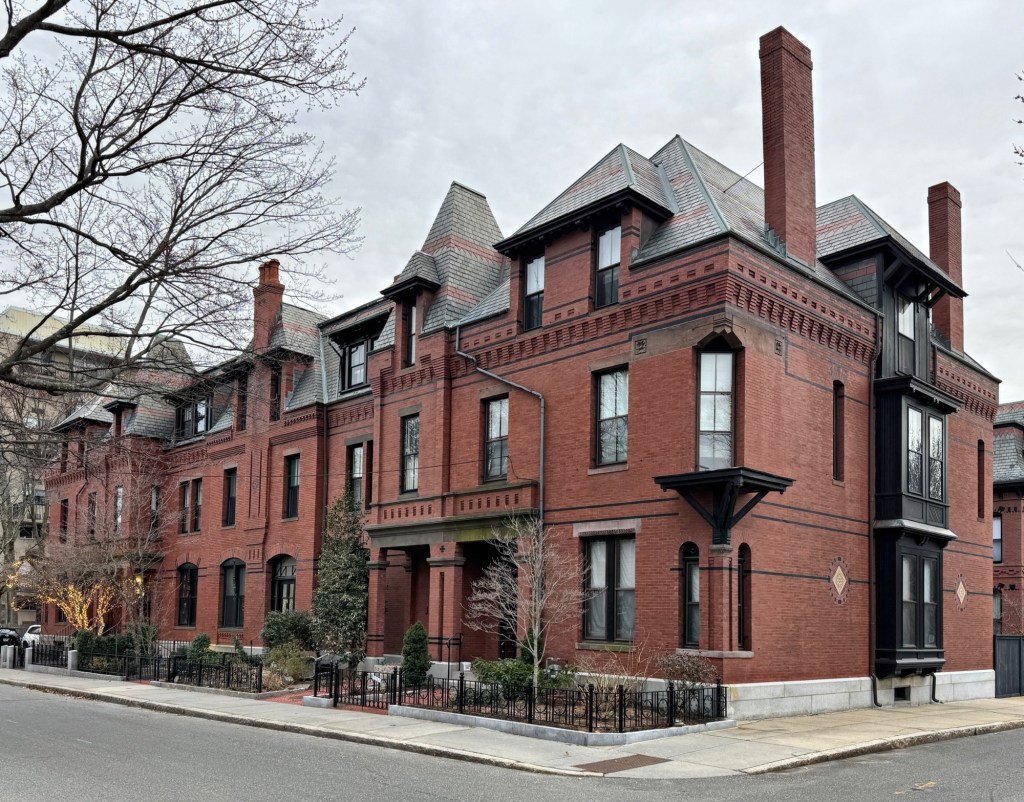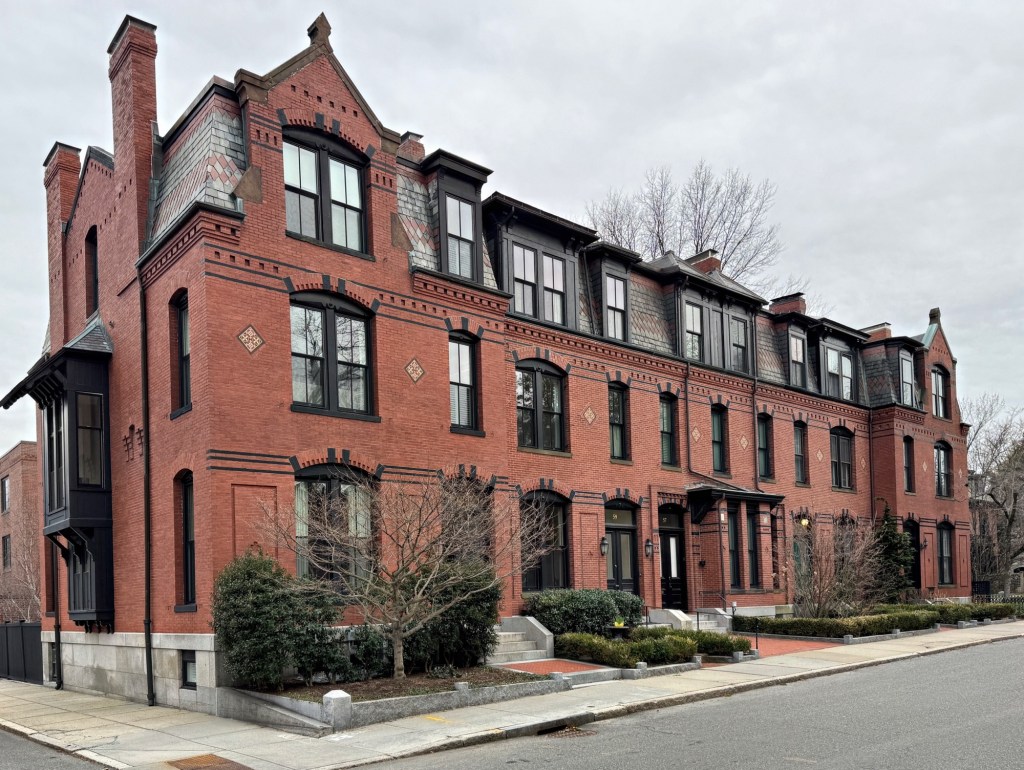
Amos Lawrence Rowhouses // c.1877

53-61 Monmouth Street

Amos A. Lawrence (1814-1886), a wealthy Boston merchant, owned land holdings in the present-day Longwood neighborhood of Brookline, just over the Muddy River from Boston, and developed the area into a wealthy and high-quality suburb. Lots were laid and Lawrence hired civil engineer, Ernest Bowditch, to plat for multiple sets of distinctive rowhouses surrounding a small green mall, which was later named Monmouth Court. Once the property was laid out, Amos Lawrence hired the Boston architects, J. Pickering Putnam and George T. Tilden, to design rowhouses for rental income. George Tilden was previously employed at the firm of Ware & Van Brunt, a firm that mastered and popularized the panel brick style in the Boston area in the 1870s and 1880s, and he clearly built upon this expertise for the rows for Amos Lawrence in Brookline. All four rows of houses are distinctive, yet compliment eachother stylistically with projecting bays. intricate brickwork, complex rooflines with dormers, and applied ornament. These two rows on the western side of Monmouth Court at 53-61 Monmouth Street and 19-27 Monmouth Court, were also likely the work of Putnam and Tilden, who practiced jointly for a couple years but published their work separately. Stylistically, the two Monmouth Street rows appear to be of the same architect, George Tilden with identical tilework and elements, and the two Monmouth Court rows as the work of Putnam with polychromatic segmental arches over the windows.
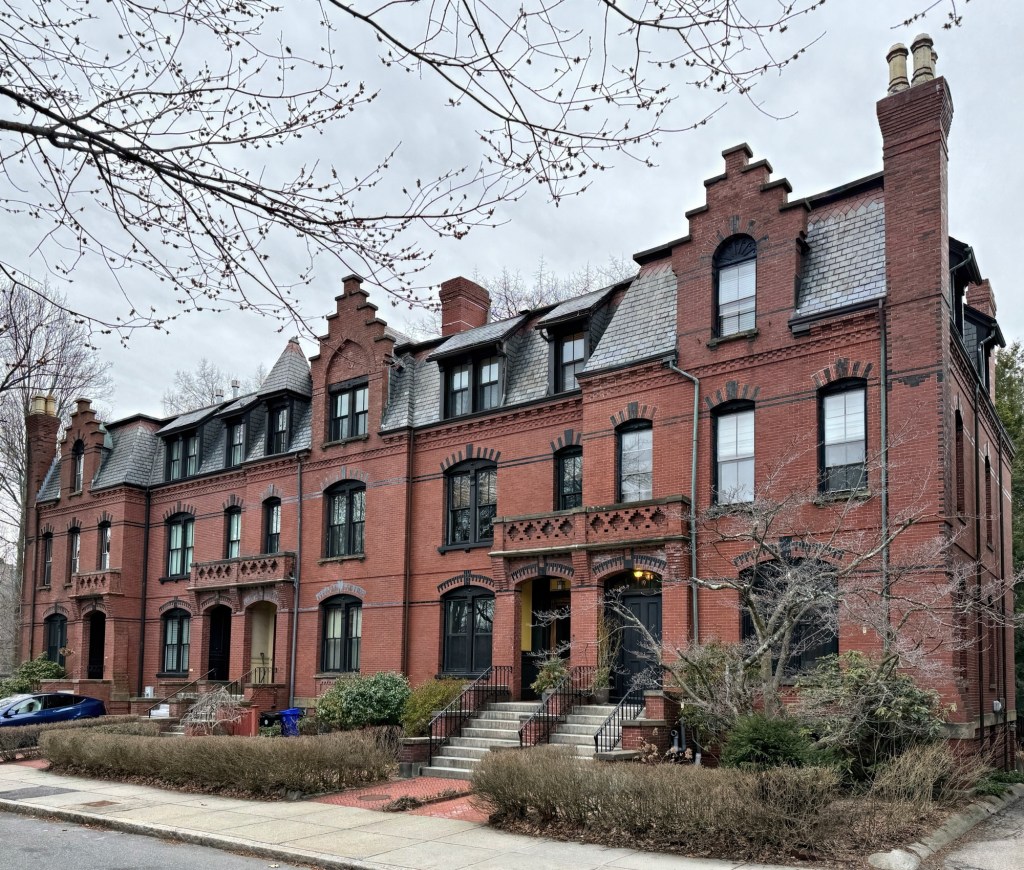
19-27 Monmouth Court

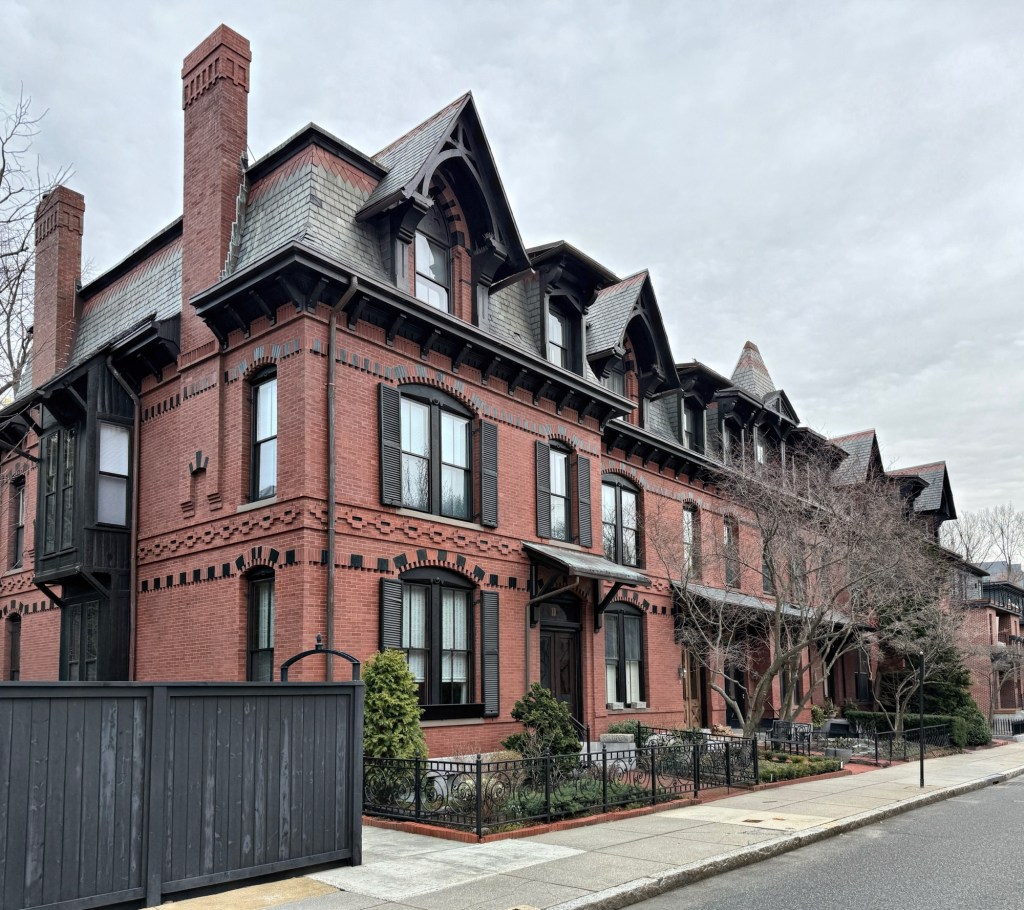
Amos Lawrence Rowhouses // 1876

Amos A. Lawrence (1814-1886), a wealthy Boston merchant, owned land holdings in the present-day Longwood neighborhood of Brookline, just over the Muddy River from Boston, and developed the area into a wealthy and high-quality suburb. Lots were laid and Lawrence hired civil engineer, Ernest Bowditch, to plat for multiple sets of distinctive rowhouses surrounding a small green mall, which was later named Monmouth Court. Once the property was laid out, Amos Lawrence hired the Boston architects, J. Pickering Putnam and George T. Tilden, to design rowhouses for rental income. George Tilden was previously employed at the firm of Ware & Van Brunt, a firm that mastered and popularized the panel brick style in the Boston area in the 1870s and 1880s, and he clearly built upon this expertise for the rows for Amos Lawrence in Brookline. All four rows of houses are distinctive, yet compliment each other stylistically with projecting bays. intricate brickwork, complex rooflines with dormers, and applied ornament. This row at 10-18 Monmouth Court was from the designs of partner, J. Pickering Putnam and was highlighted in an architectural publication soon after completion. The row exhibits a slate mansard roof disrupted by dormers with trusses, lancet arch and trefoil motifs, polychromatic brick and pent roof entrances all stepping out to the private courtyard.

Amos Lawrence Rowhouses // 1876

Amos A. Lawrence (1814-1886), a wealthy Boston merchant, owned land holdings in the present-day Longwood neighborhood of Brookline, just over the Muddy River from Boston, and developed the area into a wealthy and high-quality suburb. Lots were laid and Lawrence hired civil engineer, Ernest Bowditch, to plat for multiple sets of distinctive rowhouses surrounding a small green mall, which was later named Monmouth Court. Once the property was laid out, Amos Lawrence hired the Boston architects, J. Pickering Putnam and George T. Tilden, to design rowhouses for rental income. George Tilden was previously employed at the firm of Ware & Van Brunt, a firm that mastered and popularized the panel brick style in the Boston area in the 1870s and 1880s, and he clearly built upon this expertise for the rows for Amos Lawrence in Brookline. All four rows of houses are distinctive, yet compliment eachother stylistically with projecting bays. intricate brickwork, complex rooflines with dormers, and applied ornament. This row at 69-77 Monmouth Street exhibits inlaid tile medallions and small balconets on the chamfered corners that are missing their railings.

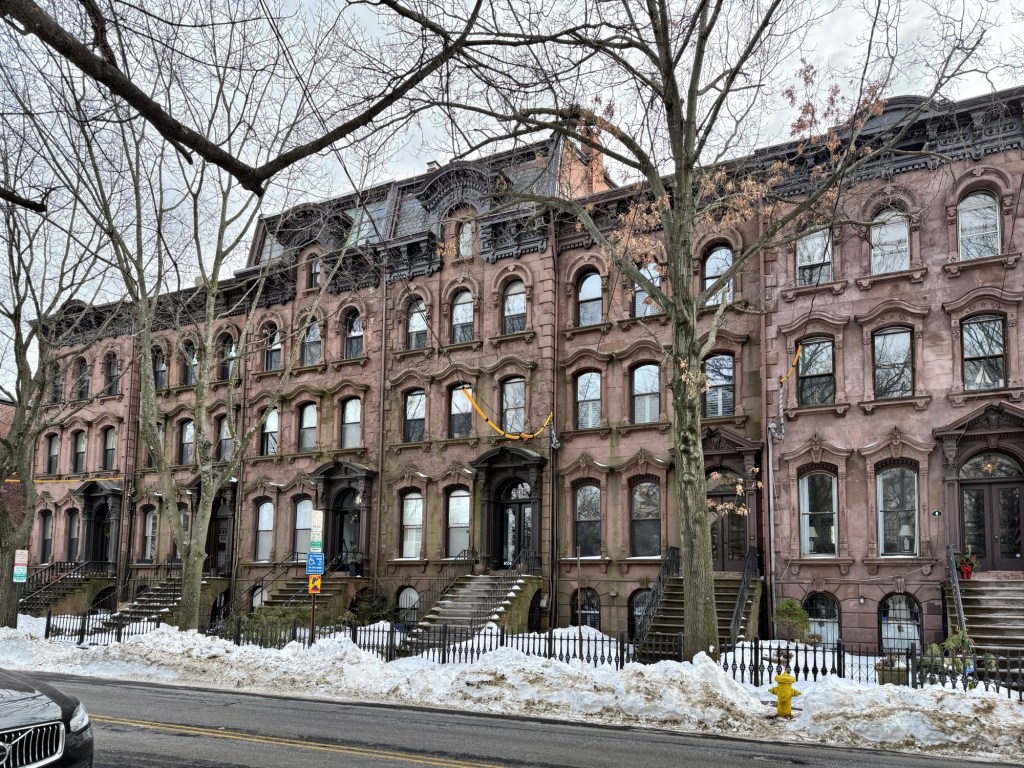
Wooster Square Brownstone Row // 1871

This extraordinary row of brownstone homes is located on Chapel Street in New Haven, Connecticut, and overlooks Wooster Square as its southern anchor. Built in 1871, the symmetrical row of six rowhouses are clad with brownstone facades which read more like Brooklyn townhouses than what is typical in New Haven, which is why these are so special. The row was designed by New Haven architect, David R. Brown, who got his start as an apprentice under Henry Austin, and became a prolific local designer. The row was likely constructed by one owner on speculation and subsequently sold to individual owners, who have maintained the structure over 150 years since. The Brownstone Row is Italianate/Second Empire in style with window surrounds, bracketed cornice and cupolas on the flanking homes with the center two residences capped by mansard roofs.

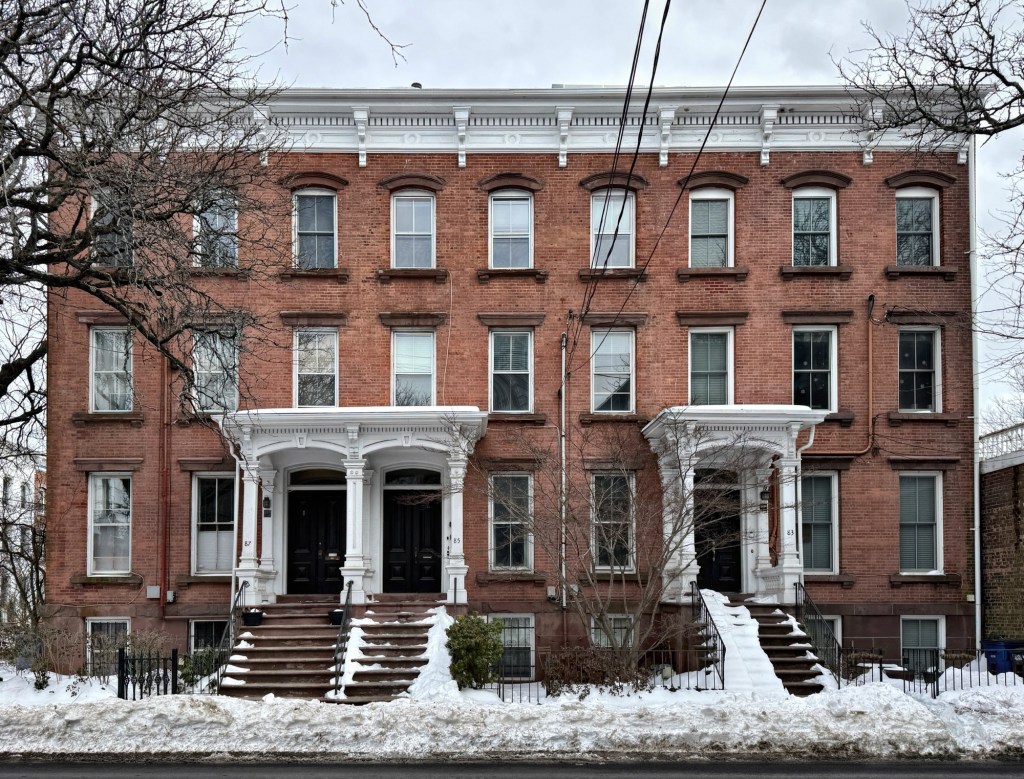
Olive Street Rowhouses // c.1865

The Wooster Square area of New Haven, Connecticut, is comprised of a lovely collection of houses and institutional buildings from the 1830s through the late 19th century, showing the ever-changing taste of architectural styles from Greek Revival to Italianate to Second Empire and Queen Anne. These rowhouses on Olive Street serve as bookends to long rows of houses on Court Street, a narrow, one-way street radiating from Wooster Square. The buildings were developed by the Home Insurance Company, a fire insurance firm and developer that helped fuel the development of residential New Haven in the 1860s by investing in real estate, primarily with fireproof masonry buildings. These Italianate style rowhouses were built in the 1860s after the Civil War and were sold on speculation to middle-class families. All buildings retain the original bracketed cornices, brownstone sills, lintels, and basement facing, and projecting porticos at the entries.

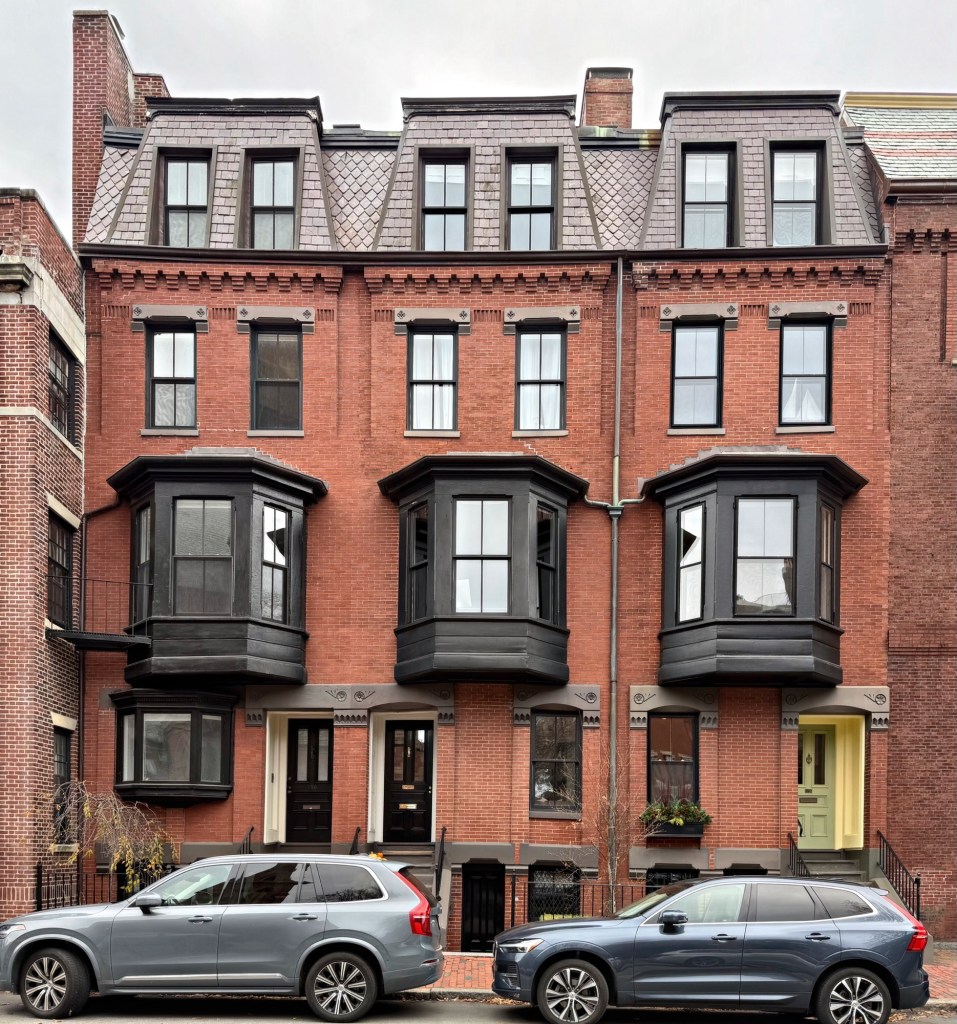
Samuel and Emily Eliot Rowhouses // 1871

These three identical three-story houses at 156, 158 & 160 Mt. Vernon Street in Beacon Hill Flat were built in 1871 as income producing properties for Samuel and Emily Otis Eliot who lived next door on the corner of Brimmer Street. The architect is not evident from my research, but they were likely designed by Abel C. Martin, who furnished speculative housing for the Eliot’s elsewhere in the neighborhood. All three residences feature brick facades with off-center recessed entries on raised stoops. The use of brownstone lintels and sills, decorative brick cornice, and second-story hexagonal oriel windows add intrigue to the design, along with the slate mansard roofs. The three houses were sold or rented and all were owned by various families, but notable owners of the central house include the architect George Russell Shaw (1848-1937) of the firm Shaw and Hunnewell through the early 1900s. Later in the 20th century, the house was owned by Kevin White (1929-2012), who served as the mayor of Boston for four terms from 1968 to 1984.
All three residences are well-preserved and look much as they did when constructed over 150 years ago.

The Boardman Rowhouses // 1899

Built between 1899-1901, the Boardman rowhouses of North Adams, Massachusetts were constructed by developer and hardware dealer Walter Penniman and his wife Susan Boardman Penniman to serve as much-needed middle-class housing for workers in the growing city. The name “Boardman” was likely taken from Susan’s maiden name. The entire row is comprised of nine rowhouses, all with a front porch, as well as servants’ quarters on the third floor. Each residential unit is fronted by a porch of granite block with Tuscan columns supporting a shed roof. Entrances are recessed behind round-arched openings, also composed of granite blocks. While much architectural details on the second story are obscured by synthetic siding, the
building’s gables retain simple bargeboarding, and eaves are bracketed. The Boardman’s designer was Edwin Thayer Barlow who opened an architecture practice in the town in the 1890s. The rowhouses are still some of the finest example of middle-class housing built in North Adams in the 19th century.