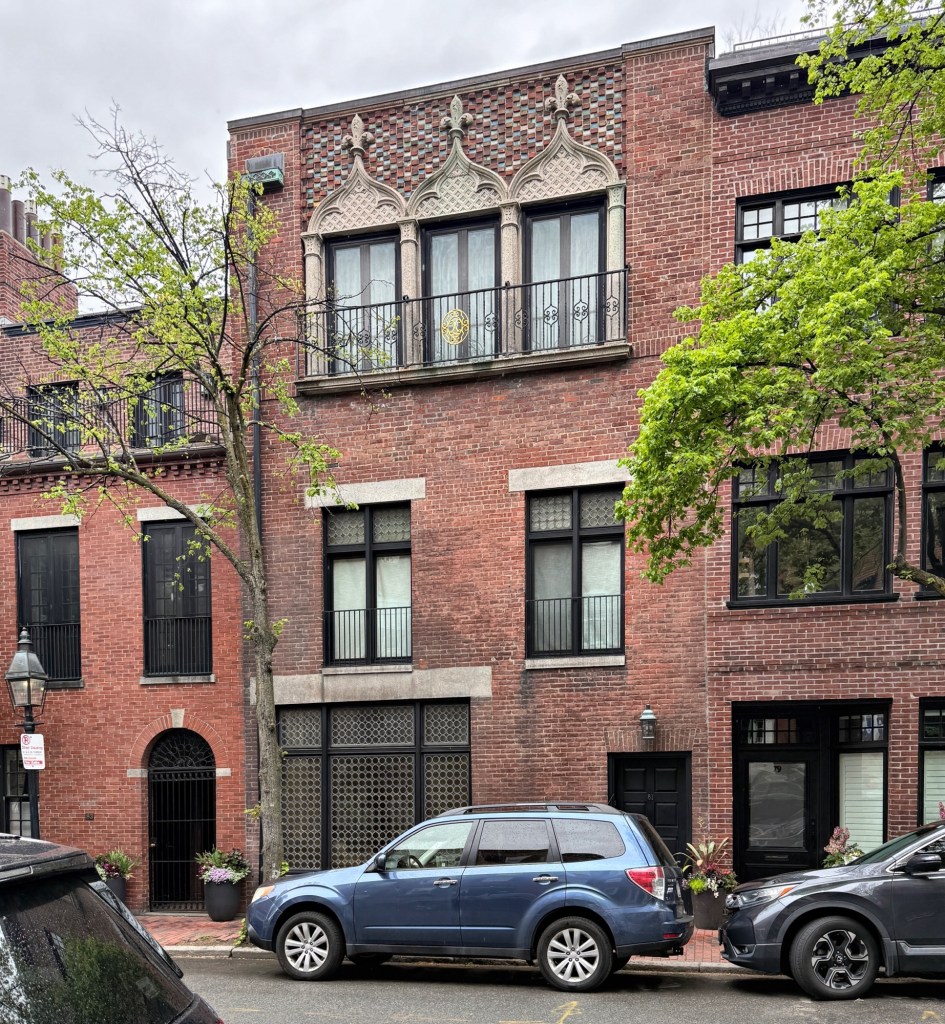
This handsome building at 81 Chestnut Street in Boston, began as a two-story brick stable and was later modernized with an additional floor and renovated for use as an artist’s studio, a perfect encapsulation of the history of the Flat of Beacon Hill from the “horsey end of town” to upper-class enclave and artist community. The stable was built around 1860 for Harleston Parker (1823-1888), the father of the more well-known, architect, J. Harleston Parker, and remained as a stable throughout the 19th century. In the early 20th century, the two-story building was converted to a auto repair shop but changed use in 1916 when owner, Edward H. Noyes hired architect, Harry Browning Russell, to convert the old stable to an artist studio. The second-story windows were enlarged and former carriage door were enclosed with small rounded art glass, likely for and by George Loftus Noyes, a painter who worked for a time at the New England Glass Company. Inside, a central landscaped courtyard flooded the spaces with natural light. In 1936, George Noyes moved to Vermont, divorcing his wife, Maybelle, but leaving her with the Boston studio. Maybelle remarried to George Lee, and soon-after hired architect, Frank Chouteau Brown, to add a third-story to the studio for conversion to a year-round residence. Brown added the unique Moorish arched windows and brickwork at the third floor.

