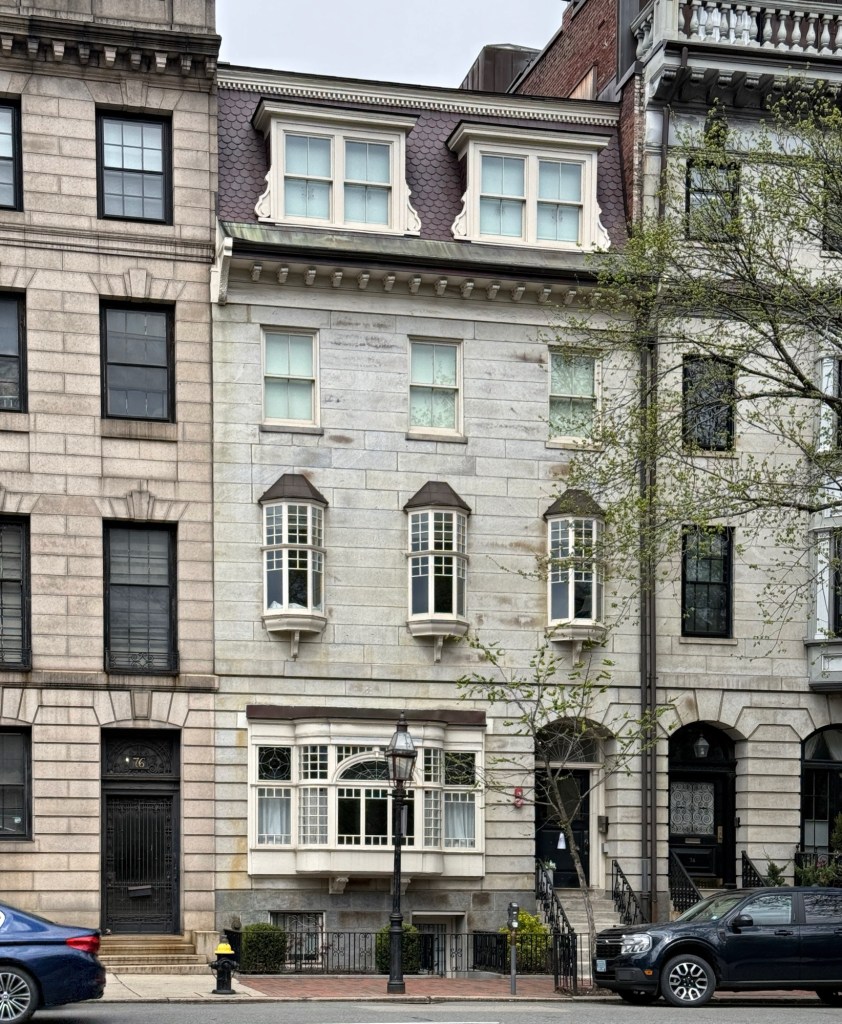
One of six attached houses townhouses between 70-75 Beacon Street, this stately granite-faced residence was built concurrently with its neighbors in 1828 on speculation for the Mount Vernon Proprietors, a group of wealthy Boston businessmen who helped develop Beacon Hill into the posh, architecturally significant neighborhood it is today. The Mount Vernon Proprietors knew how important Beacon Street was as the entry into the neighborhood, and thus, hired Boston’s premier architect, Asher Benjamin, to design the row. When completed, all of the houses were identical, but throughout the 19th and 20th centuries, they all deviated from the original design, some gaining additional floors, others adding bay windows, but all together form a cohesive and architecturally significant span of houses. Completed in 1829, the residence at 75 Beacon Street is known as the Mason-Fitz House and was originally owned by Jonathan Mason (1756-1831), a U.S. Congressman and U.S. Senator, and later inherited by his son, William Powell Mason (1791-1867), who engaged in real estate. It was likely William Mason who added the mansard roof in the late 1850s or 1860s, but the main unique detailing of the residence occurred in 1889 when newlyweds, Henrietta G. and Walter Scott Fitz hired the popular architectural firm of Little & Browneto reconfigure the front of the house in the Colonial Revival style. Little & Browne added the rather fanciful, oriel windows on the facade, which include the three, small hipped-roof oriels on the second story and larger projecting oriel on the first floor with fanlight and leaded glass. Cambridge architect, Edward T. P. Graham later purchased the residence and petitioned to convert the single-family house into eight apartments, but was denied, later converting the residence into four units. Today, the Mason-Fitz House is broken up into two larger condominium units.