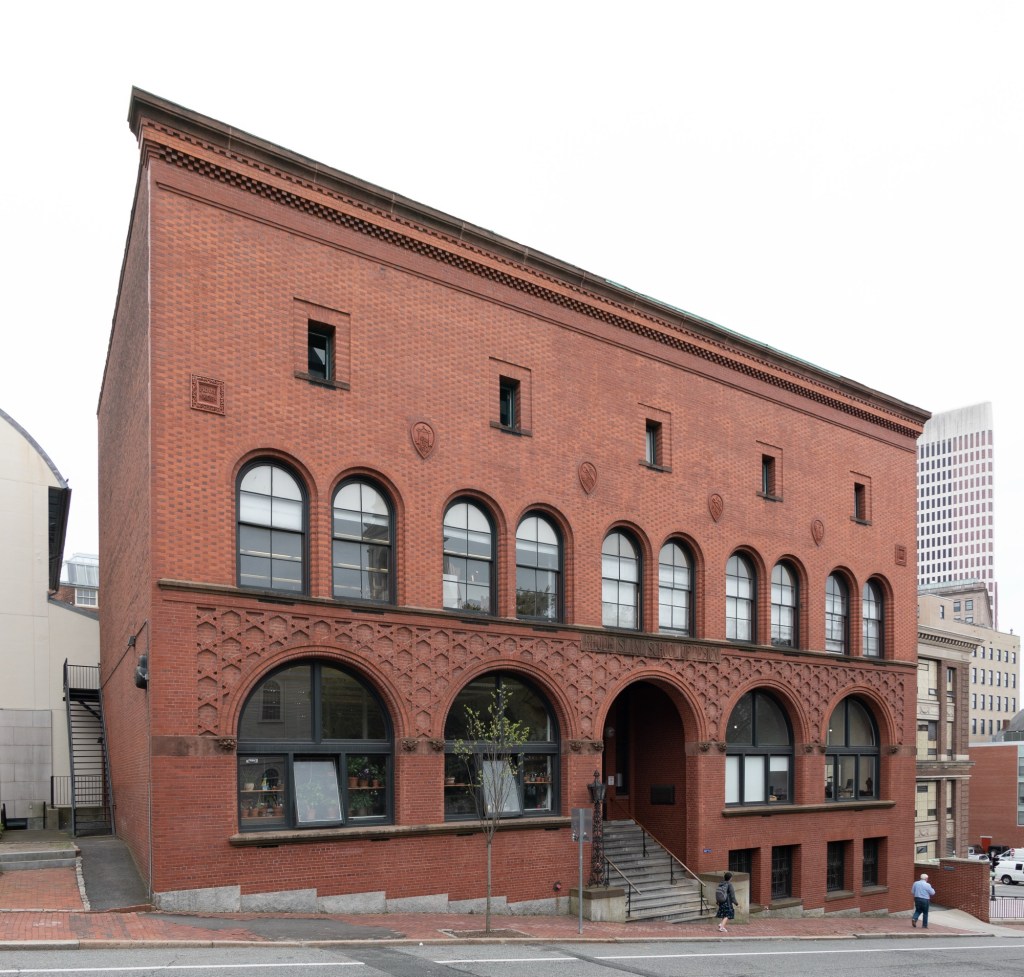
Waterman Building, RISD // 1892

The Waterman Building located on Waterman Street on Providence’s East Side is architecturally significant as an example of the Romanesque Revival style, as well as historically significant as the first purpose-built building for the Rhode Island School of Design (RISD). The school originally opened in 1877 by Helen Adelia Rowe Metcalf, who sought to increase the accessibility of design education to women, in rented space within the Hoppin Homestead Building in Downtown Providence. As the school grew coinciding with the appreciation of the arts in the late 19th century, the school’s board and president sought to provide a permanent site for the young institution. A site was purchased across from the First Baptist Church and the local firm of Hoppin, Read and Hoppin was hired to furnish designs. The short-lived partnership of Providence-born brothers Howard and Francis L. V. Hoppin and Spencer P. Read, laid out the building with studios on the upper two stories lit by arched windows on the second floor and skylights on the top floor, with a museum and classrooms occupied on the first floor. With an intricate brick facade adorned by terracotta medallions, unique cornice, and lattice brickwork in the spandrels, the building is befitting for an arts institution.
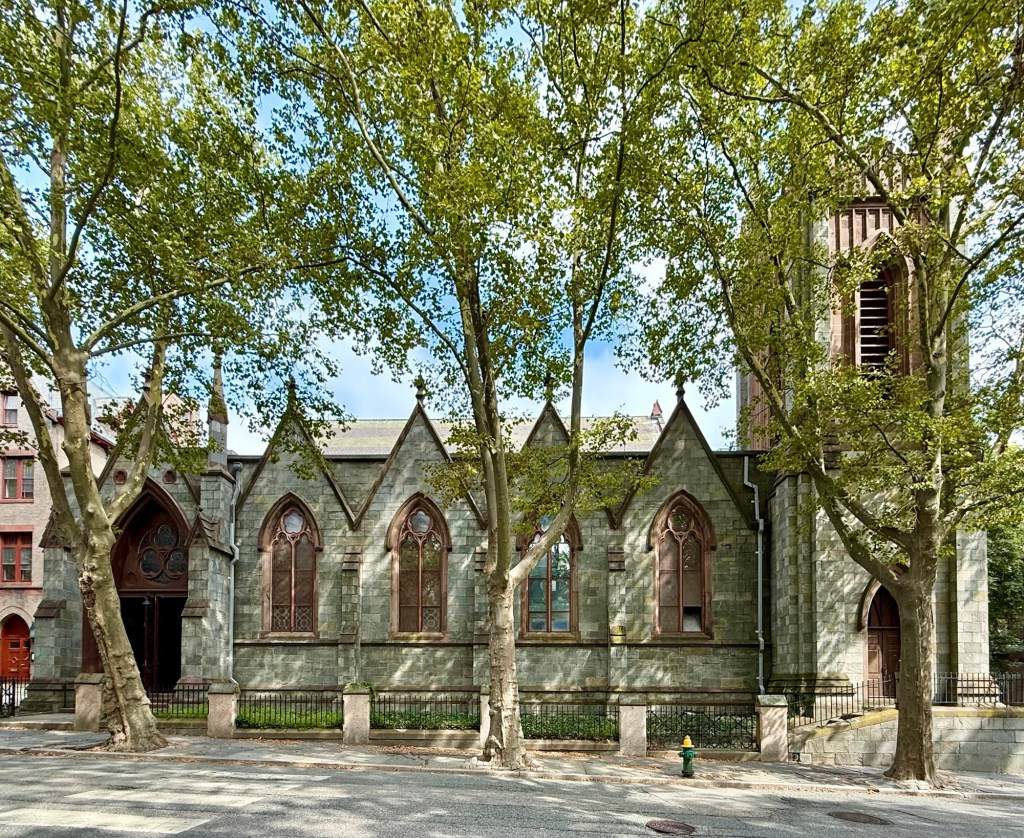
St. Stephen’s Episcopal Church // 1860

St. Stephen’s Episcopal Church is a landmark Gothic Revival church in Providence, Rhode Island, built in 1860 from plans by famed architect, Richard Upjohn. Constructed of gray stone with brownstone trim, the church is unique for its siting with the nave/long-side parallel to the street. The church was built for the local congregation, who two decades earlier, constructed the original St. Stephen’s Church on Benefit Street (now home to the Barker Playhouse), but sought to relocate to a more central location and in a more substantial building. With its entrance at one end and tower at the other, the nave is lined with a row of four gabled bays with lancet windows connecting the two. The church was modified over time, with Upjohn’s original intention for a 180-foot stone tower never undertaken, it would be capped by a copper-clad conical spire in 1900 from architects, Hoppin and Ely. The chancel was remodeled in 1882 by Henry Vaughan, and the Tudor Revival style Guild House immediately west of the church was built in the late 1890s Martin & Hall, architects. The congregation continues to this day, and preserves this significant building fitting of an English estate.

First Church of Christ Scientist, Providence // 1906

One of the most stunning and monumental buildings in Providence is this building, a church which pretty closely resembles the Rhode Island State House! Christian Scientists in Providence began to hold informal services in 1889 and received a charter from the state legislature in 1895. Construction started on this church, the First Church of Christ, Scientist in 1906 from plans by local architect Howard Hoppin who roughly modeled the building after the congregation’s Mother Church in Boston. The Classical Revival building is capped by a copper hemispherical dome supported by a colonnade of Corinthian columns. The main block of the structure at the street is fairly modest, possibly due to the residential character of its surroundings.