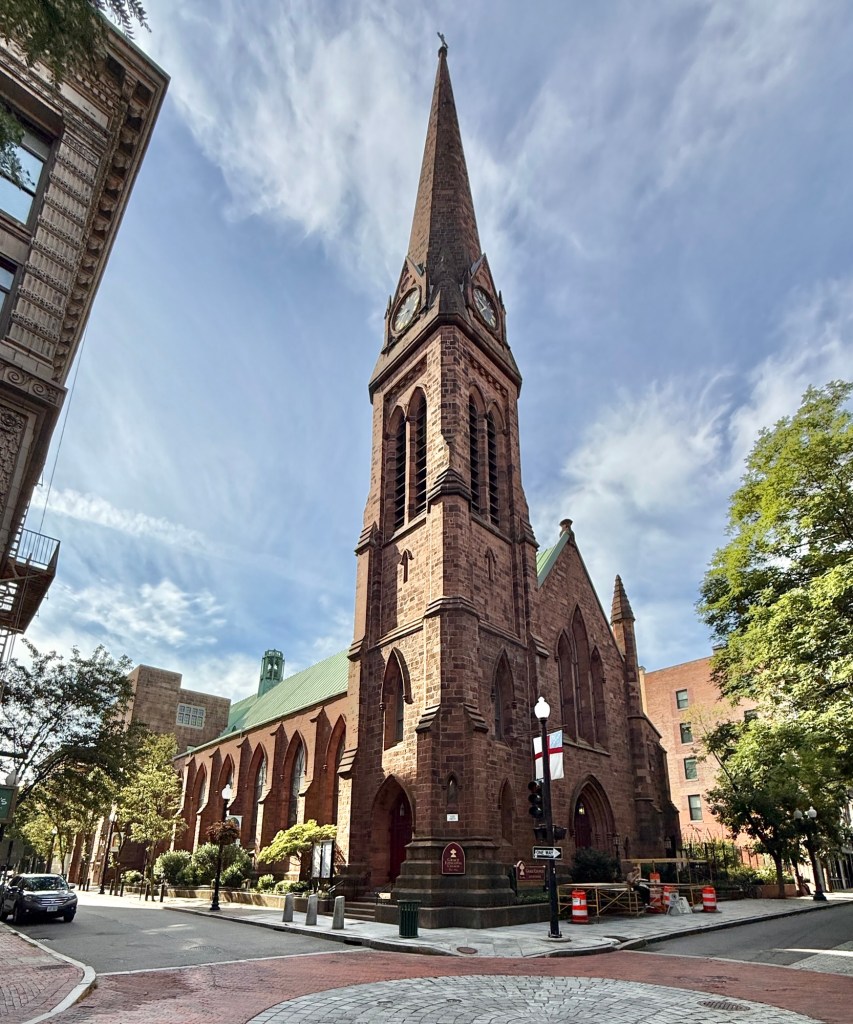
Grace Episcopal Church, Providence // 1846

Grace Episcopal Church has anchored the corner of Westminster and Mathewson Streets in Downtown Providence since it was completed in 1846. The congregation was founded in 1829 by some of the parishioners of St. John’s Episcopal Church on the East Side of Providence, at a period that the west side of the Providence River began to develop in earnest. The new parish had little money and managed to buy the old Providence Theatre, on the site Grace Church occupies today. The building was purchased and remodeled for $6,000, a large sum in those days, and converted into a church. Over a decade later, the growing parish had funding to erect a more permanent and suitable building. They hired one of the most well-respected architects in the country, Richard Upjohn, to design their new house of worship, which resulted in what is believed to be the first asymmetrical Gothic Revival church in America. In 1912, the firm of Cram, Goodhue & Ferguson deepened the chancel and added a parish house, extending Upjohn’s original design without disrupting it, and the church’s four-level tower and masonry spire still command the prominent corner in Downtown Providence today.
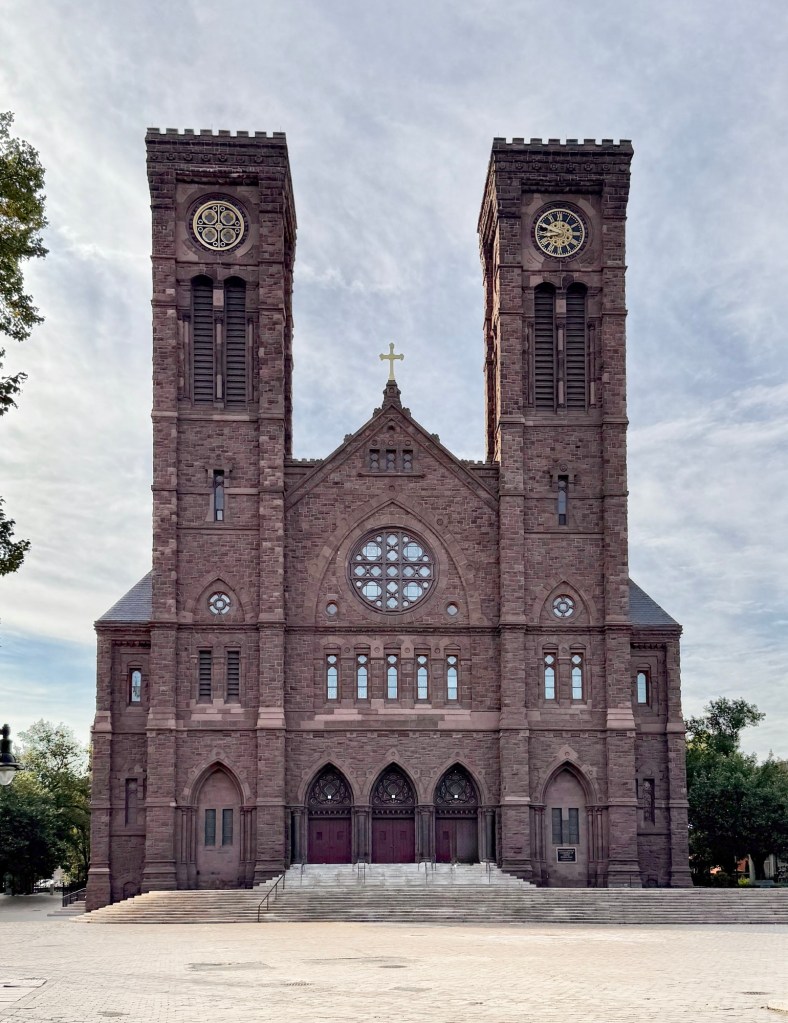
Cathedral of Saints Peter & Paul, Providence // 1878

The Cathedral of Saints Peter and Paul rises in Providence’s Cathedral Square, a sub-region of the city’s Downtown that was largely reshaped in the mid-late 20th century period of Urban Renewal. The monumental Romanesque style church is the mother church of the Diocese of Providence and was built on the site of the city’s first Roman Catholic parish, established in 1838. Designed by the prolific church architect Patrick Keely, the Providence cathedral broke ground in 1878 and was consecrated over a decade later in 1889. For this commission the blending of Romanesque and Gothic Revival detailing was likely inspired by both H. H. Richardson’s newly completed Trinity Church in Boston and on German and French medieval precedents. The structure is dominated by the two crenelated towers and displays strength with its bold proportions and use of reddish-brown stone. Inside, the cathedral is even more remarkable than its imposing exterior, distinguished by an overall multicolored, small-scale pattern of gray marble moldings and stained glass, complemented by a large Casavant organ with more than 6,600 pipes. Today, the miraculous cathedral is somewhat diminished in beauty due to the surrounding dead plaza, a scar on the built environment in Providence from Urban Renewal. In the 1960s and 70s, the entire western edge of Downtown had been slotted for redevelopment at a time when federal dollars funded mass demolition and rebuilding across American cities. The plan was designed by Modernist architect, I.M. Pei, who had envisioned a European-inspired courtyard, with a mix of residential and retail uses surrounding the church in the new development. Pei worked with the modernist landscape architects Zion and Breen on Cathedral Square, which was called a “conspicuous failure” within just a few years, a sentiment that has lasted a half-century since. The city has more recently pursued redesign proposals aimed at reconnecting Cathedral Square with the surrounding neighborhood, with the Cathedral of Saints Peter & Paul as the centerpiece.

First Church of Christ Scientist, Providence // 1906

One of the most stunning and monumental buildings in Providence is this building, a church which pretty closely resembles the Rhode Island State House! Christian Scientists in Providence began to hold informal services in 1889 and received a charter from the state legislature in 1895. Construction started on this church, the First Church of Christ, Scientist in 1906 from plans by local architect Howard Hoppin who roughly modeled the building after the congregation’s Mother Church in Boston. The Classical Revival building is capped by a copper hemispherical dome supported by a colonnade of Corinthian columns. The main block of the structure at the street is fairly modest, possibly due to the residential character of its surroundings.