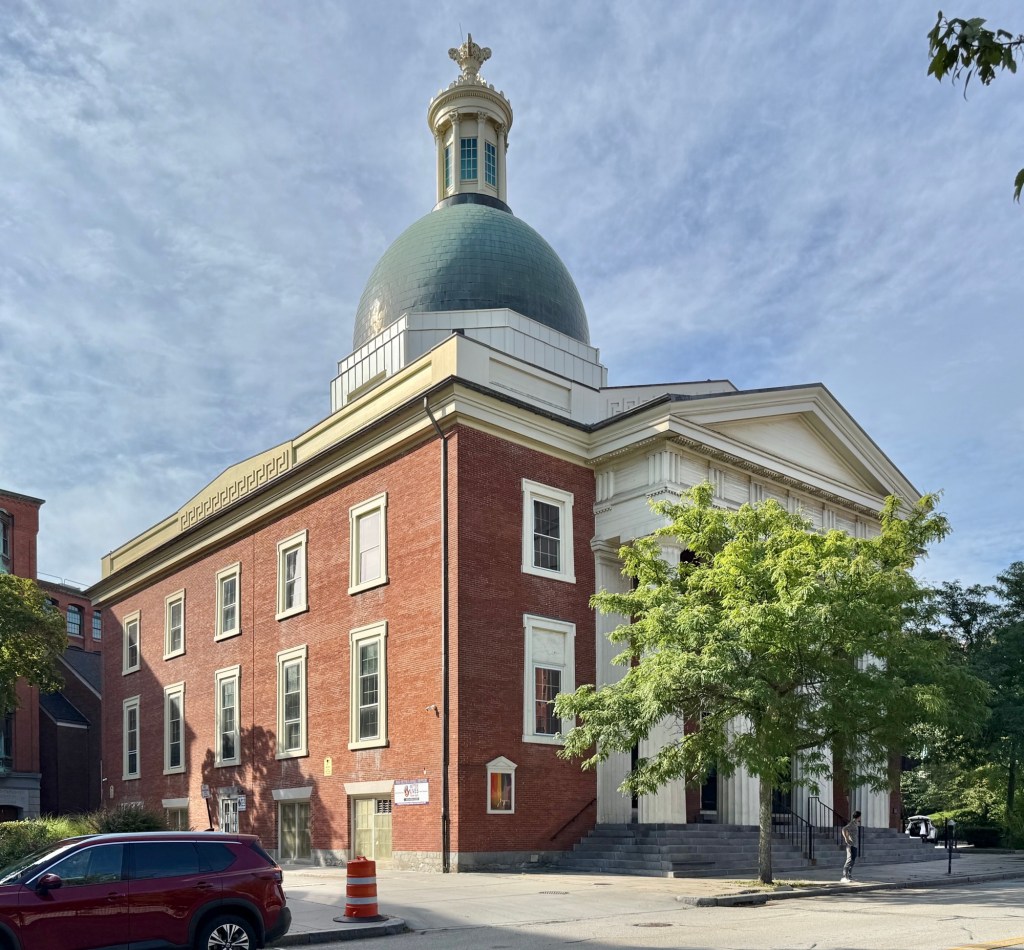
Beneficent Congregational Church // 1809

Located on Weybosset Street in Downtown Providence, the Beneficent Congregational Church, affectionately nicknamed “Round Top” for its striking dome, is significant architecturally and historically as an early Federal/Greek Revival style church and the oldest in Downtown Providence. The congregation was founded in 1743 during the “First Great Awakening” as a separatist spin-off of College Hill’s First Congregational Church (now First Unitarian Church). The offshoot occurred after when Deacon Joseph Snow, Jr. (1690-1773), a fiery preacher who was also a carpenter by trade, began preaching a more evangelical brand of Congregationalism than the more reserved members of the church could tolerate. Eventually, Father Snow, and his ardent followers established a second congregation on the west side of the Providence River in what was then an area of scattered residences and farms. The current church, the congregation’s second on the site, was constructed in 1809 from designs by Barnard Eddy and John Newman, but it was largely reworked into its present form in 1836 by the firm Tallman & Bucklin, who swapped the original Federal-era details for bolder Greek Revival trim, including the chunky Doric columns of the entrance portico, a paneled parapet, and an octagonal drum beneath the dome. That dome, along with the two-story front portico, survived the remodel unchanged in its overall form, and today it is sheathed in durable copper rather than the gold leaf that once covered it.
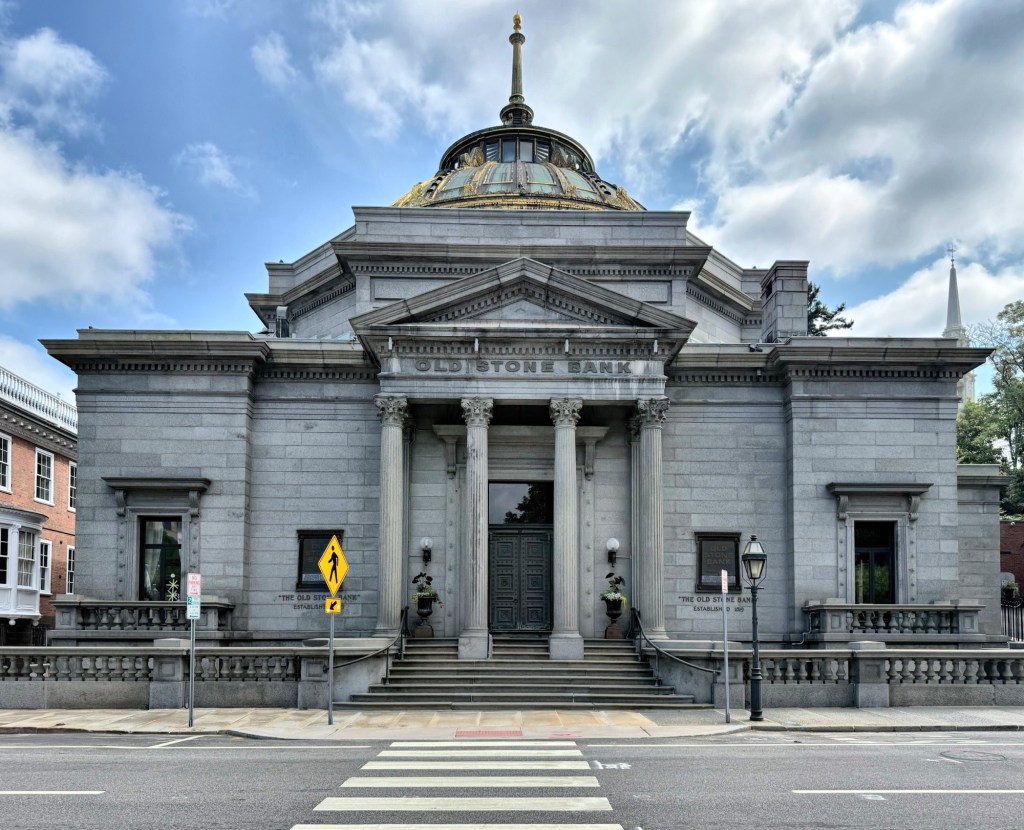
Old Stone Bank // 1896

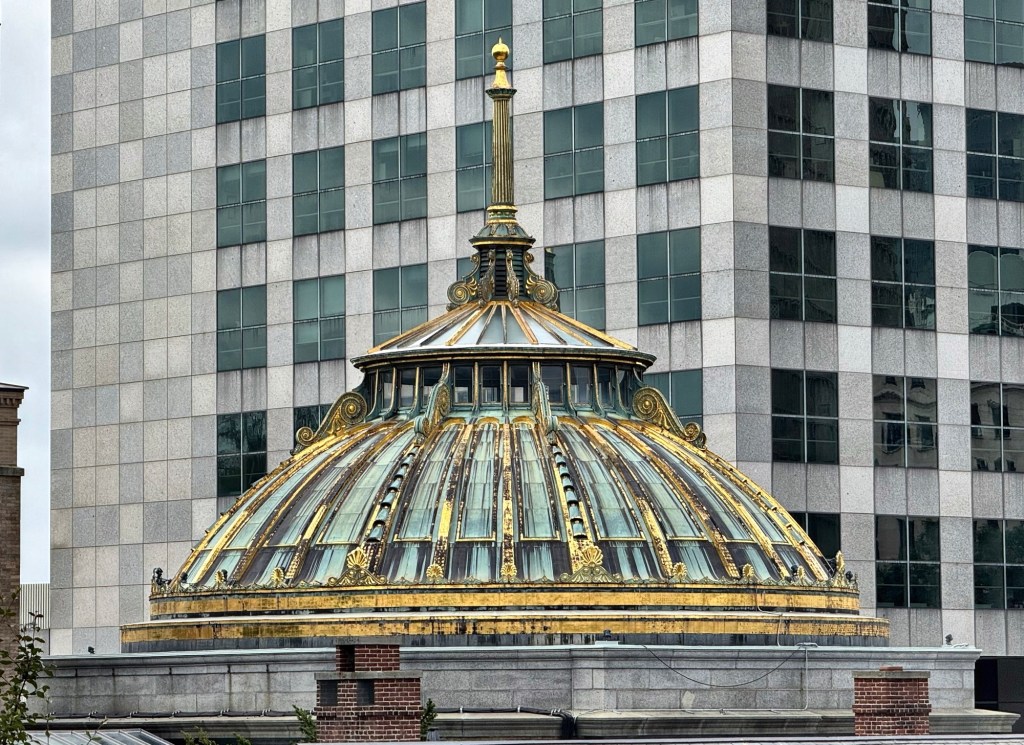
The Old Stone Bank was founded in 1819 as the first savings bank in Providence, Rhode Island, but originally under the name, Providence Institution for Savings. A constantly growing volume of business influenced the erection, in 1854, of a building for the exclusive purposes of the bank at 86 South Main Street, near College Hill. Designed by C.J. and R.J. Hall, the original stone bank stood one-story tall with a gable roof. Success and further expansion of the institution led to the erection, in 1896, of the present building, which served as the main office. Designed by the local architectural firm of Stone, Carpenter & Willson, the present domed banking structure is said to have incorporated parts of the 1854 building, and expanded the rest to the landmark we see today. The Beaux Arts/Neo-Classical banking structure is constructed of granite, with a Classical pedimented entry of monumental Corinthian columns atop the staircase, but the highlight of the building has to be the gold-leaf-and-copper domed roof which partially served as a skylight for the banking hall inside. Offices relocated to a new building in the late 1960s. The banking institution closed in the 1980s and following acquisitions and insolvency, the main bank was sold in 1995 to Brown University for $1.15 million to house the Haffenreffer Museum of Anthropology‘s collection of Native American artifacts. Years later, Brown decided it was unfeasible to house the collection in the building as the necessary alterations would have altered the historic character of the building, they then sold the building to an LLC in 2009. The Old Stone Bank is now a single-family home. Yes, you heard that right. The new owners have lovingly preserved this architectural marvel for all to enjoy as they stroll the city.

First Church of Christ Scientist, Providence // 1906

One of the most stunning and monumental buildings in Providence is this building, a church which pretty closely resembles the Rhode Island State House! Christian Scientists in Providence began to hold informal services in 1889 and received a charter from the state legislature in 1895. Construction started on this church, the First Church of Christ, Scientist in 1906 from plans by local architect Howard Hoppin who roughly modeled the building after the congregation’s Mother Church in Boston. The Classical Revival building is capped by a copper hemispherical dome supported by a colonnade of Corinthian columns. The main block of the structure at the street is fairly modest, possibly due to the residential character of its surroundings.