Fleur-De-Lys Studios // 1885

The Fleur-de-Lys Studios is of the most architecturally significant and unique buildings in New England and can be found on Thomas Street in the College Hill section of Providence. Built in 1885 and a vivid expression of the Queen Anne style and showing the emergence of the Arts and Crafts movement movement in America, the handsome building blending is the result of a partnership between artist, Sydney Richmond Burleigh and architect, Edmund R. Willson as a dedicated creative hub for working artists, a purpose it still serves today under the stewardship of the Providence Art Club, who received the deed of the property in 1939 by Burleigh’s widow. Its design draws heavily on medieval English and Tudor Revival influences, with a striking half-timbered façade, stucco panels, carved heads as hanging pendants, and projecting casement windows that break dramatically from the surrounding colonial streetscape. What truly sets the structure apart, however, is its richly symbolic ornamentation—allegorical figures representing painting, sculpture, and architecture adorn the exterior. More than a century later, the Fleur-de-Lys Studios remains both a National Historic Landmark and a living workspace, preserving its original spirit as a place where art and architecture are inseparably intertwined.

College Building, RISD // 1823 & 1936

Spanning an entire city block on College Street between North Main and Benefit streets in Providence’s East Side, the College Building at the Rhode Island School of Design (RISD), is a valuable lesson in urban context and design. The building was constructed in 1936 from plans by the local architectural office of Jackson, Robertson & Adams, who had years prior, designed the Providence County Courthouse standing across the street. Designed in a plainer version of the Colonial/Georgian Revival style than the courthouse, the new College Building at RISD is broken up into multi-bay wings terracing up the slope of College Street, which breaks up the solid massing of the building in a pleasing way. Additionally, the designers incorporated the Federal period western wall of the 1823 Franklin House, an early 19th century hotel on the site. The result is possibly one of the first examples of a facadectomy in New England, if not the United States!

Daniel Smith House // c.1750

The Daniel Smith House at 362 Benefit Street in Providence, Rhode Island, stands out in the neighborhood as an uncommon gambrel-roofed Georgian-era residence, but it was not built here! The home was built by about 1750 for Daniel Smith, and may possibly date to around 1725 a year after he was deeded land from his father and the same year he married his wife, Dorcas Harris. If the home does indeed date to around 1725, it would likely be the oldest extant house in Providence! The home was originally located across town on Chalkstone Avenue, and moved to the present site on Benefit Street in 1982 to save it from institutional expansion by Roger Williams Hospital. The hospital set a date to demolish the farmhouse, then covered in asbestos siding, and offered the building for free to someone who could move it off the site. After tense weeks and a nearing deadline, Angela Brown Fischer, a real estate executive, agreed to pay the costs to move the building across town to a site on Benefit Street, where it remains today. The home was put back together and restored by Newport-based architect, Richard Long, who worked as principal architect for the Restoration Foundation of Newport before opening a private architectural practice. What a great preservation success story!

Ives Rowhouses // 1814

The Ives Rowhouses stand at 270-276 Benefit Street in Providence and are an important and intact example of a Federal period row from the early 19th century. These four, three-story brick rowhouses were built between 1814-19 as investment property for Thomas Poynton Ives, a successful local merchant and partner in the firm of Brown & Ives, who lived nearby on Power Street. Each of the houses has a three-bay facade with pedimented fanlight doorways. The one residence was significantly altered in 1948 by the massive archway for vehicular access at the rear. The houses stand out in Providence, as fairly uncommon rowhouses, which never took off quite like they did in Boston and other New England cities. The row is today neighbors with the National Historic Landmark Hopkins House.

Ambrose Burnside House // 1866

What do this unique Victorian house and sideburns have in common? Well, you are about to find out!

The Ambrose Burnside House is sited on an oddly shaped, and sloping corner lot on Benefit Street in Providence’s East Side neighborhood, and is one of the most unique Second Empire style residences in New England. The house was built in 1866 for General Ambrose Burnside (1824-1881), a Union general in the American Civil War, who returned to Providence and was about to begin a term as governor, followed by two terms in the United States Senate. Ambrose Burnside hired local architect, Alfred Stone, to design his new city mansion, which upon completion, was deemed one of the most “modern residences” in Providence. Built of brick with Nova Scotia stone with a concave slate mansard roof and one-of-a-kind rounded corner bay, the Ambrose Burnside House does not disappoint! Ambrose Burnside died in 1881 and the property was occupied by his sister-in-law until the property was sold in 1884 and housed the Providence Children’s Friend Society House for Aged Women and the Providence Association for the Benefit of Colored Children, providing shelter and food for elderly women and children of color without parents or guardians. After WWII, the Burnside House was converted to apartments.

Now, to the sideburns… Ambrose Burnside was noted for his unusual beard, joining strips of hair in front of his ears to his mustache but with the chin clean-shaven; the word burnsides was coined to describe this style. The syllables were later reversed to give sideburns.

Tully Bowen House // 1853

Designed by great architect, Thomas Tefft, this three-bay, three-story brownstone house located at 389 Benefit Street in Providence, was built for Tully D. Bowen, a cotton manufacturer. The house, one of the finest Italianate style mansions in the state, is constructed of brownstone and features a recessed arched entrance surrounded by a flat-headed Doric-pilastered frame, pedimented first-floor windows resting on brackets with the alternation of flat and pedimented heads at the second story, and quoining at the corners. The property also retains its original Tefft-designed brick and brownstone carriage house. Thomas Tefft, who was just 27 at the time of designing this house and corresponding brownstone and iron gate, would become one of America’s finest architects before he died in Florence with a fever in 1859 at just 33 years old. The residence was converted to 12 apartments in 1941 and the carriage house was converted to residential use as well. Even with the subdividing the interior spaces of the residence and carriage house, the Bowen property remains in a great state of preservation and is one of the finest homes in Providence.

Thomas Peckham House // c.1824

The Thomas Peckham House at 395 Benefit Street is a stately, modified Italianate style residence typical of the middle-upper-class residents of Providence’s East Side neighborhood in the middle of the 19th century. The house here was built sometime before 1824, likely around that time for Thomas Peckham (1783-1843), who worked as the Deputy Collector of the port of Providence. The Peckham House was likely built as a brick, two-story Federal style house, that was expanded by his heirs in 1853 in the Italianate style, boxing off the building’s roof. Emblematic of the large Italianate homes on College Hill in Providence, the Peckham House features a boxy form, shallow hip roof with monitor, and bracketed cornice and door hood, which has engaged columns. 

Pierce-Guild Lightning Splitter House // 1781

The Pierce-Guild House at 53 Transit Street in the Fox Point neighborhood of Providence, Rhode Island, is one of the most iconic and photographed residences in the state. Known as a “lightning splitter”, the unique name is taken from local folklore that the sharp angle of the gable roof will deflect or split lightning if struck. Whether or not this superstition is true, the unique house form numbers to less than a dozen in Rhode Island. This house, arguably the most well-known for its location off Benefit Street, was originally built in 1781 as a modest 1-1/2-story cottage with a gambrel roof for Daniel Pierce (Pearce), a tailor. In 1844, the property was sold to George Guild, a grocer, who modernized the house by creating the massive gable roof to provide a narrow third floor, which was illuminated by the end windows and a diminutive dormer at the roof. The house retains much of its character, after a restoration by owners in the mid-late 20th century.

St. Stephen’s Episcopal Church // 1860

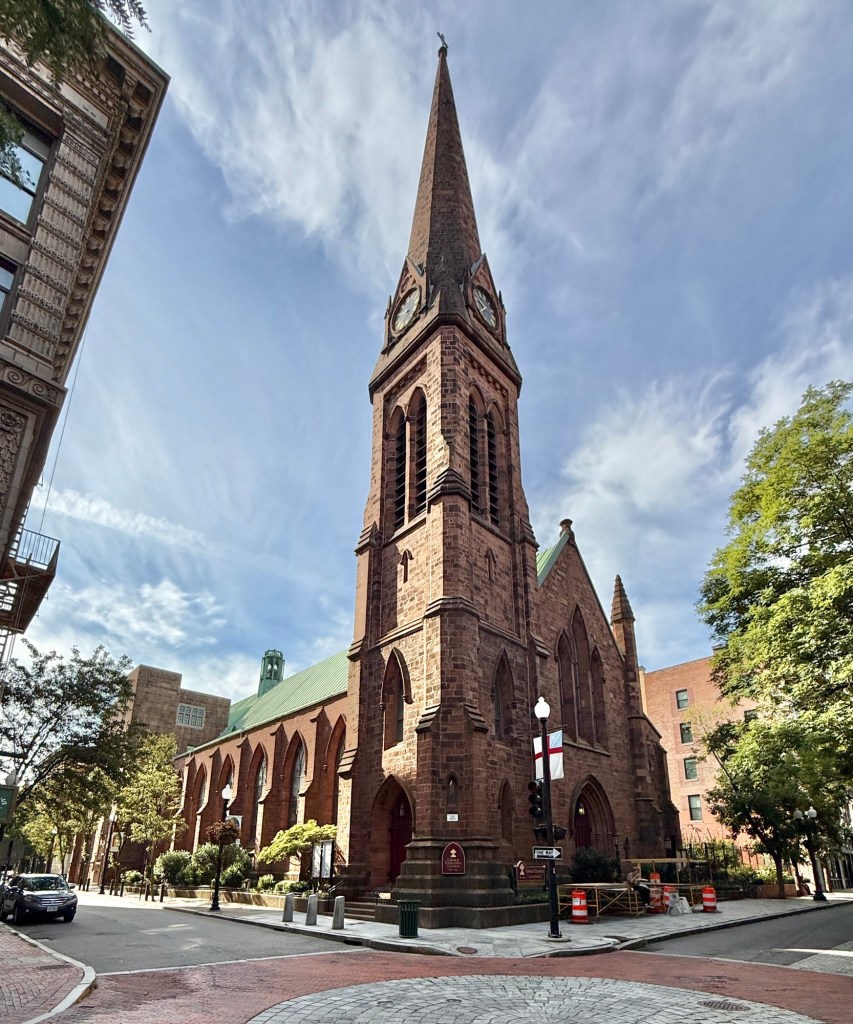
St. Stephen’s Episcopal Church is a landmark Gothic Revival church in Providence, Rhode Island, built in 1860 from plans by famed architect, Richard Upjohn. Constructed of gray stone with brownstone trim, the church is unique for its siting with the nave/long-side parallel to the street. The church was built for the local congregation, who two decades earlier, constructed the original St. Stephen’s Church on Benefit Street (now home to the Barker Playhouse), but sought to relocate to a more central location and in a more substantial building. With its entrance at one end and tower at the other, the nave is lined with a row of four gabled bays with lancet windows connecting the two. The church was modified over time, with Upjohn’s original intention for a 180-foot stone tower never undertaken, it would be capped by a copper-clad conical spire in 1900 from architects, Hoppin and Ely. The chancel was remodeled in 1882 by Henry Vaughan, and the Tudor Revival style Guild House immediately west of the church was built in the late 1890s Martin & Hall, architects. The congregation continues to this day, and preserves this significant building fitting of an English estate.

Benoni Cooke House // 1828

The Benoni Cooke House at 110 South Main Street in Providence, Rhode Island, is one of the finest examples of an architect-designed Federal style residence in the state. A fine and somewhat-typical example of architect, John Holden Greene’s 1820s work in the Federal style, the residence is actually the remaining half of what was originally a pair of mirror-image houses, built for two brothers-in-law and business partners, which once faced one another across a driveway leading to a large, well-preserved service court defined by connected stables (most of which remain). The mirror house, built for Rufus Greene, was demolished in 1895 for the expansion of the Old Stone Bank next door. The Benoni Cooke House was built in 1828 and sits atop an arcaded basement on the street elevation, which historically was used for commercial use. The Cooke House retains its iconic hipped roof with monitor (common for John Holden Greene’s works), an Ionic portico sheltering the entry with sidelights and fanlight transom, and elaborate stairhall window above. The building was later occupied as offices for the Old Stone Bank, and along with the Old Stone Bank, was acquired by Brown University, who sold the property in 2009 to an LLC, but its current use is unclear.