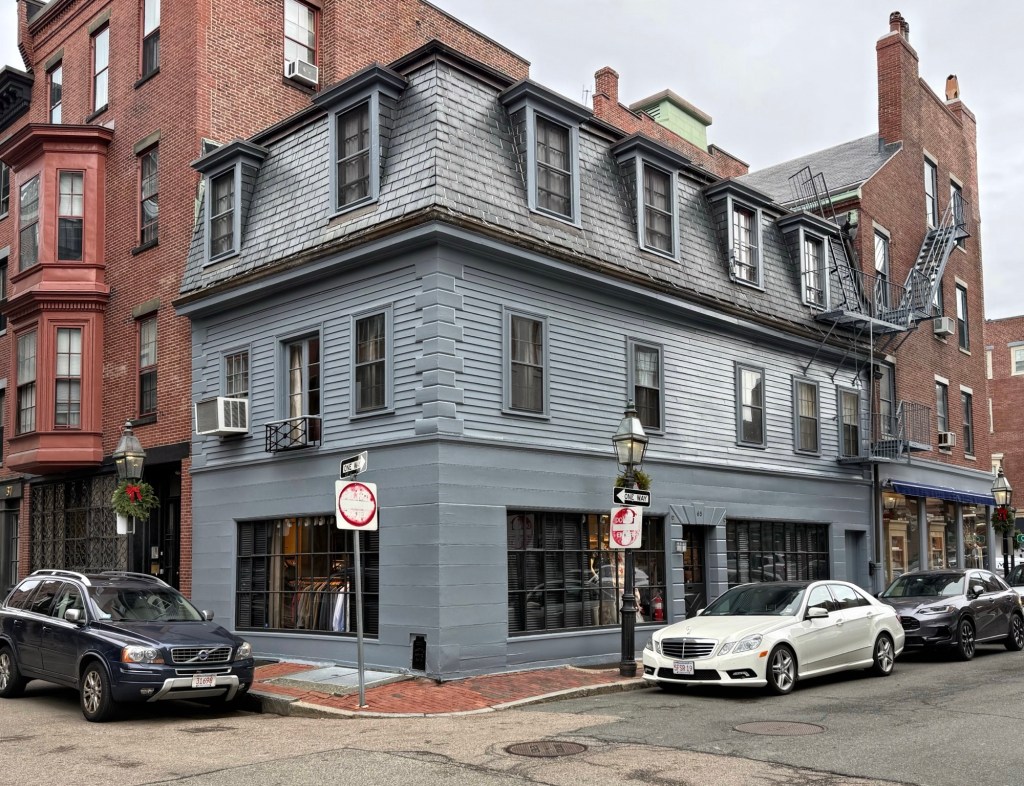
A rare extant wood-frame building in Beacon Hill, this Second Empire style building at the corner of Chestnut and River streets is one of the neighborhood’s most charming. It is likely that some of the wood-frame structure was originally a rear ell to the 1830s Greek Revival house it adjoins at 34 Charles Street. By the 1860s, the building was renovated for use as a carpenter’s shop, with the mansard roof, quoins, and loft door added at that time. City records indicate that the house on Charles Street housed tradesmen and it was listed as “Temporary Home”, the predecessor to the city Overseers of the Poor Temporary Home, a charitable organization providing lodging and food to those in need. From the late 1920s, the property was owned by Max and Rebecca Fishelson, who resided in and operated their florist shop here. In 1936, the former carpenter’s shop was renovated to contain a retail store on the ground floor with a two-family dwelling above, one for the Fishelson’s and one for their daughter. for a renovation of the wood frame annex on
Chestnut Street, which involved changing the occupancy of that section from a store and carpenter shop to a store and two-family dwelling: one for the Fishelsons and one for their daughter.