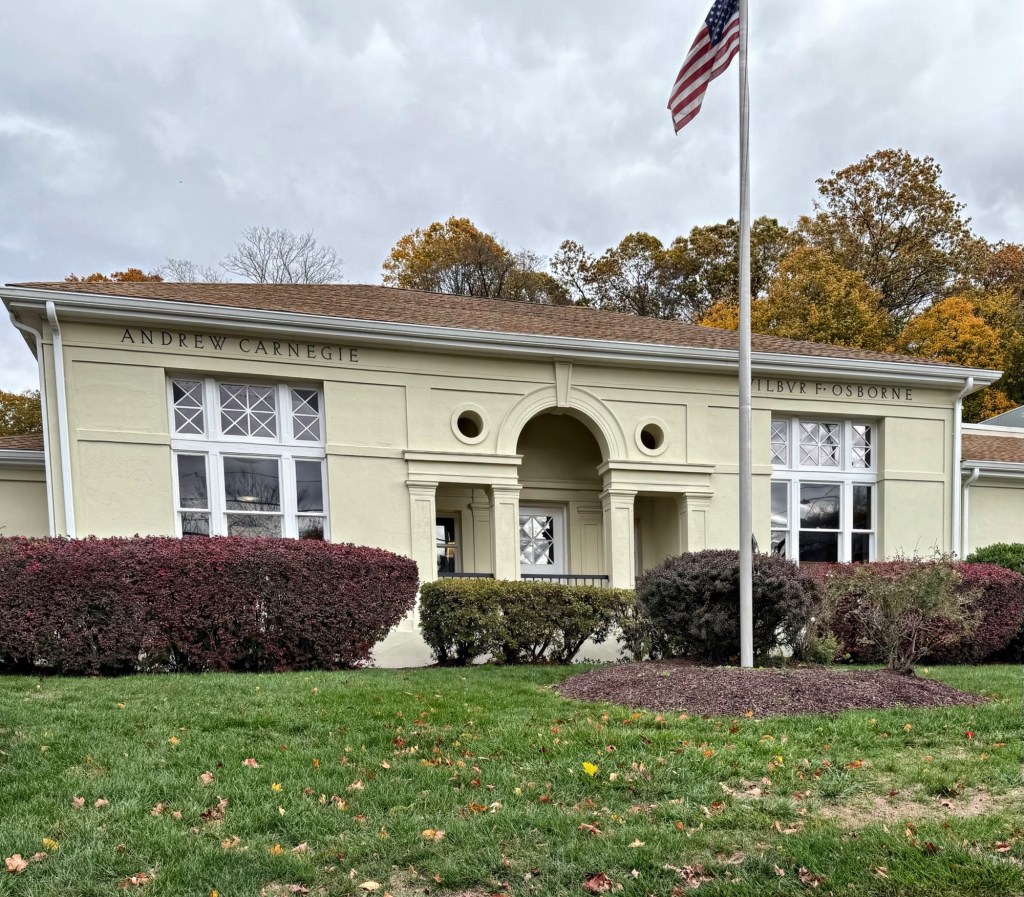
The Derby Neck Library in Derby, Connecticut, is a beautiful example of an early 20th century library and one of a few Carnegie libraries in the state. The beginnings of the library began in 1897, when Wilbur F. Osborne and his wife, Ellen Davis Osborne, who lived at the nearby Osborne Farm, donated $50 to the nearby school to begin a small library in the building. After years of growth, Wilbur Fisk Osborne, requested funds from Andrew Carnegie, who was donating money to communities all across the country for such purposes, to build a new library for Derby Neck. In 1906, Carnegie donated $3,400 to the community, and planning began on the building. Sadly, Osborne died around the time the library opened in 1907. The building was designed in the Classical Revival style by architect, Henry Killam Murphy of Connecticut. Osborne’s daughter, Frances Osborne Kellogg, who inherited her father’s farmhouse nearby, directed the library until her death in 1956. The building was expanded in 1972 and again in 1999.
 Buildings of New England
There is no denying that this library is a little gem with an interesting history and an elegant design. A look at the 1972 and 1999 additions (on Google Street View) raises a couple of questions however. The later architects, clearly striving to make the additions compatible with their use of materials, window proportions, and masonry details, may have missed the mark with the overall massing. The 1999 addition is situated as a counterbalance to the 1907 original using what I presume is the 1972 addition as the entrance to the entire assemblage. This sets off the 1907 and 1999 in an uncomfortable juxtaposition to each other. The 1999 wins in terms of massing and width, but the 1907 wins in terms of sophistication. Screening the original 1907 entrance with shrubbery doesn’t help.
Thank you for presenting this building. When the examples you present are so compelling, it must bring out the architectural critic in me.
LikeLiked by 1 person
Well said, and I agree. With so many diminutive late 19th and early 20th century libraries in New England, it is great to see so many were saved and expanded rather than built new. Sometimes, a divergence in materials, forms, and scale, can be done well to let each phase stand on its own merits (I am thinking of the Boston Public Library and Cambridge Public Library as examples of this).
LikeLiked by 1 person