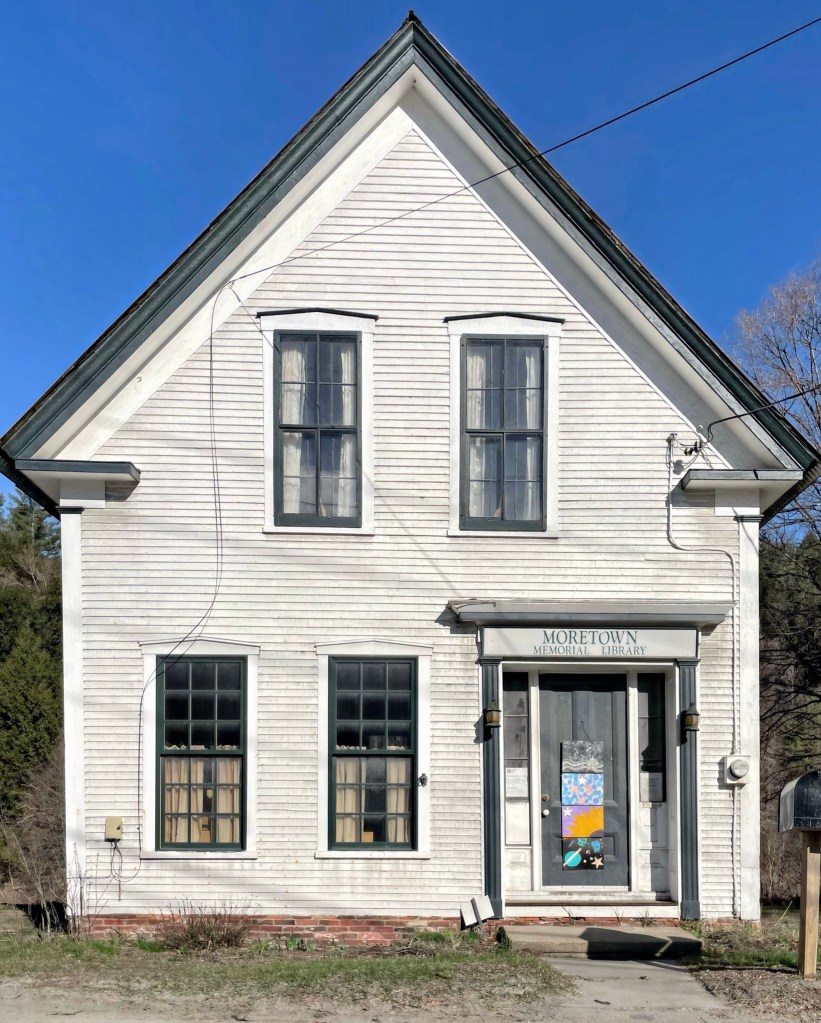
Moretown Public Library // c.1845

This 1840s Greek Revival home turned library, sits on the main street in the charming rural town of Moretown, Vermont. The quaint village never had a public library, but that changed starting in 1904, when residents and the town established a fund for purchasing books for the town’s citizens. In 1923, the library trustees purchased this residence which would serve as a stand-alone library for the village. Resident Lilla Haylett was instrumental in the accession and conversion of the home for use as a library from the estate of Ellen J. Palmer, who lived there until her death in 1923. The opening and celebration was short-lived however, as in 1927, elevated levels of the Mad River flooded much of the town. Water levels were well over the first floor of the building and nearly all books were lost. The Moretown Memorial Library was nearly lost, but the town rebuilt over years. The library remains today as a testament to the desire for learning and it serves as a landmark for the charming rural village.

Echo Bridge // 1876

Spanning the Charles River between Upper Falls Village in Newton and Needham, the Echo Bridge, is one of the most stunning structures around Boston. While not technically a building, I couldn’t help but share one of my favorite off-the-grid places to explore in the region.

The bridge served as crossing for water to be transported from the Sudbury River to the growing City of Boston. The entire aqueduct transported water over 18 miles from Farm Pond in Framingham and was stored in the Chestnut Hill Reservoir in Boston. Due to the topography of Hemlock Gorge in Newton, a large elevated bridge was required, creating one of the biggest engineering marvels around Boston. George W. Phelps, a contractor from Springfield, MA was selected as the builder of the bridge with a low bid. The 500′ bridge features a total of seven arches, with the largest spanning the Charles River being 137′, the second largest masonry arch span in the U.S. upon its completion.

Echo Bridge is constructed of large granite block and brick, which was held in place by wooden framework until the arches would be able to support their own weight at the top of the arches. Echo Bridge gets its name from the acoustical phenomenon when you stand at the base of the arch at the river and when speaking, the sound reverberates and echoes back and forth.