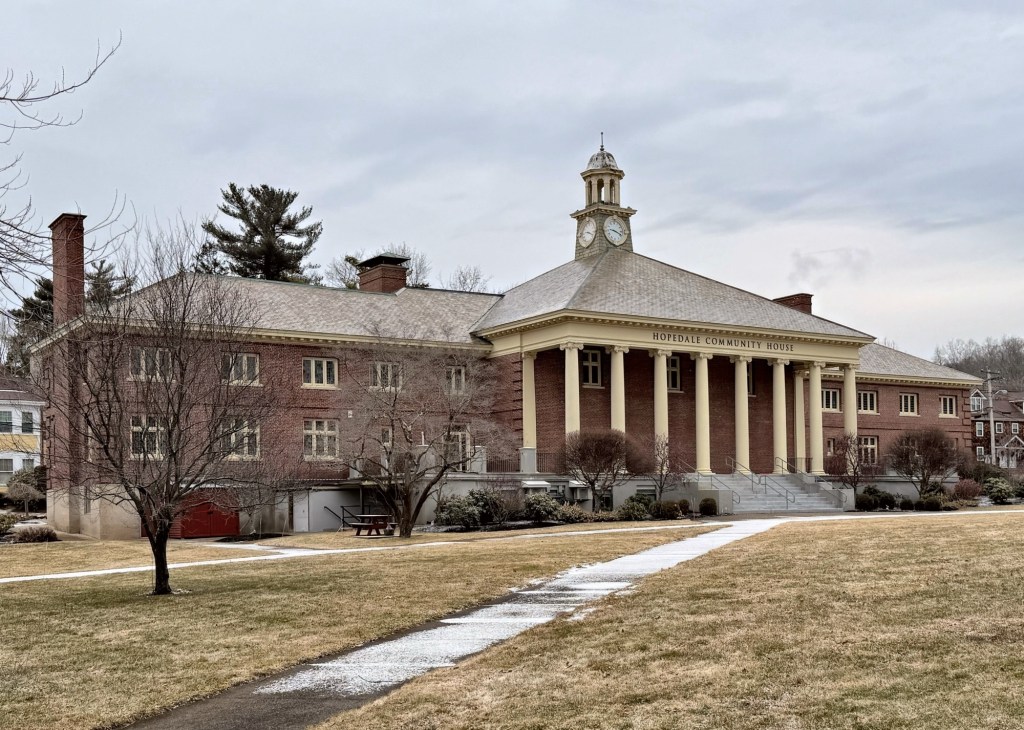
Hopedale Community House // 1923

Hopedale in the 1920s saw a civic building campaign led by George A. Draper (1855-1923), then treasurer of the Draper Corporation. Draper often talked about the need for a community center in Hopedale for his workers, and in 1919 decided to build one at his own expense. He commissioned architect Edwin J. Lewis, Jr. of Boston to design the Hopedale Community House which was intended to serve as a social and civic center for all Hopedale residents, as well as Draper Corporation employees residing in other towns. The building was opened in 1923, but sadly George Draper died before he could see it used. Colonial Revival in style, the building’s facade is dominated by a portico along the entire elevation with double-height Ionic columns. The slate hipped roof is capped by a square clock tower at the crest. The Community House included an assembly hall, a banquet hall that doubled as a gymnasium, a kitchen, rooms for smoking and cards and billiards, a ladies’ social room, the Knights of Pythias club room, and candlepin bowling lanes in the basement, all of which exist to this day.
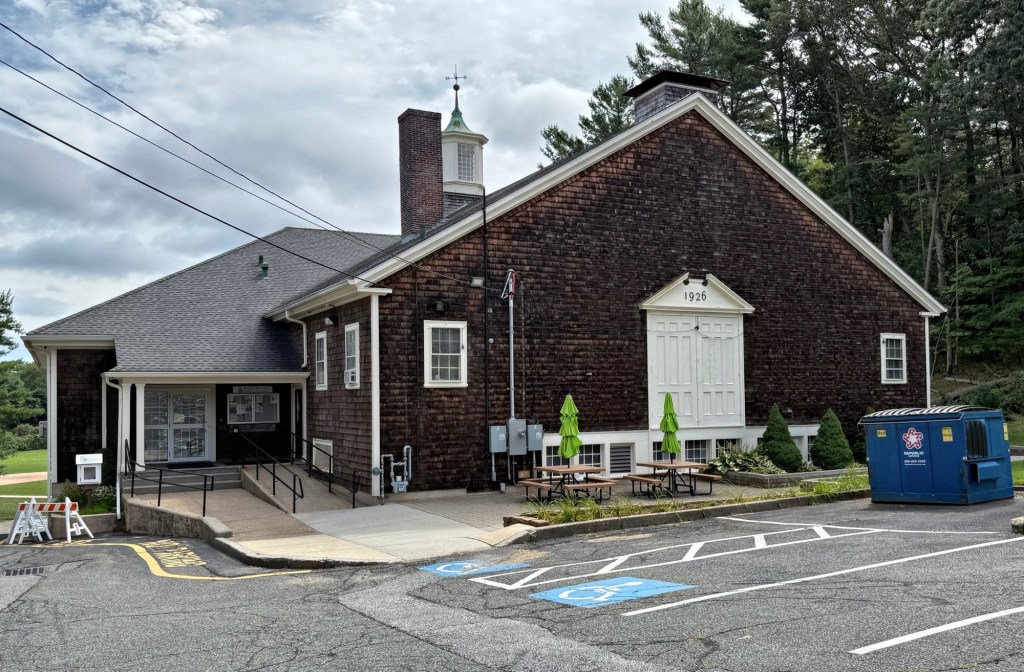
Reed Community Center // 1926

Tucked away behind the 1898 Adams Library in Kingston, Massachusetts, this shingled building has important significance to the community and is about to celebrate its 100th birthday. The Reed Community House began in 1926, when Edgar Reed (1852-1930), donated funds to the town for the construction of a community house to be built adjacent to a public playground site behind the town’s library. Edgar was a descendant of Jesse Reed, a successful Kingston inventor and tack-maker. Jesse Reed had worked in Maiden prior to coming to Kingston where he invented a ship-steering device, a luggage winch, freeze-proof water pumps, and other improvements for looms and weaving methods. The Reed family was one of several Kingston families that had relocated to Worcester, but kept close ties to their hometown. The Reed Community House was designed by Sidney Lincoln Rhodes of Worcester in the Colonial Revival style. The best part of the building is the north elevation, facing the playgrounds as the two-story portico looks over the fields. During the 1930s, the community house was used for a nursery school holding between 48 to 60 preschoolers. The Red Cross also used the building during World War II for some of its programs including first aid classes. The building continues to be an important community facility to the present day and is the home to the Kingston Recreation Department