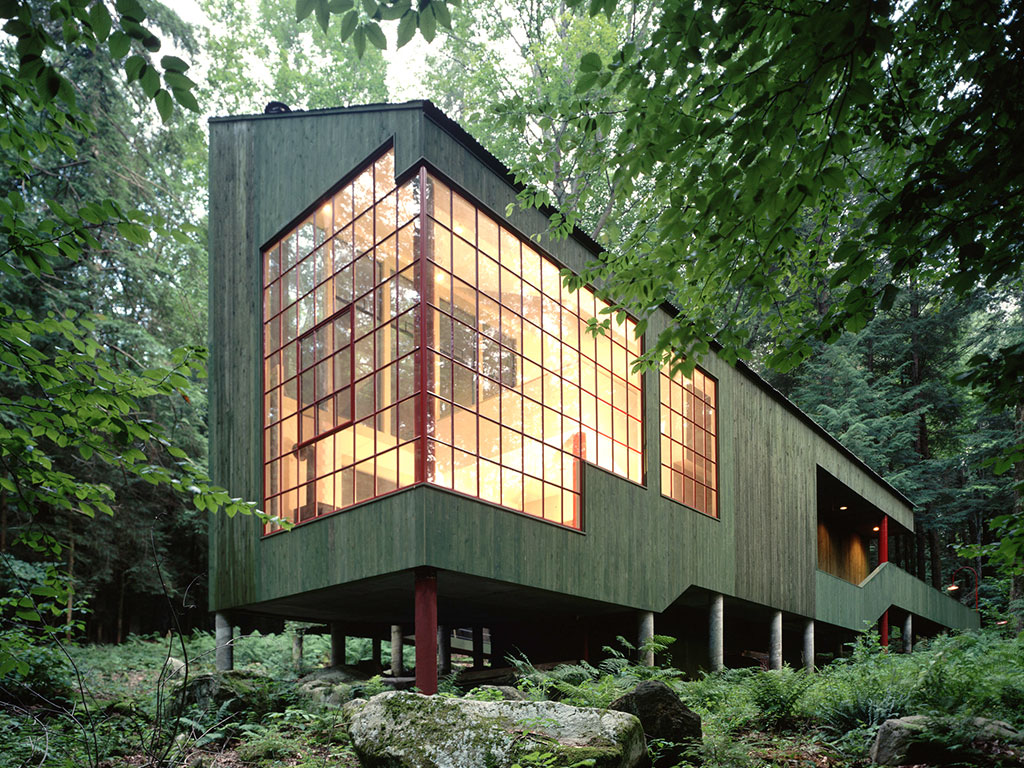
While Cornwall, Connecticut is known for its 19th century architecture, there are some amazing Mid-Century Modern houses hidden away on forested lots there. This is the Eric and Anne Bohlin House (aka Forest House) designed by architect Peter Bohlin of Bohlin Cywinski Jackson for his parents as a summer retreat. The residence was completed in 1975 and sited between dense evergreens and bright deciduous woodland in a sparsely developed part of town. Camouflaged among the trees, the green-stained exterior hovers above a boulder-strewn landscape, resting on concrete piers, with large windows to take advantage of the glorious forest views. This is a great example of high-quality, site-specific house designs, which are becoming a rarity in recent years.
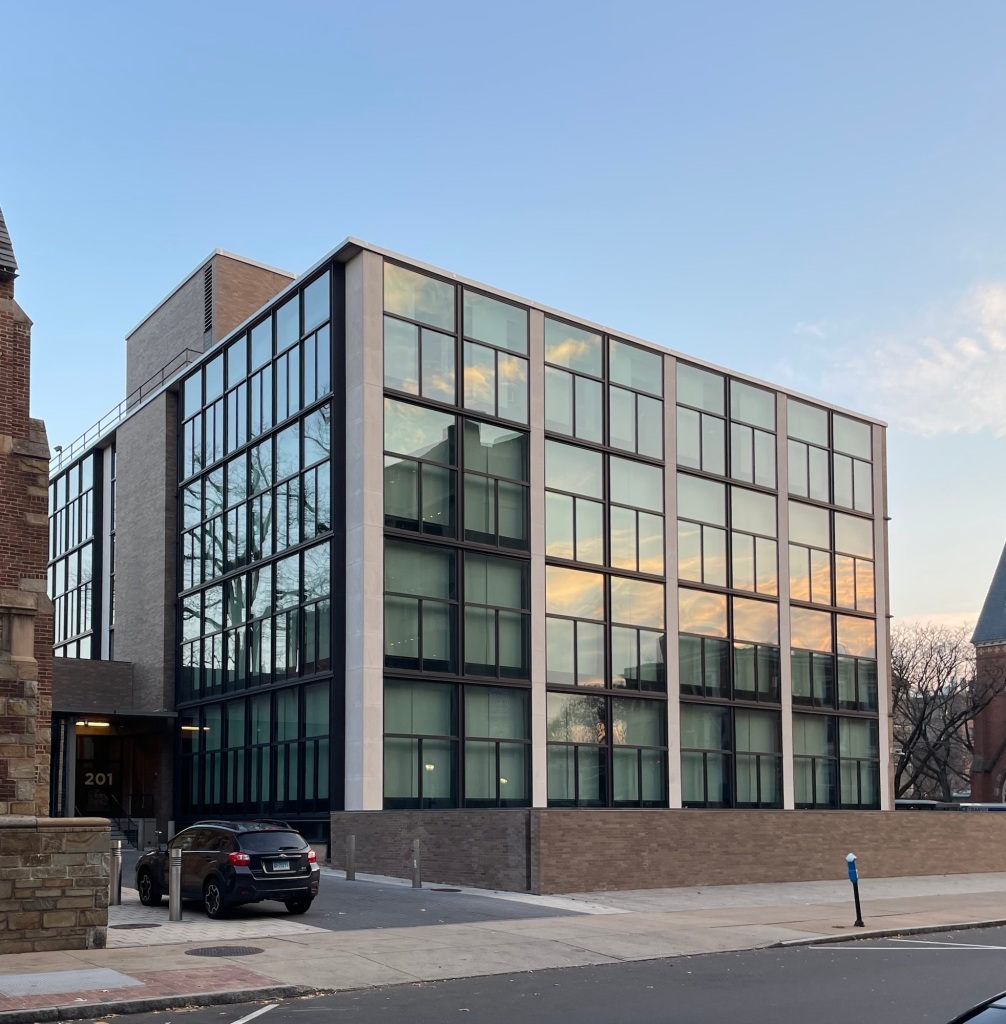
Yale University’s School of Architecture was in the midst transition when Louis Kahn joined the faculty in 1947. The post-war years at Yale trended away from the school’s Beaux-Arts lineage towards the avant-garde, and Modernist principles brought over from European architects. When the University called for a new wing for its existing Venetian Gothic style Art Gallery Building (1928), they obviously had no choice but to make a statement for the future of the school. Architecture professor Louis Kahn worked with Anne Tyng, who was both a professional partner and his “muse”, who heavily influenced his works, including here where she designed the concrete tetrahedral slab ceiling at the interior galleries. As a professor and practicing architect, Kahn hoped for students and visitors would engage with the building, even interior spaces often overlooked design-wise, such as the stairwells. While the facades are fairly minimal in design details, because the attention was paid to the interiors, which provide protection from natural light while also allowing for large floor plates for customizable exhibitions. The structure is Yale’s first true Modernist building on a campus which soon after was dominated by some of the country’s most iconic examples of the style.
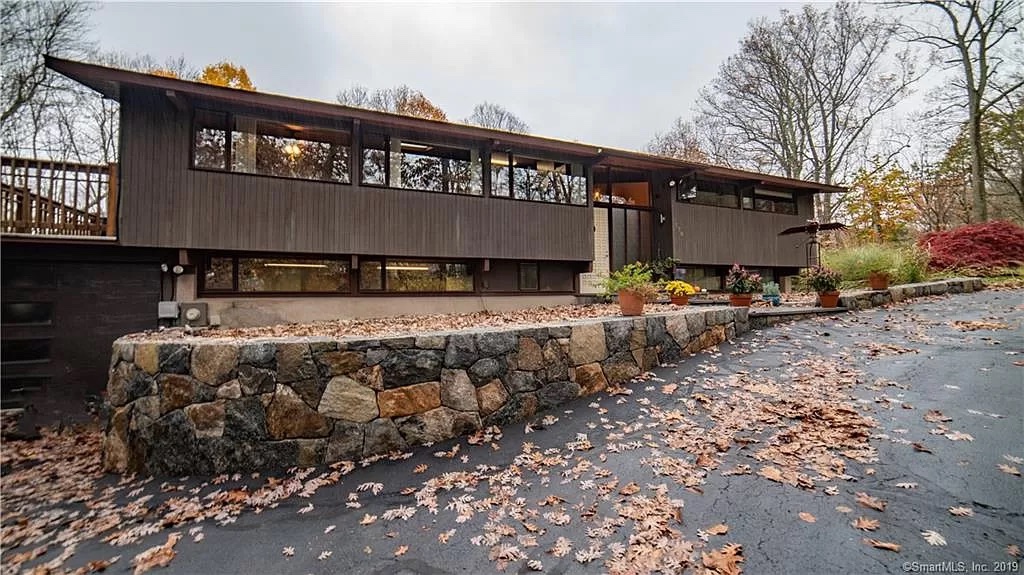
I don’t share Mid-Century buildings on here enough, mostly due to the fact that so many of the houses of the period are secluded down winding driveways and surrounded by trees! This stunning house is located in Southbury, Connecticut, and is a great example of a Deck House. The Deck House was a housing type developed by architect Carl Koch. According to At Home With Tomorrow, he began his lifelong mission to create “the good, the beautiful, and the inexpensive” in housing while at Harvard under the guidance of Walter Gropius, who is famous for the development of the Modernist Movement in architecture. After the war, he turned his focus on the housing shortage, a symptom of the Great Depression, WWII, and returning Veterans with growing families and VA mortgage loan offers. His solution was for an affordable house of pre-fabricated parts to cut costs and provide streamlined construction. In 1953, his Techbuilt house was launched, after a decade of research. William Berkes and Robert Brownell had worked with Koch at Techbuilt after graduate school, but wanted to create a design of their own. They left Techbuilt in 1959 and founded Deck House, using the same principles. The exposed Douglas fir beams, wood panel ceilings and mahogany trim and window casements are what give the deck house a lot of its signature aesthetic. A wall of glazing, open floor plan with sloping roof rafters extending beyond the walls and a low placement in seemingly untouched nature are further elements that have endeared these houses to the modern homeowner.
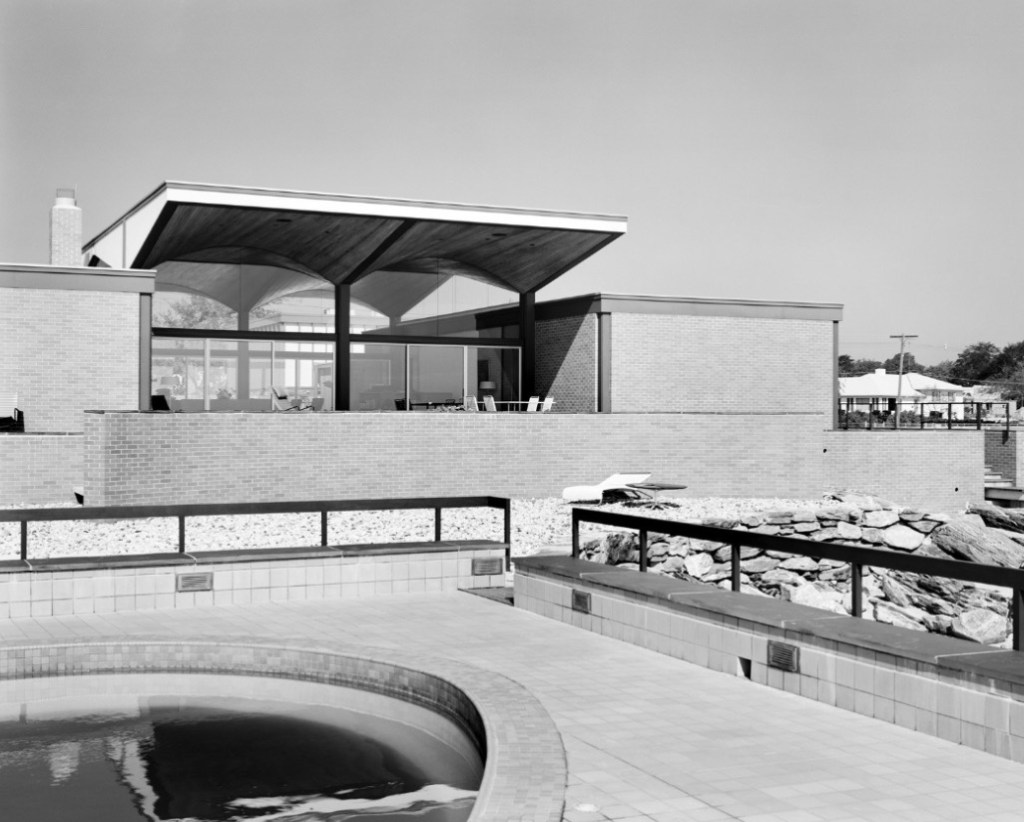
Perched atop the rocky coast of New London, CT, and seemingly at the base of the iconic New London Harbor Light, the “Castle House” stands as one of the most significant examples of 1960s residential design in a state known for such homes. The Castle House was completed in 1964 from plans by German-born American architect Ulrich Franzen (1921-2012), who attended Harvard’s Graduate School of Design after his service in WWII. After graduating, Franzen worked under I.M. Pei, until he formed his own firm, Ulrich Franzen & Associates, in 1955. The home’s signature element is its dramatic free-floating glass living room pavilion with cantilevered paraboloid vaults and flanking service wings, with a jaw-dropping cypress butterfly ceiling. Additionally, the oval pool sits over the harbor water and provides the best possible views of the 1801 lighthouse towering above. The house was recently updated by SchappacherWhite, a design firm who are known for their thoughtful Mid-Century Modern house preservation projects.
Between 1900 and 1970, the town of Suffield doubled its population, and the 1899 public library was outgrown. The city gathered funds to construct a new library, knowing that the endowment for the day-to-day operations of the library by Sidney Kent, in memory of his parents, would transfer to a new building as long as the name carried with it. The town hired Warren Platner, an architect, interior designer and furniture designer, based out of New Haven. Platner designed the Modern library with a concrete frame, faced with pink stone and white painted brick above, surrounds a central garden court. The flat coffered concrete roof and overhanging concrete project outwards over the terraced exterior courtyards. The interior is on five floor levels connected by gradual ramps with no stairs inside (at least at the time of construction). The town proposed a plan to demolish the library in 2008, replacing it with a larger library, but it was voted down by residents, saving (what is believed to be) the only free-standing Platner building remaining in the country.