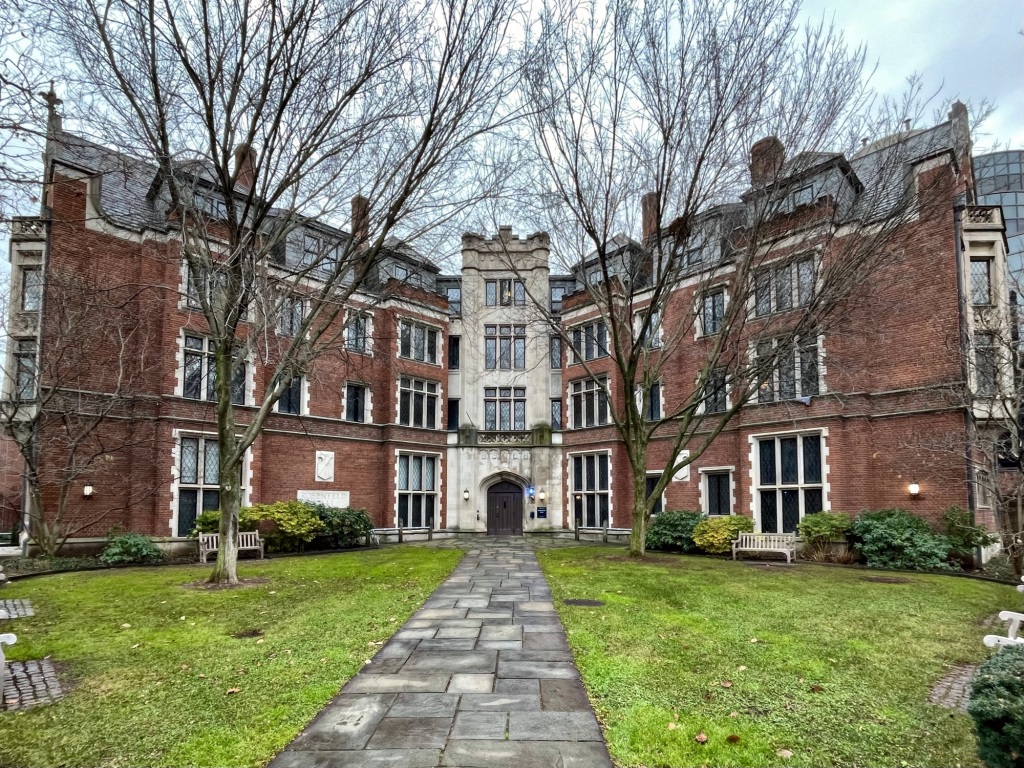
St. Elmo Hall – Rosenfeld Hall // 1912

St. Elmo Society at Yale was founded in 1889 as a chapter of the national fraternity Delta Phi, and it is today one of the “ancient eight consortium” of secret societies at the university. The society’s original building was erected in 1895 and provided housing, meeting spaces, a library, smoking room, and other recreational spaces for the members. Just over a decade later, the group’s increasing wealth and membership necessitated a larger building. This building, named St. Elmo Hall was designed by architect Kenneth MacKenzie Murchison in an Elizabethan style and built in 1912 for the society, replacing its former residence hall. The society saw dwindling funding and during World War II, St. Elmo Hall became a convalescent hospital for soldiers who were out of the hospital but still need observation. After WWII, the group began leasing some rooms out to Yale University, who eventually purchased the building in 1962, renaming it Rosenfeld Hall after Richard Rosenfeld ’63. The L-shaped building is sited opening up to the corner lot and is Neo-Gothic in style, likely drawing inspiration from Yale’s established Gothic stylistic influence.
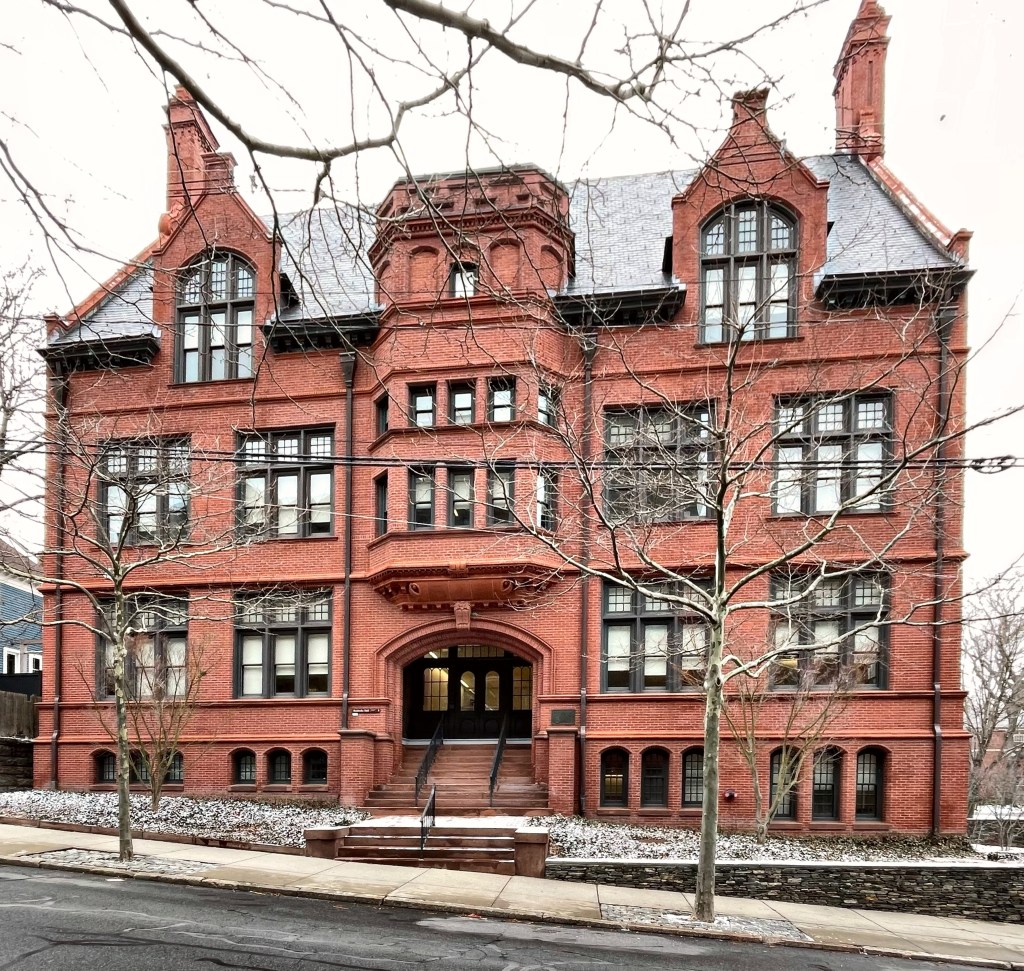
Pembroke Hall – Brown University // 1896

Brown University from its founding in 1764 until 1891 never admitted women. Brown’s all-male student body was first challenged in 1874, when the university received an application from a woman (who to this day is still unnamed). The Advisory and Executive committees decided that admitting women at the time was not a good proposal, but they continued to revisit the matter annually until 1888, when they began work to establish a separate women’s college affiliated with Brown. After similar institutions like Radcliffe (affiliated with Harvard) and Barnard College (affiliated with Columbia) were established in 1879 and 1889 respectively, Brown had a blueprint for how to operated the new women’s college. Professors at Brown would work alongside women educators and taught many of the the same courses to men as they did for female students. Pembroke Hall was the first building for Pembroke College and was built in 1896 from plans by local firm Stone, Carpenter and Willson in the Elizabethan Revival style. The building was designed to be multi-purpose with administrative offices, classrooms, reception rooms, and a library in the attic. Pembroke College was officially merged with Brown University in 1971, which was long overdue. The building is one of the finest on Brown’s now co-educational Ivy-league campus.