As the Elmendorf family put its roots down in Hurley, Ulster County, New York, the descendants built stone houses as a nod to their ancestors of Dutch heritage, following those building traditions. This five-bay stone house was built around 1789 and is a vernacular Federal home with Dutch and English building influence. The property exhibits shed dormers and a Colonial Revival portico, but exudes 18th century charm.
When Pieter Ostrander settled in Hurley, NY with his family in the late 1600s. Being of Dutch descent, he (and other settlers) built their homes and barns in Dutch traditions. This lot along the village’s main street was acquired by Pieter and inherited by his son, Arent in about 1710, about the time the home is estimated to have been built. It was acquired by the Elmendorf Family by the early 19th century. At that time, the property operated as the Half Moon Tavern, after Petrus Elmendorf purchased it in 1804. The addition to the east (right) was built as a weaving room. The property remained in the Elmendorf family until 2008 (that’s almost 300 years in two families!) It was acquired by the new owner who has been restoring and researching the home ever since. He runs a blog documenting the property’s rich history.
Pieter Pieterzen Ostrander (1657-1706) was born in Amsterdam, Netherlands by 1657. His father died in the East Indies and soon after, Pieter, his mother, his stepfather Arent Teunissen, and older sister Tryntje Pieters immigrated to New Netherland (New York), arriving in 1661. Initially the family settled on Coney Island in Brooklyn and were eventually forced out by English settlers. The family removed to Wiltwyck (present-day Kingston, in Ulster County, New York. In Kingston, Pieter married Rebecca Traphagen Ostrander (1662-1720) in the Reformed Dutch Church of Kingston, New York, on 19 January 1679. Some time after their marriage, Pieter and Rebecca moved southwest to the nearby village of Hurley, where in 1687 he was one of several villagers to take an Oath of Allegiance. They built a small, single-room cottage here and lived there until it was expanded around the time Pieter passed away. In 1715, the house was deeded to Pieter’s son, Arent. During the time of the American Revolution, the home operated as a tavern. In October, November, and December of 1777, this house is said to have been the military headquarters for General George Clinton’s Continental forces and the town was the temporary capital of New York State. In 1782, the home was later believed to be where a reception was held in front for George Washington as he rode through town in 1782. In the 19th century, the left (northern) half of the house was added on by owner Abe Houghtaling, who operated that side as a wagon making shop. Whew! That’s a lot of history!
As Woodstock New York surged in popularity as a retreat for American and European artists, savvy businessmen from Manhattan could not help themselves but to envision ways to make a little extra money. Morris Newgold and his son, Gabriel of New York City who purchased the Overlook Mountain House in 1917, sought to expand their upstate lodging empire and built a secondary establishment in the village of Woodstock, the Colony Hotel. The Colony Hotel serve as a more modest establishment to the grand Overlook Mountain House atop Overlook Mountain and would be a staging area and a stopover point for guests coming up the Hudson River by boat or train. Guests would spend the night at the Colony and eat at its fine restaurant before making the arduous trip up the mountain to the Overlook Mountain House the next day. The Colony Hotel appears to have been Gabriel’s idea who prided himself on the new building being “pretentious” as it was much more substantial than the more modest, vernacular buildings around the village. Gerald Betz of nearby Kingston was the architect for the Colony Hotel. Construction began for the Colony Hotel in 1927, and it opened to guests the summer of 1929. Morris died in 1940 and Gabriel continued to manage the Colony until his son took over from 1945 until the 1960 but as event space for arts and antiques fairs. It became known as the Colony Arts Center. The Colony’s website goes on to state that the building sat empty almost entirely through the next forty years. It was recently restored by artists Alexia and Neil Howard who converted it to a music venue and beer garden, it is pretty amazing and a must-see for history buffs visiting Woodstock.
By 1919, artists from all over the United States and Europe were living and creating art in Woodstock, NY. As a thriving and expanding group of diverse individuals, the need for a welcoming and open-minded gallery space was quickly recognized. To facilitate this, a group of five painters established two complimentary organizations: The Woodstock Art Association (later changed to Woodstock Artists Association in 1933) who would maintain the exhibition space and set its artistic principles, and the Artists Realty Company who would finance the construction and maintenance of the physical space. The five painters being: Carl Eric Lindin (1869-1942), John F. Carlson (1874-1945), Frank Swift Chase (1886-1942), Henry Lee McFee (1886-1953) and Andrew Dasburg (1887-1979). New York City architect William A. Boring was commissioned to design the new museum and art space for the group. Boring (whos career was anything but boring) briefly worked for McKim, Mead and White for a year before starting his own practice with Edward Tilton in 1891. His most noted work is his 1897 Immigration Station on Ellis Island for which he and Tilton won the design competition as relative unknowns. The refined Colonial Revival building for the Woodstock Artists Association sits right in the middle of the village and its symmetrical façade is defined by a central double door entrance with transom and pedimented enframement. Of particular interest is the row of four elliptical windows above the double-hung windows.
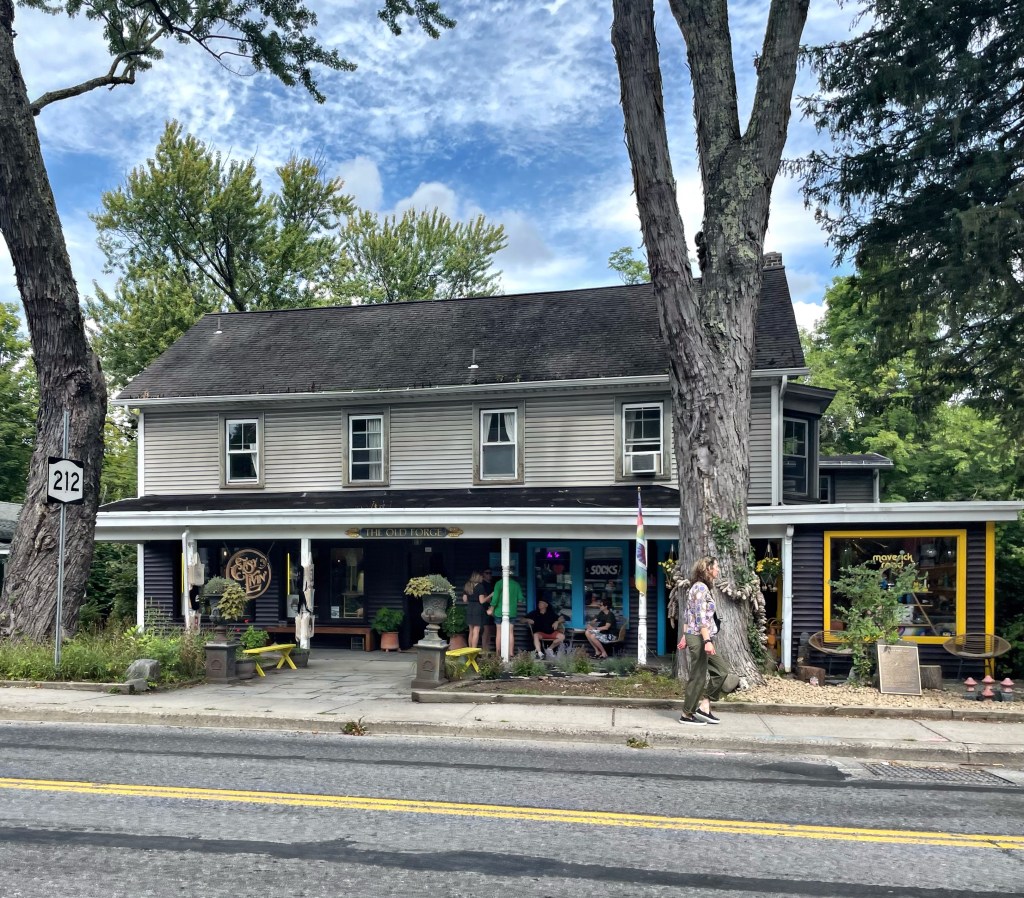
One of the oldest extant buildings in Woodstock Village is the old Tannery Brook House. The building (or a part of it) was originally an old grist mill developed by Isaac Davis and it was later turned into a saw mill. Around the end of the Civil War, the structure was home to the village blacksmith operated by John Wigram Davis, then it was enlarged as a barn for wagons and carriages. Later, owner Peter Longendyke operated a boarding house from the building. Around 1904, the New York Art Students League is believed to have had their first summer art class in the upstairs rooms of the building. In 1935, owner Lamonte Simpkins remodeled it as “The Art Shop”. Upstairs Mr. Simpkins sold clothes, shoes and drygoods, while downstairs The Art Shop and Tannery Brook Garden Flourished. The building was rebranded as the Old Forge House, as a nod to its historic use. It remains a vernacular, and important piece of Woodstock’s rich history from sleepy industrial village to vibrant artist community.


 Buildings of New England