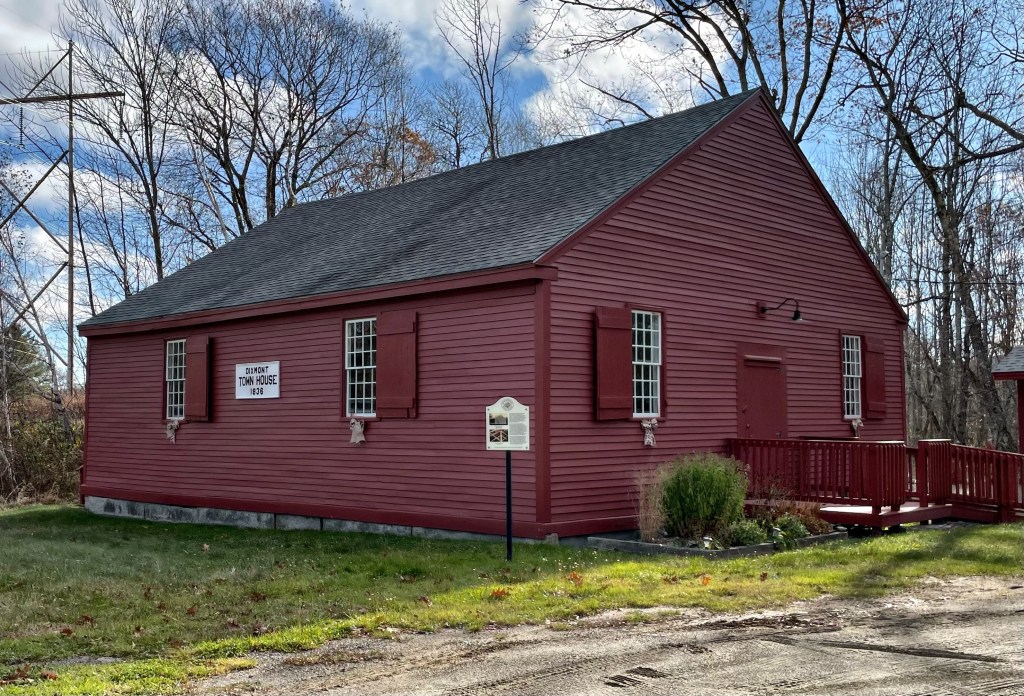
Dixmont Town House // c.1836

Dixmont, a small rural town in central Maine was originally originally a land grant by the Commonwealth of Massachusetts (of which Maine was then a part) to Bowdoin College, which sold the first settlers their land for profit to build on their campus. As a result, the town was originally called “Collegetown”, which was obviously short-lived. Dr. Elijah Dix (1747-1809) of Boston, who never lived there but took an interest in its settlement, encouraged others to settle there, and when the town was officially incorporated in 1807, it named itself after Dix, as Dixmont. A “malignant fever” broke out among the settlers in the early years, also killing Elijah Dix while in Dixmont on a trip there in 1809, he was buried in the Dixmont Corner Cemetery. Elijah was the grandfather of reformer and nurse Dorothea Dix. The early settlers had this Town House built in the center of the township around 1836 as a vernacular structure. The building (like many early town houses) was used for both secular and religious purposes. This small structure is one of the oldest surviving town houses in the state and served as the town government center until 1952 when it hosted its last town meeting. It was restored in the early 2000s and looks great!
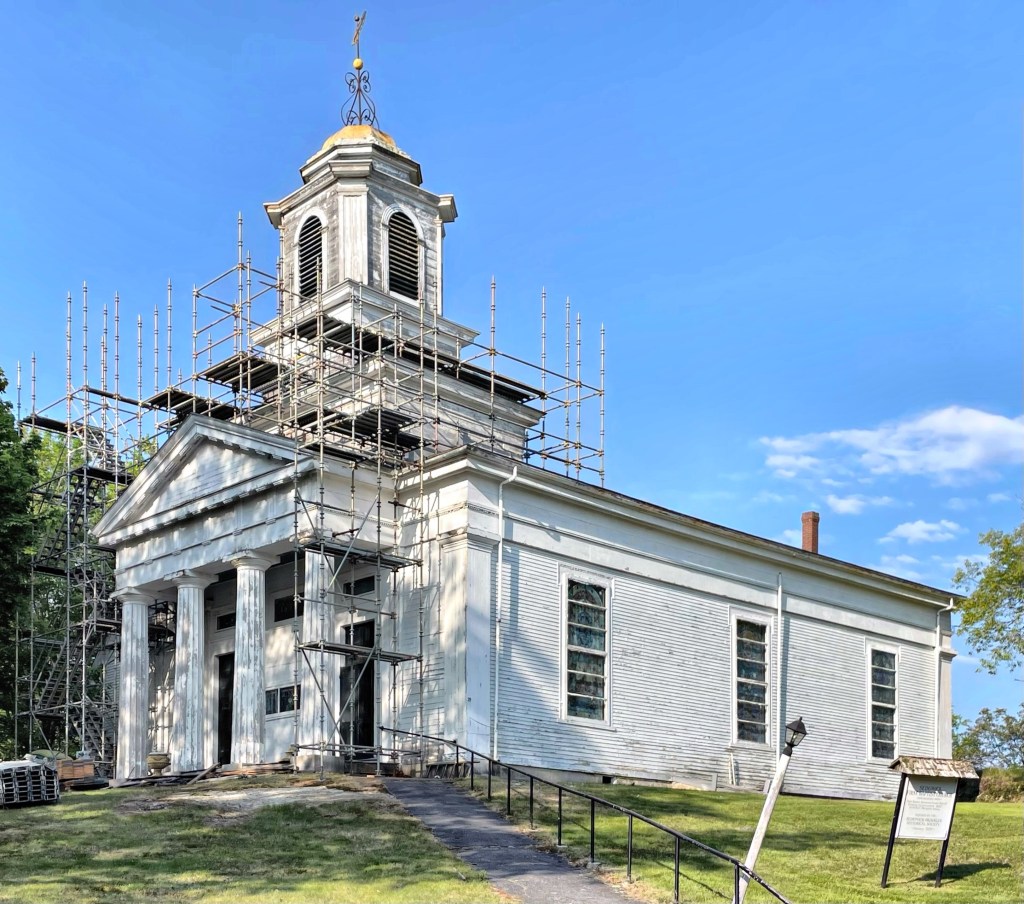
First Baptist Church of Sedgwick // 1837

Sedgwick, Maine is a coastal town overlooking the Penobscot Bay separating it from the better-known Deer Isle. The town was originally inhabited by the Wabanaki people. In the 18th century, land here was granted by the Commonwealth of Massachusetts in 1761 to David Marsh and 359 others, and settlers began arriving and building homes here shortly after. In 1789, the town was incorporated as Sedgwick, named after Major Robert Sedgwick, who in 1654, captured nearby Fort Pentagouet from the French. The land in Sedgwick was very rocky and was thus better suited for grazing than cultivation. Because of the geology, for decades Sedgwick had operating many granite quarries, which shifted southward toward Stonington in later decades. The town then became a hub of seafaring professions, from ship-building to trading, to fishing and clam-digging. The town’s Baptist population established a congregation in 1794 as a Congregationalist organization which underwent a large-scale conversion to Baptistry in 1805. This congregation retained Bangor architect Benjamin S. Deane to design its church, which was built in 1837 in the Greek Revival style. Deane’s design is based on a drawing publisher by Asher Benjamin in his Practice of Architecture. The church had seen a dwindling congregation for decades until it was disbanded in 2008. The church was acquired by the Sedgwick-Brooklin Historical Society, who have begun a restoration of the building.