Skinner-Boardman Mansion // 1832

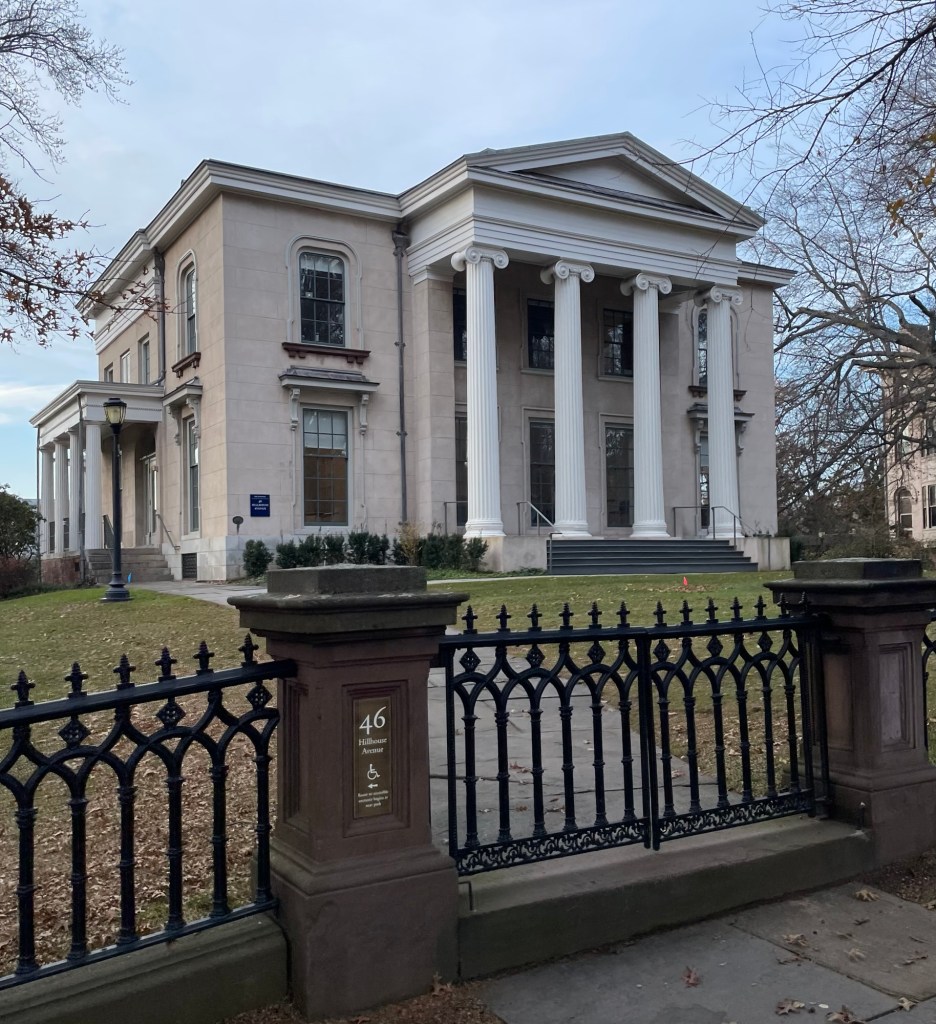
One of the finest houses in New Haven is this stately residence, the Aaron Skinner Mansion on Hillhouse Avenue. The mansion was built in 1832 for Aaron Nichols Skinner (1800-1858) from plans by architect Alexander Jackson Davis. Skinner was a Mayor of New Haven (1850-1854), and for a short time, ran a boy’s boarding school out of this house. Skinner was also a CT State Representative, serving two terms. The house was originally built as a three-bay, two-story house with one-story side wings and a rear ell. After his death, the house was purchased by Judge William W. Boardman, who in 1859, modernized the property hiring architect, Henry Austin, who filled in the side wings and added Italianate window mouldings. The monumental portico supported by fluted, Ionic columns, creates such a stately presence for the early house on the street. In the early 20th century, the mansion was owned by Rutherford Trowbridge, who renovated the house for his own use. The house remained in the Trowbridge family until the death of his last daughter, Miss C. Rachel Trowbridge, when the estate became the property of Yale University.

Farnam House – Yale President’s House // 1871

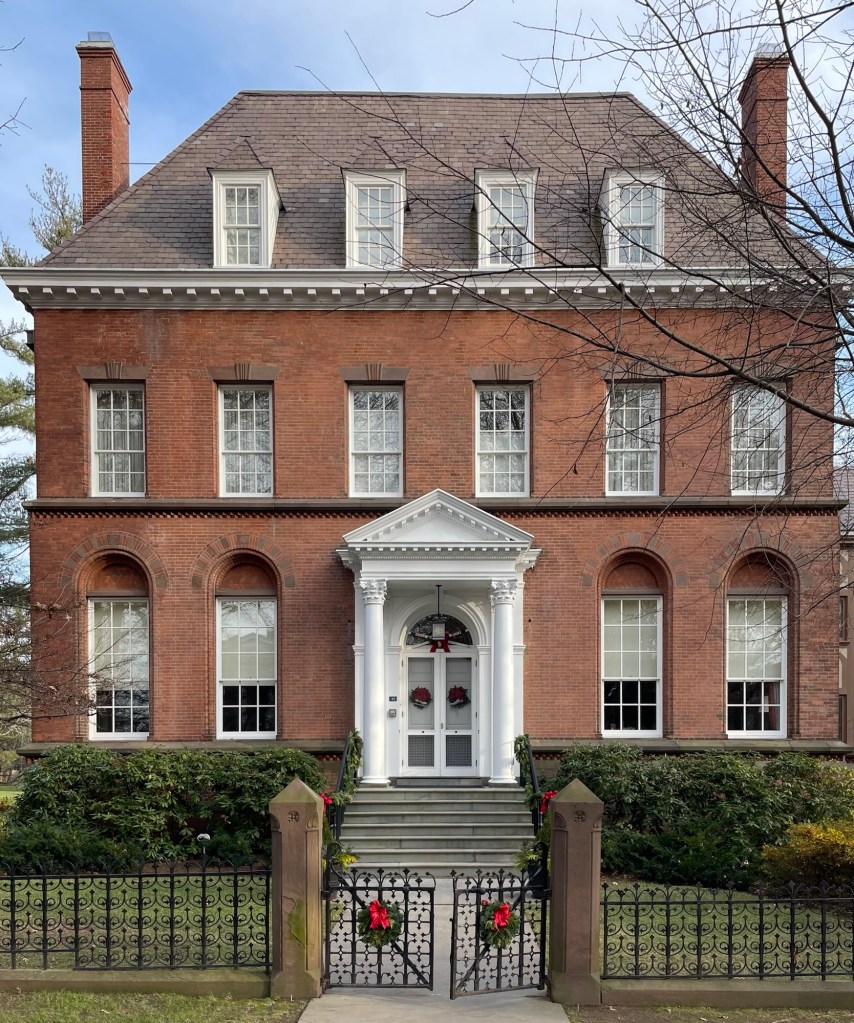
In 1871, wealthy engineer and philanthropist, Henry Farnam (1803-1883), purchased a house lot on the desirable Hillhouse Avenue in New Haven, Connecticut, where he would live out his final days in retirement. Mr. Farnam made his fortune beginning in 1839, when he was instrumental in building the railroad connecting New Haven to New York. In 1850, he moved to Illinois where he partnered with Joseph E. Sheffield to build the Chicago, Rock Island and Pacific Railroad, becoming that railroad’s president in 1854. In 1868, Farnam moved back to New Haven when he hired Russell Sturgis, Jr., to design and oversee construction on his home there. Henry Farnam also worked with Sturgis on Farnam Hall at Yale, where he is the benefactor and namesake of the building. Henry Farnam died in 1883, and in his will, he stipulated that he would gift his property to Yale College under the condition that his son, Henry W. Farnam, could live there until his death. Henry Walcott Farnam was an economist, and served as president of the American Economic Association. In 1933, the property ownership was officially transferred to Yale University, who in 1936, renovated the property, changing its appearance from Victorian Gothic to Colonial Revival. Architects, Richard A. Kimball and Ellery Husted furnished the designs for the stately residence. Since that time, the Farnam House has served as the residence of the Yale President.

Yale University Art Gallery // 1953

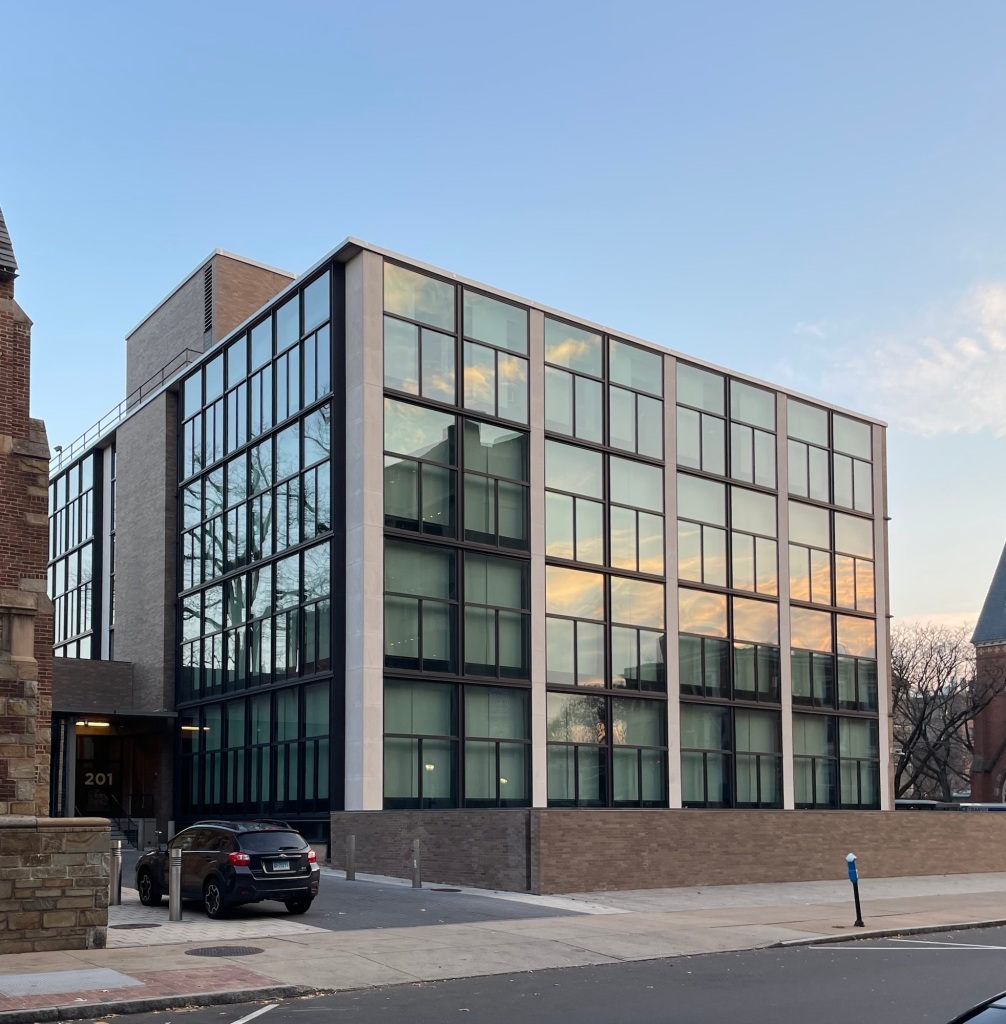
Yale University’s School of Architecture was in the midst transition when Louis Kahn joined the faculty in 1947. The post-war years at Yale trended away from the school’s Beaux-Arts lineage towards the avant-garde, and Modernist principles brought over from European architects. When the University called for a new wing for its existing Venetian Gothic style Art Gallery Building (1928), they obviously had no choice but to make a statement for the future of the school. Architecture professor Louis Kahn worked with Anne Tyng, who was both a professional partner and his “muse”, who heavily influenced his works, including here where she designed the concrete tetrahedral slab ceiling at the interior galleries. As a professor and practicing architect, Kahn hoped for students and visitors would engage with the building, even interior spaces often overlooked design-wise, such as the stairwells. While the facades are fairly minimal in design details, because the attention was paid to the interiors, which provide protection from natural light while also allowing for large floor plates for customizable exhibitions. The structure is Yale’s first true Modernist building on a campus which soon after was dominated by some of the country’s most iconic examples of the style.

Yale University – Trumbull Gallery // 1832-1901

Pre-1869 image of Trumbull Gallery, Yale Archives

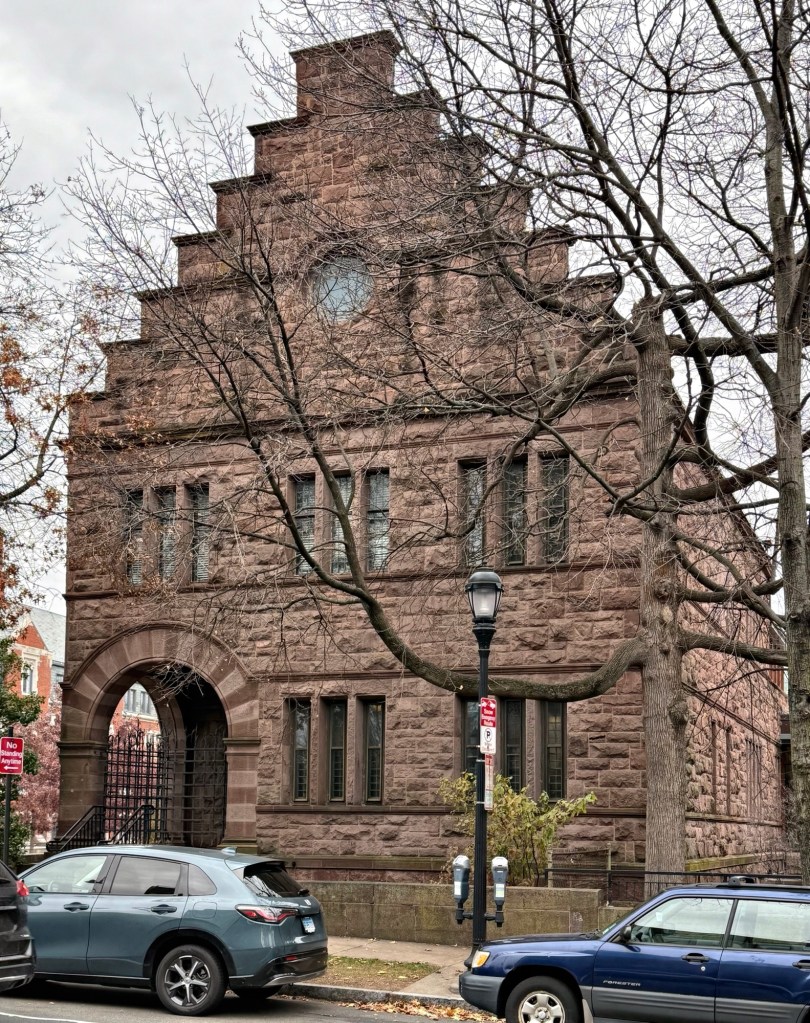
Before there was Street Hall or the Old Yale Art Gallery Building, there was the Trumbull Gallery, the first college-connected art museum in the United States. This building was erected in 1832 by artist and collector, John Trumbull (1756-1843), who specialized in Revolutionary-era works, and was known as the “Painter of the Revolution”. In his later years, Trumbull sold 28 paintings and 60 miniature portraits to the Yale College, and helped establish the college-affiliated art museum. He is said to have designed this Classical style building, to house his collections, all with minimal windows to protect his collection from direct sunlight. The gallery also housed a crypt for Trumbull and his wife, hence its tomb-like appearance. When Street Hall was built, the collection and tombs were relocated there, and again in the late 1920s when the Art Gallery was constructed. In 1869, Yale College added windows to the building and operated the school treasury from here until it was demolished in 1901. The Trumbull Gallery stood just in front of the Old Library.