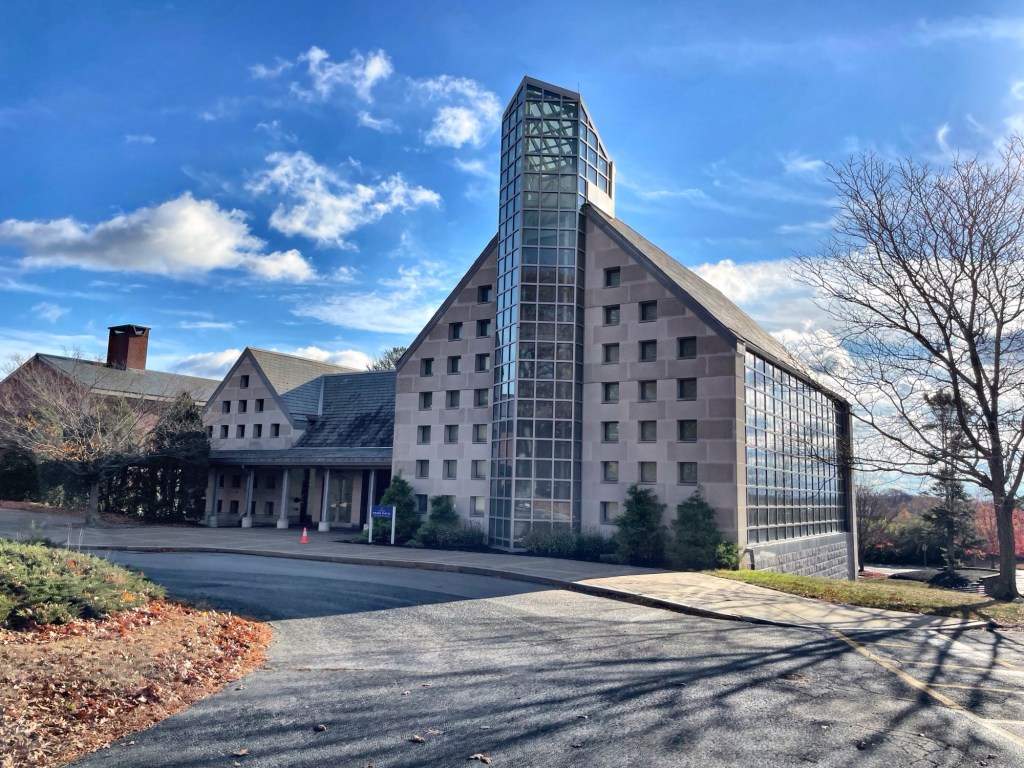
The last building constructed on the former Andover Newton Theological School in Newton, Massachusetts, was Wilson Chapel, located at the edge of the campus. The building is a modern interpretation of the traditional New England meetinghouse, and was completed in 2007 from plans by Context Architecture. The limestone building is punctuated by a grid of square punched windows and raised panels with the primary facade dominated by a glass tower, resembling the more traditional steeple. To me, the building does an excellent job at respecting the basic forms of a New England chapel, while utilizing contemporary materials and design elements to distinguish it as a 21st century structure.


“To me, the building does an excellent job at respecting the basic forms of a New England chapel, while utilizing contemporary materials and design elements to distinguish it as a 21st century structure.”
I struggle with contemporary interpretations of historic styles. If the architect recognized the need to respect the basic forms of a New England chapel, why is it okay to ignore the scale and proportions of elements (windows, doors, etc.) within the basic forms? I’m never convinced that this approach is as successful as a truly traditional approach or a truly modern approach.
LikeLiked by 1 person
I definitely understand your view, but I do not think it is trying to represent a historic style, more-so the traditional gable-end form and scale but with modern fenestration, materials, and materials. The glazed tower resembles a traditional steeple/belfry and is very contemporary. But I value the discussion and analysis!
LikeLike