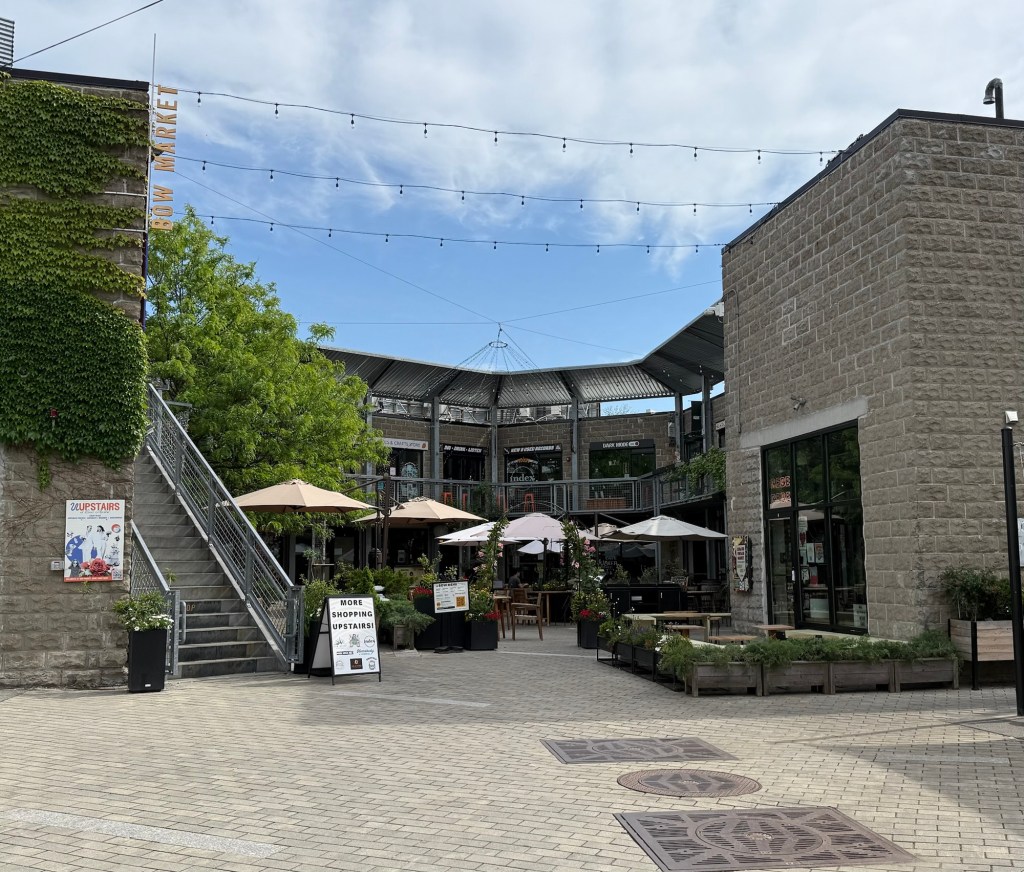
Bow Market // 2018

One of the best and most successful examples of adaptive reuse in the Boston area has to be Bow Market in Somerville’s Union Square commercial district. Tucked away behind buildings on the busy streets, a former concrete block storage facility was reimagined as a vibrant, European style marketplace of local vendors and businesses. The project was envisioned by business partners Matthew Boyes-Watson and Zach Baum, who worked with Matthew’s father, architect Mark Boyes-Watson, to renovate the storage building to create storefronts. The team worked with landscape architects, Merritt Chase, to make the public courtyard more enticing, which each micro-commercial space opening onto the landscaped communal courtyard. Design elements include seat walls constructed from recycled granite from the renovation of the Longfellow Bridge and reclaimed wooden beams from a ship building facility in Hingham. If you haven’t been to Bow Market yet, you must. This project is exactly what good urban planning and design is all about!

Heritage on the Garden // 1988

Located across Arlington Street from the since demolished Shreve, Crump & Low building (last post), Heritage on the Garden stands overlooking the Boston Public Garden. Heritage on the Garden was a result of a redevelopment initiative known as the Park Plaza Project, one of the city’s many urban renewal projects of the 1960s and 1970s, where buildings, blocks, and sometimes neighborhoods were razed and redeveloped. As part of the city’s effort of dramatic urban renewal, the Park Plaza area was identified as a site for intensive new uses, including hotel and apartment towers ranging from thirty to fifty stories! The impact of these buildings on the Public Garden and Boston Common was considered unacceptable by many residents of the city, with citizen participation helped to require lower-height buildings which would front the iconic Public Garden. In the 1980s, nearly the entire block of Boylston Street between Arlington and Hadassah Way was razed for the erection of the new condominium building, developed by the Druker Company and designed by The Architects Collaborative (TAC). The project was one of the last of the iconic TAC firm, once led by Walter Gropius, who helped bring Modernism to the United States. The Post-Modern style building ranges from five- to twelve-stories tall and is constructed of brick with cast stone, a nod to the historic Boston architecture, but with modern forms and projections. I think it works quite well, but maybe that is because I wasn’t around to see what was there before…