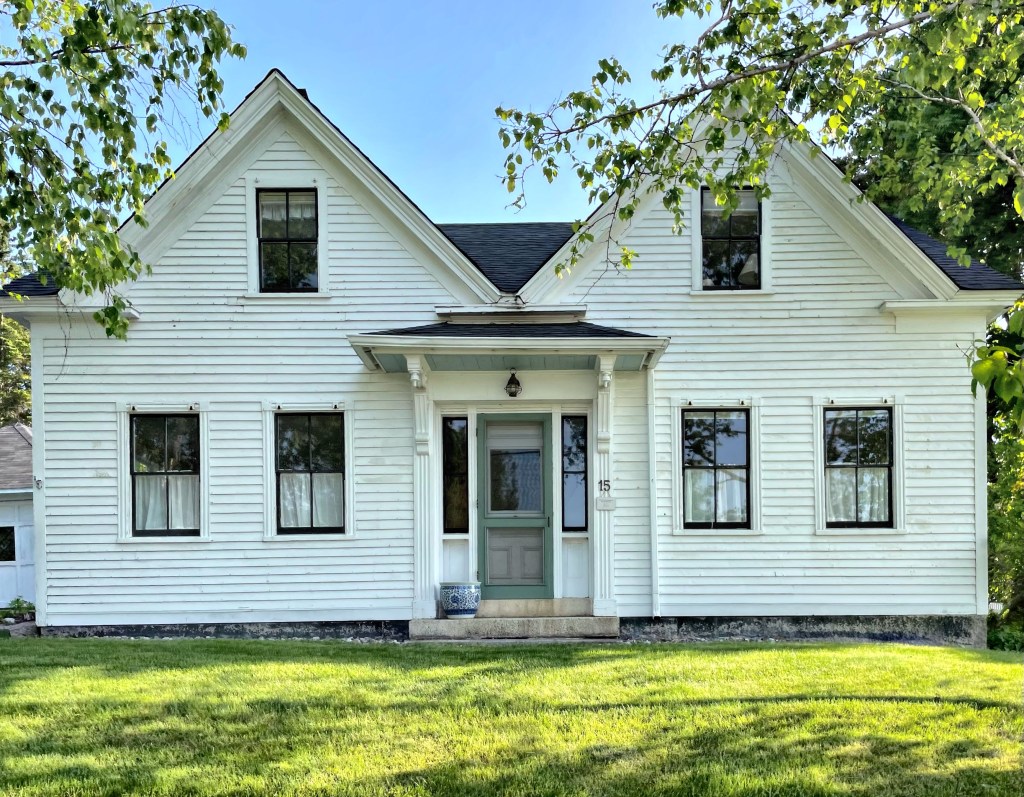
This stately mansion on Main Street in Sedgwick, Maine, was built in the mid-19th century as one of three adjacent, near-identical homes. This house was purchased by Luther Groves Philbrook who appears to have “Victorianized” the formerly modest five-bay residence. He added a central tower, porch, and side addition. The home recently was listed for sale and has been decaying for years, here’s to hoping this old home gets restored.
Dr. Rufus Hagerthy (1859-1933) was born in Surry, Maine to father, Daniel Hagerty (sic) a naturalized citizen in 1871 who hailed from County Kerry, Ireland and mother, Carrie. Rufus went to Bowdoin College where he completed his study of medicine in 1884. He moved back to Sedgwick, Maine and married Jane C. Holden (1861-1896), the couple lived in this home, which served as a home-base for Dr. Hagerthy to make house calls by horse or sleigh (depending on the weather). Dr. Hagerthy was eventually wealthy enough to get involved in real estate, and developed Byard’s Point in Sedgwick in 1909, the town’s first sub-division.
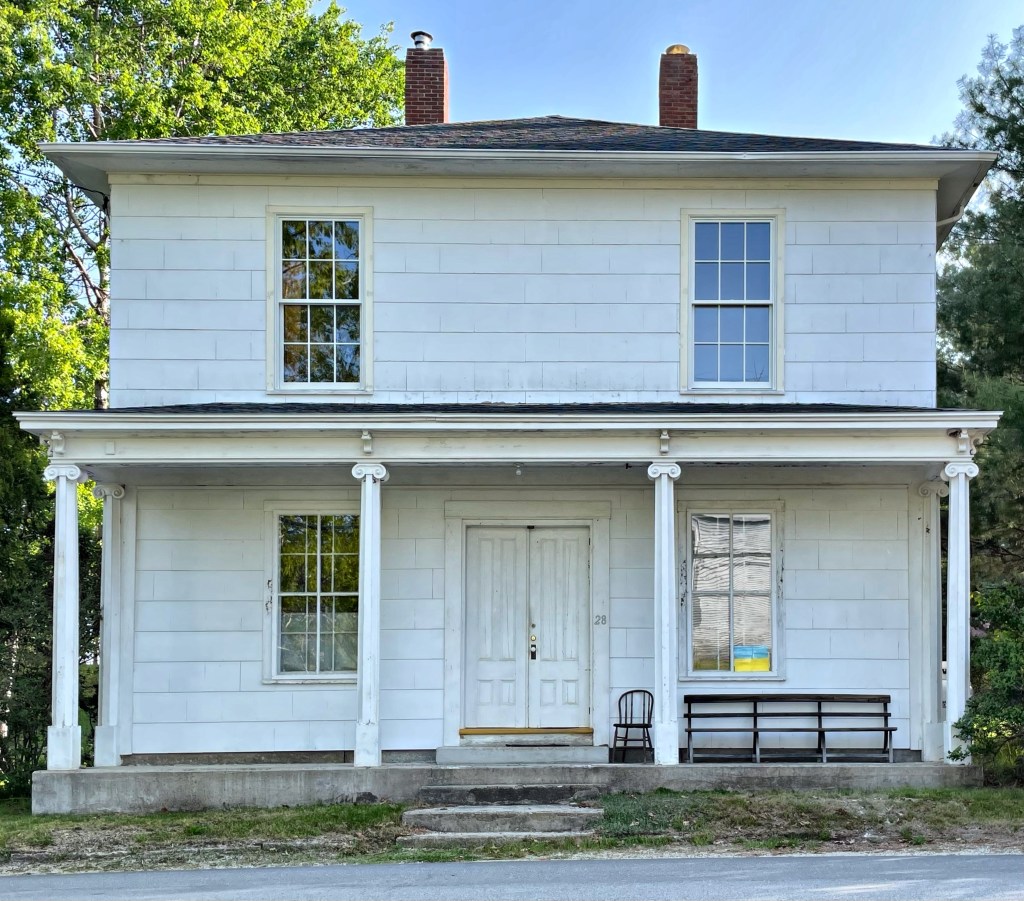
Located across the street from the Sedgwick Baptist Church at 28 High Street, this modified Greek Revival style building in Sedgwick, Maine stopped me in my tracks. Sadly, I could find little on the building besides the fact that the building is absent from an 1860 map of Hancock County, but it appears in an 1881 map listed as “Hall”. The building exhibits flush siding which is scored to resemble ashlar/stone construction, overhanging eaves with a hipped roof which was common in the Italianate style, and a full-length one-story portico supported by square posts with applied Ionic detailing. That’s something I’ve never seen before! Upon a little more digging, I found a historic image of the building titled, “Riverside Hall”. The photograph shows a Second Empire style building with a mansard roof and cupola. The unique portico is shown as well. The local library lists the Riverside Hall as a community hall where events and gatherings were held. A fire destroyed the roof and much of the interior, but it was renovated and converted into a single-family home.
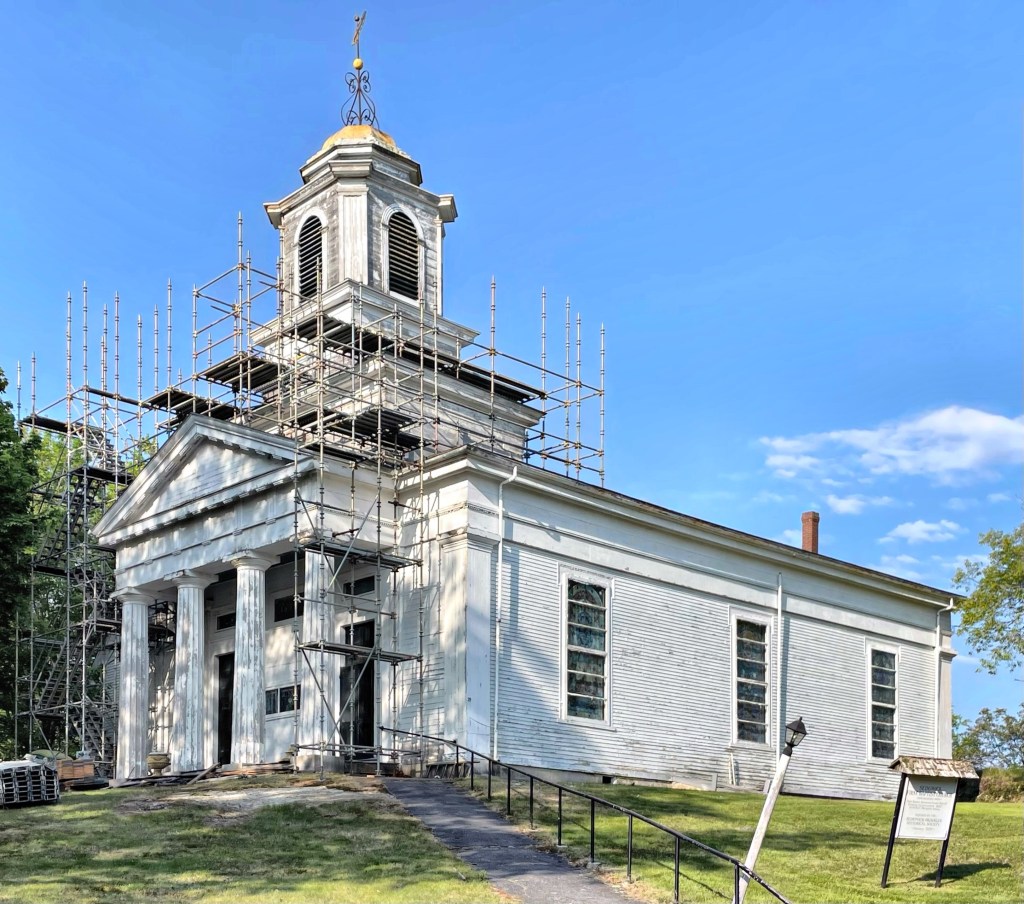
Sedgwick, Maine is a coastal town overlooking the Penobscot Bay separating it from the better-known Deer Isle. The town was originally inhabited by the Wabanaki people. In the 18th century, land here was granted by the Commonwealth of Massachusetts in 1761 to David Marsh and 359 others, and settlers began arriving and building homes here shortly after. In 1789, the town was incorporated as Sedgwick, named after Major Robert Sedgwick, who in 1654, captured nearby Fort Pentagouet from the French. The land in Sedgwick was very rocky and was thus better suited for grazing than cultivation. Because of the geology, for decades Sedgwick had operating many granite quarries, which shifted southward toward Stonington in later decades. The town then became a hub of seafaring professions, from ship-building to trading, to fishing and clam-digging. The town’s Baptist population established a congregation in 1794 as a Congregationalist organization which underwent a large-scale conversion to Baptistry in 1805. This congregation retained Bangor architect Benjamin S. Deane to design its church, which was built in 1837 in the Greek Revival style. Deane’s design is based on a drawing publisher by Asher Benjamin in his Practice of Architecture. The church had seen a dwindling congregation for decades until it was disbanded in 2008. The church was acquired by the Sedgwick-Brooklin Historical Society, who have begun a restoration of the building.

 Buildings of New England