New Haven Fire Department Headquarters // 1961

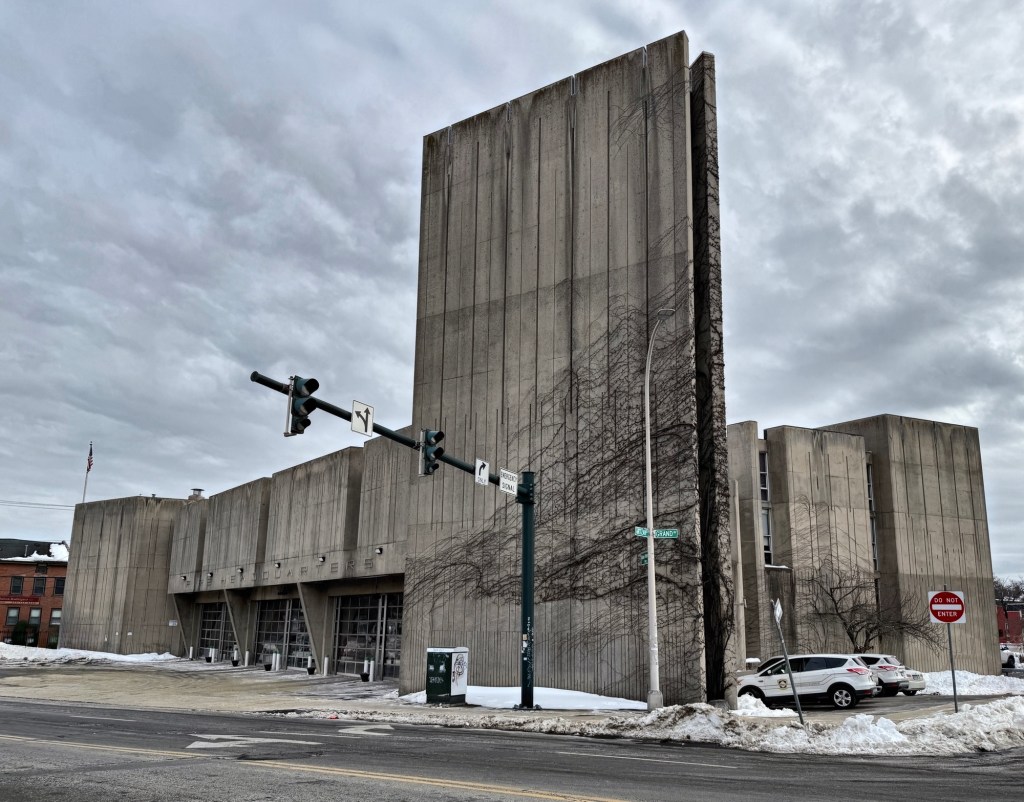
New Haven’s Central Fire Headquarters at 952 Grand Avenue, was constructed in 1961 as part of the Wooster Square Redevelopment Project, a targeted urban renewal plan to revitalize the historic neighborhood. Architect Earl Carlin and his associates, Peter Millard and Paul Pozzi, were hired to design a functional yet streamlined and powerful municipal building to serve as a symbolic gateway into a neighborhood the City wished to revitalize. The fortress-like structure is built of exposed cast-in-place concrete and features strong geometric forms with four corner towers that anchor the main block and vary in height. The fire station’s smooth concrete flanks are scored with subtle vertical grooves which help to provide additional intrigue and depth. Inside, the first level holds space for fire trucks and equipment while the second floor contains office space and the firefighters’ residences. The New Haven Fire Department Headquarters is significant as an early and well-designed example of the often maligned Brutalist style, and as a visual landmark that tells the story of the period of Urban Renewal in New Haven post-war and is holding up quite well!
Town House on the Park // 1964

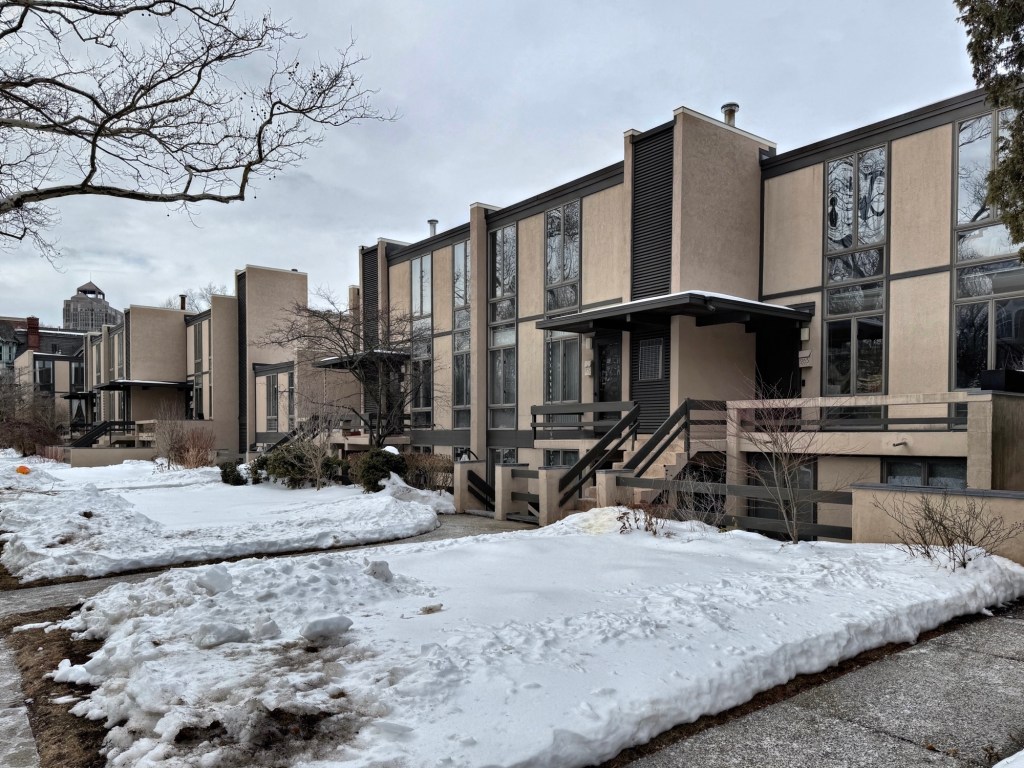
By the turn of the 20th century, the growth of industry around Wooster Square neighborhood of New Haven, Connecticut, forced out the wealthy residents which had lived there, to be replaced by recently arriving Lithuanian, Italian, and Italian-American families who established a thriving immigrant community here, which still exists today. After WWII, suburbanization saw families leaving urban centers, and to attempt to draw back in tax dollars, city officials began to plan for urban renewal areas, where “slum clearance” would redevelop areas with new and modern housing and offices with federal tax dollars. Strong neighborhood support for preservation of the area, paired with a sympathetic Planning Department, saved much of the core of the Wooster Square neighborhood with a few exceptions. The former Greene Street School and a number of residences along Greene Street and Hughes Place were razed in the 1960s and replaced by Town House on the Park, a Mid-Century Modern townhouse development. The project is comprised of thirty-six, three-story dwellings in a rowhouse configuration designed with their ground floor below grade as so to reduce their scale from the street. The development was designed by architect William Mileto and was given an award by House+Home Magazine in 1964 and featured in other publications as a good example of infill housing in a dense urban environment. What do you think about Town House on the Park?

Becton Engineering and Science Center, Yale // 1968

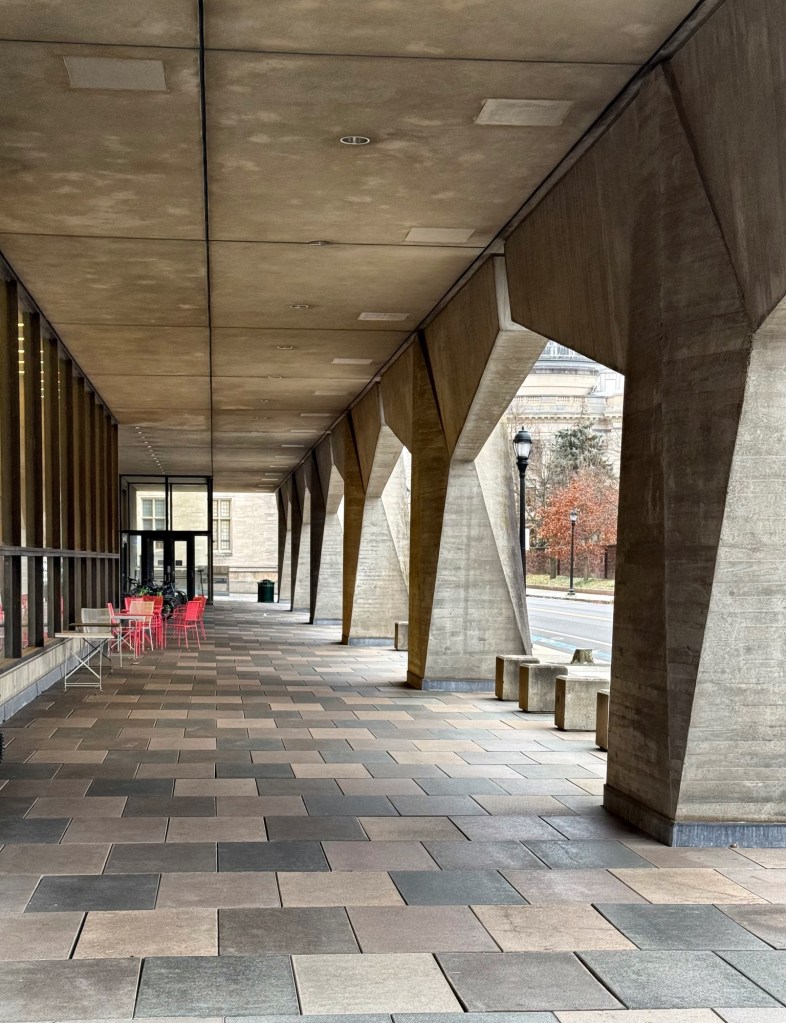
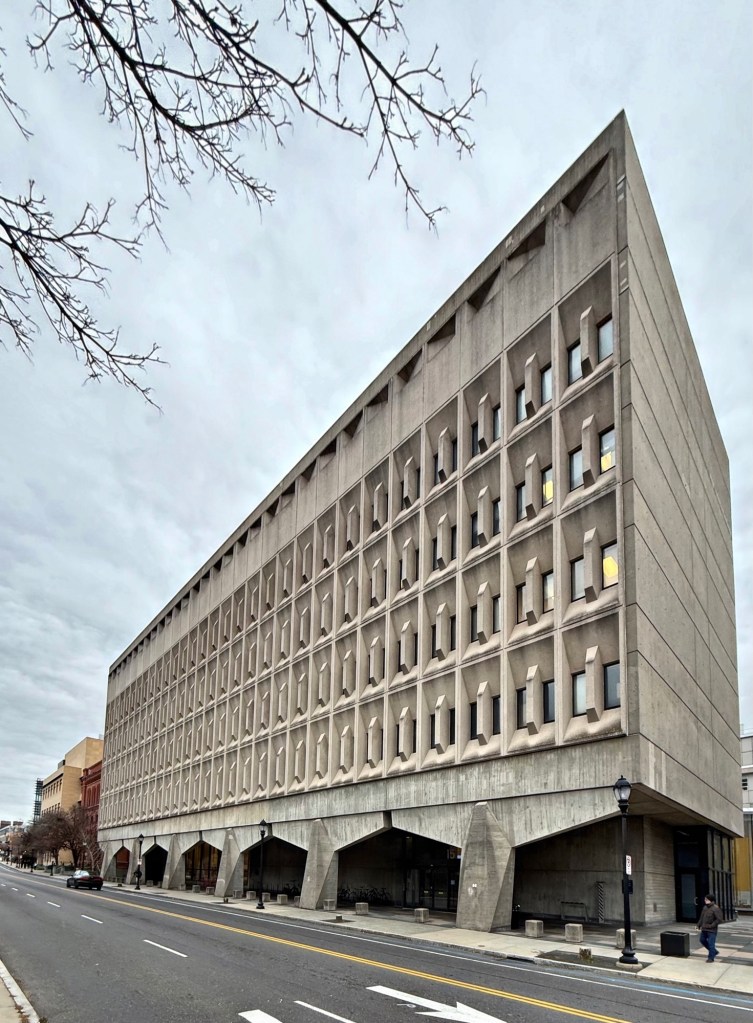
The Becton Engineering and Science Center at Yale is a behemoth academic building on Prospect Street containing offices, laboratories, a library, and an auditorium for the world-renowned institution. Discussions about a new engineering and science center began in 1965 after a generous donation by Yale alumni, Henry Prentiss Becton, and the University hired famous Modernist architect, Marcel Breuer to design the new building opposite the city’s Grove Street cemetery. For the design, Breuer used precast concrete panels and logical planning, to maximize interior space through the building which required less vertical columns in the floorplates. At the street, an elongated arcade provides views into the interior spaces and serves as a shelter from the weather. The arcade and facade above is supported by stunning buttress-like columns, a Modernist nod to the predominant Gothic buildings and character of Yale’s campus. A landmark example of the Brutalist style, the Becton Center serves as a great, and well-preserved example of an often maligned period of American architecture.