The Deacon Turner House, built in 1849, is an impressive Greek Revival house located at the Town Common in Willington, Connecticut. The Greek Revival portion was constructed onto an earlier house or store that was built 50 years prior. The one-story structure was likely moved and incorporated into the current house as a rear ell. The present house was designed by architect Augustus Treusdel of Coventry and built for Deacon John Turner by Emery Williams a well known local builder. John Turner was Deacon of the Willington Congregational Church, nearby.
Located on the southern edge of Willington Connecticut’s town common, this vernacular example of the Federal style with later alterations is really appealing, mostly for its simplicity and proportions. The house was built around 1820 for Hiran Rider, who served as a judge, county sheriff, and town selectman. The Rider Family were hit by tragedy in 1851 when dysentery hit the household, killing Hiram, his wife Sarah, and their daughter. The home was altered by a later owner with 2-over-2 windows, an Italianate style door, and a door hood.
This Greek Revival cottage appears to have been built in the 1830s or 40s based on the style, and early maps list the owner as W. Shaffer. It appears that William Shaffer (1799-1892) was hired by the West Willington Glass Works, which ran a factory across the street, and he either built this home or modernized an earlier home to give it the current configuration. The West Willington Glassworks was in operation 1817-1872 and made everything from inkwells to flasks to pickle jars. The house exhibits bold pilasters at the corners and at the entry with entablatures above them. Oh and that red is just beautiful!
TOOT TOOT! Next stop, Willington, Connecticut. Historically, all of central Connecticut was occupied by various Algonquin tribes which for thousands of years inhabited the region, the larger Pequot and Mohegan, and the smaller Nipmuck, Podunk, Shenipset and Skunkamaug all sharing a common-lineage, and language. In 1720, a party of eight men, originally from England, bought 16,000 acres of the region and called it Wellington after the town in England. Willington was incorporated in 1727. Like many early towns, Willington began as a farming community with modest industry until the 19th century, when the American Industrial Revolution saw mills and factories sprouting up all along the river towns in the region. Villages spouted up in town, mostly following their geographic location in relation to the town center (South Willington, West Willington, etc.) and each had their own industry and character. By the 20th century with industry in decline, many of the former mills and villages closed up and residents moved to “greener pastures”. The town is today mostly rural and serves as a suburb to larger towns nearby.
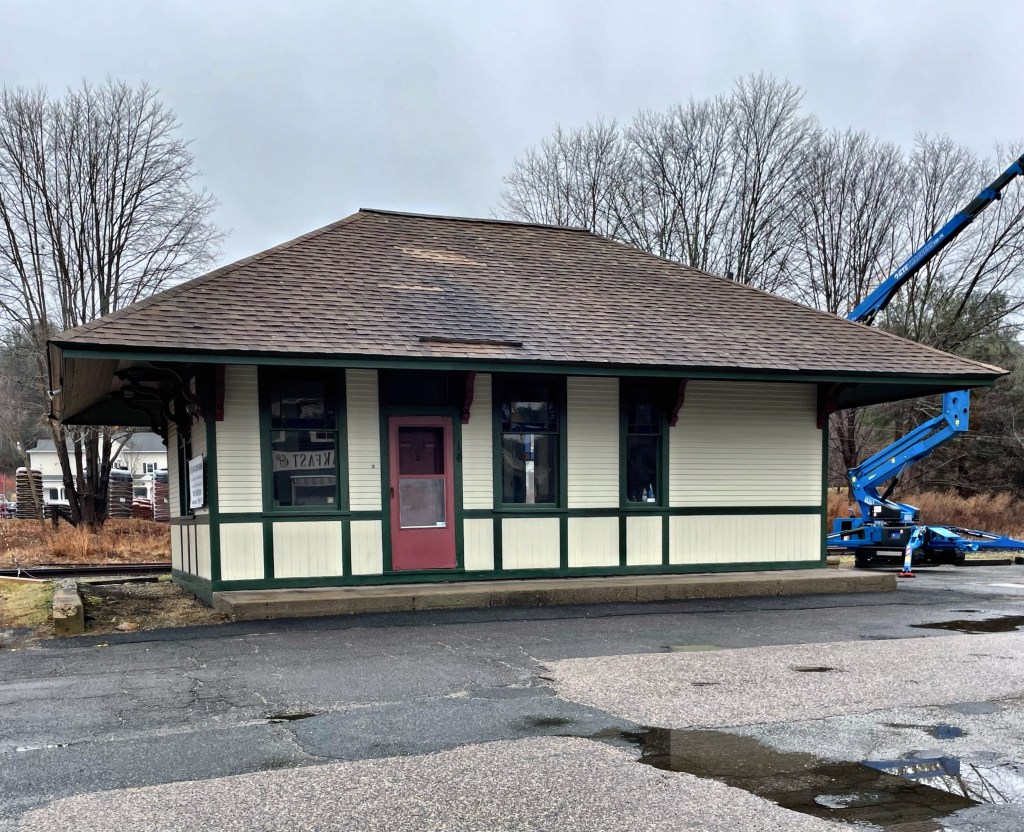
This train depot is located in West Willington just over the town line of Tolland. Due to this, the depot was originally named Tolland Station. Rail service began here in 1850, when the New London, Willimantic and Palmer Railroad Company built a freight and passenger station near this location. The rail line was later absorbed into the larger Central Vermont Railway in 1871. The original depot burned down in 1894, and was replaced that same year by this structure. The line, and this station, were in use for passenger service until 1947, when it closed. The depot has luckily been occupied by businesses ever-since, preserving this building typology in America that we are losing every year.


 Buildings of New England