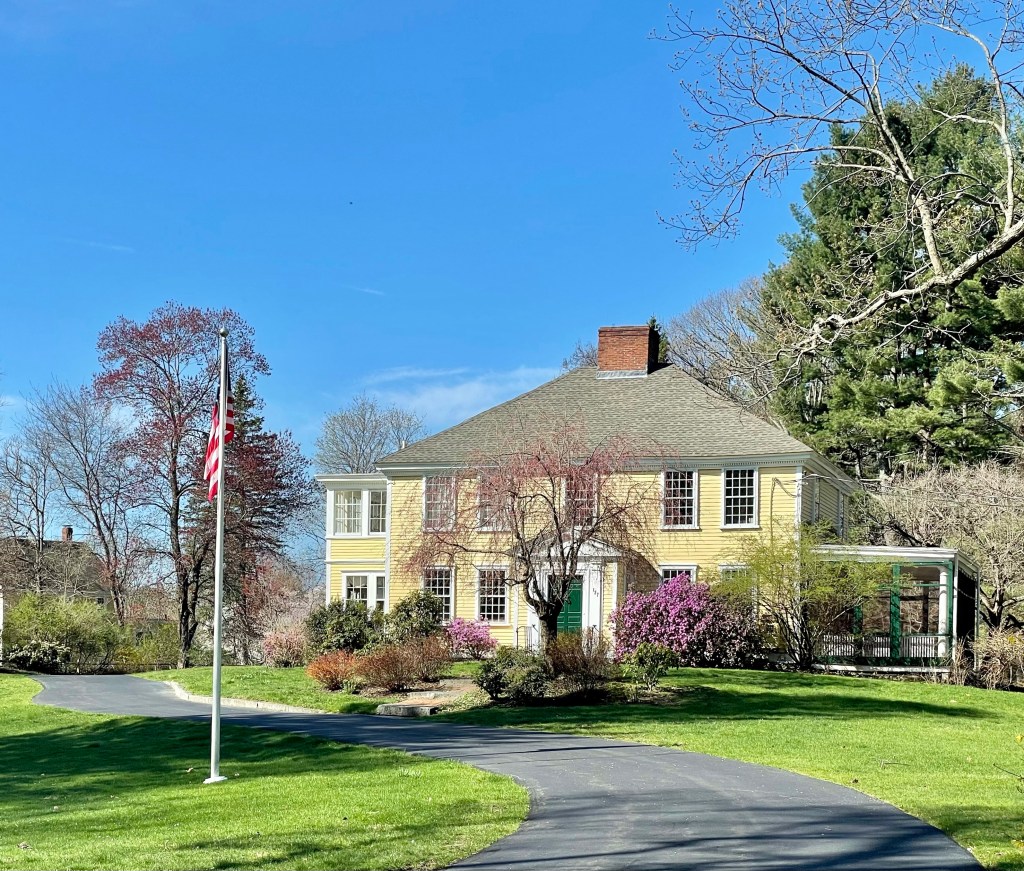
This stunning Georgian farmhouse in Acton, Massachusetts, was built around 1773 for Seth Brooks (1740-1831) and his wife Molly Conant Brooks, on land that had belonged to her father, William Conant of Concord (part of which was later annexed to Acton). Seth Brooks fought under Captain Isaac Davis on April 19th, 1775 at the Battle of Concord, who was among the first killed and was the first American officer to die in the Revolution. It was Brooks who ordered Davis’ body carried from the field after he fell, so he could be buried with honor. After the war, the family suffered an unfathomable tragedy. Seth and his wife, all their nine children, and all but one of their grandchildren died of the same type of tuberculosis, “slow consumption.” The family “curse” appears to have been broken by grandson Nathan Brooks, Jr., (1799-1881,) who inherited the property. According to local legend, a room beside the center chimney sheltered runaway slaves, as Nathan Brooks was an avid abolitionist. At the turn of the 20th century, the farm was purchased by Brookline timber merchant Benjamin Pope, owner of the Pope and Cottle Company of Boston. For many years, the Pope family used the house as a summer residence, with managers working the property as a dairy farm. It was Pope who named the farm “Stoneymeade,” and added greenhouses, an icehouse, and had an elaborate water system installed. Stoneymeade Farm continues to this day as an equestrian farm with boarding space for horses.
 Buildings of New England
The horse farm is no longer part of this property. It is separate from this house.
LikeLike
Thanks for this addition!
LikeLike
Was doing work in a basement recently and noticed this lumber stamp on some of the old wood. While doing research on the company I found Pope and Cottle Lumber from Chelsea, MA. Very few articles, this being one of them and some others about a fire in 1914. Did the lumber yard close down in 1914 due to the fire, meaning this wood is over 110 years old?
LikeLiked by 1 person
Seems like it! It’s often older lumber lasts well over 100 years, its older growth wood (compared to most lumber available today).
LikeLike