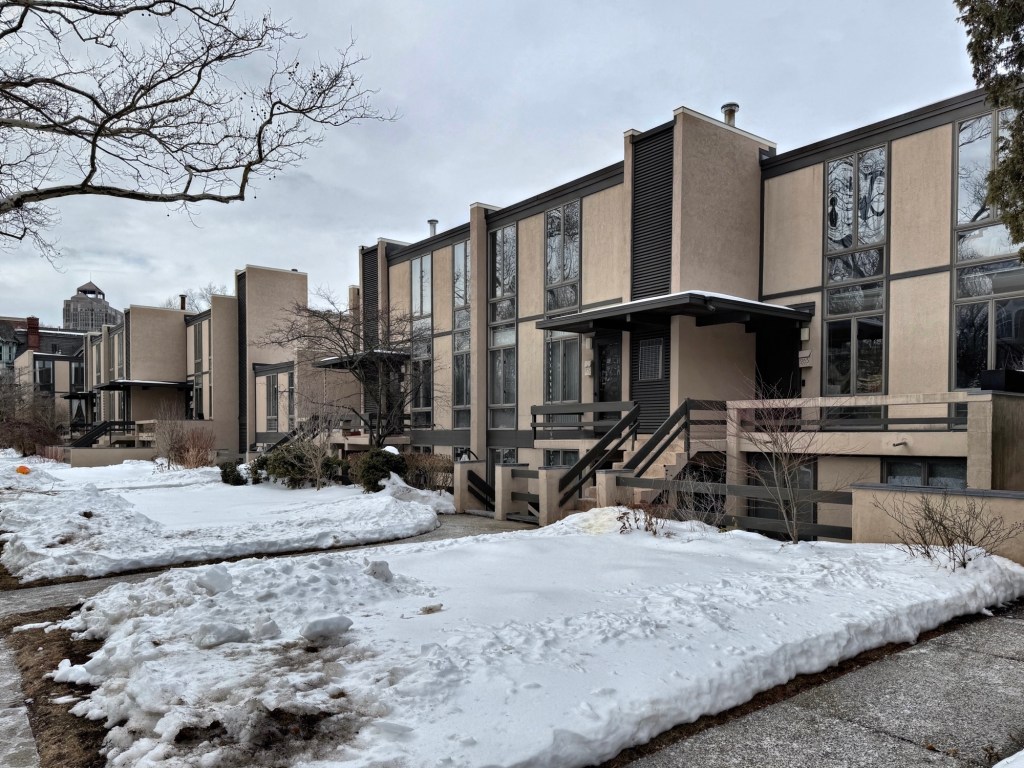
By the turn of the 20th century, the growth of industry around Wooster Square neighborhood of New Haven, Connecticut, forced out the wealthy residents which had lived there, to be replaced by recently arriving Lithuanian, Italian, and Italian-American families who established a thriving immigrant community here, which still exists today. After WWII, suburbanization saw families leaving urban centers, and to attempt to draw back in tax dollars, city officials began to plan for urban renewal areas, where “slum clearance” would redevelop areas with new and modern housing and offices with federal tax dollars. Strong neighborhood support for preservation of the area, paired with a sympathetic Planning Department, saved much of the core of the Wooster Square neighborhood with a few exceptions. The former Greene Street School and a number of residences along Greene Street and Hughes Place were razed in the 1960s and replaced by Town House on the Park, a Mid-Century Modern townhouse development. The project is comprised of thirty-six, three-story dwellings in a rowhouse configuration designed with their ground floor below grade as so to reduce their scale from the street. The development was designed by architect William Mileto and was given an award by House+Home Magazine in 1964 and featured in other publications as a good example of infill housing in a dense urban environment. What do you think about Town House on the Park?
 Buildings of New England
In response to the invitation “What do you think about Town House on the Park?”
I grew up north of New Haven in the 1960’s and ’70’s. New Haven was an architectural Mecca for me; Paul Rudolph, Louis Kahn, Kevin Roche, Philip Johnson, Eero Saarinen, and one of my personal favorites, Peter Millard. These guys could do no wrong in my book. Then, I went to architecture school at Cornell and I began to understand the difference between “object” buildings and “contextual” buildings. I learned that the modern gems were most successful when they were in dialog with traditional buildings and traditional urban design approaches.
Town House on the Park, in my opinion, is a product of its time. The look is clearly 1960s, but the quality of materials and detailing makes it better than most post war urban housing in New Haven and elsewhere. There is a clear attempt to reference traditional row housing (elevated first floor, porch, sunken courtyard, and so on). The resemblance to traditional housing ends with the lack of hierarchy on the facades (first and second floor are same height, windows are identical, there is a lack of a meaningful cornice). Also, there is too much space between the façade plane and the sidewalk resulting in a no man’s zone that traditional row housing simply doesn’t have.
So, what do I think in summary? I think the 1960’s were a period of aggressive experimentation in architecture. Lessons were learned, and others were not. As long as we continue to respect what came before us (witness the overwhelming majority of the buildings featured in the Buildings of New England blog) we do right by our cultural inheritance.
LikeLiked by 1 person
What great points and observations! Thank you for the contributions to the future discussion of this site. I largely agree with my major critique of the development is the large setbacks which feel like little attempt was made to make it blend within the historical context of the Wooster Square area. I also think some nods to the Italianate style would have been effective, from boxy forms with shallow eaves and a modern interpretation of brackets, it could have been a bit more playful.
LikeLike