Captain Edward Penniman House // 1868

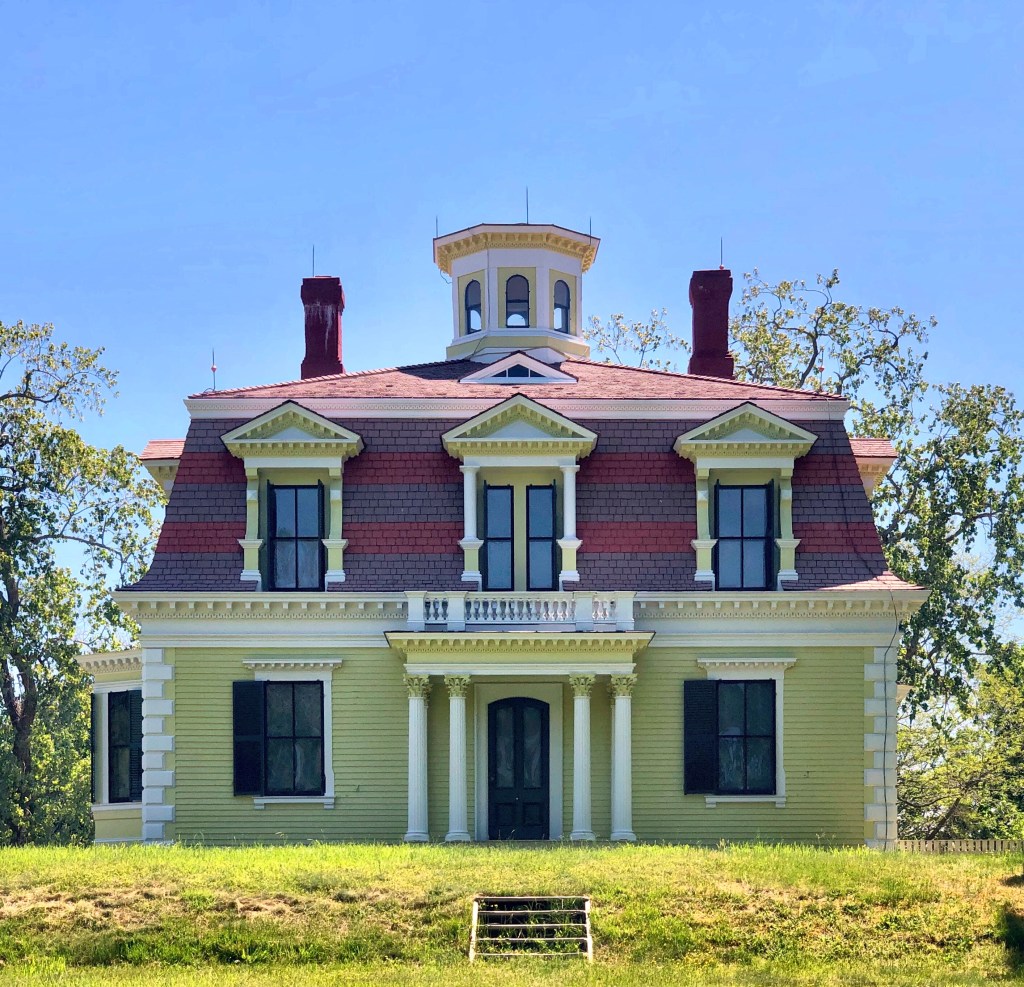
The Edward Penniman House is the finest example of Second Empire style in Eastham, and is one of the finest examples of this architectural style on Cape Cod. The grand home was designed and occupied in 1868 for Edward Penniman (1831-1913), one of the most successful whaling captains in New England.

Born in 1831 in Eastham, Edward Penniman set sail for the first time at age 11. The voyage was to the dangerous and unpredictable waters of the Grand Banks, a rich fishing ground off the coast of Canada’s Newfoundland. Nantucket had a flourishing whaling industry as early as the late 1600s, but it was New Bedford with its deep water harbor and railway system that would become New England’s whaling capital. In 1852 at the age of 21, Penniman would journey to New Bedford and sign on to his first whaling expedition. Later when Penniman became a captain he would select New Bedford as his home port setting sail seven times to hunt whales.

With whale over-harvested in the Atlantic along the shores of New England, whalers were forced to go further and further from home to hunt. Whaling expeditions often spanned three or four years, and it was not uncommon for wives and families of ship captains to go along on the trip. Penniman’s wife, Betsy Augusta Penniman, called “Gustie” by her husband, went on three such voyages often assisting with navigation and other shipboard matters. In addition, each of the three Penniman children accompanied their parents on various journeys with eldest son Eugene eventually becoming a whaling captain himself.

After the Captain’s death in 1913, Mrs. Penniman and their daughter, Betsey, continued to live in the home. Mrs. Penniman’s died in 1921. Betsey Penniman, who never married, stayed around and raised her niece, Irma. Upon Betsey’s death in 1957, the home was left to Irma Penniman Broun. Irma and her husband sold the house with twelve acres to the National Park Service in 1963 when the Cape Cod National Seashore was formed.
Nauset Light and Keepers House // 1877

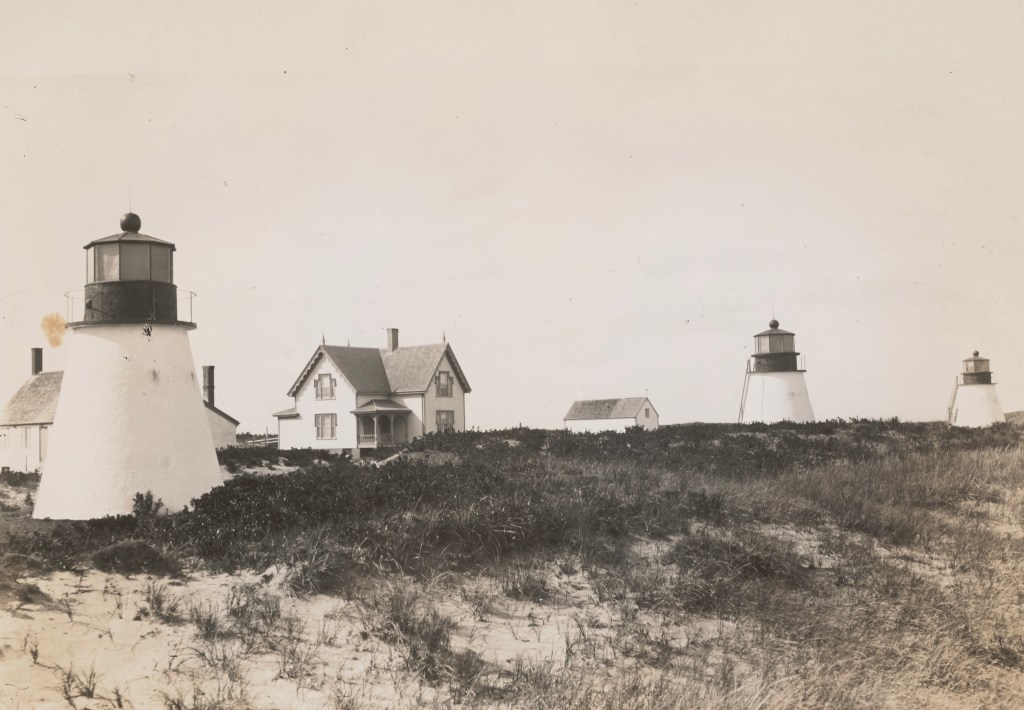
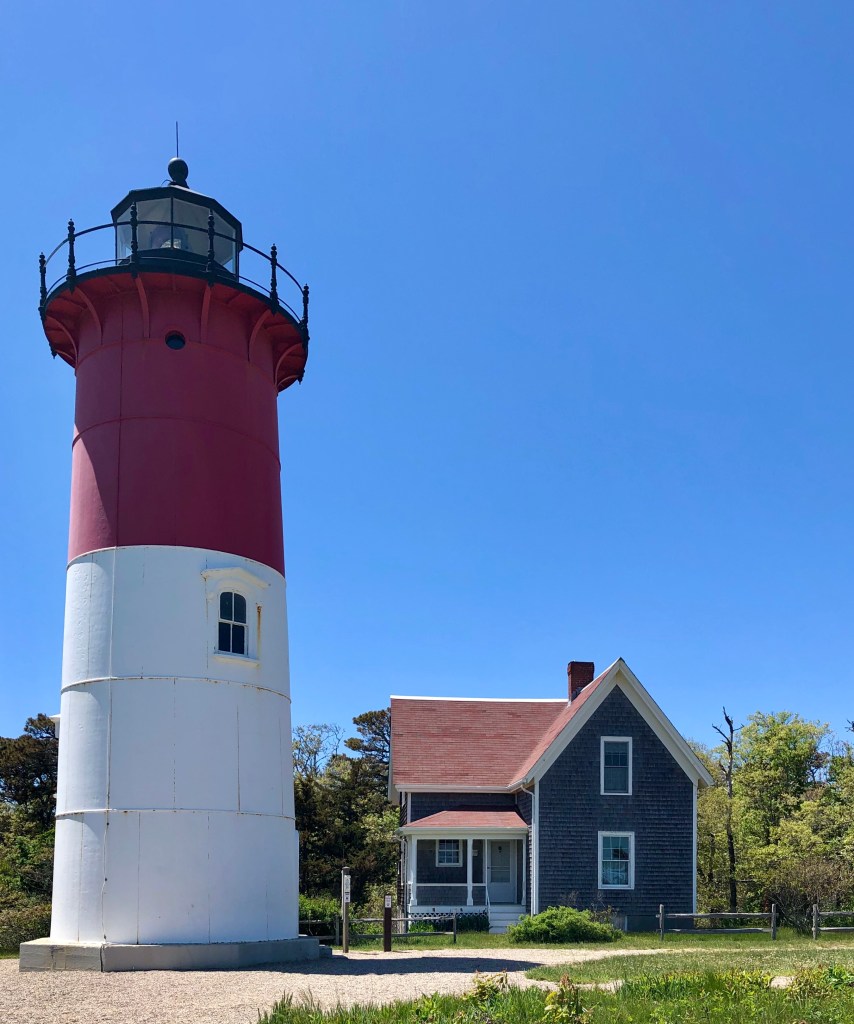
In 1838, three brick lighthouses served as aids to navigation off the Nauset Beach shores in Eastham on Cape Cod; these lights were replaced by three wooden towers in 1892. From 1911 to 1923, only one of these Beacons were used, as technology had evolved sufficiently enough to install a revolving light. Nauset was thus distinguished from the single light of Highland to the north in Truro and the twin lights of Chatham to the south. The forty-eight-foot-tall, brick-lined, cast-iron Chatham tower, originally built in 1877, was dismantled, hauled up the cape, and rebuilt atop a cement foundation 200 feet from the cliff’s edge at Nauset Beach. To provide accommodations for the keepers of the relocated cast-iron tower, the 1876 dwelling built for the Three Sisters was relocated farther away from the edge of the bluff. The cliff continued to fall into the sea over time and the lighthouse and dwelling were moved again in the 1990s. Both structures are owned and maintained by the Nauset Light Preservation Society.

Learn more on the history of the site in the Three Sisters Lighthouse post.

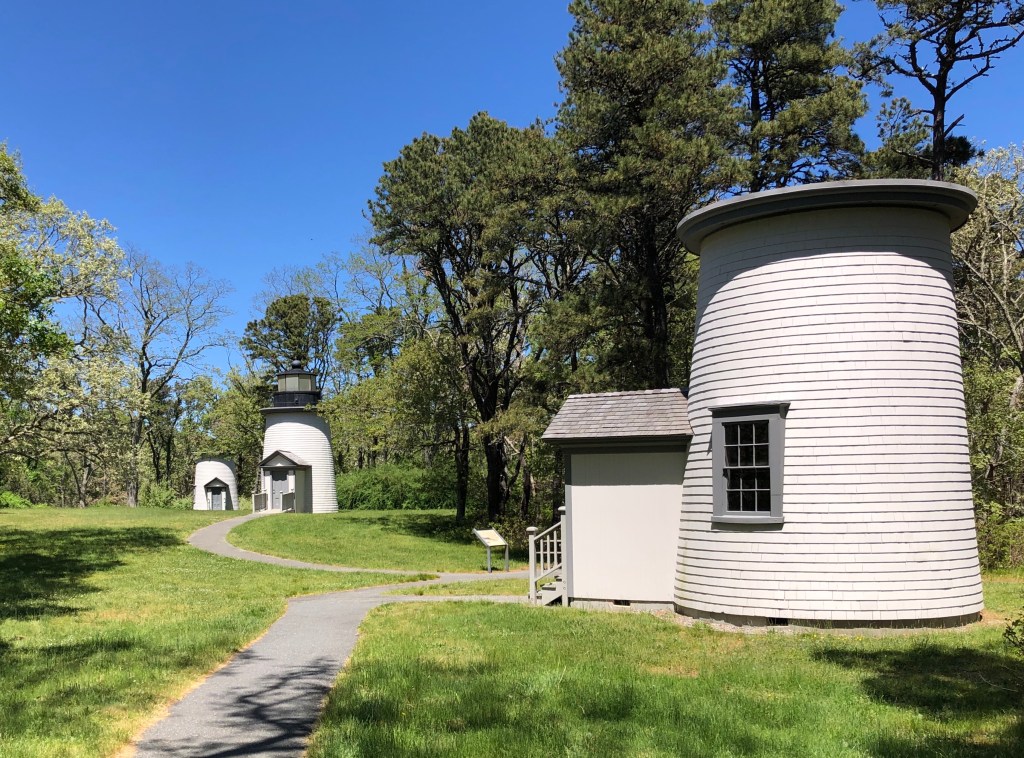
Three Sisters Lighthouses // 1892

The first lighthouse station for Eastham, known as the Nauset Beach Light Station (nicknamed The Three Sisters), was completed in 1838. The name Nauset, which came from a local Native American tribe, formerly referred to the fifteen-mile stretch of Cape Cod from what is now Brewster almost to modern-day Truro. The lighthouse station actually consisted of a group of three lights atop 15-foot high brick towers located on a bluff looking over the Atlantic. Even though there were three lighthouses, the station was staffed by only one keeper up until 1867, when the position of assistant keeper was added. The assistant lived with the head keeper and his family in the station’s one dwelling (talk about cozy)!. The Lighthouse Board in 1873 noted the inadequacy of these accommodations in a report stating, “The dwelling-house should be enlarged, or a small cottage built for the accommodation of the assistant keeper, as the building now occupied is entirely too small”. Congress allocated $5,000 in 1875 for a keeper’s dwelling at Nauset Beach, which was erected in 1876.

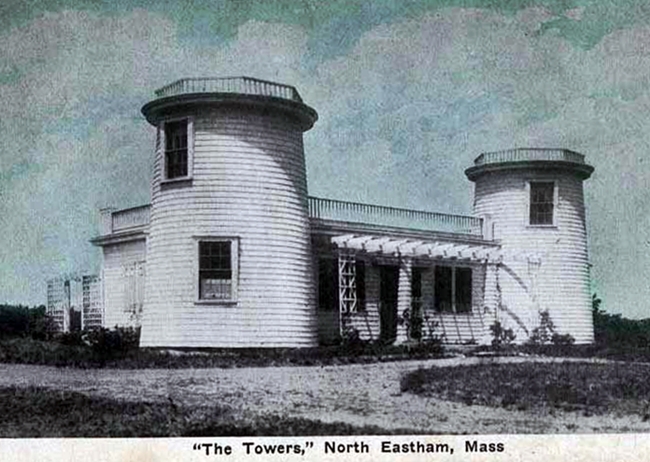
After the relentless Atlantic Ocean brought the three brick towers to the brink of disaster due to the eroding land under them, in 1892, three new towers were constructed thirty feet west of the originals along with a brick oil house. The replacements were constructed of wood so they could be readily moved if the need occurred again. By 1911, it was determined that there was a need for only one lighthouse (as three could get confusing), and two of the three lighthouses were auctioned off, the third was attached to the keeper’s house. The two towers (minus their lanterns) were sold in 1918 to the Cummings family of Eastham for $3.50. The family moved the two towers to a nearby location and joined them together as a summer cottage called “The Towers” on Cable Road. In 1923, the smaller wooden lighthouse was retired and replaced with the current Nauset Light. In 1983 after much uncertainty as to their future, the National Park Service united the Three Sisters in a park, just west of their original location for history geeks like us to enjoy!