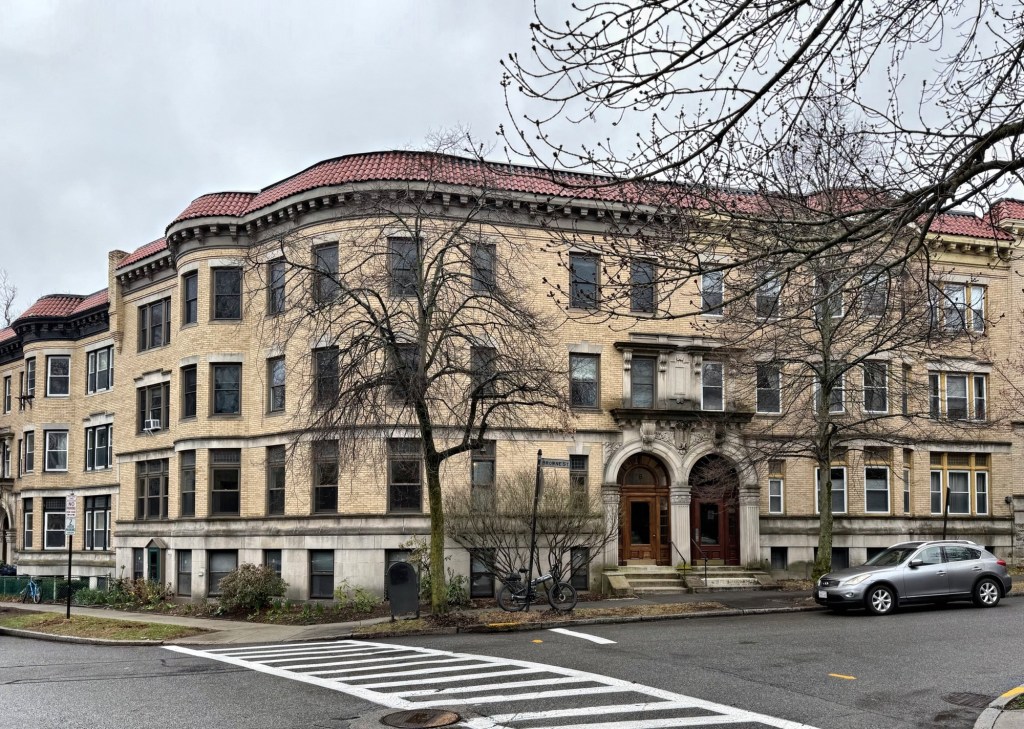
Snider and Druker Apartments // 1913

By the beginning of the 20th century, Brookline was developing rapidly as a desirable Boston suburb, with easy-access to downtown via streetcar and rail, all with less cramped land and less industrial development impacting the air quality. Developers soon realized that they could build high-quality apartment blocks within established neighborhoods to market to middle-income families who wanted to live in these desirable enclaves without breaking the bank. Developers Snider & Druker (a precursor to the Druker Company) purchased house lots in the neighborhood adjacent to Cottage Farm, a rich enclave of large homes on large lots, and began building apartment buildings. They hired architect Frederick A. Norcross, who specialized in multi-family housing designs, to furnish plans for these Renaissance Revival style apartments at the corner of Browne and Powell streets. Besides the use of buff brick, limestone trim and detailing, and the use of projecting bays to break up the facades, the building’s terracotta roof adds intrigue and individuality to a building form often maligned for blandness. 

Heritage on the Garden // 1988

Located across Arlington Street from the since demolished Shreve, Crump & Low building (last post), Heritage on the Garden stands overlooking the Boston Public Garden. Heritage on the Garden was a result of a redevelopment initiative known as the Park Plaza Project, one of the city’s many urban renewal projects of the 1960s and 1970s, where buildings, blocks, and sometimes neighborhoods were razed and redeveloped. As part of the city’s effort of dramatic urban renewal, the Park Plaza area was identified as a site for intensive new uses, including hotel and apartment towers ranging from thirty to fifty stories! The impact of these buildings on the Public Garden and Boston Common was considered unacceptable by many residents of the city, with citizen participation helped to require lower-height buildings which would front the iconic Public Garden. In the 1980s, nearly the entire block of Boylston Street between Arlington and Hadassah Way was razed for the erection of the new condominium building, developed by the Druker Company and designed by The Architects Collaborative (TAC). The project was one of the last of the iconic TAC firm, once led by Walter Gropius, who helped bring Modernism to the United States. The Post-Modern style building ranges from five- to twelve-stories tall and is constructed of brick with cast stone, a nod to the historic Boston architecture, but with modern forms and projections. I think it works quite well, but maybe that is because I wasn’t around to see what was there before…