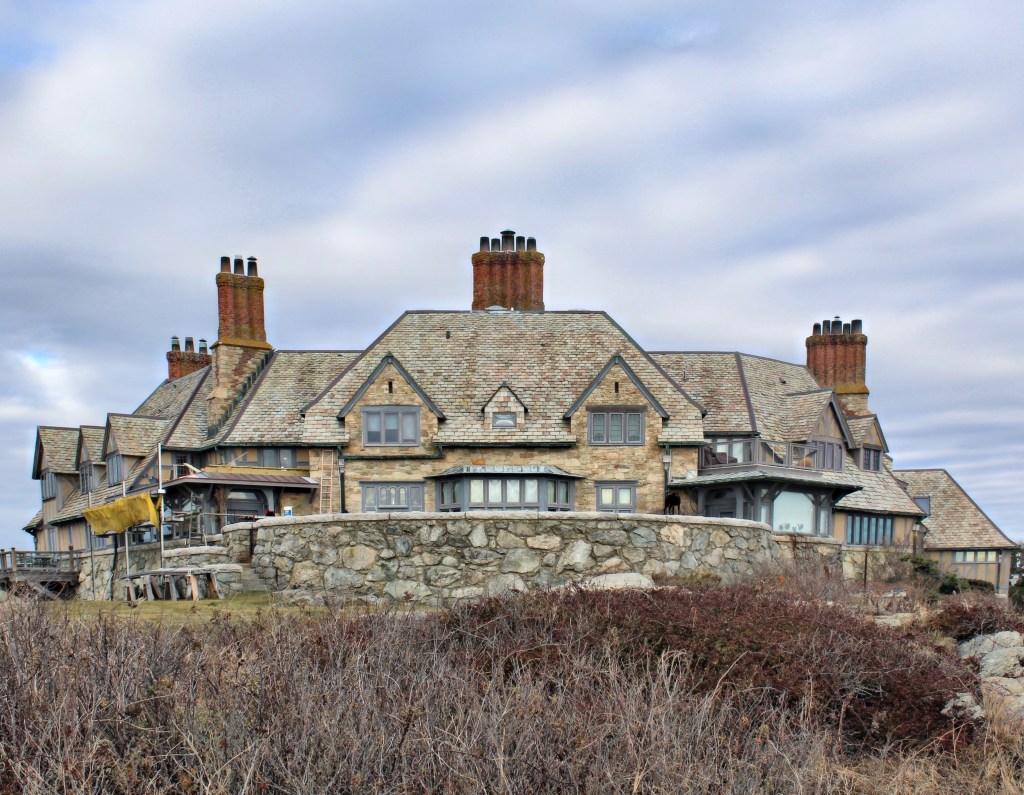
“The Waves” // 1927

If anyone knows me, I absolutely LOVE Tudor and French Norman style houses, but they are much less common compared to the Colonial Revival style, which dominated residential architecture in New England for nearly a century. Located on Ledge Road, at the southeasternmost peninsula of Aquidneck Island in Newport, you’ll find this absolutely giant estate as you conclude walking Newport’s iconic Cliff Walk. “The Waves”, was built in 1927 by architect John Russell Pope (1874-1937) as his own residence. He built it over the ruins of the former Gov. Lippitt Mansion which was previously built on the site and demolished by Lippitt’s heirs. In designing The Waves, Pope wanted to focus on the natural, rocky site and build a structure that would blend in. The Tudor style mansion features stucco and stone siding, half-timbering, and a complex roof covered in slate, all in a U-shaped form. Years after completing his home in Newport, Pope would become even more well-known for designing major public buildings in Washington D.C., including the National Archives Building (1935), the West Building of the National Gallery of Art (1941), and the Jefferson Memorial (1943). After Pope’s death, the massive home became the first mansion in Newport to be converted to condos, a great preservation tool that maintains these massive mansions, and allows for them to be utilized today.

Land’s End // 1864

One of the more architecturally modest and refined Gilded Age summer cottages of Newport sits on one of the most picturesque pieces of land at the southeastern point of Aquidneck Island and is aptly named Land’s End. The cottage was built in 1864, Land’s End was designed by John Hubbard Sturgis for Boston banker, Samuel Gray Ward, his father’s business associate. The home features a refined Italianate style base with a roof comprised of a variation of the Second Empire mansard style called a “turtleback roof”. Land’s End is probably most famous as the residence of Edith Wharton (1862-1937) after she acquired the property in 1889. She worked with Boston designer Ogden Codman, Jr., to experiment with a style of subdued classical interiors and a remodel of the exterior, which was later featured in their book, “The Decoration of Houses”. Wharton was inspired to show what good taste is after the influx of Vanderbilts and other newly moneyed summer residents of Newport. The book focused on how to build and decorate houses with nobility, grace, and timelessness. It would, they hoped, lead its readers out of what Wharton called (pace the Vanderbilts) a “Thermopylae of bad taste” and into an aesthetic Promised Land. Wharton only lived at Land’s End for a decade, when the “stuffiness” of high-society there led her to move to the Berkshires in Massachusetts, where she worked with architect Ogden Codman to design her new home, The Mount. It the monstrous Lippitt Mansion, Breakwater was built at the time, just next door! did not help that Sadly, many of the interiors have been altered since Wharton’s time there, but with more recent interventions, but the book did help shift some of Newports later homes to a more refined, classical taste.