Old Brant Point Lighthouse // 1856

Located nearby the present Brant Point Lighthouse on Nantucket, the old lighthouse remains as a significant piece of island history preserved. In the 1740s, Nantucket’s whaling industry was growing fast, so at a town meeting in 1746, it was determined that a lighthouse at Brant Point was to be built, to mark the point around which all vessels passed as they entered the island’s inner harbor. On or near this site, nine lighthouses stood, guiding ships into and out of the harbor. This brick tower and attached keeper’s house were constructed in 1856. The tower itself was brick, topped by sandstone, which supported the lantern. The cast-iron lantern had twelve windows. A circular iron staircase led to the lantern, situated forty-seven feet above the ground. By the 1850s, Nantucket faced a sudden decline after the invention of kerosene, cut the need for whale oil and a growing sandbar blocked the harbor. The shifting sands would eventually require a new lighthouse built nearby, the present 1901 wooden lighthouse. The 1856 tower was retained ever since and is an important historical artifact for Nantucket’s maritime history.

Coleman House // c.1750

In 1802, a young sea captain, Laban Coleman purchased this house on Orange Street on Nantucket within a year of his marriage to Jane Carman. Historians estimate the date of construction of the house to be from sometime between 1729 and 1750, but it could date closer to the time that Coleman purchased the house from a joiner, Elisha Raymond, who possibly built the house. I particularly love the simple door with transom above and the narrow, second-story stairhall window. What do you like the most about this Nantucket home?

Second Congregational Meetinghouse of Nantucket // 1809

Located on a fairly quiet street on Nantucket Island, you will find the Second Congregational Meetinghouse of Nantucket, towering over the rows of historical homes nearby. Erected between 1808-1809, the church was constructed to house Nantucket’s growing population of Congregationalists on land formerly occupied by a dwelling house and barn. The bell was brought from Lisbon, Portugal, in 1812 by Captain Thomas Cary, was placed in the square belfry in 1815. The Great Fire of 1846, combined with the collapse of the whaling industry, brought hard times to the island. The congregation found itself unable to support a minister, and for the next forty years the church struggled on the brink of financial collapse. The building and its congregation persevered and the building is both an architectural and cultural landmark to the charming island community.

Captain Silas Jones House // c.1774

Brick houses are not too common on Nantucket, so I love to highlight them whenever possible! This gambrel-roofed residence was built by 1774 for Silas Jones, a whaling captain around the time of his marriage to Judith Gardner. As originally built, this house had brick endwalls while the facade and rear walls were constructed of wood. It was not until under the ownership of Silas’ son, Daniel, that the house was “modernized” with its present appearance. Daniel added brick walls to the front and rear walls, added brownstone lintels and sills to the openings, and added twin chimneys, likely replacing a single, central chimney. Due to his materiality and heavy presence, the house looks more like it belongs in Salem or Providence, so seeing it in the coastal town of Nantucket makes my heart sing. Standing out is a good thing!

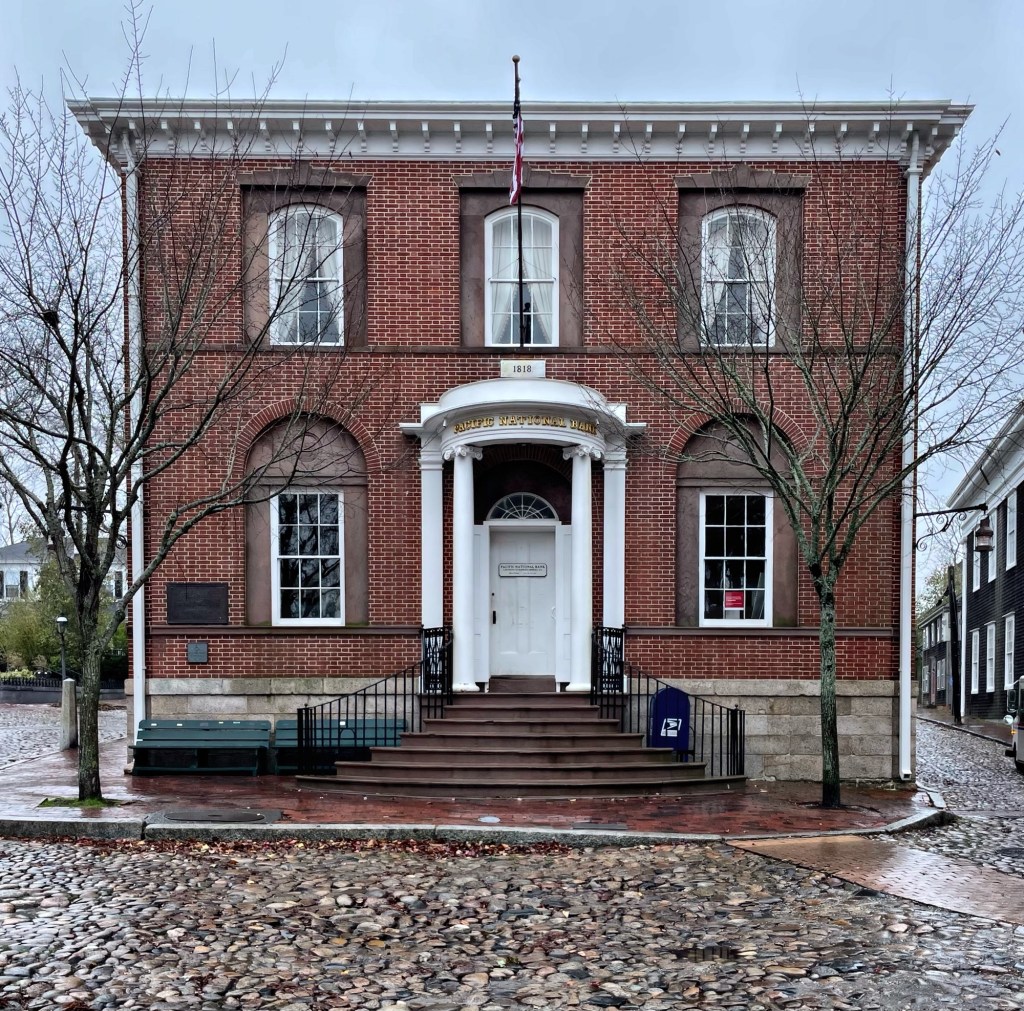
Pacific National Bank // 1818

Whaling captains and crew upon returning to the island of Nantucket, would be flush with cash and goods and needed a safe and secure institution to hold their earnings. By the late 18th century, the depletion of the whale population in the Atlantic required whaling vessels to travel further and further in search of oil to fill the barrels in their holds. Ships began sailing to the Pacific and due to the distance, would be out at sea for years rather than months. Money from the Pacific voyages flowed back to the island, which soon required real banking facilities, and the Pacific Bank was established in 1804 and immediately prospered. The bank erected this stately brick building at the end of Main Street Square. Details such as the blind arches filled with sandstone panels that surround the building’s windows, the semi-circular Ionic entry portico and the high brown sandstone stoop with wrought-iron railings are unique on Nantucket and among the finest examples of their type in the region. Also interesting about the building is the fact that it contained living quarters for the cashier whose presence was intended to provide security. The building is now (of course) home to a Bank of America.