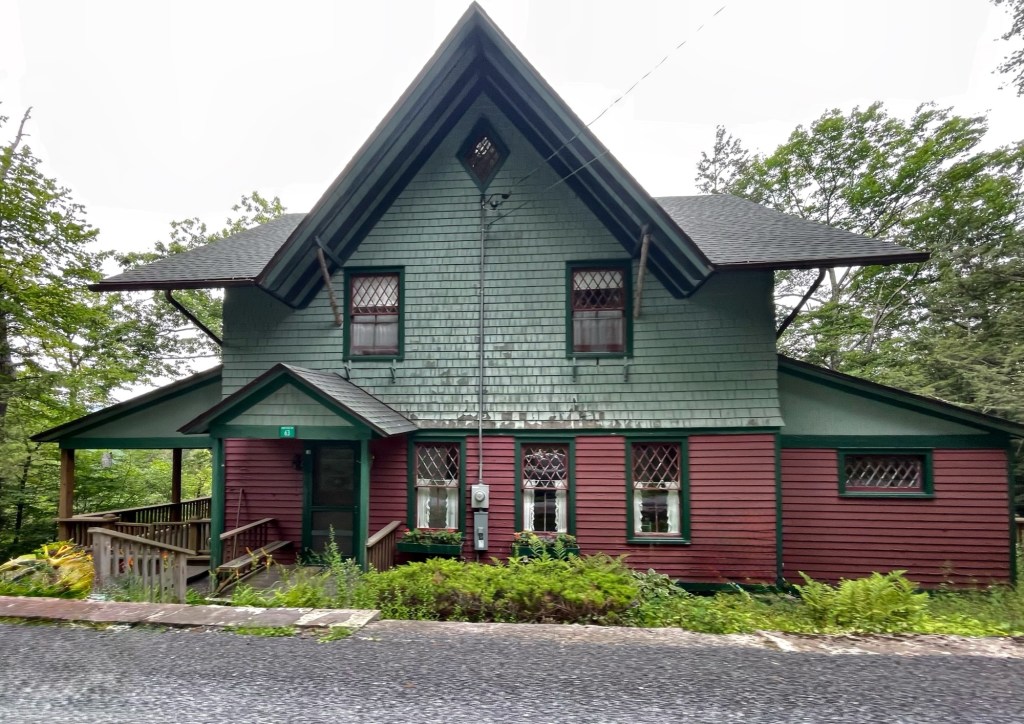
Crossways Cottage // c.1890

Tucked away in the town of Hunter in the Catskill Mountains of New York, the summer colony of Twilight Park has stood as an exclusive and private resort community established in the late 19th century. Twilight Park was born out of the Twilight Club, a Manhattan social club in the late-19th century and brought to life by founder, Charles F. Wingate. Mr. Wingate traveled to the mountaintop in 1887, and became enamored by its natural beauty. He arranged for the purchase of a former sheep’s meadow and led the construction of the first cluster of cottages in what would become a large community of over 100 summer homes. Cottages were laid out on roughly parallel roads at different elevations and on old connecting paths that later became roads with all lots built on ledges overlooking the Catskills. The first cottages were log cabins, and quickly followed by larger, Queen Anne style “cottages” as others invested in the development. Crossways Cottage is one of the many unique late-Victorian summer “cottages” in the exclusive Twilight Park colony in the Catskills of Hunter, New York. The cottage stands out for its cross-gable roof with overly deep eaves which are supported by rustic twig brackets, diamond sash windows, and the use of varied clapboard and shingle siding. 
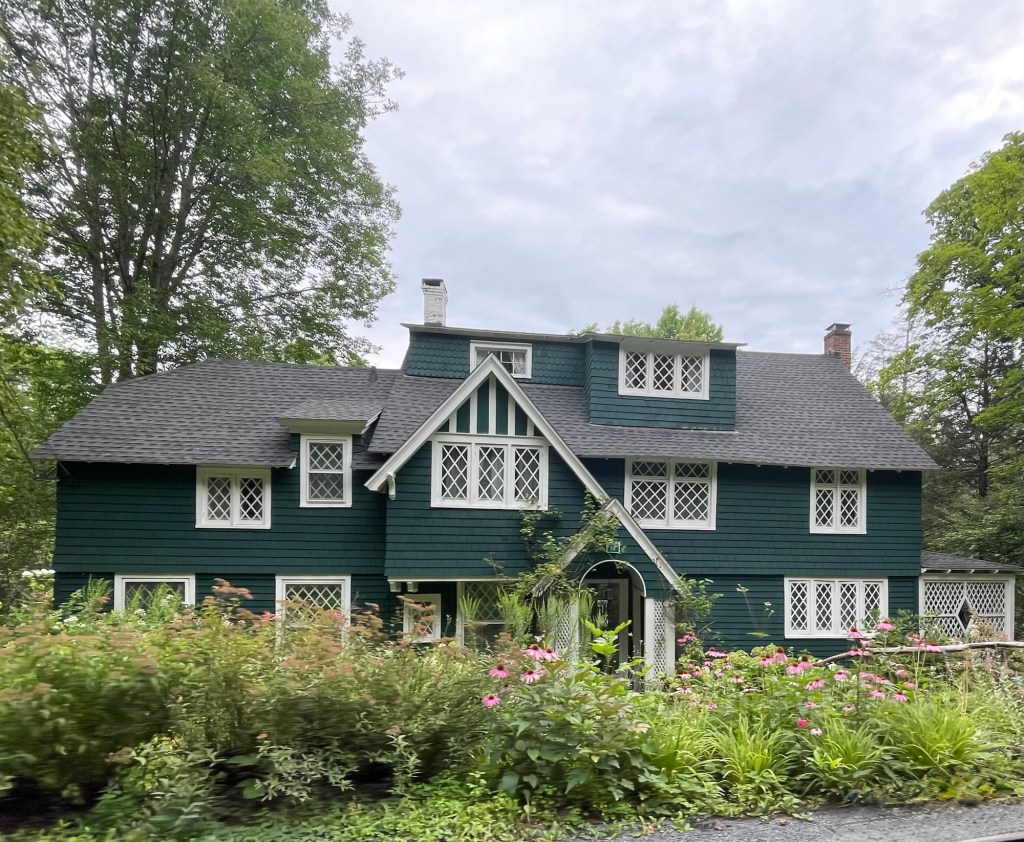
Braeside Cottage // 1888

Tucked away in the town of Hunter in the Catskill Mountains of New York, the summer colony of Twilight Park has stood as an exclusive and private resort community established in the late 19th century. Twilight Park was born out of the Twilight Club, a Manhattan social club in the late-19th century and brought to life by founder, Charles F. Wingate. Mr. Wingate traveled to the mountaintop in 1887, and became enamored by its natural beauty. He arranged for the purchase of a former sheep meadow and led the construction of the first cluster of cottages in what would become a large community of over 100 summer homes. Cottages were laid out on roughly parallel roads at different elevations and on old connecting paths that later became roads with all lots built on ledges overlooking the Catskills. The first cottages were log cabins, and quickly followed by larger, Queen Anne style “cottages” as others invested in the development. This cottage, known as Brae Side Cottage, was built in 1888 during the first phase of development in Twilight Park, and it is notable for its varied siding, diamond-pane windows, complex roof form with dormers, and the laticed entry.

Roosa-Van Deusen House // 1744

For my last building feature in New York in this series, I feature the Roosa-Van Deusen House on Hurley’s Main Street village of old stone homes. This house dates to 1744 and was built upon land owned by Jan Alderts Roosa, who emigrated to New Netherland (New York) with his family on the Spotted Cow in 1660, when he was 14 years old. The house was likely built by Jan Van Deusen (Jan Roosa’s grandson), a blacksmith who worked in town. The Van Deusen House famously became the capital building of New York when in 1777, the newly formed New York state government moved here for two months while Kingston was being rebuilt after the British Army had burned it in retaliation for the creation of the state. It is thus the second of the state’s three capital cities, the present, Albany, being the third.

Van Etten-Dumond “Spy” House // c.1726

One of my favorite houses in Hurley is the Dumond House (also known as the “Spy House”), a pre-Revolutionary stone cottage built in Dutch traditions. The house is one and one-half stories high, and is built of limestone. The limestone walls are of various thickness, from a nearby quarry, with the square ends laid up in mortar made of clay, and pointed with lime mortar outside. The house was built by Jacobus Van Etten (1696-1779) and used as a Guard House during the American Revolution. In 1777, it was famous for housing the convicted British spy, Lt. Daniel Taylor after he was caught carrying a message between British Generals Henry Clinton and John Burgoyne. Lt. Taylor was arrested as a British spy, convicted in court of spying and held in the basement of the Du Mond House as a prisoner. He was hung on October 18, 1777 from a nearby tree. American soldiers encamped in the area were paraded by the body as a warning to any potential British sympathizers. The home was later owned by the Dumond Family. It has been owned by the Kent family since 1933.

Polly Crispell Cottage // c.1700

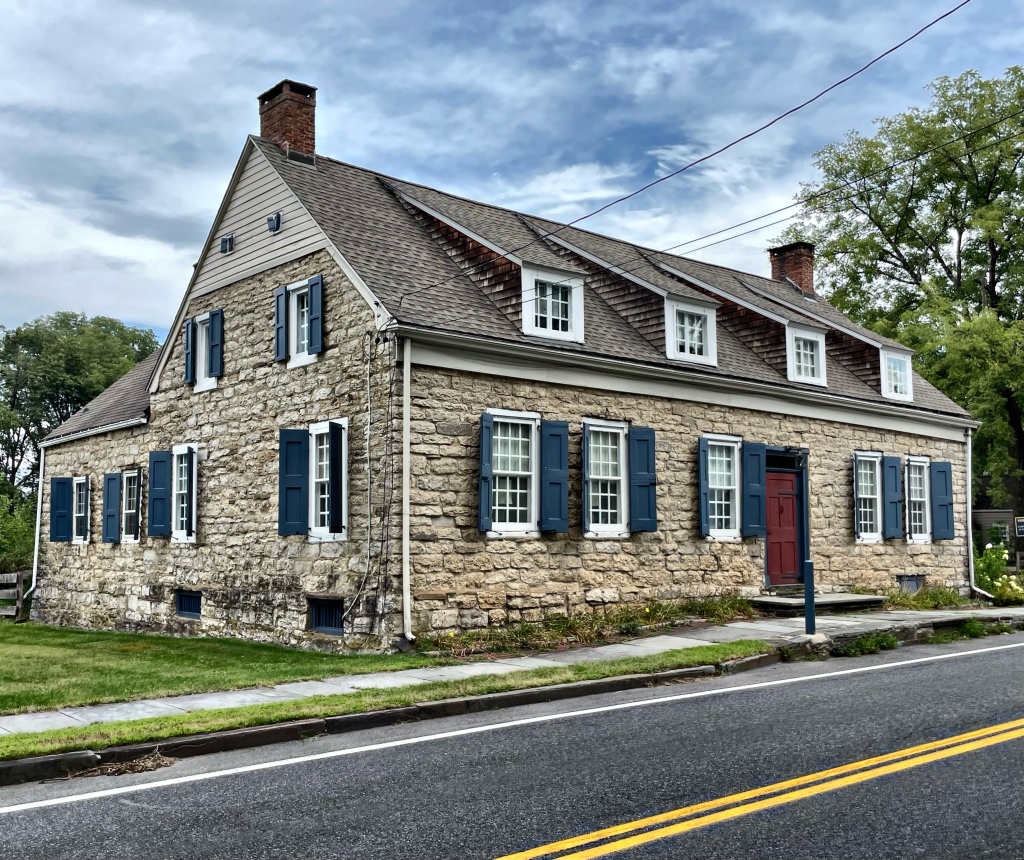
Another of Hurley’s stone houses is this beauty, known as the Polly Crispel Cottage. The house was built before the American Revolution c.1700 by an Anthony Crispell, a cordwainer. The home was likely a half cape in form with the door and two windows to its right. The other half was added at a lower level later on with the floors uneven, likely in 1735 where a construction date plaque read. The home also features a dutch door, which I wish we had more of in New England.

Half Moon Tavern – Elmendorf House // c.1710

When Pieter Ostrander settled in Hurley, NY with his family in the late 1600s. Being of Dutch descent, he (and other settlers) built their homes and barns in Dutch traditions. This lot along the village’s main street was acquired by Pieter and inherited by his son, Arent in about 1710, about the time the home is estimated to have been built. It was acquired by the Elmendorf Family by the early 19th century. At that time, the property operated as the Half Moon Tavern, after Petrus Elmendorf purchased it in 1804. The addition to the east (right) was built as a weaving room. The property remained in the Elmendorf family until 2008 (that’s almost 300 years in two families!) It was acquired by the new owner who has been restoring and researching the home ever since. He runs a blog documenting the property’s rich history.

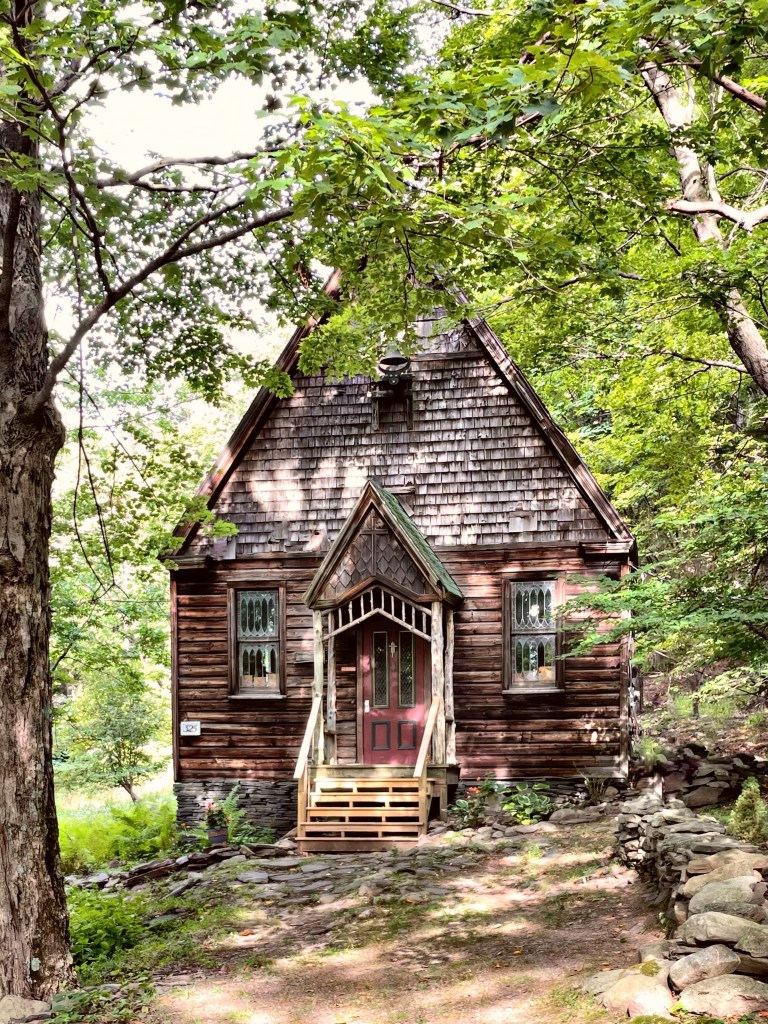
Church of the Holy Transfiguration // 1891

Highlighted by the establishment of the Catskill Mountain House in the 1820s, and furthered by the construction of subsequent resorts and boarding houses, the Catskill Mountains enjoyed a lively seasonal tourist industry that continued largely unabated throughout most of the nineteenth century. Mead’s Mountain House was representative of the smaller, less ostentatious boarding houses that sprang up in the region to serve a more middle-class clientele of tourists. This church, the Church of the Holy Transfiguration was originally constructed in 1891 in association with Mead’s Mountain House as a modest place of worship for guests of the Mead family’s boarding house and those of the nearby Overlook Mountain House. The chapel was constructed in 1891 and modestly built, constructed with a wood balloon frame above a fieldstone foundation with detailing reminiscent of the rustic aesthetic, popular in the Adirondacks to the north. In the 1960s, Father Francis, the much-beloved “hippie priest”, here welcomed hippies who had congregated in town during those years that culminated in the famous art and music festival. Fr. Francis began the practice of this lesser known branch of Catholicism, which acknowledges the Pope as an earthly spiritual leader but, unlike classical Roman Catholicism, does not consider the Pope to be supreme or infallible. The small chapel remains as a quirky and important piece of local history.

Overlook Mountain House Ruins // 1923-

One of the most intriguing and historical hikes around is at Overlook Mountain in Woodstock, there is just something so mesmerising and enchanting about abandoned places. Overlook Mountain has long been a significant location in New York. In the boom years of New York City after the Civil War, more than 90 quarries in the Town of Woodstock (many around Mount Overlook) produced bluestone for sidewalks in Manhattan. By the end of the 19th century, the mountain and surrounding area became a tourist location for New Yorkers escaping the woes of city living, looking to breathe in the fresh mountain air up the Hudson. The current ruins Overlook Mountain House was actually the third hotel on the site. The first Overlook Mountain House was built in 1871 and accommodated 300 guests, before it was destroyed by fire in 1875. It was rebuilt in 1878 by the Kiersted Brothers of Saugerties. Overlook was used irregularly between 1887 and 1917, when Morris Newgold of Manhattan purchased the hotel. In 1921, it was the site of a secret organizational meeting of what was to become the Communist Labor Party of America. The second incarnation of the Overlook Mountain House was destroyed by fire in 1923. And Morris Newgold sought to rebuild with fireproof construction.

His architect used concrete to rebuild the hotel, which likely would have been covered with stucco. They also broke ground for a chapel, stables, and a standalone lodge for private housing for his family. Newgold’s shaky finances paired with the Great Depression made for slow progress, and portions of the resort were still “under construction” as late as 1939 (and the main hotel never being finished from what I could find). Morris Newgold died in 1940 and the property was either sold by his son or acquired via eminent domain by the New York State Conservation Department and made part of the Catskill Forest Preserve. You can now explore the old ruins of the Overlook Mountain House between views of the Catskill Mountains.

1928 House

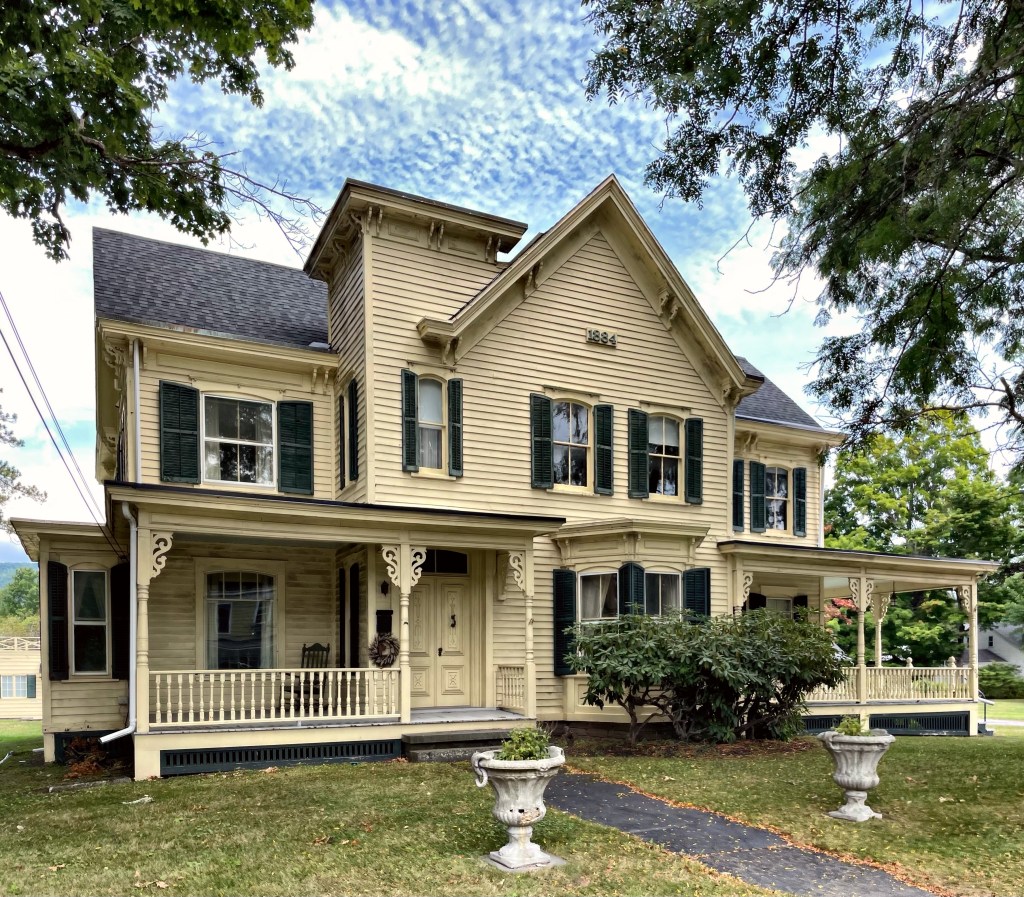
James Nelson Lasher House // 1884

The James Nelson Lasher House in Woodstock, NY was built by James Nelson Lasher (1829-1906) in about 1884. “Nelson” Lasher, a farmer from Bearsville, acquired 45 acres on the outskirts of the village of Woodstock and established an undertaking business on the property, in 1879. Over the next two decades, he farmed the property with his son Franklin “Frank”, who by 1890, also began to manage the undertaking business. Frank Lasher (1864-1912) may have added the Queen Anne porches and tower to the house around this time. In the early 1900s, the Lasher household consisted of Nelson and wife Elizabeth, and Frank and his wife and three children. Nelson died in 1906 and Frank died six years later, leaving the property to his son, Victor, who continued the family undertaking/funeral home business. The property was sold out of the Lasher family in 1960, but operated as a funeral home until 2019. The property has recently been eyed as a hotel and for town offices, I wonder what its future holds!

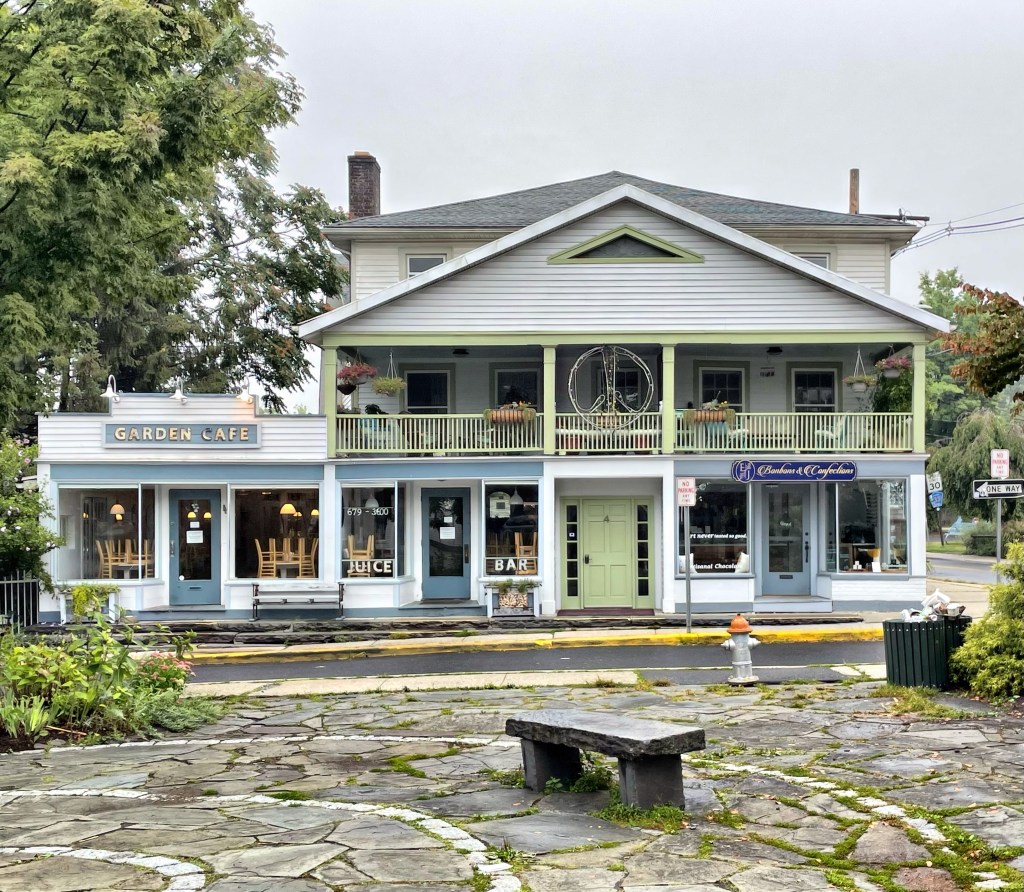
Krack House // 1870

One of the largest buildings in the charming village of Woodstock, NY, is the former Krack House… I know what you are thinking, and no it was not due to illegal activity! The Krack House was developed in 1870 by Charles H. Krack (1824-1893), as a response to the success of other summer hotels built nearby as the area saw a boom in tourism. Charles Krack was born in Germany and after serving in the military there, he arrived to America in the mid-1800s. Here, he served as an overseer of a Georgia plantation, and moved to New York City after the Civil War, operating a hotel in Manhattan. He later became the owner of a floating bathhouse on New York City’s East River anchored near Grand Street, and made great money, investing it up the Hudson in Woodstock. In Ulster County, he got involved in politics. The Krack House was a summer lodging facility with food service and all the best amenities in the village. After Charles’ death in 1893, the property was eventually purchased by Stanley Brinckerhoff Longyear, who rebranded the hotel in his name, The Longyear. The building appears to now contain apartments above commercial spaces.