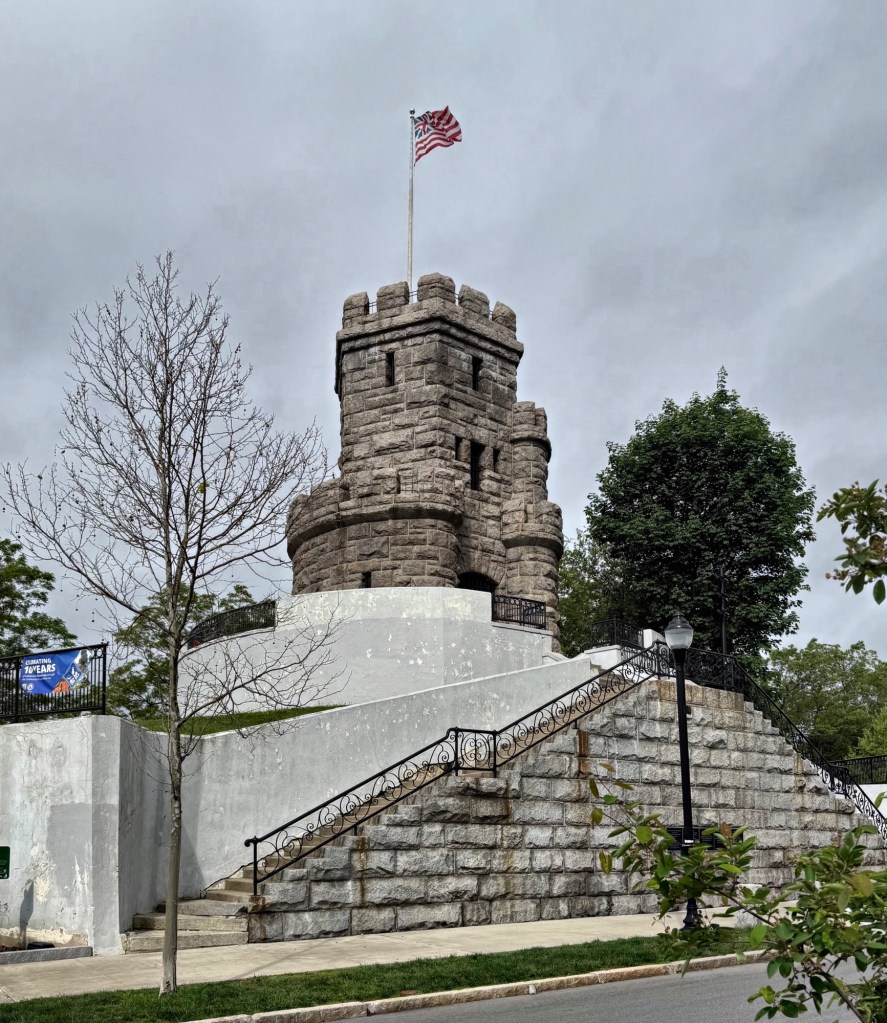
Originally part of the town of Charlestown, Massachusetts, Prospect Hill is now located in the nearby town of Somerville, established in 1842. As one of the hills closest to the city of Boston, the hill played a pivotal role in the line of defensive works constructed after the Battle of Bunker Hill. The area developed slowly, with old farms around Prospect Hill, largely subdivided in the late 19th century for residential development. Around this time, in 1886, the Prospect Hill Park Association was formed, and in 1898, land here was purchased for a public park. The focal point of the iconic neighborhood park is the stone castle structure at the top. Completed in 1903 to commemorate soldiers of the Revolutionary and Civil wars, the rusticated granite tower was designed by Ernest W. Bailey, the City Engineer of Somerville, who also worked to landscape the surrounding park. The granite blocks were shipped in from Deer Isle, Maine. By the 1960s, the structure began to suffer from deferred maintenance. The City of Somerville added the concrete retaining walls to shore up the landscape, which worked for some time. Decades later in the early 2000s, the structure was at risk of further deterioration. Through Community Preservation Act funds, the tower and surrounding landscape were restored and made safer, making this important memorial accessible and enhanced for all to enjoy.
 Buildings of New England